Showing posts with label Immersion. Show all posts

Saturday, 4 April 2026

Crosstalk Cancellation/Ambiophonics: Updated CTXMatrix Lite with standalone processor & 60° speaker angle support.

Significant changes in the UI from the previous CTXMatrixBeta release.

I want to remind 2-channel "immersive sound" lovers about the potential for using stereo crosstalk cancellation (XTC) / ambiophonics playback to enhance the 3D soundstage. You might have already heard of uBACCH in the audio magazines and on forums - why not try a similar effect for free (or through a small coffee donation)?!

You might recall, last year STC contributed a post on CTXMatrixBeta DSP for Windows. Well, it's great to see that he has continued to develop the software with updated user interface and abilities, this latest edition renamed CTXMatrix Lite, currently at version 1.3. It now includes a standalone processor which I'll spend some time discussing in this post, along with the 64-bit VST3 plugin as shown above that can be used in JRiver, Audirvāna and DAW software like Reaper.

Furthermore, there is now a VST3 plugin for Linux. Since I primarily use Windows for my music listening and processing, I'll stick with the Windows variant here with the hopes that some of this will be applicable. In my discussions with STC, he's aware of interest from Mac OSX users.

Perhaps the most important update in the last few months is that there is now improved support for standard ~60° stereo speaker angle (typically, the recommendation is 20-30° in ambiophonics). As a result, one should have a much better experience with the effect on most set-ups. In particular, hopefully more desktop computer music lovers will give this a listen without needed to move the speaker position and explore what you might be missing in your existing music library.

[If you run a miniPC streamer in the sound room like I do, CTXMatrix can easily be used like with HAF X-talk Shaper DSP discussed a couple years ago.]

Sunday, 5 October 2025

Stereo Crosstalk Cancellation (XTC) / Ambiophonics: Introducing CTXMatrixBeta, a Free VST3 Plugin with XTC Calibration. [Guest post, STC.]

Greetings audiophiles!

As you may recall, Archimago and I (STC) wrote the previous article from October 2023 on stereo crosstalk cancellation (XTC). If you're not familiar with the topic, I recommend a look at that to familiarize yourself with the principles behind the technique.

I now want to introduce CTXMatrixBeta, a free 64-bit VST3 plugin that brings Ralph Glasgal's vision with freely accessible Ambiophonics for all to try. (In the near future, I'm planning to work on adding support with surround channels for the "Domestic Concert Hall" [DCH]. The ideas and logic are ready to implement.)

Regarding CTXMatrixBeta, by harnessing intuitive ear-based calibration, this plugin aims to deliver precise XTC, empowering enthusiasts to experience the immersive, lifelike sound of their 2-channel recordings with unmatched clarity.

Tuesday, 1 April 2025

Multichannel/Atmos 3D Audio Walkthrough. The idea that DACs sound about the same. Countercultural & honest audiophiles?

Hey audiophiles, I've been wanting to do this for awhile now. Back in 2021 when I wrote about "Spatial Audio" music streaming on Apple Music, in the back of my mind I was thinking it would be pretty cool to not just listen to the music and consider whether this kind of content is worthy of audiophile exploration, but to actually fire up a DAW (digital audio workstation) and play around with Dolby Atmos myself to create a little something that I can also use as a demo or to help with set-up in my own room.

Nothing too fancy of course since the intent is to demo spatial capability rather than wow the listener with overly complex sounds or movements. It's also a fun way for me to learn how to use the software and to go a bit deeper into 3D audio - beyond just expressing opinions on the consumption side.

So, over the Spring Break with a little more time available, I bought a copy of DaVinci Resolve Studio 19 (currently US$300) and got to work on figuring out how to author some 3D audio content. The price is very reasonable for such a powerful piece of software which I plan to use in other audio/video projects. Other packages that allow Atmos audio mastering include Avid's ProTools, Steinberg's Nuendo and Cubase, Ableton Live, Apple's Logic Pro and Final Cut Pro.

Once I figured out how the Fairlight "audio console" module in DaVinci Resolve worked and got the immersive pieces authored, a friend who works in audio professionally helped with the Dolby Media Encoder (US$400/year subscription) side to bring the track over to Dolby Digital Plus / EAC3-JOC, TrueHD-Atmos, and AC-4 IMS.

Saturday, 2 March 2024

Home Audio Fidelity's (HAF) X-talk Shaper DSP. And is crosstalk correction/cancellation (XTC) just an "effect"?

See video and plug-in info at Home Audio Fidelity site.

Let's spend some time talking about X-talk Shaper in this post, a new DSP plug-in that will allow speaker system listeners enjoy crosstalk cancellation.

For those who have not read much about this, perhaps review the post from last year written with STC on crosstalk cancellation (XTC) and Ambiophonics. There's also the reposted article written by Ralph Glasgal that discusses some of the rationale for Ambiophonics you might find interesting and I hope provides good background for the 'hows' and 'whys' of this technique.

Saturday, 20 January 2024

On Stereophile's "Dolby Atmos: A Bleak Shadow?" - really? 🤔


I saw Stereophile's "Dolby Atmos: a Bleak Shadow?" article the other day. Honestly, I found it a bit irritating. The ideas seemed poorly contextualized with little background or meaning for what I imagine would be the average audiophile reader. It basically consisted of hearsay-level cherry-picked concerns as if these are significant (including that title).

Let's be clear about this. It's not like any of us must or even should love Atmos or multichannel. We can easily get through a lifetime of music enjoyment with 2-channels. Even though I like and even prefer multichannel/Atmos for many of my albums, it's just an option for those like myself who want to explore the surround-sound music experience as a superset of modern audio reproduction technology. Some artists and audio engineers these days are also exploring the extensive flexibility and ways to best create the mix. So if a traditional audiophile magazine believes that staying at 2-channels is all that's needed, well that's fine. But one doesn't have to write articles that seem to be trying to induce some kind of emotional response, stirring intrigue or concern even in just that title. (These days, sound bites and headline titles might be all that many pay attention to.)

So what do you mean by "bleak shadow", Mr. Lindberg (as reported by Jim Austin)? Are we talking just about numbers like bit-rate going down when a lossy stream is delivered to the consumer, or are we implying that sound quality changed significantly in a negative, "bleak", way? If it's only bit-rate reduction, that's totally fine, isn't it? Since the consumer isn't keeping the data, there's no point wasting network bandwidth! Streaming services like Netflix or Disney+ all stream lossy video and audio. Many customers, I'm sure including discerning ones, will not complain if they understand the nature of the technology and the quality limits depending on how it's consumed.

Saturday, 6 January 2024

MUSINGS: Fidelity, Immersion, and Realism (FIR) - Levels of Audiophile Attainment


As we start 2024, let's think about a "big picture" topic. Like with most things in life, I find it useful to think about the overarching philosophy - the "forest" if you will - alongside the details - the "trees" - which is when we get down to measurements and tests of specific products. Hopefully by doing this we can develop a more comprehensive understanding of whatever it might be we're engaged in.

As discussed years ago, I don't think the audiophile hobby is a monolithic entity based on only one core pursuit. In reality, it's a multitude of hobbyist pursuits ranging from the "music lover", to the "hardware audiophile", to subgroups like the "gear hoarder", "LP collector", even "high end (luxury) enthusiast", each of us at varying levels of emotional intensity; even resulting in more "fetishistic" extremes! 🙄

We're not a particularly large group of hobbyists. Sure, there are billions of music lovers out there, but when it comes to guys (mostly) wanting to talk about audiophile hardware, geeky high-fidelity (transparency) reproduction, and things that appear extravagant to the general public, there really are not many of us. It's also hard to know if this hobby is growing, stagnant or diminishing in numbers.

As I look around at magazine reviews and YouTube videos, that idea of stagnation has entered my mind many times over the last few years. Not just wondering about the numbers of audiophiles and whether the hobby is growing, but rather, in what directions are we as hobbyists going forward, if even at all!

Approaching the mid-2020's, are we still in search of "High Fidelity" after all these decades and the multitudes of products? Maybe, maybe not... Let's talk about some ideas which I believe are the goals that audiophiles can aspire to which I've acronymized as FIR - Fidelity, Immersion, and Realism.

Saturday, 25 November 2023

MUSINGS: Beyond "High Resolution" recordings. Into "Immersive" and "High Reality" content.

The other day, I was reading this interesting article about someone upgrading his computer gaming gear to the latest and greatest, only to find that it ultimately made no meaningful difference for today's games that he's playing. No surprise? (As discussed a couple months back, I upgraded to the nVidia RTX 4090 but not for gaming.)

As tech hobbyists, it's important not just to be aware of what we could buy, but more importantly, what is it that buying the hardware would achieve.

Human sensory systems are not infinite - whether it's the angular resolution of vision, or how many frames per second we need for gaming before it's no longer noticeable (upper limit I've seen maybe 75fps?). So too, there's only so much audio frequency bandwidth or dBs of dynamic range we need to more than saturate our auditory limits.

To me, it's not good enough to just be fed information from the usual magazines or advertisers or reviewers, it's more important to understand what it is that the technology is able to do and by doing so, we understand what we really need, and have a chance to anticipate what we might be looking for ahead instead of being unduly externally influenced.

In this spirit, let's take some time to consider the road ahead. After all these years, where is progress to come from? Let's think about this...

Saturday, 4 November 2023

MUSINGS: Multichannel mixes are more dynamic than 2-channel, stereo releases. (Going beyond 2-channel stereo legacy.)

Last week, in the Part II review of the Topping PA5II+ amplifier, I talked about a few albums like The Rolling Stones' Hackney Diamonds and the sound quality of the album. For years now, I'm been unhappy with the status quo of ubiquitous Loudness War, dynamic compressed albums. We've even explored using DSP to artificially improve the content for example.

A complaint I have with the Stones album is that the dynamic range of the CD is poor at DR6; and yes, this is an audible limitation. However, if you like this album, I recommend listening to the multichannel/Atmos stream or grabbing the limited edition BluRay import box with 7.1 TrueHD-Atmos mix which is much less compressed, with album dynamics averaging DR12!

[For simplicity, I'll stick with the DR "crest factor" result due to familiarity for many of us. These days we can talk about LUFS, EBU R128, etc. as discussed before as measurements of volume and for normalization. Check out the DR Database for results from many albums.]

In the last few years, I think some of us will have noticed this pattern of much more gentle use of dynamic compression in multichannel content. This is why a few months ago, I suggested that multichannel streaming simply sounds better than standard stereo 2.0 to my ears (this possibility was also suggested back in late 2022 and discussing this Steve Wilson multichannel mix).

Let's have a look at some examples.

Sunday, 15 October 2023

A Psychoacoustic Rationale for the Subjective Evaluation of Stereophonic Sound Systems by Reviewers and Audiophiles (Ralph Glasgal)

With the discussion of ambiophonics ("ambio") and crosstalk cancellation (XTC) last time, I came across a number of fascinating writings from Ralph Glasgal in the Ambiophonics Facebook group. The one below is one of them I think worth considering that I had not seen before, explicitly written as copyright-free. I've made some mild formatting edits and wording substitutions/additions for clarity as well as emphasis in areas I felt of importance. I trust this mildly edited version retains the full meaning and intent of the original found at the group above. A copy of this has been sent to Mr. Glasgal but I'm not sure if he's reviewing his E-mails or active in audio discussions these days in his 90s.

A Psychoacoustic Rationale for the Subjective Evaluation of Stereophonic Sound Systems by Reviewers and Audiophiles

By Ralph Glasgal, BEP, MSEE, AES, IEEE
glasgal@ambiophonics.org

The oft repeated assertion that high end components of stereo systems can only be truly evaluated by listening rather than by measurement or blind A/B testing by listening panels has been argued for decades now. The following text will, I believe, provide a psychoacoustic explanation of why this position is largely correct and not a question of practicing voodoo audio.

Very few audiophiles will want to read what follows since it is rather long, too technical, and not what they are used to reading in Stereophile or The Absolute Sound. But this article is for the record, for discussion forums, and to have it available for future debates. Anybody is free to use or forward this text. It is not copyrighted. Supporting technical references by a variety of authors are available at ambiophonics.org (mirrored).

Sunday, 8 October 2023

Stereo Crosstalk Cancellation (XTC): A review by STC. And trying out uBACCH, ambeo.one, and AmbiophonicDSP VST plus Foobar foo_dsp_ambio plugins.

Hey everyone, it has been very busy as expected through September here at the Archimago household. As a result, I haven't been able to spend as much time on the audio hardware hobby (still very much enjoying the music of course!).

Over the years, you might have come across the term "crosstalk cancellation" (XTC) for speaker playback, words like "ambiophonics" or acronyms like "BACCH" may have passed by in your readings (for example great discussion on Reddit). For this blog post, let me ask an outspoken advocate of XTC to join for some guest content to discuss the reasons and techniques, and later on, we'll talk about a few DSPs one could try at home to experiment...

Take it away STC for Part I, I'll be back with STC for Part II, then I'll talk about trying some of the DSP options in Part III:

Part I: An introduction to XTC (by STC)

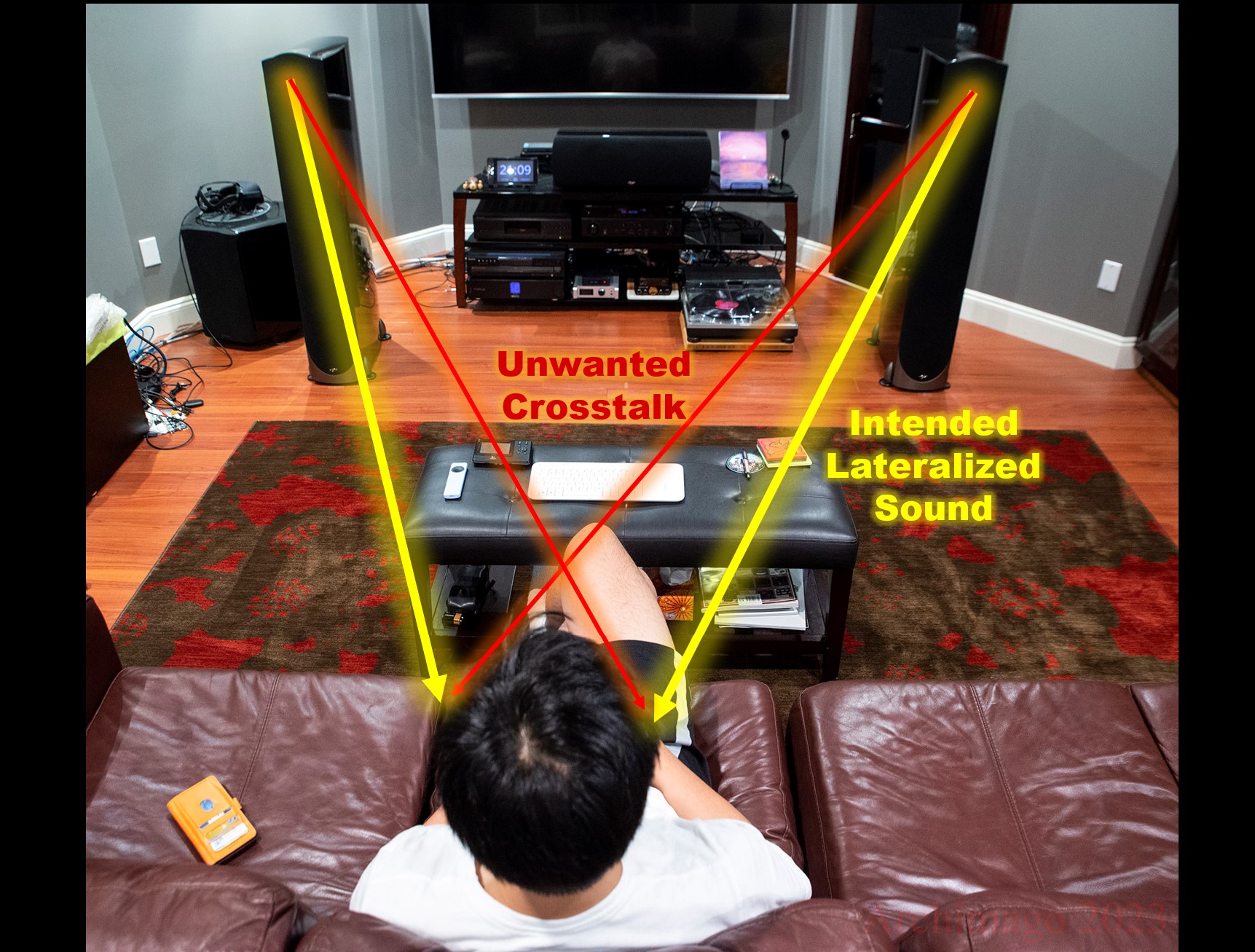
Crosstalk cancellation is an attempt to deliver stereo sound as it was meant to be played without the interaural crosstalk errors with loudspeakers (see Keele, 1986 for a technical exposition). Many listeners may not realize how much realism their high-end stereo hi-fi system is lacking until they hear a system with crosstalk-cancelled (or XTC for short) playback. It is like comparing a photo of a window with a view to an actual window looking out at the scenery. Or like watching Avatar in 2D versus 3D.