Showing posts sorted by relevance for query phono stage. Sort by date Show all posts

Sunday, 14 December 2014

RESULT: Archimago's LP Needle Drop Blind Test

Okay, finally it's time to put up the test results for the "LP Needle Drop Blind Test"!

Of course the TMS system looks great compared to my "man cave" vintage Technics rig. :-)
A big thank-you to those who spent the time to listen to the 3 vinyl rips and then entered your results in the survey site I put up!

As I noted with the test page, this test is more for fun and obviously has less potential significance than the previous high bitrate MP3 listening test, or the more recent 24-bit audio blind test. Nonetheless, I think it does illustrate some points about vinyl sonic reproduction to those who had a listen and provides an opportunity to talk about the relative cost of audio hardware and what that actually buys in terms of sound quality...

Procedure:

As described previously, the purpose of this blind test was to ascertain the preference of respondents listening to a high-resolution rip of Paul Simon's "Diamonds On The Soles Of Her Shoes" from the same Graceland album (2012 25th Anniversary Edition - RTI 180gm remaster - Matrix / Runout (Side A): 88691914721-A RE1 20315.1(3) STERLING RKS). The samples were all ripped with the same ADC (my Creative E-MU 0404USB) and laptop (Acer Aspire 5552-7858) using Audacity 2.0.5 at 24/96 bitdepth/samplerate. The raw audio files were edited with Adobe Audition 3 for equivalent fade-ins and fade-outs, and average volume was normalized across the three samples (alas resulting in a few clipped samples which I do not affect the final "gestalt" of the sound). I felt that a 2 minute sample was adequate for evaluation of sound quality. Instantaneous A/B testing with something like the foobar ABX Comparator was encouraged.

A significantly more expensive turntable system consisting of the Roksan TMS, SME309 tonearm, Ortofon Cadenza Black moving coil cartridge and Whest PhonoStage.20 preamp was compared with my own modestly priced stock Technics SL-1200 M3D turntable with either a Denon DL-110 (high output moving coil) or Shure M97xE (moving magnet) cartridge fed to an Emotiva XSP-1 preamp with phono input. 

In total, I received 39 responses to this test. I know that my FTP site uploaded >150 copies of the audio test file so I suspect many more people must have listened than took the time to respond. There was also an alternate download site so I suspect much more than 150 people downloaded the samples.

Compared to previous tests with survey result of >100 responses, 39 results is relatively small but realize that this is still larger than most informal surveys I have seen done on audiophile forums. Also, compared to previous surveys, this one wasn't advertised to nearly as many places. Vinyl rips are a little odd, "straddling" both computer audio in that they're often ripped at high-resolution (24/96 in this case) so ideally the tester has high-res digital playback gear, but the actual sonic differences are mainly due to the analogue hardware and would likely only interest those who know about turntables and cartridges. Needless to say, despite the growth in LPs, the LP format remains a niche market (8.3 million LPs in all of 2014 for the U.S. isn't bad, but remember, weekly CD sales is on the order of 4-5 million units but dropping).

I announced the test only on the Audio Hardware forum on Steve Hoffman Music Forums, the Squeezebox Audiophile forum, the Vinyl forum on Audio Asylum, and the Vinyl Circle at AudioCircle.

As in previous tests, the responses came from various countries around the world:

Interestingly the majority of survey responses came from Europe - ~54%. Followed by North America with 33%.

Results:

In the survey, I asked respondents to rate which of the 3 files they liked the MOST, the SECOND, and finally LEAST.


As you can see Sample A marginally edged out Sample B as the "best" sounding file by only 1 vote. However, if we include results for what was "second best", clearly Sample A beat out B and C as preferred. Consistently, Sample C was considered least well liked.

A weighted score (3-points for best, 2-points for second best, and 1-point for least preferred divided by total of 39 entries) results in:
Sample A - 2.28
Sample B - 2.03
Sample C - 1.69

So, what analogue gear produced these samples:

Sample A - Technics SL-1200 M3D with Denon DL-110 cartridge
Sample B - Roksan TMS/SME309/Ortofon Cadenza Black cartridge
Sample C - Technics SL-1200 M3D with Shure M97xE cartridge

Overall, it looks like the Technics SL-1200 and Denon combo connected to the Emotiva XSP-1 preamp was the "winner" in this survey! Not by a huge margin of course.

To gauge whether respondents thought the difference was worth an upgrade between the "best" and "worst", these were the results:


In total, about 1/3 of respondents thought the difference was worth the upgrade versus a combined 51% thinking there's probably not enough of a difference to consider a $1000 upgrade (of course the price difference between the TMS system and the Technics is much larger!). Interesting to see that 15% basically found that the difference was significant but would not change their level of musical enjoyment if upgraded.

I was curious - of the 33% who thought an upgrade was warranted, which system they thought sounded the "best", "second best", and "worst" (to get an idea of which system they thought was most worth upgrading to):


Weighted score of the data above (of 13 respondents, maximum 3 "Best"):
Sample A - 2.23
Sample B - 2.0
Sample C - 1.77
Again, we're seeing a similar pattern to the results of the full sample; that overall Sample A (Technics SL-1200 M3D + Denon DL-110 cartridge) was preferred and the same turntable with the Shure M97xE was least preferred. There was no evidence of any special preference with the group that heard a greater difference.

Like with my other tests, I asked the respondents to identify the digital gear used to listen to these samples. Also like before, clearly most audiophiles who took this test used very good equipment to listen with. DACs used included the Schiit Modi, Naim DAC-V1, Meridian Explorer, ATOLL DAC 200, M-Audio Delta 410, iFi Micro iDSD, FiiO X3, Benchmark DAC2, Mackie Onyx Blackjack, Simaudio Moon 100D. Only about 4 respondents reported using the built-in computer motherboard DAC. About 50% of respondents identified themselves as using headphones for the evaluation. Headphones identified included many using Sennheiser models (HD800, HD650, HD600, HD280, HD580, HD428), Sony MDR-7520, HiFiMan HE-500, Audeze LCD-2 rev2, AKG K530, AKG K612 Pro, AKG K701, Denon AH-D2000, AudioTechnica ATH-M50x, Grado SR80. Speaker systems included Monitor Audio RX8, Linn Isobarik, B&W 805, Rega RS5, Klipsch Heresy, Dynaudio Contour S3.4, Devialet 200 + B&W 802D system, Meridian active speakers, Mission 702e. 18% reported using foobar ABX Comparator or equivalent.

Summary - So What?

Well, I did say this is for fun, right? But I think there are a few general facts to keep in mind when talking about vinyl drops in general and specifically analogue gear.

1. I believe a well recorded LP needle drop (especially at high resolution) does represent the actual sound produced by the turntable/cartridge/preamp - essentially 100%. I tested this by recording the track at 24/96 (with the old E-MU 0404USB) and volume matched with the turntable playing back the song in realtime, switching between inputs resulted in indistinguishable sound at least for me (and my wife was willing to lend her ears); as in all subjective experiences YMMV. Of course, it's important to make sure you play the digital files back with an accurate digital front end. As a result, I believe one can evaluate the sonic differences quite easily - audibly obvious compared to say high bitrate MP3 vs. lossless or the difference between 16/44 and high resolution digital. for example, a friend sent me his rip of this same track using the Audio-Technica AT150MLx and the high frequency boost from that cartridge was easily heard.

2. A number of people commented they did not like the sound of vinyl rips in general compared to the CD rip. I can totally understand, especially since so many respondents used headphones for evaluation. Vinyl rips, especially when completely untouched like the samples in this test do contain the imperfections of vinyl playback. Surface noise is heard during quiet segments and the occasional crackle and pop will be heard from dust, static, or vinyl defects. I have seen people post on forums that they've never experienced surface noise and never heard a pop - that's just nonsense. It's not uncommon to find new LPs with noisy background even after thorough cleaning and many of my records from the oil crisis days of the early to mid-1970s clearly were made with noisy, probably recycled vinyl. (Interestingly, most of my 1980's LPs sound great even though they may appear thin on inspection.) Over the years I have checked out some beautifully recorded vinyl rips rivalling the quality of professionally produced remasters; there's a real skill and art in restoring the sound especially for music that was dynamically squashed in the CD/digital release.

3. I think this is a nice demonstration of how important the choice of a good cartridge is! Notice that the "best" overall sample was the Technics turntable with Denon DL-110 cartridge. And the "worst" sample was the Technics turntable with Shure M97xE. The only difference being the different cartridges. Nice to know that the more expensive Denon in this case was felt to be superior on the whole (at about 3x the price). The main complaint about the Shure was that it accentuated the sibilance in Paul Simon's vocals (like in the word "she"). Even so, 20.5% of respondents thought the Shure sample sounded best so there's obviously significant subjective variation.

4. BUT a much more expensive system like the TMS turntable + SME tonearm + Whest phono preamp did not draw higher preference overall from the respondents. It goes without saying that there is always a point of diminishing return with mature technologies and it's no surprise that price itself is not necessarily a determinant for best sound quality. I have already previously posted on wow & flutter measurements for both the Roksan TMS and Technics SL-1200 M3D demonstrating that the Technics is actually more accurate in terms of absolute speed. A few respondents and chatter on the Steve Hoffman Forum noted that Sample B (TMS system) had an audible hum in the silent portion. This is true and can be heard at 57 seconds at the end of the Ladysmith Black Mambazo segment as it transitions to the Paul Simon vocals. This is much more obvious with closed headphones or a quiet sound room with low ambient noise. It's obvious that not everyone heard this anomaly though. I've gone back to my friend's place and confirmed that it's coming from the Whest phono stage (rather than the TMS turntable or phono cable). It serves as a good reminder of the importance of sensitivity to noise of an analogue setup. Remember that the Ortofon Cadenza Black is a low output voltage (0.33mV) moving coil cartridge (vs. 1.6mV Denon vs. 4mV Shure). This means there's greater amplification applied by the phono preamp and a concomitant increased risk of picking up hum in the system. The quality of the phono amplification stage therefore becomes extremely important. I cannot tell if this hum is unique to my friend's Whest unit (which is a number of years old at this point). For the record, vibration isolation isn't really an issue in this case because I was recording the needle drops without the speakers playing the music and the room was basically silent during LP playback.

Well folks... I hope you enjoyed listening to the Paul Simon LP samples. I'm still having fun with some used vinyl collecting. Lots of good stuff out there to collect and at exceptional prices as well. I know a few people have gotten into vinyl and have been disappointed with the sound. I think there's a lot of hype out there around this almost mythical "sound quality" of vinyl that some people will excitedly plunk a wad of cash down expecting audio nirvana to emanate from their speakers. Sure, if everything goes right, the sound can be excellent, but like everything in life, it's important to have realistic expectations. :-)

Hope you're all enjoying the music as we head into the Holiday Season... Thanks again for all the respondents; I obviously wouldn't be able to do any of these blind tests / surveys without your time and participation!

I have a new audio "toy" to play with over the holidays! Stay tuned...

--------------

ADDENDUM:
Last night I went to watch the movie Interstellar at the local megaplex. Wow! Neat movie; reminds me of 2001: A Space Odyssey with all kinds of sci-fi ideas - AI (robots with humor!), evolution of humanity, almost "divine" guidance, centrifugal artificial gravity and cryosleep. Elements of modern science gets thrown in: black holes, wormholes, Grand Unified Theory, space-time relativity, and genetics. Of course we must throw in the human elements: love, family, relationship, fear, loneliness, perhaps even madness. Highly recommended flick and one I'll be looking forward to on Blu-Ray.

But as reported elsewhere (here, here and here for example), the movie soundtrack was remarkably "loud"! Although I didn't have any issues with deciphering the dialogue (seriously, Matthew McConaughey's southern accent and lack of enunciation at times doesn't help), there were parts that were obviously rife with clipping distortion. I have actually never heard these levels of distortion to the point of hearing "pops" and "crackles" at this specific theatre before (with excellent sound setup including Dolby Atmos decoding). As I noted previously, the Dark Knight Rises soundtrack (another Christopher Nolan film with Hans Zimmer score) from 2012 was remarkably compressed for an orchestral score. I really don't know what the point is of doing this other than annoying the moviegoer! Loud is one thing which the theatre can accomplish by turning the knob up, but to the point of pushing the levels to "11" on the mix itself? That's obscene. (In fact, ironically I wouldn't be surprised if this theater turned down the volume if many viewers complain thinking it's their sound system crackling rather than inherent in the soundtrack mix. I believe I've heard louder transients in the theater before on other movies.)
Saturday, 8 July 2023

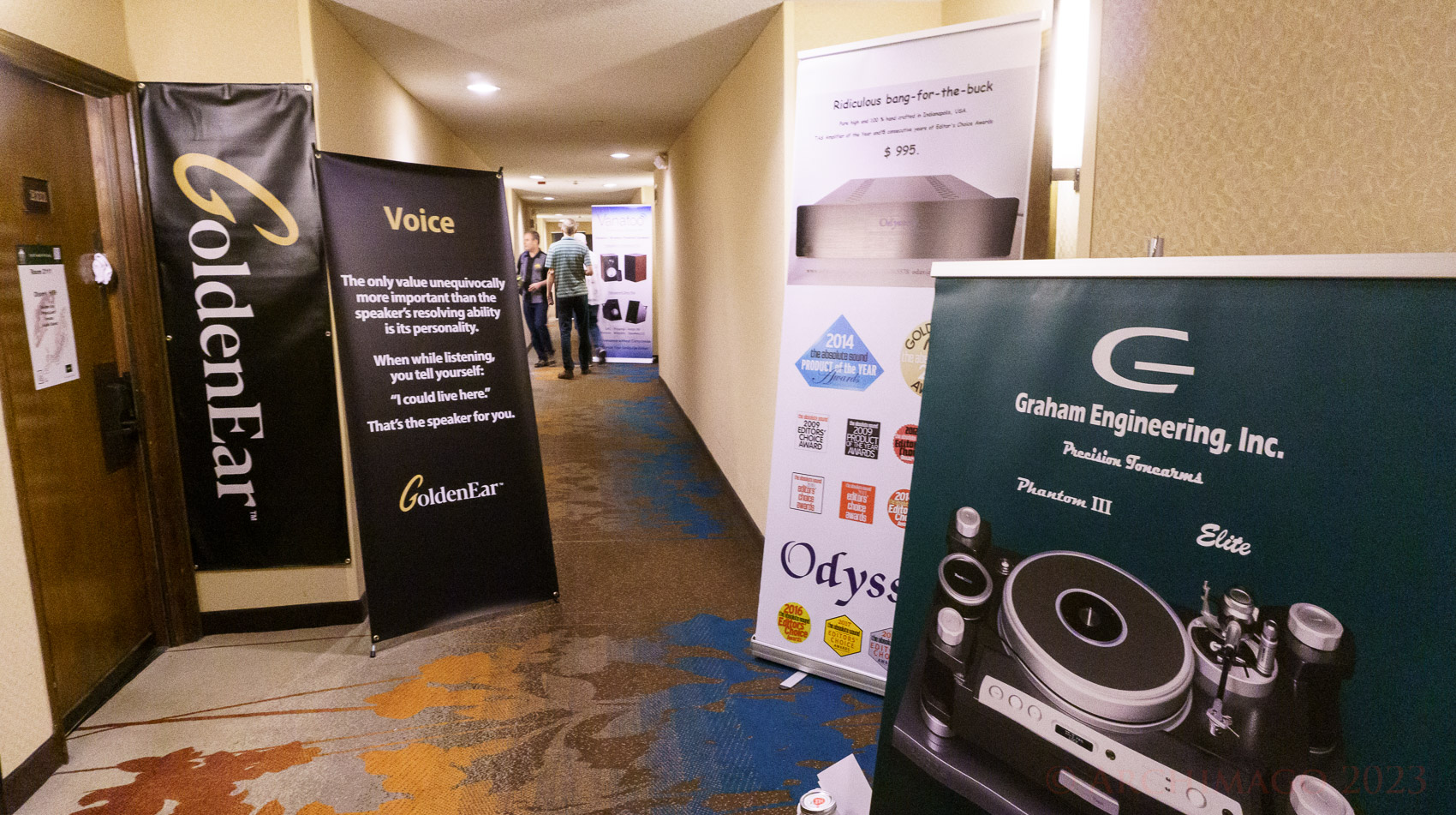
Pacific Audio Fest 2023: Part II - Hotel wing audio rooms. A few words on sound quality, and emotional connectedness.


Let's continue exploring Pacific Audio Fest 2023 beyond the main ballroom and larger rooms from last time. As you're probably aware, audio shows take place in hotels with companies renting out rooms to show off their gear. At PAF2023, we have 4 hotel "wings" to explore located on the first, second, and thirteenth floors.

Mercifully, PAF2023 isn't a big show which allowed me to enter each room and have a listen over the leisurely 3 days (Friday to Sunday) that I was in Seattle. Let's go for a stroll and see what each room had to offer. While I don't think I missed any of the rooms, I'll only highlight the ones that seemed most interesting...

Saturday, 19 November 2022

EARLY LOOK: The E1DA Cosmos Scaler prototype. As usual, Neil Young (in "World Record" album interview) remains neurotic against digital...


Today, let's talk about something rather unique.

In the image above, we see the E1DA Cosmos Scaler in use as I was running measurements of some DACs I have around here. As I mentioned last time, this is a prototype product which although has been announced/discussed online, as far as I am aware, is not at the stage of imminent production or public release. As such, be mindful that details I describe here might change if this were to be released as a product.

The Scaler functions as a balanced 2-channel in/out pre-amp that can apply 16 discrete levels (this is not a regular volume knob for routine volume control) of very clean amplification (using OPA1612) from 0dB to +26.7dB along with an "auto-ranger" feature that aims at a target voltage level to feed the ADC. Along with this, the Scaler's stable high 200kΩ balanced (100kΩ unbalanced) input impedance resolves one of the limitations of the Cosmos ADC; the lower input impedance for example 1.66kΩ at a commonly-used 4.5Vrms setting.

Thanks again to Ivan Khlyupin (IVX) for sending me the package to test out.

As with any pre-amp product, the question is how quietly does this device perform when feeding the output into a high-resolution measurement ADC in this case. And related to that, whether the device adds any of its own distortions.

Tuesday, 10 September 2019

RMAF 2019 Day 3...


As it has been said, Day 3 of audio shows tend to be a quieter day. It was no exception this year at RMAF. The picture above is from the "Headspace" ballroom down one of the lines of booths where headphone-related vendors display products and demo for the visitors. This picture was taken around 10:30 in the morning shortly after opening at 10:00. While number ebbed and flowed through the day, it wasn't difficult to find plenty of headphones to try and devices to play with as I wandered in and out through the day.

Since I did indeed start my day in the "Headspace" exhibits, let's start there and listen to a few interesting products...

Saturday, 14 September 2024

Pacific Audio Fest 2024: Part I. [And expensive speaker cables unanimously turned down in a blind test?! 😕]


This is the third year for the Pacific Audio Fest which first started in 2022, basically after the COVID-19 pandemic reopenings. I think the first 2 years of the show were quite similar in size but this third show is clearly a smaller event with fewer display rooms and less stalls in the Marketplace. Correlated with that, I also noticed fewer headphone set-ups to try out.

To be honest, while I think this probably was disappointing for some, I only had a couple of days to visit anyways so this actually worked out driving into Seattle on Saturday morning, stayed a night, and got home by later afternoon Sunday having felt like I spent enough time in each room, even visiting a few of the rooms a number of times to compare.

So, let's have a peek at some audiophile eye-candy and consider the goods out on display this year. Let's be honest, one of the most important specs whenever doing any shopping is the asking price. Unless specified otherwise, all prices are in USD.

The show ran from September 6-8, 2024 at the SeaTac DoubleTree Hilton which is the same as in previous years. I spent the 7th and 8th "hitting the rooms". Let's go!

Saturday, 23 July 2022

Summer Musings: On Stereophile's "Quackery, Gullibility, and Open-mindedness". Nature of audio devices. Truths in audio (and medicine).

Well ladies and gents, I guess it's official. Stereophile, at least in part, is not a journalistic venture based on a recent "My Back Pages" article. In the opening 3 paragraphs of "Quackery, Gullibility, and Open-mindedness", Rogier van Bakel basically discards the importance of skepticism as a journalist, and seems to set the stage for audiophiles to accept basically all manners of quackery and snake oil.

For those who have been on this blog over the years, you probably know that I'm a physician working here in Vancouver, Canada. I write these audio musings and technical review articles as part of my audio hobby/journey to go beyond enjoying the music as a consumer, towards further understanding of how the technologies work, with the hope that the results of the explorations may be helpful for other pilgrims along this path as we discuss hardware and improving sonic fidelity.

On quiet evenings when the kids are asleep and my wife is enjoying her TV dramas, examination of electrical devices and their waveforms can provide a much-needed distraction from the marvelous yet frequently incomprehensible complexity of human physical and mental states.

Saturday, 6 October 2018

MEASUREMENTS: RME ADI-2 Pro FS as DAC (Part II - frequency response, noise, distortion and jitter)


As we saw previously, the RME ADI-2 Pro FS is based on the AKM AK4490 DAC chip and provides a good assortment of features like filter settings. We've seen that the headphone output amplifier provides plenty of power and the beginnings of what looks like a highly accurate DAC; consistent with my subjective opinion.

Time for part 2 of the objective evaluation today as we continue to explore the DAC output quality.

Sunday, 8 September 2019

RMAF 2019 Day 2...

Alright guys and gals, let's continue with the sights and sonic impressions from Day 2 of RMAF 2019!

Here's a picture of Colorado Ballroom C where the seminars are presented. Bob Hodas was presenting on room acoustics this afternoon and I suspect this is one of the best attended sessions:


I was able to catch most of the presentation. There were a few useful tidbits I suppose, and I imagine it will be up on YouTube for all to see at some point. Hope he would have been a bit more concrete with the equipment he uses and provided more basic discussion on what he's looking for from the measurements he does.

Saturday, 22 August 2015

PREVIEW: A Look at the Light Harmonic Geek Out V2...

Well... I guess the good thing about not being a "professional" audio reviewer is that while on holiday, playing with my toys isn't really considered "work" :-).

Here's what the postman brought earlier this week:

From a bang-for-the-buck perspective, I suspect you can really get a lot of quality from the small "USB stick" type DACs. The reason being that manufacturing costs can be quite low with these devices. There's no need for fancy LCD screens, no need for a large enclosure (made of milled aeronautical aluminum of course!), no fancy connectors other than the USB port and some headphone jacks. The challenge of course is in making sure that noise levels are low in the analogue output given the proximity to the computer and dependence on the power rail off the USB port.

Previously I had already tested the AudioEngine D3 and AudioQuest Dragonfly 1.2 DACs... This time, enter the Light Harmonic (LH Labs) Geek Out V2...

Saturday, 2 June 2018

MEASUREMENTS: Oppo UDP-205 Part 1: Output levels and digital filter settings... (And a few words about recent Munich 2018 MQA interview videos, McGill listening test out.)

Well guys, with this post, I'll begin a multipart look at the Oppo UDP-205 4K Blu-Ray player as an audio component "more objectively". Clearly, as I presented in the preview a couple weeks back, the UDP-205 is very much a device created to appeal not only to videophiles but audiophiles. Why else would Oppo go the extra mile and use dual "reference" ESS ES9038Pro Sabre DACs, provide 2-channel asynchronous USB 2.0 input, both multichannel and stereo analogue outputs plus balanced XLR? It even provides a secondary HDMI 1.4 "audio" output for lower jitter to an external DAC compared to the higher spec HDMI 2.0 which is of course a necessity for 4K/60fps/HDR video; something that I have not seen before. IMO, for home video purposes as a 4K player, the UDP-203 would in fact be very much sufficient - the upgrades found on the UDP-205 are primarily for those who want elevated audio performance. We'll look at whether this is true through these objective measurements.

For the post today, let's start with a few of the "microscopic" measurements that I typically put devices through. The reason I'm breaking measurements into multiple parts is because there are so many ways you could use this device! You could spin disks and make this a CD/DVD-A/SACD/BluRay-Audio player. Hook it up to a streamer/computer through the USB 2.0 interface. Use HDMI input for multichannel audio decoding. Of course it could be used as a S/PDIF DAC with TosLink or coaxial inputs. How about use it as a DLNA/UPnP streamer (works fine with JRiver, even 5.1 multichannel FLAC)? We'll look at bits and pieces in the performance of this device over the next while, concluding in a general assessment of quality and shortcomings once all is said and done...

Saturday, 19 September 2020

As We Hear It: Thoughts from an audiophile friend on assembling his sound system.


Every so often, I have the pleasure of having friends and readers add their thoughts to these pages. The other day my buddy whom I visited at the end of 2019 (a.k.a. "linnrd" online) sent me this discussion piece. Back in December when I visited, I invited him to take the opportunity to write about his equipment and how he came to this interesting collection of gear. Well, he delivered...

--------------------

A Complex Path to Simple Sound


Audio systems are generally an assemblage of products from different manufacturers. While significant R&D resources go into designing the various pieces that make up a system, it is left to the consumer to deal with the "R&D" of system design from "soup to nuts", as it were. The popular audio press is more oriented to singing the praises of individual components instead of educating and helping the reader actually assemble a decent combination of the aforementioned. Perhaps this a result of whom they view as customer and who as the product. A graveyard visit allows one to see much touted wonders such as Shakti Stones and the green CD marker (Ed: also see Harley's extensive investigation in Stereophile in 2004 amounting to nothing of course), to name just two, with the rotting corpse of MQA lying in wait for a plot (in both senses of the word!). 

Unfortunately, the self-proclaimed experts actively ignore existing knowledge and science and make it extremely difficult to fix this fundamental problem of the spread of misinformation by also subscribing to junk science. In other words, they are really messing up the S:N ratio of information transmission. As Bill Whitlock from Jensen says, reiterated in a recent discussion: "It often feels like an uphill battle to educate in a world of marketing deception and self-appointed experts."

Saturday, 3 April 2021

MEASUREMENTS: Melody Onix SP3 Mk. II (~2006) Class AB Tube Integrated Amplifier. (And it isn't "diminishing returns" on sound quality, often there are simply "no returns".)


Recently I was curious about trying a tube amp in my system and my dad who's into his vintage gear including some older tube devices offered me this amp to test out. It was time to take up the offer and have a listen plus put some tube gear on the test bench for a peek at the performance.

As you can see, for today's post, we have the Melody Onix SP3 Mark II which I believe was first released in 2004 for US$1000. This one I believe was bought in 2006. It's a relatively compact unit (12" x 8" x 13" or so), 56lb beast designed by Melody Australia, made in China. Over the years, there have been various reviews on this product from 6Moons (Best of 2005 list), Audioholics, Home Theater Review, High Fidelity Review among others. Here's the Melody company website. I think this model was discontinued by around 2010.

I've always liked the look of this box. There's a cage that normally protects fingers from the four large power tubes and individual smaller covers (you can see 3 on the right removed) that protects the 6 flanking tubes. Turn off the lights at night and it all looks very cool.

Saturday, 30 November 2019

MEASUREMENTS: Onkyo TX-NR1009 "WRAT" AV Receiver Class AB Amplifier... Plus Pi / LP / Resolution miscellany.

I currently have 3 AV receivers here at home. The Denon AVR-3802 is my oldest machine, purchased back in 2001 and being used in the living room for stereo playback. My newer Yamaha RX-V781 (2016) is currently in use for movie playback with Atmos/dts:X decoding. This leaves the Onkyo TX-NR1009 (2011 model) that I bought used in 2013 which has actually been sitting unused for the last few years mainly because it's an older HDMI 1.4 device which did not support full 4K/HDR/60fps switching:


It's a shame because I think of the 3 receivers, subjectively this is probably the best sounding (no blind test done, just a suspicion), has the highest power rating (135W into 8Ω, 1kHz, 1%), THX Select2 Plus certified, can amplify 9 channels (9.2 decoding), and when new, was also the most expensive of the three. I'm sure at some point I'll find a use for this 41 pound monster - maybe if/when the old Denon breaks down :-).

I don't think anyone can fault the external build quality which also looks quite handsome. Onkyo did unfortunately have some electronics failure issues with this generation of receivers however and back around 2016, I sent this unit back to them for an HDMI board replacement (here's a thread on the issue a few years back).

For this post, I think it would be interesting to explore the sound quality of this device as a 2-channel amplifier (especially compared to the little Yeeco TI TPA3116 amp last week). It'll give us an idea of how well a good receiver could perform and give us a peek at a modern Class AB device sitting in the higher end of the consumer price ladder (Class AB receiver amplifier designs have not changed that much in the last number of years). These days a similar tier THX model with equivalent power would be the newer Onkyo TX-NR1030 and TX-RZ1100.

Saturday, 26 April 2025

Part III: Topping DX9 "15th Anniversary" Limited Edition DAC & Headphone Amplifier - DSD, S/PDIF inputs, headphone out, pre-out, and AMPT. And the desire beyond Perceptibly Perfect.

With Raspberry Pi 'Touch' streamer showing album art running RoPieee, and the Topping DX9 VU meters playing, this looks quite nice in the audio rack!

Let's finish up with the last installment of the review/measurements for the Topping DX9 "15th Anniversary" DAC (see Part I, and Part II previously). As we have seen up to this point, it's quite a unique looking DAC and the initial PCM measurements over USB2.0 look great as a modern hi-resolution converter. In Part II I noted that there was an issue with the 176.4/192kHz frequency response that Topping was able to correct quickly with a firmware update. I'll be using the latest firmware 1.23 for the measurements here.

Let's continue then to dive in and explore the objective performance with some of the other main features for this DAC.

Saturday, 29 June 2019

LISTENING: Fully battery-powered wireless streamer & amplifier system (Yeeco - TI TPA3116D2, TalentCell 12V battery)


A few weeks ago, I read this review on an independent audiophile site about an inexpensive Nobsound Class D amplifier based on the TI TPA3116 chip. I was curious so I ordered an equivalent one off Amazon - the little Yeeco Bluetooth-capable amplifier shown above with box contents including the 12V power supply for <$US32 (for an even cheaper package, here's one without the switching power supply, <US$25).

As you can see, the reviewer linked above gave the product some positive comments on the sound. I was curious to listen and since we know that Class D amps like these are very efficient, how about we run the playback system - music streamer to amp to speakers - completely wirelessly and battery powered for a listen also?

Saturday, 15 July 2023

Pacific Audio Fest 2023: Part III - Final show musings... On sponsorships, seminars, unique listening opportunities (DSD256 vinyl sounds great ;-), and suggestions.

Collected promo materials, PAF2023.

Having published on the products seen at PAF2023 in Parts I and II, I thought it would be interesting to take some time to chat about other experiences from this show and parting observations.

These observations might apply at other audiophile shows as well.

Saturday, 5 October 2024

Pacific Audio Fest 2024: Part III - parting thoughts, audiophile education, speaker:amp price ratio & the future?

Hypothetical scene in Seattle...

Another year, another Pacific Audio Fest in the annals of audio shows. Looking back, this show would be the 6th of this sort I've attended and subsequently discussed on this blog over the last decade, let's see:

Rocky Mountain Audio Fest 2019 - final RMAF
[Pandemic Years]

It's interesting reviewing some of those others over the years. I think most audiophiles will recognize that over time, not really much has changed, has it? Sure, the companies come and go, we've seen the ebb and flow of themes both in this blog as well as at the shows (for example, jitter was more of an uncertainty when AudioQuest introduced their JitterBug device in 2015). We've seen the rise of "high-end" computers and streamers (also discussed here), and these days I noticed that the companies are not as aggressive in the marketing as these products mature. Streaming may have reduced the need for local libraries, or simply that consumers themselves are comfortable with digital audio quality, the lack of sonic difference (and the "Bits Are Bits" reality).

Saturday, 29 January 2022

REVIEW & MEASUREMENTS: Chord Mojo DAC/Headphone Amp. A note on LH Labs (Light Harmonic "subsidiary") audio crowdfunding. And Neil Young's ultimatum to Spotify. [Early Mojo 2 specs.]

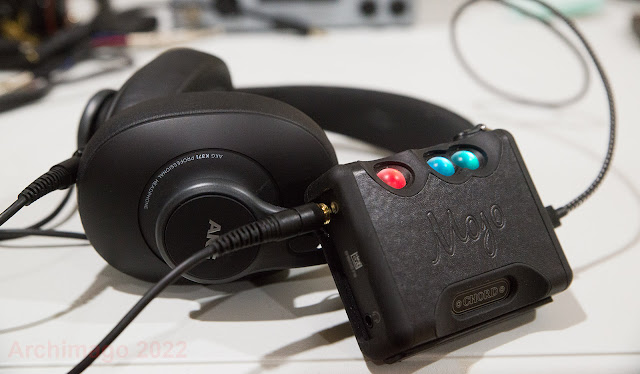
Mojo as shown here in the official rubber and leather Mojo Case. Looks and feels great in the hand. Shown with AKG K371 headphone.

Well, in the "better late than never" category, when I returned my friend AudioPhil's Cayin RU6 the other week, I borrow his Chord Mojo ("Mobile Joy", ~US$475 new but I think currently discontinued) for a spin!

This DAC has been out since October 2015! That's ages ago in the world of electronics. However, to be honest, high fidelity audio reproduction is rather ageless whether the device is 10 months old or 10 years old. So long as the internal components aren't deteriorating with age ("break-down" instead of "break-in", right?).

As you've probably seen in countless reviews on the Mojo (like here, here, here), this seems to be quite a popular DAC with a good following. It has been said that Chord sold something like 100,000 of these over the years. Objectively, the Stereophile review in fact showing some impressive performance results back in 2016.

As usual, Chord gear tends toward the large bulbous glowing buttons, at times steampunk metal esthetic. Colors are used to provide feedback on volume (the pair of buttons for +/- volume) and the main power button (red in image above) which changes color for sampling rate. I think this is an acquired taste and figuring out the colors will take some time as you get used to the sequence of colors in a rainbow with red (lowest volume/samplerate) on one end and purplish/grey/white (highest) on the other..

Saturday, 23 November 2019

MEASUREMENTS: Yeeco TI TPA3116 Class D Amplifier (aka Nobsound NS-01G, Douk Audio F900S, Mogu F900S)

As I posted back in June of this year, we can get inexpensive little amplifiers these days based on Class D chips such as the TI TPA3116D2 (first released in 2012) which is what is inside the device here:

Yeeco TPA3116 amp being probed... Notice that input is through the AUX phono jack in front from the RME DAC.
As you can see, I have a "Yeeco" branded device but these are produced in China and will come in a number of brands like the Nobsound NS-01G from Douk Audio, and other names like Fac"Mogu" discussed in this review and here's Z Review with an older version.

I mentioned in the previous post that once I have the amplifier measurement rig going I was going to have a look at the output from this little amplifier. I figure this would be a good device to start with using the MOAR amplifier procedure described last time.

So what does US$30 buy us in terms of sound quality in 2019?!

Monday, 17 April 2017

RETRO-MEASURE: 2002 Lynx L22 PCI audio card in a ~2008 Intel Q6600 Computer. (On "computers are noisy!" for audio)

As many of you probably know, Mitch "Mitchco" Barnett is a regular contributor to the Computer Audiophile website with his articles. He's also the author of the book Accurate Sound Reproduction Using DSP (now available in paperback). A great guy who has logged many hours back in the day in the audio production world!

The cool thing is that Mitch doesn't live far from where I am and last year, we met up at the Vancouver Audio Show 2016 (which by the way appears to be running again this year June 24-25, 2017). We chatted a bit before the show about various topics both in life and audio. From those discussions, one of the questions we wondered about was this whole notion about electrically "noisy" computers and just how "bad" the inside of a typical PC is for high-fidelity computer audio. After all, these days we see all kinds of products claiming the importance of "noise isolation" from USB cards to power supply upgrades.

At the Audio Show, Mitch kindly lent me an old computer audio card he had at home in storage which he was no longer using (in part because he's up to date with his computers and no longer runs a machine with PCI slots :-). Here it is:


Behold, the Lynx L22 24/192-capable PCI "digital audio interface" designed circa 2002. Back in the day, this package had an MSRP of US$749. It filters the power supply, is said to have very clean ground planes, and utilizes high quality components (here's a review from 2003). At a time when probably many of us were rockin' with Creative Soundblaster Live! type sound cards, this is something meant for home studios and maybe some DVD audio production... At 15 years now since the design of this device, we had to wonder - how does this sound card measure and sound sitting in a "noisy" old computer enclosure with components dating back to the era of conventional PCI (not PCIe) slots?