Showing posts with label Lossy CODEC. Show all posts

Sunday, 15 February 2026

More Audio Potpourri: What's the best sample rate converter? The other father of MP3 (James D. Johnston "JJ"). Are measurements important? And TAS' "objective" confusion.

For this post, let's discuss a few other audiophile items that have come my way in recent weeks.

First, let's talk about something I haven't brought up for awhile now: sample rate conversion (SRC).

A few weeks ago, Spoon (a.k.a. Steven Elkins of Illustrate) sent me an E-mail about his new src.hydrogenaudio.org page evaluating and ranking the qualities of various software sample rate converters. I believe the page has been online since late 2025. Check out the forum discussion about the project as well.

Saturday, 10 May 2025

nVidia RTX 5070 Ti GPU - a look at the lowest-priced version. And imagine, relinquishing "lossless" orthodoxy.


Hey everyone, as usual, every once awhile I'll look at other tech than audiophile stuff. In late 2024, I wrote about the nVidia GeForce RTX 4070 Super GPU and mentioned in that article about the upcoming RTX 5070 Ti and some of the expectations I had about this interesting card in comparison to the previous generation. Well, now in 2025, the new generation is here and as you can see above, I've got one to test out.

The box above is the Gigabyte GeForce RTX 5070 Ti Windforce SFF 16GB model which is probably the lowest-priced "MSRP" version of this class of cards; I got one of these at a local dealer. This is similar to the Gigabyte GeForce RTX 5070 Ti Windforce SFF OC (Canada) I see available online at places like Amazon but you'd save some money with a non-OC model if you can find it. (As usual, check out other brands like MSI, ASUS, Zotac, PNY for comparisons and relative deals.)

The only difference between OC and non-OC that I can tell for the Gigabyte Windforce is that this card is obviously not pre-overclock from the factory and I believe software like Afterburner power limits at 100% instead of 110%. Since I really have no desire to overclock GPUs (if anything, I do the "Power Limited Overclock" thing by pushing up GPU/Memory clocks but lower the power limit), I'm willing to stick with stock speed and tweak if I have the inclination.

Wednesday, 20 September 2023

RIP MQA codec? (Yeah. On Lenbrook Group's acquisition of bankrupt MQA Ltd., and SCL6.)

Hey folks, it looks like the saga around MQA never ends, but I think they're just scraping the bottom of the barrel with one last crank of the hype machine with hopes that this is somehow face-saving as well. :-|

So as of yesterday (September 19, 2023) it appears that Canadian brand Lenbrook Group of Companies - NAD, PSB, Bluesound - has acquired the intellectual property for MQA. Let's talk about this.

Saturday, 26 August 2023

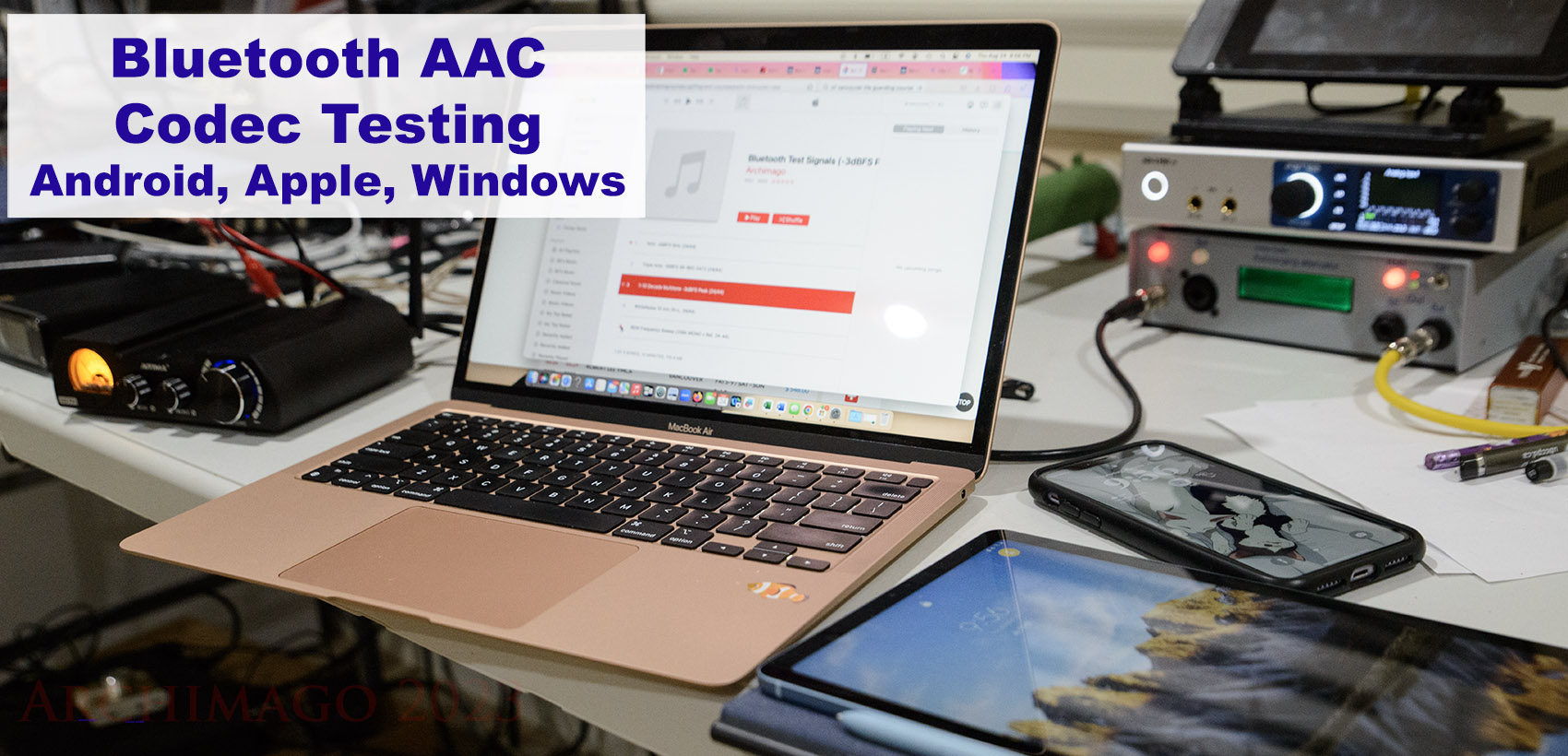
Part II: Comparison of Bluetooth Fidelity - AAC encoder quality (Android 10 & 13, Windows 11, Apple iPhones & Mac)

Greeting everyone, time to jump into Part II of our assessment of lossy Bluetooth music transmission.

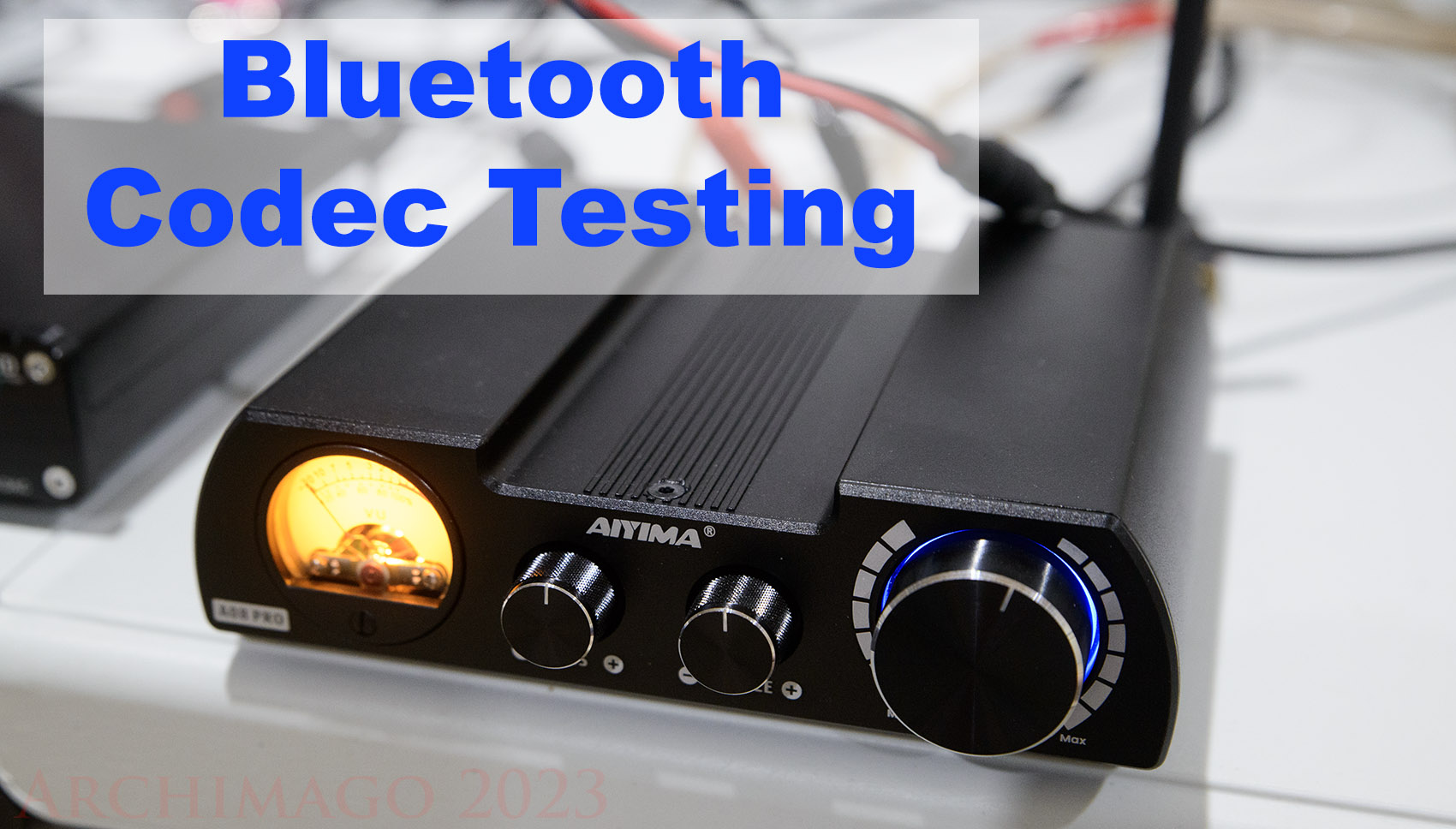
In Part I, we examined the use of an Android 10 device (Huawei P30 Pro) as audio transmitter showing the differences between the codecs as played back with the AIYIMA A08 PRO amplifier and its Qualcomm QCC5125 Bluetooth SoC. Please refer to that article for details about the methodology and comparison with the output from a high resolution Topping desktop DAC.

For this Part II, let's focus on the Advanced Audio Coding (AAC) codec which has become a very popular option. Other than the universal default SBC, AAC is probably the most common one for music transmission on account of the fact that the "elephant in the room" - Apple - uses this across its product lines as their standard codec running at 256kbps. Given the amount of use, this is basically a practical standard for quality music transmission over Bluetooth.

Given the broad range of computers/tablets/phones used among family members here, when I'm looking for wireless headphones, I would want to make sure the device supports AAC; probably more so than aptX or LDAC.

Note that there is actually a "family" of AAC profiles from the early Low Complexity AAC (LC-AAC) originating in 1997 up to later versions like Extended High Efficiency AAC (xHE-AAC) released in 2012. As end users, we're generally not privy to such details so I'll just use the generic term "AAC" in this article.

Saturday, 19 August 2023

Part I: Comparison of Bluetooth Fidelity - SBC, aptX, AAC, LDAC (Android 10 source)

Blue ring around power/volume knob = Bluetooth input.

I've been wanting to do this for awhile. The last time I had a look at Bluetooth playback quality was way back in the days of the Oppo Sonica DAC in 2017.

Bluetooth has been our ubiquitous wireless audio transmission technology for more than 2 decades now; Bluetooth 1.0 was released in 1999 but it took a few years for the number of supported devices to grow and costs to come down. Since then, with subsequent versions, we have seen an increase in bandwidth, codecs, transmission range, and power efficiency.

Currently, we are at Bluetooth 5.X (version 5.0 standard released 2016) with the potential for up to 2Mbps transfer rate and distance maximally up to 240m (800ft)! These are clearly ideal numbers. Bluetooth transmits in the 2.4GHz bandwidth like WiFi but can "hop" (Frequency Hopping Spread Spectrum) between 79 channels, 1MHz wide, so there are usually no issues with coexistence. 

Given the 2Mbps limitation, lossless audio transmission would be a problem. Lossless 16/44.1 stereo is already just over 1.4Mbps uncompressed. Yes, we could losslessly compress but compression ratios are variable. Due to inevitable errors in transmission plus protocol overhead, in practice, at most we should think of Bluetooth 5 as operating around 1Mbps reliably under reasonable, if not close to ideal, conditions with transmitter/receiver nearby.

Friday, 14 October 2016

MUSINGS: Keeping it simple... MQA is a partially lossy CODEC.

Connoisseurs of French cuisine will know this guy...
In the last few days, I noticed my inbox containing a number of questions again about MQA... Presumably due to a combination of the last blog post with Agitater's comments and I guess some news on MQA after the recent Rocky Mountain Audio Fest 2016 where a number of companies were playing MQA and apparently allowing A/B comparisons of sorts.

I say "of sorts" above because it seems from descriptions the best comparisons were more along the lines of using the same file but with MQA decoding turned on/off "on the fly". Not an actual native 16/44 CD resolution file vs. MQA decoding in a volume controlled state using the same source mastering of course. Remember, the processing itself likely affects the sound quality (indeed, Meridian/MQA wants us to believe MQA processing will still benefit playback even without a decoder and folks testify about this as well). My little ABX test suggests small differences as well.

So, let's just keep it "simple" ("but not simpler" as per Einstein). Here's the bottom line for us consumers IMO...

Thursday, 15 January 2015

MUSINGS: Miscellanies on audio encoding (Dolby Atmos & Meridian MQA Concerns)

Hey everyone. It really gets dark in January in Vancouver; just the kind of weather to cozy up in bed with a nice book or maybe some spirits in front of the hi-fi system :-).

So, I thought I'd offer up a few miscellaneous thoughts this week as I looked over recent CES reports.

I figured it'd be good to spend a few moments on the new encoding techniques that came out or were announced in 2014. I think the biggest advancement in audio encoding (at least as it pertains to the home) this past year was Dolby's push for Atmos into the consumer space. Remember that Atmos has already been out for a couple years in the movie theaters since 2012's release of Pixar's Brave. This happened with announcements in June 2014 and the first Atmos-encoded Blu-Ray came out on September 30 with Transformers: Age Of Extinction. Not exactly a movie that will win Academy Awards (maybe in some technical categories), but appropriate to show off some sound effects I suppose.

With Atmos (and other techniques like Auro-3D and the upcoming DTS UHD/MDA), digital processing takes another step up... We all know about the role DSP's have played in home audio including bass management, then room correction (like Audyssey MultEQ), and now we have dynamic, object-oriented sonic rendering in 3D space adapted for one's speaker configuration on top of the typical multichannel (5.1/7.1) mixing. Cool.

I'm unclear whether this will have much relevance for audiophiles (unlikely I would think) given the relatively small numbers of "multichannel audiophiles", but it does represent a true technological step forward. The question is whether many folks will be able to have a home theater setup capable of experiencing a significant difference given the "need" to increase the number of speakers. Even having a dedicated sound room (the solution to the WAF issue of course!), I'm really not keen to cut holes in my ceiling for placing speakers up there and running even more wires to the audio rack for height channels. Dolby's push for ceiling-bounce speakers (like these Definitive Tech A60's [see review]) is an interesting though compromised solution when it comes to fidelity. From a physics perspective, there's only so much that can be done with what would be small up-firing speakers, room interactions, and the timing/phase issues that need to be accounted for. Even if there were compelling high-fidelity music to be enjoyed, I doubt many if any of these up-firing solutions would be acceptable for audiophiles used to very low distortions in their existing speaker systems. I see that Kalman Rubinson in January's Stereophile suggested the potential for 3D speaker arrays to be used for even more effective room correction. Hmmm, not sure if this would be worth it if those extra channels actually are of inferior sound quality... One could be creating more problems than it's worth.

Time will tell and certainly an interesting technical development to keep an eye out for if one has a multichannel setup now that the "800lb gorillas" (Dolby & DTS) seem to be seriously getting involved with their usual hardware partners (like Denon, Pioneer, Yamaha...).


The other "advancement" in encoding technique in 2014 comes from Meridian and their MQA. This certainly got lots of air time in the audiophile press late last year. Smart move throwing a fancy party (oooooohhhh... 69th floor! The audio must have been orgasmic!) and inviting your media friends of course - everyone loves a good party! Let us spend a bit more time on this one.

Wednesday, 22 May 2013

MEASUREMENTS: Do lossless audio formats sound different? (WAV vs. AIFF vs. FLAC vs. ALAC vs. APE vs. WV vs. lossy MP3 & AAC...)

The year is 2013.

Digital audio has been around for a long time. The CD 16/44 PCM format has been the de facto standard of audio delivery for 3 decades now. For the last decade at least, many of us have been involved in computer audio of one form or another. Personally I started seriously archiving all my CD's with bit-perfect rips since 2004 and conversion of all my PCM audio to FLAC by 2005/2006.

In all these years, I do not believe I have ever felt that playback of a compressed lossless format like FLAC compromised sound quality. Yet, if you look around the Internet at the various audiophile forums, you hear from all kinds of folks how uncompressed formats like WAV and AIFF "sound better" than the lossless compressed formats like FLAC, Apple Lossless (ALAC), WavPack (WV), and Monkey's Audio (APE).

Let's have a look...

Setup:

MacBook Pro (Decibel player) --> shielded USB --> TEAC UD-501 DAC --> shielded 6' RCA --> E-MU 0404USB --> shielded USB --> Win8 laptop

MacBook Pro is the 17" early-2008 model previously described. Nothing fancy, and in fact relatively "old" 2.6GHz Core 2 Duo processor. Running OS X Mountain Lion with no OS tweak for audio. Decibel version 1.2.9 (haven't upgraded to latest version yet). For Decibel I did not even turn on the "load file to memory" option so the lossless decompression is happening real-time.

Win8 laptop is the Acer Aspire 5552 which has been my measurement "work horse". Again, nothing fancy, just 2.2GHz AMD Phenom X4 processor to grab data from the E-MU 0404USB and process the data through DiffMaker.

Procedure:

I encoded the DMAC Test using dBPowerAmp 14.3 from FLAC (which I used to standardize the test results) into the various formats supported natively: WAV, AIFF, ALAC. I downloaded the binaries for APE (v.4.11) and WavPack (v. 4.60.1 Windows) from the official web sites respectively. I used the highest compression level available for each - level 8 for FLAC, -hh "very high quality" for WavPack, "Insane" for APE.

All files were transferred to the Mac and played back off the machine's 240GB SSD drive. I ran 3 iterations with each file format to account for some inter-test variability. DiffMaker comparison was made between my "standard" FLAC recording and each of the test recordings.

Results:


All the lossless formats scored within a narrow range. Correlated null depths across the board were in the 80-90dB range for the lossless formats. As expected, the lossy formats (MP3 and AAC) did not score as well. Also as expected, AAC 192kbps showed less variance (spectrally more accurate) than the equivalent MP3 encoded at 192kbps - AAC is newer and clearly better at lower bit rates.

Conclusion:

A couple observations...

Firstly, notice the greater variability in numerical results for the lossless formats (but remaining in the 80-90dB reference range). Remember that the correlation scale is measured in dB's - it's logarithmic. With "bit-perfect" measured correlations up around 90dB's, sensitivity is very high and it doesn't take much difference to alter the measured value. Measurements with results lower down like in the 60's and 50's tend to show less inter-test variability.

Secondly, when I listen to the "difference" WAV file produced by DiffMaker of 80-90dB correlated null depth, I need to turn up the headphone volume on the TEAC (listening with Sennheiser HD800) to maximum where it still sounds soft. With normal audio, this would be uncomfortably loud. Sonic differences therefore would be orders of magnitude softer than the normal music itself.

Bottom line. The measured variance from the TEAC DAC analogue output between lossless file formats decoded using an older Core 2 Duo computer without decoding into RAM first is extremely low - basically, there's no difference in the sound.

Do lossless compressed formats all sound the same? YES, they should, and in this test, they do.

Based on what I'm hearing and measuring, it's obviously not hard to get good bit-perfect sound. If a piece of equipment is producing audibly different output from say WAV vs. FLAC (that is, assuming the difference isn't cognitive/perceptual bias), then I think there's something wrong with the setup since this was not the intent of the creators of lossless compression. Either the settings are wrong (eg. transcoding to lossy format, ReplayGain tags being applied, or DSP turned on) or there's something 'broken' in the decoding process (eg. CPU too slow, data transfer speed issue, or poor software unable to keep up with the relatively low processing demands). This is a problem and diagnostics should be run to determine how to fix it.

As usual, please feel free to drop me a note or link to good evidence if you run across any information contrary to these test results and opinion.

Enjoy the music...


--------------------------------
Addendum (those interested in spectral plots of the difference between FLAC reference and test file):

FLAC / APE / WV / ALAC / WAV / AIFF all look somewhat like this - not much to see. Note: There's always a little bit of noise in measuring the analogue output plus limitations of the E-MU ADC.:


This is what lossy looks like in comparison - quite striking how much can be "reconstructed" and still sound good!
MP3 320kbps:

AAC 320kbps:

MP3 192kbps:

AAC 192kbps:

Tuesday, 5 February 2013

High Bitrate MP3 Internet Blind Test: Part 4 - SUBJECTIVE DESCRIPTIONS

Previous - Part III: Discussion

I know some of you have been wondering if the dataset contained descriptions of the subjective experience of respondents between the two sets. Compiled below are the respondents who commented with a subjective description - I have removed any identifying information in the spirit of maintaining anonymity and only included the responses where there was a suggestion of what was heard/not heard that may have allowed the respondent to choose. There were understandably few comments from those that did not hear an audible difference.

IMO, whether the commenter was correct in identifying the lossy compressed sample or not is not as important as the thoughtful consideration and comments in participating in what I believe is a difficult task.

As a reminder, the question was which 'Set' was felt to be 'inferior'. Set B was the actual lossy compressed option.

Those who chose Set A:


"Although I could easy hear the differences. It's very hard too discribe the difference. They are very small. There is some glare, a little bit harsness, a liitle less ambiance, ect. Most easy was it too recognize the differences on voices on the church track."

"Set B sounded more "there" to me, for each track. In particular, bass sounded more present, and treble sounded sweeter. Interested to see the final results"

"I could hear the most difference at the top end. Symbols/High hat and "s" seemed subdued in set A. However I am not sure if the conversion process to MP3 didn't enhance/reveil the top end. I struggled to detect any difference on the Megaherz tracks. I'll try again on a good HIFI later as I am sure my old scud of a laptop's sound card isn't up to much."

"I sort of tried to deduce. In term of preference, I have no preference over either (not my kind of tunes). Set A just sounds a tiny bit louder and given they seem to have been treated to be at equal loudness, I just thought a bit louder = lower dynamic range = must be compressed (the same way my AVR makes sound seem louder by reducing the dynamic range). :D"

"Much more difficult to tell a difference than I thought. Shorter song selections might have made it easier (hearing memory isn't very long). I hope my choice was correct! I just thought the B selections sounded better. Can't wait to see the results."

"Well, took me a while to tell the differences but indeed there are differences especially in terms of details, attack and decay. Easily identifiable on large loudspeakers rather than on headphones. I am quite surprised that they are very close. A better comparison than this would have been a high res studio master/higher bit rate vs MP3 320kbps. In the first place, the music information should have been there rather than just an upsampled CD/MP3."

"It comes with experience. Harmonics isn't easy to listen out for in the first try."

"Bass drum @ ~2 minutes of Church Distortion guitar and cymbals at start of Keine Zeit"

"Very difficult to tell the difference - in fact, it seems that it's just an impression that set B sounds better, slightly clearer, maybe. But listening to he samples more and more seems to even them out. Can't tell if there is more bass or treble here or there. It's just an overall impression. Thanks for putting this survey together. I'm curious to see the results! All the best!"

"I noticed a difference within a minute or so on my computer which has a small Hi-Fi system with bookshelf speakers. I confirmed it in my listening room and my wife concurs. By the way, you did not ask age, but for reference, I have 65 year old ears."

"Listened for the deeper base and the higher sparks. Pink Floyd's Time and Lyle Lovett's Church made it easier to find those missing bits that MP3's remove due to general midrange equipment cannot reproduce those extreme lows and highs. Those details are retained in the FLAC file. The bass went deeper with the subwoofer for set B and the piano sounded more full bodied with on the headphones."

"Set B sounded sharper if you listen carefully a few times, but the third song were hard due to the drum"

"I can't pinpoint exactly what's different, but set B sounds more open and sparkles more than set A to my ear."

"Extension of frequency by comparison, like if lossy, u won't hear very low or high frequency."
 
"'Time' set A actually sounded superior to me. But overall, B superior."

"I made the test two times. At the very beginning of the survey in good and silent conditions and 2nd time today January 27 with windows open and neighbors drilling behind the wall and electricity polluted. Both time the results are the same and are manifested with MUCH more air, natural details of female voices, clapping less harsh cymbals and generally more separated sources (voices and instruments). The DSOTM was the hardest, because my home version sounds slightly different. The metal band was easiest, because mp3 turns the cymbals into a constant dirty sheen."

"B just sounds more "real" especially in the percussion on Megahertz - listen to the hi-hat @ 1:14 (i'm a drummer); but I could be just be guessing ... it is VERY difficult to tell the difference! thanks for putting this together, looking forward to "hearing" the results!"

"obvious only on Keine Zeit (i.e. need complex sounds)"

"I wouldn't use the terms "inferior" or "superior" or "better" or "worse" - I'd just ask "Which one did you like better?" "Time" is one of my all-time favorite songs. I heard a difference immediately between "A" and "B" - but the funny thing is, I couldn't tell you what the difference is. Tried listening with the "...is it the bass? The high end? Better depth? Better tone?..." kind of mindset, but that was hopeless. What it comes down to is "B" sound more "solid" and "3 dimensional" and "real" to me than "A" does... but I can't tell you why. It just does. I don't know if it's because of the difference digital datastreams, or because of the processing you did to *GENERATE* the different data streams. For all I know, the "B" track might be the MP3, but whatever you did to transcode the "A" to the "B" made me like "B" better. Who knows? Thanks for putting this together, was quite interesting."


Those who chose Set B:


"With the good DAC this was REALLY easy to discern. I could tell within a second which was which. It's interesting it did not take a megabuck rest of the system to hear the difference. With the SBT analog outs the difference was much closer, but still there."

"I wonder if the you should have used tracks with "more going on" to help the listener? Tracks with more prominent percussion for longer periods of time, for example, since that's where it was fairly easy to detect mp3's in the past. Interesting test... it's my first listening test. Thanks!" (Selected "no difference")

"Although picked B as mp3, I'm not really that sure. Only a few things made me *think* this is true (e.g., piano). But I wouldn't be surprised to hear that I was wrong. mp3 is at worst very transparent here."

"the music was flat vs open i also tried with (cheap) headphones on a laptop and was almost impossible to hear a difference"

"Presence."

"There is a common sound to PCM processed with floating point math, also dither (especially with noise shaping) and MP3 (worst of all). All these processes smear the precision of the sounds in time and stereo position, likely introducing quantisation errors that the designers of AD and DA converters tried hard to avoid :)"

"I'm 67 and sadly, my high end rolls off @13khz. I found the highs on the bells & chimes in "Time" to be harsher and more strident on the B version"


"I used ABXer for the test. I scored 100% on Church, 60% on Keine Zeit, and a big zero on Time." (Ed: Thank you for spending the time!)

 "I listened to the cymbals. HF content, easy clue for spotting bad compression. Cymbals seemed more mellow/relaxed/natural in A, but if there was a volume difference, that probably fooled me. I heard very little difference."

"I'ts a very difficult test. I've recognized difference only on the first Time track. Others are indistinguible for me."

"great test this has helped me realize that i don't have those golden ears and i should just simply enjoy the music"

"not sure if i'm correct as my audio set-up is not exactly "hi-fi", but the most audible difference i heard was the hi-hat in the ending part of church, in B, it sounded more synthetic compared to A. I guess MP3s are still awesome when space is a constraint, i don't strain my ears so hard when listening normally and so do most people in order to enjoy music! (right?) very glad to help you with the survey, hope i have been of some help!"

"hard edge at top end"

"Not much difference really. Maybe headphones thru a laptop isn't much but noticed in Lyle Lovett's Set B, his vocal's seem more 'pronounced'"

"For me, the one thing I noticed is the the sound stage was completely different with the clocks on Time. One set had a real definied space for each clock, where the other was a lot tougher to pinpoint the clocks actual location. In fact, I would have honestly said it was two different masters moreso than one being compressed or another. I've not experienced anything like that with my LAME Mp3 settings... my mp3s match my FLAC files to the point no one has ever been able to guess which is which. This has been a very interesting an fun thing! Next time let me compress the files and give them to ya! ;)"

"There is a distinct difference between the sharpness of both encodings but whether the sharpness is considered better quality or inferior quality is up to our tastes. I chose the sharper quality as the better recording."

Saturday, 2 February 2013

High Bitrate MP3 Internet Blind Test: Part 3 - DISCUSSION

Previous - Part II: Results

DISCUSSION:

So, what does this all mean?

Firstly, it's important to keep in mind the limitations of this survey. As an attempt to gather testers around the world, there are numerous uncontrolled variables including the varying degrees of technical savvy among users and competence in terms of maximizing the sound quality of their gear. Having said this, looking at the responses I got, I believe most respondents did give the test a fair trial and looking at the responses where equipment was listed, it's clear that the cohort doing this test is beyond the average consumer of audio electronics in terms of quality of hardware. For the most part, even those describing equipment used as <$100, the models chosen are generally highly regarded within the price bracket.

Despite the lack of control of equipment or listening methodology, this test is 'naturalistic' and captures the preference of the "audiophile" in his/her own room, and own equipment. Even if unfamiliar with the music, there's a familiarity with the sound of the gear and the room which one would expect should help with sound quality evaluation. Furthermore, plenty of time was afforded so there should have been no stress since this is not a time-limited task nor were the respondents forced to choose one or the other (as I said in the instructions, I was also interested in those who did not think they could hear a difference).

As I noted in the PROCEDURE page, the MP3 encoding is somewhat unorthodox in that the parameters used were chosen to mask certain anomalies easily detected in MP3 files sourced with standard settings. Nonetheless, I believe the resulting quality still reflects approximately the same lossy characteristic as a direct 320kbps encode. In fact, one might even suspect that these test files could actually be worse (from an accuracy perspective in comparison to the lossless source) because the audio was run through the psychoacoustic process twice (once at 400kbps, second time 350kbps), and in retaining the full 16/44 audio spectrum, significant portions of the bitrate were devoted to encode inaudible frequencies rather than more accurately represent the audible.

Reading the comments on the various message boards, I believe that I have been successful in maintaining the anonymity of the MP3 files. There was one board where someone commented on how the frequency spectrum appears unusual but was not able to identify which was MP3 sourced.

As for the test itself (a blind AB comparison) and the survey question "which Set sounds inferior", the respondent has to make 2 choices:
1. Is there a difference between the two Sets of audio? If not, the respondent can vote "no difference".
2. If there were a perceived difference, which is "inferior"?

For question 2 above, intellectually we can imagine that "lossy" compression implies the music has been altered such that the loss is somehow bad or a degradation in quality. Likewise, the general consensus in media (as per my links in Part 0) suggests MP3 should be "bad sounding". But isn't it also possible that running music through a psychoacoustic model may "clean up" the sound by retaining a focus on the most relevant signals? One might imagine that this might come across as a less noisy background or reduced ultrasonic intermodulation distortion since high frequencies are often filtered out. An alternate model like the ABX paradigm would have resolved these two concurrent decisions but ensuring the integrity of a blind test would be impossible.

Even based on the result from this admittedly small survey of 151 respondents, there was a significant preference for the sound of the MP3 Set (ie. most thought the lossless Set sounded "inferior"). The fact that a significant result was achieved suggests that high bitrate MP3 is NOT strictly "transparent" since this would imply exactly the same sound and presumably a random insignificant result. The fascinating suggestion from this dataset therefore is that in a blind test, most listeners would actually consider the MP3 tracks as sounding better! This pattern of preference surprisingly appeared EVEN STRONGER in those using more expensive equipment to evaluate. Furthermore, respondents who thought there was a greater difference in the more "noisy" and distorted track 'Keine Zeit' also showed an even stronger preference for the MP3 encoded version (some were very vocal in noting how "obvious" this was) even though from an objective perspective, this was the most difficult track for MP3 encoding.

As with any survey / study based on group results, even though the consensus points to one conclusion, this does not necessarily apply to everyone. To be clear, there were a few respondents who appeared very sure of their perception in the survey and proved to have been correct.

Going into this endeavor, I expressed that my reason to do this test was to find out whether MP3 encoding resulted in significant deterioration in sound quality. From what I can tell with 151 responses from around the world, a majority did not find a significant deterioration, and surprisingly most thought it sounded superior! Let me know if you've seen any other tests show such a bias.

Thanks again to all the respondents in contributing their time! :-)

Continue to - Part IV: Subjective Descriptions

High Bitrate MP3 Internet Blind Test: Part 2 - RESULTS

Previous - Part I: Procedure

RESULTS:

The final tally for respondents is 151. Here's the updated map of where the responses came from:


As I mentioned in "Part 0", the majority of responses were from North America (64), followed by Europe (47), Asia (33), Australia & New Zealand (4), finally South America (3). It looks like freeonlinesurveys.com may actually not be completely accurate since at least one person indicated they were in Russia which was not highlighted on the map!


First, lets have a look at the demographic that responded to this test in terms of equipment used:


As you can see, the price range (asked to specify in $USD) of the audio gear and system setup varied greatly.  A large proportion of respondents used headphones for the test (23%) which I suspect is reasonable especially given the computer-audio nature. I suspect many of us consider the headphones plugged into the computer/DAC to be superior to whatever speakers may be on the desk. 25% responded to the optional field and actually listed the gear used (thanks!). Depending on the price range, scanning the responses I see a huge range of headphones tested (Beyerdynamic DT990, 880 & DT770 seems popular, a few AudioTechnica M50's & AD700, Sony V6, Creative Aurvana, Senn HD800/650/600/570, Bose QuietComforts, AKG K701, Shure SRH440, Hifiman Re-0, Ultimate Ears Triple-Fi 10, Superlux 668B, Fostex). Likewise a full range of speakers like Martin Logans, PBN Montana, Decware MG944, a couple Magnepans, B&W 802D's, KEF iQ1, Sapphire ST2). It's notable that some folks used a combination of headphones and speakers. Some DIY guys also got involved with their own DAC's - one respondent specified a homemade Sabre DAC. Network streamers were mainly Squeezebox Touch models sent to outboard DAC's, one person listed the Naim NDX. As for DAC's, I see everything from a dCS setup to DragonFly to Mytek to Xonar Essence ST / D2 / One's to Meridians... Looking at the detailed responses, I think I can honestly say that respondents took the test seriously, some describing their test procedure and running foobar2000 ABX tester themselves.

As for which song was felt to be easiest to differentiate between MP3 and lossless:


"Time" was the winner followed by "Church". Interesting given that from Part 1, we can say with some objectivity that it's actually "Keine Zeit" which shows the greatest variance in comparison to the original lossless audio. For most of us, familiarity is important and I think for the demographic, "Time" and "Church" would likely be most accessible (like I said, I had complaints about putting the metal track in the test!). Some respondents would have preferred a classical track as well. I agree this also would have been revealing but it's always a compromise trying to keep the test simple and download size reasonable.


 Perhaps not unexpectedly, most respondents had to work hard or felt it was impossible to tell the difference between the Sets (total 50.7% for these 2 groups). Interesting that almost 1/4 (21%) thought the test was "easy" - it'll be interesting to see later if this confidence leads to accurate identification!

Finally, what you've all been waiting for:


WOW! Remember that Set B was the MP3, yet for those who picked A or B, most thought A sounded inferior! Looking at just the ones who selected A or B, assuming a 50% chance of success in a "guess", the fact that only 45 respondents got the answer correct out of 123 is statistically significant with a probability <1%.

Let's have a look at those who were confident and said this test was easy:


As you can see, despite the confidence, most of the respondents thought that Set A (the original lossless audio) sounded worse than Set B (MP3).

How about those with more expensive equipment vs. less expensive?


For those who used equipment $6000 and above, we see a similar distribution of preference for Set A, but look at what happened to the proportion for those using less expensive equipment. It appears that those using <$500 actually showed a more balanced preference of A and B - it seems like the participants with more expensive equipment preferred the lossy tracks.

Looking at the larger groups, it was interesting to see that those who used speakers (either floorstanders or bookshelves) seem to prefer Set A more than headphone users (likely not significant but interesting observation):


As for the songs themselves, the song "Keine Zeit" where the lossy file measured with the most variance compared to the original lossless file (ie. the song most difficult to encode resulting in the most error), was the one where most preferred the sound of the MP3!


In contrast, the other 2 songs were slightly more balanced. Note though that since songs were grouped as "sets", these results are obviously not independent of each other.


Surprised by the results? I sure was!

Continue to - Part III: Discussion

Friday, 1 February 2013

High Bitrate MP3 Internet Blind Test: Part 1 - PROCEDURE (Set B = MP3)

The survey has closed today (February 1, 2013). Over the next few days, I will have write ups on the Procedure (released today), followed by Results, and finally a Discussion section.

As you'll see in the description below, "Set B" was the MP3 encoded collection of music.

For the survey participants - now that you know, consider how you voted.  Do you believe MP3 ~320kbps causes significant or serious sonic degradation, or in a significant way impaired your ability to enjoy the music through your system?

--------------------------------------

Procedure:

Over the course of approximately two months (December 10, 2012 - February 1, 2013), an anonymous survey was activated on freeonlinesurveys.com to gather feedback on the audibility of 2 "Sets" of FLAC-encoded audio files. One set of files contained segments of music ripped directly from audio CD (PCM 16/44) whereas the other set had the audio converted to MP3 then decoded back to 16/44 format where it was converted to FLAC. The specific details of this MP3 conversion will be discussed below.

Song selection:
The 3 musical segments selected for the test were:

1. "Time" (2:29) from Pink Floyd off the 2011 re-master of Dark Side Of The Moon - a 2.5 minute excerpt with all the ruckus of chimes, bells and clocks in wonderful detail and space. A classic audiophile test track. This segment has a score of DR11 using the Foobar2000 dynamic range meter.

2. "Church" (2:31) (from Lyle Lovett off his 1992 record Joshua Judges Ruth. An acoustic country track with layered vocals, hand clapping, and a choir to evaluate sound quality with. The DR16 measurement for this segment represents a highly dynamic and natural-sounding track.

3. "Keine Zeit" (1:20) from Megaherz off the recent 2012 album Götterdämmerung. For those who have used VBR algorithms for lossy encoding, "loud" music tends to demand higher bitrates to encode. This track at DR6 is not particularly dynamic but is representative of modern mastering for music in the hard rock / metal genres.

Participant Invitation for Test:

During the 2 months that this test was conducted, "subjects" were recruited from a number of "audiophile" and music related message forums. The hope was to achieve an adequate number of serious audiophiles and music lovers representing a cohort who would be able to seriously assess sound quality and would own higher quality equipment for audio playback. In principle, this would be the group most likely to be critical of sonic degradation. Invitations were posted on the following forums:

- audioasylum.com "PC Audio"
- forums.slimdevices.com "Audiophile"
- www.head-fi.org "Computer Audio"
- www.computeraudiophile.com "General Forum"
- stereophile.com "MP3 vs AAC vs FLAC vs CD" article comments
- www.hydrogenaudio.org "Listening Tests"
- www.audiocircle.com "The Discless Circle"
- www.stevehoffman.tv "Audio Hardware"
- www.wiredstate.com "Equipment Reviews, Listening Impressions"
- www.xtremeplace.com "Planet Audio" (Singapore)
- vr-zone.com "Audiophile's & HTPC Corner" (Singapore)
- www.lowyat.net "Home Entertainment / Audiophiles" (Malaysia)

Reminder messages were posted on the forums approximately ever 2-3 weeks to increase visibility of the invitation with the last reminder approximately 1 week before the closure of the survey. There should have been plenty of time for all the respondents to listen and make judgments on perceived quality of the samples.

How the MP3 test tracks were produced:
For those with some experience with digital audio editing, it is relatively trivial to detect if a WAV/FLAC file were sourced through a standard MP3 process. Lossy encoders like MP3 will "throw out" frequencies the psychoacoustic model deems inaudible. For example, running an FFT frequency analysis on many MP3's quickly reveals that most encoders will remove frequencies at 18kHz and above. Characteristics like this allow programs like Tau Analyzer to estimate the probability of an audio file to have been modified by lossy encoding. Therefore, for the purpose of this test where the samples are freely available to many likely technologically savvy participants, it was necessary that the MP3-encoded samples be process in some way which results in equivalent sound quality to a direct MP3 encode around 320kbps, yet mask the file from easy detection.

A 2 stage technique was used to create the MP3 test files using LAME 3.99.5 (current version at this time):
Stage 1 - convert to 400kbps
lame.exe --freeformat --lowpass -1 -b400 <file.wav> <file400.mp3>
lame.exe --decode <file400.mp3>

Stage 2 - convert to 350kbps
lame.exe --freeformat --lowpass -1 -b350 <file400.wav> <file350.mp3>
lame.exe --decode <file350.mp3>

Use dBPowerAmp to convert the <file350.wav> to FLAC

This utilizes LAME's "free format" to create initially a 400kbps MP3 without the usual lowpass filter in place, then runs the resulting file through the MP3 encoder again but at a lower 350kbps bitrate (again with low-pass turned off) which closer approximates the 320kbps target bitrate for the test. By doing this, even though the resulting MP3 size is slightly larger by 30kbps, the degradation in sound quality by objective measures is in fact approximately the same or slightly worse than if the audio were processed directly through 320kbps but without the tell-tale sign of the strong low-pass filter.

Since this was not a direct conversion to 320 kbps, to confirm the amount of sonic degradation of this process used to create the test MP3, WavDiff was employed to calculate the variance from the original lossless file vs. the MP3 processed test files and also the variance of the original lossless file vs. MP3 encodes at CBR 320 kbps and 256 kbps (for the sake of brevity, I will just report the RMS Error [RMSE]):
Time - Test file: 105.879  /  MP3 (320): 110.403  /  MP3 (256): 176.337
Church -  Test file: 46.591  /  MP3 (320): 46.915  /  MP3 (256): 76.357
KeineZeit - Test file: 393.914  /  MP3 (320): 372.550  /  MP3 (256): 607.282

From the values above, one can see that the three musical selections objectively are similar in variance to a 320 kbps MP3 and that variance is significantly larger with 256 kbps (as expected). Note that I have also used the above technique to encode test tones to ensure that the distortion characteristics from the encoding method closely represents CBR 320kbps MP3. Something to keep in mind is that because the low-pass filter was turned off, bits are now being used by the MP3 encoder for frequencies beyond the usual threshold for hearing for most people (is there ever a need to allocate any bits for 20-22kHz for example?), taking away from the ability for the encoder to better represent audible frequencies. Theoretically this should worsen the sound quality by worsening the distortion for the frequencies we are more sensitive to.

On a side note, "KeineZeit" seemed to be the most difficult to encode resulting in the highest amount of error going through the lossy encoding process.

The files were checked with the "Foobar2000 Dynamic Range Monitor" and ensured to be equal in  volume after the MP3 compression of  <0.01 dB difference.

The original lossless files were labelled Time_A, Church_A, and KeineZeit_A; whereas the lossy MP3 encoded/decoded files were labelled Time_B, Church_B, and KeineZeit_B. The files were encoded to FLAC for lossless compression and delivered for download as a ZIP file with instructions totaling approximately 75MB.

As noted above, freeonlinesurveys.com was utilized to collect the survey results. The primary question asked was for the respondents to choose whether "Set A" or "Set B" sounded INFERIOR; with the implication probably being that the MP3 encoding would deteriorate the sound quality (it is by definition "lossy"). In order to not force the respondents to guess if in their opinion the samples are equivalent, an option was provided to select "no difference". The other questions in the survey pertained to which of the 3 songs was thought to be most revealing of differences, confidence of the respondent ("easy" to "impossible to tell"), approximate cost of the audio system used, and a description of the type of equipment used. The hope is that these other variables can be used to analyze the data to determine if the respondent's level of confidence and cost of the system (presumably the more expensive systems are more revealing) predicted accuracy.

Continue to - Part 2: Results

Monday, 28 January 2013

High Bitrate MP3 Results Part 0: Preamble

As of this writing, there are a few days left for final submissions.  I thought that I would publish this first to basically get the "preamble" over with!

Firstly, I want to thank all the people who have taken the time to download a rather substantial 75MB file, take the time to read the instructions, go through all that they needed to do to get it to play (eg. upload to music servers, run Foobar comparator, burn to CD, etc.), tolerate the varied genres (I got a few comments that "Keine Zeit" wasn't their cup of tea), and ultimately come to some conclusion and take the time to complete the survey.

Looking at comments in the survey response, clearly most respondents took this test seriously and took the time to give me a detailed account of the equipment used.  I very much appreciate your support and charity.

Although I cannot vouch for complete accuracy, "Free Online Surveys" kept track of the international participation - here's a map of where responses came from so far:

It's great to see 5 continents represented. Not surprisingly, so far of 142 submissions, 60 respondents have come from N. America, 3 from S. America, 4 from Australia & New Zealand, 31 from Asia (big thanks to all the Singaporeans and Malaysians for getting the word out!), and 44 from Europe!

All together, I believe this test is one of the most "complete" audio tests of this nature in the sense that respondents have provided information about their confidence in themselves as well as details of the equipment used outside of a professional environment. The fact that respondents are using their own equipment in their own homes also allows for a "snapshot" into the naturalistic environment of the hi-fi / "audiophile" group responding to this survey through the forum invitations which I will talk about more in future sections.

Once again. A warm thank you to everyone who took the time to contribute!

Section 0: Personal Motivation and Disclaimer

As I noted in the testing material, the catalyst for this test had to do with discussions on an audiophile forum - Audio Asylum - back in Nov/Dec. 2012. Comments were made about how intolerably poor "320 kbps MP3" sounded to the point where it was felt by some that the difference in quality could be easily detected within seconds of listening to a piece of music passed through MP3 lossy encoding.

Over the years, I have long thought about running a blind "Crowd Test" over the Internet like this one. My first exposure to MP3 was back in 1995 when I ran into a copy of Madonna's "Holiday" while "surfing" over the university Usenet forums and was amazed at the fidelity achieved out of only a few megabytes. Through the late 1990's, I realized however that 128 kbps was inadequate (touted by Fraunhoffer as "CD quality") - obvious high frequency distortions were noted, "swooshing" sounds were obvious with a good pair of headphones, clear phase distortions running the music through the old Dolby Pro Logic DSP's of yesteryear was also most unwelcomed.

By early 2000, I started migrating to a computer music-server based system and due to storage limits, decided to use MP3. In 2004, I went through my own tests of audio transparency and determined that LAME ABR at 210kbps, low pass filter set at 20kHz was transparent (actually, I thought 192kbps with ABR was good enough but I bumped up the low pass filter and bit rate just to be sure) with the equipment I had back then (primarily old pairs of Sony MDR-V6 & Grado SR60 headphones, Creative Audigy soundcard).

Over the years, as MP3 consumption increased, the audiophile press and general sentiment continued to deteriorate towards lossy compression in general despite advances made in algorithms. Bitrates have advanced up to 256+ kbps for most digital downloads these days as well. Despite all that has been written in the press or public opinion, I remained curious as to whether "transparency" with un-lossy-compressed CD audio is achievable.

For those who haven't read up on this, here are a few samples. Note that some of the articles do have good thoughts on the matter, but I'm questioning their take on what is perceivable sound quality; as if somehow MP3 (including high bitrate encoding) is a significant compromise in sound quality. Furthermore, I find it interesting that articles are taking the concept that "data rate" is equivalent to "sound quality" which I suspect was best publicized last year by Neil Young in his interviews (really? is bigger and more data better for perceived sound quality?).
- Neil Young and his rants against MP3 quality
- Wired's take
- Why MP3 sounds bad
- PCMag's take


Despite some comments I have received, this test is not about encouraging further adoption of MP3 - it's already adopted as the defacto lossy format. In my opinion, MP3 had its "time in the sun" as an efficient encoding scheme when storage was small and expensive (in fact it has been superseded by AAC/iTunes for many consumers). What I'm more interested in is whether the sound quality of MP3 encoding truly deteriorates to a point where it deserves to be the topic of great (or even any) criticism. From a practical perspective, if I buy a high bitrate MP3 from a place like Amazon, should I worry that I'm not able to experience the full sound quality even when played on good equipment?

Disclosure: I do not have any affiliations with the audio press, equipment manufacturers, and do not work in the audio field at all. This blog has no ads and I have no need for "clicks". I do not tout the contents of this study as "scientific" or even "accurate" by nature of the uncontrollable variables, but will try to present & interpret the data as objectively and thoroughly as I can.

In a few days, the survey will close...  See you soon with preliminary results!

Tuesday, 11 December 2012

High Bit-Rate MP3 Survey Is Up!


As I discussed with a few people over the last 2 weeks, I wanted to put up an audio test to see if I can capture some data among music lovers and audiophiles regarding MP3. Well... Here it is!

Below are the instructions...  You can get the whole test package (music, instructions) from upload.to:

Feb 1, 2013 Update: The following links will be going down soon...

Original package:http://ul.to/ixt7vkgl
or
NEW tagged files (easier to integrate into music server):
          (Thanks Abe!): FAST
          (Upload.to): http://ul.to/a5wz1oh0
          (FilePost):  http://fp.io/588362aa/
or
TORRENT of the tagged files: Get Torrent File

BTW: Feel free to convert to ALAC/WAV/AIFF/etc. or use the Foobar ABX plugin...
 
-------------------------------------------
'Audiophile' High-Bitrate MP3 Audibility test:

Hello folks,
As "everybody" knows, MP3 quality is poor compared to the original uncompressed source, right? Recently, there was a discussion on Audio Asylum (hangout for a number of audiophiles:
http://www.audioasylum.com/index.html) about the merits of MP3 in 2012. As expected, a number of respondents opined that within seconds, even high bitrate MP3 (~320kbps) could be differentiated from the original CD source due to the poor sound quality from lossy compression.
Thus was born the idea for this test...  My hope is to obtain ANONYMOUS statistics from music lovers to see if:

1. It is true that high bit-rate MP3 can be differentiated in a naturalistic setting (ie. in the comfort of your own home with your own equipment).

2. There is any correlation between ability to differentiate the sound quality with the equipment used (ie. would be great to gather info on cost of equipment used and list of what was used to listen!).

I know over the years there have been many blind tests and such, but I hope this isn't a stressful exercise. Have fun with it, maybe have a little get together with audiophile friends and enjoy the evening while listening.

------- PROCEDURE----------
Your 'mission' (should you choose to accept):

In this ZIP are 3 songs in 2 Sets presented as FLAC's. ONE of these Sets (either A *or* B) was processed extensively through an MP3 encoder (LAME 3.99.5 – latest stable version) at a high bitrate ~320kbps:

1. "Time" from Pink Floyd off the 2011 re-master of "Dark Side Of The Moon" - a 2.5 minute excerpt with all the ruckus of chimes, bells and clocks in wonderful detail and space. A classic audiophile test track. DR11 - good dynamic range for a remaster in the 21st century.

2. "Church" from Lyle Lovett off his 1992 record "Joshua Judges Ruth". Even if you're not into country music, this track has plenty of layered vocals, hand clapping, and a choir to appreciate. IMO the early 90's resulted in some awesome recording and mastering efforts. DR16 here folks...  About as dynamic as you'll ever hear off a CD!

3. "Keine Zeit" from Megaherz off the recent 2012 album "Götterdämmerung". About as heavy as they come!  Recommended by a resident metalhead on Audio Asylum who feels this would strain MP3 encoding. DR6 is typical of recent releases.

Have a listen to each Set, remember ALL three songs were processed the same way for each Set, so if you think "Time_X" is an MP3 encode, then "Church_X" and "KeineZeit_X" (X = either A or B in this case) must also be MP3 processed.

I know the temptation is there for many, but please do NOT open up the audio files with a file editor until you’ve had a good listen and completed the survey! We listen with our ears, not with our eyes, right :-)?

Once you have listened, come fill out the ANONYMOUS survey – EVEN/ESPECIALLY IF YOU DO NOT HEAR A DIFFERENCE! (only 6 questions):

I will report on the results of this survey in about 2 months (February 2013) on my blog including analysis to give everyone time to listen as well as specifics on the bit rate and how I molested the files through the MP3 encoder!


Happy listening and happy holidays everyone!

Survey complete - Part 1.

-------------------------
Note that the procedure and testing is purely for research / educational purposes. The audio files are partial segments borrowed with no intent or opportunity for any financial gain on my part. Please erase the audio files once testing is over and if you enjoyed the music, purchase the respective CD's as described above. Thank you!