Showing posts with label Gaming. Show all posts

Saturday, 10 May 2025

nVidia RTX 5070 Ti GPU - a look at the lowest-priced version. And imagine, relinquishing "lossless" orthodoxy.


Hey everyone, as usual, every once awhile I'll look at other tech than audiophile stuff. In late 2024, I wrote about the nVidia GeForce RTX 4070 Super GPU and mentioned in that article about the upcoming RTX 5070 Ti and some of the expectations I had about this interesting card in comparison to the previous generation. Well, now in 2025, the new generation is here and as you can see above, I've got one to test out.

The box above is the Gigabyte GeForce RTX 5070 Ti Windforce SFF 16GB model which is probably the lowest-priced "MSRP" version of this class of cards; I got one of these at a local dealer. This is similar to the Gigabyte GeForce RTX 5070 Ti Windforce SFF OC (Canada) I see available online at places like Amazon but you'd save some money with a non-OC model if you can find it. (As usual, check out other brands like MSI, ASUS, Zotac, PNY for comparisons and relative deals.)

The only difference between OC and non-OC that I can tell for the Gigabyte Windforce is that this card is obviously not pre-overclock from the factory and I believe software like Afterburner power limits at 100% instead of 110%. Since I really have no desire to overclock GPUs (if anything, I do the "Power Limited Overclock" thing by pushing up GPU/Memory clocks but lower the power limit), I'm willing to stick with stock speed and tweak if I have the inclination.

Saturday, 22 February 2025

nVidia Shield TV Pro (2019 version), still relevant in 2025! A listen to Auro-3D & Auro-Matic Upsampler.

Hey guys, I thought it would be fun to talk about something that's been around quite awhile already but which I still bought in 2025. As per the image above, it's the nVidia Shield TV Pro (US$200, CAD$260). For years, I've been using the Apple TV 4K (2nd Gen, 2021) which is a fine unit with all the bells and UI whistles of the Apple ecosystem. But it is missing something that "serious" movie audio lovers - and even audiophile music lovers - might want; lossless audio bit-streaming for Dolby TrueHD/Atmos and DTS/HDMA/X.

That's right, sadly, after all these years, Apple doesn't care to update the AppleTV to support basic bit-streamed audio. 😢

Note that I don't necessarily blame them as a company, they make no money off local libraries of UHD/BluRay-ripped content. So if I were running the business, I'd also think twice about getting developers to support a feature that at this time in history they will make no streaming subscription revenue from. Streaming services - Apple TV, Apple Music, Netflix, Prime Video - all do not send lossless multichannel audio content, opting typically for lossy Dolby EAC3 with or without Atmos. Not supporting much beyond the basic feature set is nothing new with Apple as part of their KISS closed ecosystem mentality. (The only lossless multichannel I've come across are the few albums on Qobuz.)

Since 2021, without lossless bit-streaming to the receiver, I've been using Infuse PRO on the Apple TV which will decode Dolby TrueHD and DTS-HD Master Audio to multichannel PCM. Doing this removes the embedded Atmos or DTS:X height effects (can turn on Dolby Surround Upmixer or DTS Neural X to extract some content back). At least lossy EAC3-Atmos is sent directly to the receiver.

Therefore in 2025, the only other mainstream choice is still the Shield TV, a device that seems to be catered more to the home-theater enthusiast with lossless audio - thanks nVidia.

Wednesday, 18 December 2024

Game PC Update: nVidia RTX 4070 Super GPU. That "game console vs. PC" debate; twilight of the consoles? Upcoming RTX 50XX GPUs. And graphical diminishing returns in the Art of Gaming.

I know, that's a massive title! But sometimes there's a bunch of stuff to talk/think about before the holidays. ðŸ™‚

With recent holiday sales, like I did recently with the Server, I thought it was time to finally update that GPU in my GAMING rig. Although I had updated the CPU last year to the AMD Ryzen 7 5700X (~US$150) 8-core processor, I was still playing with the old-skool nVidia GTX 1080 GPU that I got back in 2017. 

Clearly, after 7 years and a few generations, it was time to get a modern gaming GPU; yeah I have the RTX 4090 but that's for the workstation rather than gaming, in fact, I haven't even installed a single game on this workstation!

As you can see, I got the ASUS GeForce RTX 4070 Super Evo OC Dual-fan model, currently ~US$600 (~CAD$800). The RTX 4070 Super variant was released in January 2024, not long ago and I figured would make for a good contemporary card with longevity for upcoming games and should last me into the 2030's. It's equipped with 12GB of GDDR6X which should be adequate for awhile. And because it's the dual-fan model, it's not as long as the 3-fan cards; this is important because the enclosure I'm using has a limit to the length of large graphics cards it can accommodate.

Saturday, 11 November 2023

Why not? 😉 AMD Ryzen 9 5950X Workstation & Ryzen 7 5700X Gaming CPU upgrades. Slowing pace of obsolescence & hardware waste for Windows 11 compatibility?

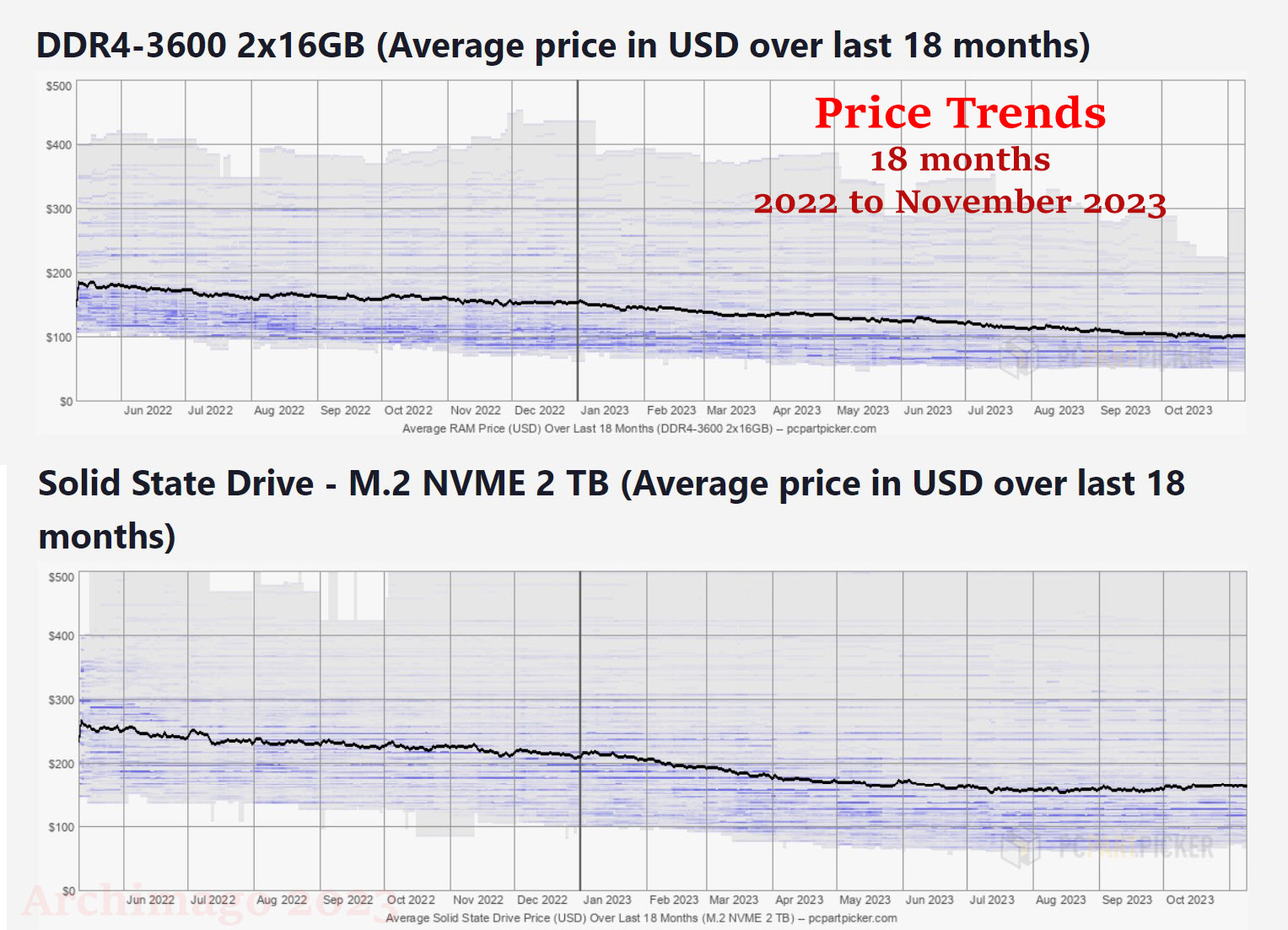
Although typically I write about audio stuff on these blog pages, not infrequently I'll talk about my computer updates as well. Looking back, this has allowed me to review the journey along the way over the last decade. As we enter into the Christmas season this year, I think this is a good time to be looking at computer parts as prices of things like SSD drives and DRAM in particular seem to be very attractive with DDR4 and DDR5 memory trending down, M.2 SSD likewise appearing to be bottoming over the last 18 months perhaps as the cost of basic necessities (food, housing, gas) have risen and disposable income reduced. I would not be surprised if inflation starts to drop in 2024 while the electronics parts rise in price again.

Who knows exactly what the future brings, but this looks like one of the best time to grab something like a 2TB M.2 SSD or some RAM:

The trend isn't as obvious with CPU prices. However, I upgraded my Workstation computer recently to the AMD Ryzen 9 5950X CPU - 16-cores, 32-threads I found at a decent price. And since it has been ages, I also updated my Gaming PC in the living room for the heck of it to the Ryzen 7 5700X.

Saturday, 2 September 2023

MUSINGS: nVidia's GeForce RTX 4090. Power Limited Overclock settings. On technological progress into cognitive domains.

For this post, I thought I'd explore technological progress in the computing space. While I speak mainly about audio topics in these pages, I hope this post gives you an idea of the broader technological progress happening around us.

As per the image above, I've updated my workstation graphics card to a Gigabyte GeForce RTX 4090 Gaming OC. This card is truly a beast, covering 3.5 slots in the computer thanks to the extra vapor cooling chamber. [Related to this card is the slimmer Gigabyte GeForce RTX 4090 WindForce V2 that "just" takes up 3 slots.]

Years ago in 2017, I spoke about my GTX 1080 used in the game machine of that time. Since then, it's obvious that technology has moved forward very substantially! Every couple years has seen a new generation of graphics cards churned out by nVidia typically with AMD following suit and these days Intel making headway with their more budget-friendly ARC line.

With each iteration, we're seeing objective improvements in computational ability and physical characteristics like the shrinkage of the transistor "process" from 16nm for the GTX 1080 down to the 5nm (near limits of silicon) in the RTX 4090 today. With the ability to fit more transistors into a smaller area (higher density), the number of parallel computational cores has increased from 2560 shading cores (also known as CUDA cores) in the GTX 1080 to 16384 units in the RTX 4090, a 6.4x increase in this one metric alone; not to mention the addition of new features like the Tensor cores (high speed, mixed precision, high-dimensional matrix multiplications) released in the RTX 20*0 generation, important in deep-learning tasks.