Showing posts with label Media criticism. Show all posts

Friday, 17 July 2026

SUMMER MUSINGS: True audiophile aspirations; recent events in the audiophile culture - end of Atkinson's Stereophile measurements, YouTube influencer legal drama.

Through my years as an audiophile, I've come across articles in magazines and online talking about hobbyist "aspirations". At audio shows, and seemingly each new issue of magazine we read, we're introduced to the latest and greatest piece or gear, the next "must have" item to consider in this never-ending path of upgrade to satisfy luxury consumeristic appetites.

Given that it's "Summer Musings" season, let's take some time to think about what I think is the most important aspirational item in all of the audiophile hobby - your room. And since in the last month there have been other events happening in audio news, let's also talk about the fact that John Atkinson has retired from doing measurements for Stereophile magazine, and the interesting legal drama around the case of an "influencer" (Michael Gefteas/The Greek Audio Geek) and social media.

Saturday, 6 June 2026

On Envy, "Cope", and just plain Reality in Audiophilia. More GR-Research/Danny Richie drama.

After writing the articles looking at room acoustics over the last month, I thought this would be a good time to discuss another observation about the psychology and culture of the audiophile hobby and some of the claims that people make.

As I noted last time, room treatments like the IKEA Mittzon absorption panels are far from the exciting products highlighted in magazines each month or even popular forum topics commonly discussed. While they do review realistic, non-controversial room treatments once awhile (like this), I would find it shocking if one day I opened an issue of The Absolute Sound and saw an article reviewing the Mittzon panel!

Sunday, 10 May 2026

Small Room Acoustics: Example of impact with (ultra) high-end speakers in Stereophile. (On AI audio writers, and Asia vacation pictures. 😊)


Last time, we discussed small room acoustics and audiophile listening rooms. In that article, I used an idealized loudspeaker with flat frequency response from 40Hz up. As I'm still traveling, away from my gear, I figured for this article, let's look around published data in audio articles to examine room effects and consider what this means.

One widely available and consistent source of objective data over the decades comes from Stereophile. While there are clear examples in the magazine where they perpetuate the "woo" in audiophilia, I appreciate that they do provide measurements for audiophiles who can read graphs and consider the technical performance of devices beyond subjective claims of how "great" something sounds, at some point in time, to someone, in some nebulous-quality sound room.

So let's take a look at a very recent Stereophile article - this one reviewing the Marten Mingus Septet Statement Edition loudspeakers - and consider the effects from room acoustics. Clearly, at an asking price of US$200k/pair, we're in the zone of "ultra high-end" luxury audio hardware. These speakers would be way above and beyond what the vast majority of audiophiles (never mind "music lovers" at large!) would ever spend.

Saturday, 28 March 2026

Do HDMI cables make a difference for IIS/I2S/I²S-HDMI audiophile DACs?

It's taking a bit longer for my testing of the inexpensive I²S/IIS/I2S-HDMI DDC boxes due to some unexpected results which I'm chasing down currently; hopefully that gets resolved or understood soon.

In the meantime, let me address something that folks might be curious about related to this topic of the I2S-HDMI interface... Does the HDMI cable make a difference to the sound quality?

As with much of audiophilia wherein some members of the culture have the belief that "everything makes a difference", obviously this is not the case and I do not recommend this kind of mindset. There are many things that don't make much, if any difference (as discussed here and here) based on experience and understanding principles of the technology.

Since I have not seen measurements examining the effect of HDMI cables on I²S performance from a DAC, let's do some testing here.

Sunday, 15 February 2026

More Audio Potpourri: What's the best sample rate converter? The other father of MP3 (James D. Johnston "JJ"). Are measurements important? And TAS' "objective" confusion.

For this post, let's discuss a few other audiophile items that have come my way in recent weeks.

First, let's talk about something I haven't brought up for awhile now: sample rate conversion (SRC).

A few weeks ago, Spoon (a.k.a. Steven Elkins of Illustrate) sent me an E-mail about his new src.hydrogenaudio.org page evaluating and ranking the qualities of various software sample rate converters. I believe the page has been online since late 2025. Check out the forum discussion about the project as well.

Saturday, 31 January 2026

Audiophile Potpourri: December 2025 web traffic among audio sites, price of cables poll, and flashback 2014 while looking ahead.

Let's have some fun this week on miscellaneous topics.

Occasionally, I'll highlight items I've either written or found on audio discussion forums I think would be good to share. One reason I decided to start doing a blog beyond just contributing to forum discussions was precisely because while the public forums are great for interactions with community members, meaningful posts often become obscured behind pages and pages of chit chat, irrelevant responses, and sometimes unpleasant arguments.

[I've unfortunately witnessed situations where very meaningful threads are closed off prematurely based on the bias of moderators. Even worse, threads with useful discussions might be erased entirely from existence which I feel is an slap in the face of well-meaning participants who put their time and efforts into thoughtful reflections. This is nothing new in the audiophile world; for example last year Stereophile scrubbed their website of all public comments accumulated over decades!

While I acknowledge the right of a website's owner to do such things, that doesn't make it any more palatable. I certainly understand the need for moderation in removing nonsensical, trollish, unethical, or crude statements that add nothing to promote thoughtful discussions.]

Speaking of forums and websites, I thought here in early 2026 it would be fun to explore website traffic numbers of some of the most common audiophile/audio sites using a common metric. One can get monthly visit numbers from Similarweb for free, a well-known website traffic tracker.

Friday, 19 December 2025

On the Danny Richie / GR-Research's UberBUSS hypocritical video against Amir / Audio Science Review.

After writing the article recently about New Record Day's "AI assisted research" on the P.I. Audio / GR-Research UberBUSS, I thought it was disturbing seeing this recent, rather juvenile, video from Danny:


As we can see, there is this ongoing conflict between Danny and Amir/Audio Science Review (ASR) over the years. Obviously, ASR has been highly critical of some GR-Research products like their power cable and speaker designs. I think that's to be expected; since when did objective-leaning audiophiles care for US$400+ power cables? Objective reviews naturally compare metrics and seek out good value so high-priced items that cannot show improvements in the measurements (nor with controlled listening) simply cannot be recommended.

Given that Danny made this video voluntarily, released publicly, I assume he wanted to foster discussion, so let's get into this for a bit.

First, consider the title - "Measurements vs Listening — and the History of a Site with an Agenda". Sure, Audio Science Review has an agenda and it's different from Danny's. There's nothing wrong with that and in fact is to be expected for anyone trying to publicly make a point to influence others! I'd be dishonest if I claim to have no agenda either given the kinds of articles I write in these pages. Here are some of the items on my agenda list:
A. To discuss audiophile topics through a "more objective", rational lens.
B. When I review stuff, to aim to show demonstrable effects (measurements, graphs, etc.).
C. To speak clearly when products appear to be Snake Oil.
I trust that none of those 3 points above would be a surprise to anyone who has read an article or two around here.

Saturday, 6 December 2025

On using AI/ChatGPT analysis to convince consumers about audio snake oil? GR-Research UberBUSS anyone?!

These days we have AI making hit music, and AI actors coming soon. The AI industry is "hot" and impressive, seemingly the answer to all kinds of queries we may have right at our keyboards! I think it's absolutely true that with the advent of LLM's and multi-modal deep learning models, we have even more ability now to learn, analyze, and summarize all kinds of information unheard of just a few years back. Like all things, there's always a catch which is that we have to use the tools responsibly and we need to make sure not to be overly reliant on these things because the results can also easily be wrong, like the "hallucinations" (more like "confabulations") that happen still all too often during AI chats.

We're seeing the advent of AI-driven intersubjective delusions in some people. Over reliance of these information tools can lead to all kinds of unforeseen negative outcomes across different domains (like in the legal space).

So I guess it's natural then that audiophiles might want to apply the technology to answer some of audiophilia's deepest never-ending debates - the stuff at the heart of numerous snake oil products.

The other day, I ran into an interesting New Record Day / Ron Brenay video where he uses ChatGPT to assess room audio recordings either from components using stock power cables, or through a new fancy GR-Research power conditioner called the "UberBUSS Power Filtration System" starting at US$1,600 that Danny Richie obviously is getting all excited about (my goodness, everything is "another level" with this guy - how many levels are there with mature technology?). This UberBUSS is further paired with his poorly reviewed US$380-$480 B24 power cable for the test.

[I see the UberBUSS isn't a totally new power filter, non-surge suppression product. Apparently it has been out since before 2021, earliest mention 2018, made by P.I. Audio Group which I guess is now defunct? If at first you don't succeed... Keep trying?]

Let's have a look at this video and what's being done...

Saturday, 22 November 2025

MUSINGS: On various characters in the audiophile hobby, debates, opinions and the Hearing Test.

Hey everyone, once awhile I'll take a look at stuff YouTube offers me in the feed that might be interesting. I see that in the last few months, there has been this channel called "The HiFi Five" and in Episode 6 (November 19, 2025) they invited Dennis Burger of SoundStage! for a discussion. I found this video actually quite interesting as an illustration of objective/subjective mindsets, biases, and the personality styles that come through in communicating such ideas.

Check this out if you have time for a deeper dive with discussion to follow, related to the contents and characters:

Saturday, 25 October 2025

As if higher prices always correlate to fidelity: Stereophile's Defense of Luxury Audio & the false Binding Statement of High-End Audio.

Hublot Big Bang Unico, ~US$20k+ depending on model.

Hey everyone, I just got back from the wonderful trip to Central Europe and figured I'd extend some thoughts expressed in the previous article: The Luxury of Sound and Time: Audiophile products, the Rolex and Timex Analogy.

That article went online October 12th and I was surprised to see Stereophile posted their article “In Defense of Sticker Shock” on October 17th written by Rogier van Bakel featuring a fancy looking, but inexpensive quartz wristwatch as the title image; what synchronicity! I assume his article must have been published in print/e-magazine earlier than when it showed up online.

I see the article pretty much opens with this statement:

Say “$10,000 DAC” and watch audio-forum commenters descend like pigeons on a dropped hot dog, flapping and furious.

Yeah, that's probably a fair observation! However, I think the first question we must ask ourselves is: “What’s wrong with that?

Saturday, 20 September 2025

QUICKIES: Black aluminum alloy footers. Equipment racks. Center channel in music. Underwhelming Spotify Lossless. More Paul McGowan/PS Audio USB cable & jitter foolishness.


Hey guys and gals, not much time this week to test stuff but to start I thought I'd show some pictures of the black version of the inexpensive aluminum footers that were discussed last week.

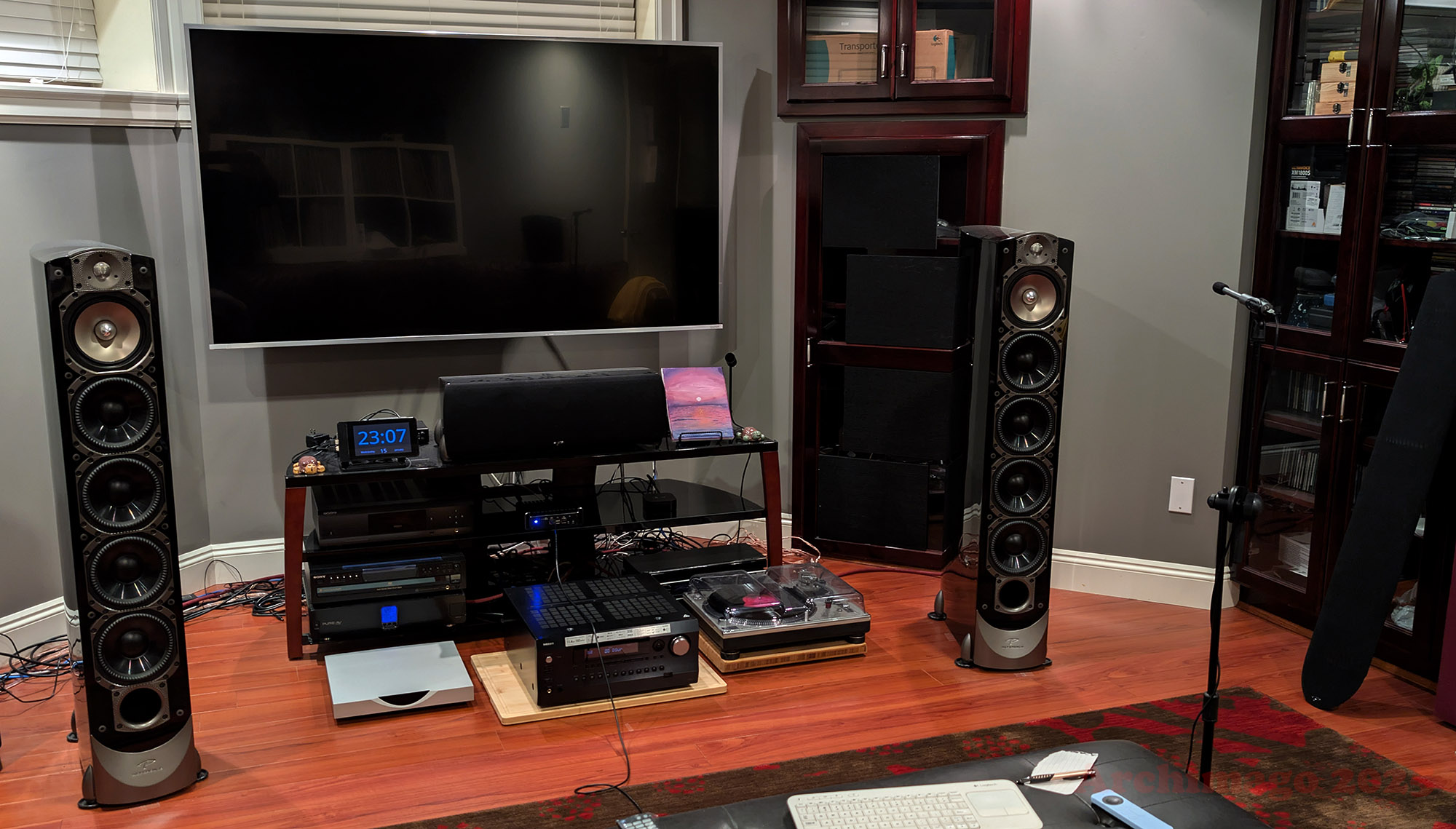
I got these black-colored ones (AliExpress) for my center channel, the Paradigm Signature C3 v.3 which is a 3-way, 4 speaker design that sits on my wood/glass component rack. (You can see other pictures of that component stand in my room article, or earlier when setting up the room.)

I picked the black ones since the center channel is sitting straight in front of me when watching movies, keeping it black will not add any color contrast to potentially distract from the show.

Saturday, 13 September 2025

Do loudspeaker footers make a difference? Inexpensive aluminum alloy "isolation" footers.

As you can see through my posts, I'm obviously not averse to trying out "cheap audio guy/gal" products. šŸ˜ I trust that this is completely consistent with my perspective on audio hardware for the most part being mature technologies, refined over decades already. For the high-fidelity audio reproduction pursuit, we can achieve excellent quality at very reasonable prices. Many (not all of course) of the "high-end" stuff that go for very high prices are clearly targeting a luxury crowd without necessarily achieving better fidelity. And some products, like what we'll be talking about in this post, I believe only demand "low-tech" solutions anyway.

China is the de facto consumer manufacturing powerhouse of the world in the 21st Century and we'll often find interesting and inexpensive products by mail order from places like AliExpress or Temu. Possibly worth trying some of this stuff if tariffs or shipping charges aren't too high for your country (eg. the de minimis suspension in the USA could take a big tax bite out of easy access to inexpensive goods). Technologically mature products made of standard materials at reasonable quality do not need huge price tags. For example, in early 2024, I grabbed this Nordost-like cable which worked out quite well and I believe performs equivalently in the ways that matter.

Similarly, for this post, let's look at this set of aluminum "isolation" footers which we can easily source from places like Amazon, AliExpress, and Temu:

Price: only about US$25 for a set of four as shown above - available in matte silver, black and gold. I bought two sets of the silver color for my pair of Paradigm Reference Signature S8 v.3 speakers for less than $50 total from Temu among other trinkets in that shipment. šŸ˜†

Tuesday, 1 July 2025

SUMMER MUSINGS: Paired speaker testing, more crossover thoughts, running tests ourselves and for ALL speaker reviews!

Paradigm Signature S8 v.3 speakers with grilles off. miniDSP UMIK-1 microphone for some simple testing with Room EQ Wizard (REW).

Well it's summertime which means (hopefully) a bit more opportunity to enjoy the nice weather around here in Vancouver with the family, more time to listen to music, maybe a little trip out of town on weekends.

As for my audiophile interests, it also gives me time to think about the broad topics and maybe run a little bit of testing here and there. Often these summer articles flesh out ideas and results covered over the last few months I may have left aside or on the "cutting floor" when writing.

This post will be along those lines in that these results were actually captured back in the January-February 2025 timeframe when I was doing the ferrofluid replacement for my tweeters, and then subsequent discussions about "audiophile" crossover parts and addressing beliefs of people like GR-Research/Danny Richie.

Since I grabbed these measurements and pictures when I was considering the importance (or not) of crossover part affecting sound quality, I thought I'd post them with some further summertime-meandering and related discussions.

Sunday, 22 June 2025

1kHz Test Tone: Does increasing the number of PCM values really matter? And Stereophile's "still listening" to the community (so they say).

Hey there audiophiles, lots happening in life to keep me busy these days as we enter summer 2025, so let's do another little follow-up of a topic based on reader comments.

In the previous post, there was a comment by Mister MB about the 1kHz test tone and the idea that it would be good to use tones that employ more PCM values as quoted from Ken Pohlmann's book Principles of Digital Audio (currently 6th Edition, 2011, from page 81, emphasis mine):

"Digitally generated test tones are often used to measure D/A converters; it is important to choose test frequencies that are not correlated with the sampling frequency. Otherwise, a small sequence of codes might be reproduced over and over, without fully exercising the converter. Depending on the converter’s linearity at those particular codes, the output distortion might measure better, or worse, than typical performance. For example, when replaying a 1-second, 1-kHz, 0-dBFS sine wave sampled at 44.1 kHz, only 441 different codes would be used over the 44,100 points. A 0-dBFS sine wave at 997 Hz would use 20,542 codes, giving a much better representation of converter performance. Standard test tones have been selected to avoid this anomaly. For example, some standard test frequencies are: 17, 31, 61, 127, 251, 499, 997, 1999, 4001, 7993, 10,007, 12,503, 16,001, 17,989, and 19,997 Hz."

Certainly a good point to think about. However, if we look at actual hi-res DACs these days, and the way we're running 1kHz tests to show routinely >100dB SINAD, would we actually see significantly different results depending on how we create these test tones, specifically whether more or less PCM codes are being used in the signal sent to the DAC?

Well, while I still have the Topping DX9 on my testbench, let's have a look at the analog output from the device with a few ~1kHz test tone variants.

Saturday, 14 June 2025

Follow-up: Topping DX9 DAC tests. And reduction in the ability to comment on the Stereophile website.

Topping DX9 DAC sitting on Linn Klimax DS/2 which we'll talk about another time.

Hey guys and gals, thanks for the comments and feedback over the years on this blog. It really helps to refine the testing and of course explore broader ideas about audiophilia and what it is we're after in this hobby. I think it's important that we're free to discuss and critique not just the hardware, but also the ideas (including the philosophy and psychology) that "we" as individuals believe in. There's so much unsubstantiated audiophile cultural beliefs out there based on myths such that everything should be up for examination regardless of who says what. It's not unusual to find that audiophile review "high priests" are wrong, and some "heroes" of the audiophile world are nothing more than false prophets.

It's also good to get feedback suggestions on the published measurements, for example in the recent series on the Topping DX9 flagship DAC (based on rare AKM AK4499EQ chip), Nick in the Part III comments suggested that I consider this:

"Hi Archi,

Prior to version 5.40.78 beta rew had a gross error in IMD vs Level plotting, the results were underestimated by about 12 dB. It looks like the version you used has this error.

IMHO there are not enough performance measurements at high frequencies for a complete picture. If still available, it would be very interesting to see THD (without noise) vs frequency performance, accurate THD measurement at 10kHz and wideband fft (without weighting) with a weak signal such as the signal for the DR test.

Thanks!"

Excellent feedback and suggestions Nick, let's focus on checking this out in this post!

Saturday, 7 June 2025

Roon in 2025, 10 years on: Sound quality, thoughts, and suggestions. And an increasingly AI-generated Internet.

Notice it has been "10 Years" for Roon as per the top left.
Roon 1.0 was released May 2015.

Obviously, it's impossible to get on all the discussion forum about the myriad subtopics in this audiophile hobby. However, I do get newsletters in my inbox and I see frequently asked questions that inspire many of the topics addressed here.

If we've come across each other on the audio forums (places like Steve Hoffman's site, or Audiophile Style), you'll notice that I often will respond with links to articles on this blog. I've posted more than 600 long-form articles already, the vast majority digging pretty deep into the audio topic. One of my intentions over the years is for this to be a repository of information, articles I can use as "landmarks" when I engage in discussions with fellow audiophiles; how I understand the hobby including big-picture philosophy, psychology, the debates. Contained within these pages are the thoughts, character, understandings of "Archimago the anonymous audiophile from the early 21st Century" with contributions from guest posters. Familiarity with these articles I think will provide a good starting point for "rational audiophiles", without necessarily going too deeply into technical details.

Apart from discussing individual products, broadly, I think we've covered many of the usual issues raised in audio circles already, much of it analyzed with data to seek out the facts, rather than mere opinions. Feel free on the main page of this blog to use the "Search This Blog" widget as I suspect you'll find articles addressing many questions.

So, coming back to a frequently asked question, for this post, let's think about Roon software in 2025 (currently version 2.51 build 1534). In a recent Roon forum newsletter, I saw this question posed by Eric_Pell:
"I am wondering for years why the most expensive app in the world of hifi and high end only has a sound quality which is only ok. If you compare Roon with JPLAY i think JPLAY has only a few people to develope (sic) software and improve sound quality. But here the difference. What is Roon doing to improve sound quality and do they compare with JPLAY or not?"

Saturday, 15 March 2025

MUSINGS: Trust, empirical testing, and evidence in the Audiophile hobby. And the Double Blind Test (DBT) strawman argument.


For this post, let's spend a little bit of time thinking about "levels of evidence" in audiophilia. This is important because it helps determine how we gauge the veracity of the articles we read and how we build confidence as we create our own internal models of the topics covered in this hobby.

Inevitably, if we stick around this hobby of audio gear and products long enough, we'll come across the abbreviation 'DBT' - that dreaded Double Blind Test; that seemingly ultimate methodological scientific "gold standard" in human research to tell us whether an intervention or change in our systems actually resulted in a worthwhile difference.

But do audiophiles actually throw around the comment "You need to do a DBT!" very often? Or insist that "I don't believe that unless a DBT proves it!". The answer is 'NO!'- of course not!

Let's start by zooming out a bit and thinking about the very big picture...

Saturday, 15 February 2025

Frustration of the Euphonophile Salesman. Audiophile evaluation methods & intentions.

Through February 2025, and with today's third post of the month, I've been exploring the current audiophile culture with videos from contemporary YouTube channels. While never exactly the same among participants, we can see "archetypal" characteristics shared among personalities in this hobby.

We've talked about the technical channel that presented facts but also blurs boundaries into unusual beliefs to make sales and justify products, the subjective-only hobbyist channel willing to do listening tests (great!), and today let's talk about the audiophile who appears to insist on purely subjective-based evaluation, rejects objective measurements, and is a salesman in the Industry.

I'm talking about OCD Hi-Fi Guy who's quite an entertaining fellow. He calls it like he sees it - "no BS" - I can respect that to a point. His name is Mike "Mikey" Powell and he runs a company called 11 Stereo. His followers are known as the "HiFi Tribe" and in the videos, we see promotions of the companies and products that he represents including Playback Designs DACs and Fischer & Fischer speakers, prominently mentioned among others. 

Every once awhile you'll see on my blog a reference to something on his channel that I found entertaining - like this post addressing the interview with Machina Dynamica guy. His use of diction suggests an intelligent fellow but I suspect he comes across a bit "spicy" in his language for many audiophile gentlemen and gentleladies. At other times, some of his viewpoints around politics and towards other cultures might be unpalatable.

If you watch his videos, I think it becomes quite clear that his moniker is inaccurate because he is neither "OCD" (his answers are far from perfectionistic), nor is his philosophy towards audio particularly "Hi-Fi" (high fidelity). Let's have a deeper look at this with a recent video that's entertaining, yet highlights the frustration that I think some salesmen might experience online these days as they try to assert unsubstantiated beliefs.

Saturday, 8 February 2025

Do CD and lossless streaming sound the same? A response to ana[dia]log video. And on excessive complications in the audiophile culture.

Today's blog post was inspired by Mister MB in a comment he made on the post last week (about GR-Research, and the hype around passive crossover components):

Hey Arch,

Slightly unrelated, but I thought you'd be interested in this recent video about CDs vs Streaming by Guido of Anadialog:

https://www.youtube.com/watch?v=pY8PeMpT2DE

What do you think? ...

Thanks for the link MB. I've come across the ANA[DIA]LOG YouTube channel but admittedly haven't spent much time watching the contents. I certainly appreciate the host, Guido's, passion and energy! I see the content caters more to physical music media, especially tapes and LPs. As you probably know, for me, subjective preferences aside, analog media represent lower-resolution sound; no offence to vinyl/tape lovers, it's just a statement of fact (especially with LP/vinyl) given the much higher resolution capabilities of modern digital ADC and DACs, achieved with less hassle.

Good to hear about the interest around CDs these days. I guess what's old eventually becomes new (maybe even trendy) again at some point after a couple of generations! Although I have a feeling Edison's wax cylinders might have a tougher time staging a comeback. šŸ™‚

Saturday, 1 February 2025

Loudspeaker crossover parts and sound quality. (Regarding Danny Richie / GR-Research's claims, of course.)

At the heart of most subjective vs. objective heated audiophile debates is the concern about the ease by which a person can dramatically exaggerate claims about sound quality without controlled listening tests, measurements, or any other higher level of evidence beyond personal testimony.

Without any meaningful repercussions, we can say almost anything, claim we experience almost anything, regardless of whether it's true, misperceived, or intentionally exaggerated for financial gain, status among peers, or other benefits. It is necessary therefore that audiophiles who read, watch, or listen to such comments develop the skills for critical thinking to assess such "testimonies"; acceptance without critical thought is simply blind faith, potentially leading us in directions we regret or might even be unhealthy. (See also the article on the types of "subjectivisms" in audiophilia.)

For this post, let's talk about a topic which has been around awhile but perhaps more notable over the last few years about passive speaker crossovers. In particular, the idea that at times quite expensive parts upgrades make desirable, even "huge" differences toward better sound quality.

Grab a seat, open up a beverage, sit by the fireplace if it's cold outside, and let's think about this stuff for a moment, dear audiophiles...