Showing posts sorted by date for query phono stage. Sort by relevance Show all posts

Saturday, 26 April 2025

Part III: Topping DX9 "15th Anniversary" Limited Edition DAC & Headphone Amplifier - DSD, S/PDIF inputs, headphone out, pre-out, and AMPT. And the desire beyond Perceptibly Perfect.

With Raspberry Pi 'Touch' streamer showing album art running RoPieee, and the Topping DX9 VU meters playing, this looks quite nice in the audio rack!

Let's finish up with the last installment of the review/measurements for the Topping DX9 "15th Anniversary" DAC (see Part I, and Part II previously). As we have seen up to this point, it's quite a unique looking DAC and the initial PCM measurements over USB2.0 look great as a modern hi-resolution converter. In Part II I noted that there was an issue with the 176.4/192kHz frequency response that Topping was able to correct quickly with a firmware update. I'll be using the latest firmware 1.23 for the measurements here.

Let's continue then to dive in and explore the objective performance with some of the other main features for this DAC.

Saturday, 5 October 2024

Pacific Audio Fest 2024: Part III - parting thoughts, audiophile education, speaker:amp price ratio & the future?

Hypothetical scene in Seattle...

Another year, another Pacific Audio Fest in the annals of audio shows. Looking back, this show would be the 6th of this sort I've attended and subsequently discussed on this blog over the last decade, let's see:

Rocky Mountain Audio Fest 2019 - final RMAF
[Pandemic Years]

It's interesting reviewing some of those others over the years. I think most audiophiles will recognize that over time, not really much has changed, has it? Sure, the companies come and go, we've seen the ebb and flow of themes both in this blog as well as at the shows (for example, jitter was more of an uncertainty when AudioQuest introduced their JitterBug device in 2015). We've seen the rise of "high-end" computers and streamers (also discussed here), and these days I noticed that the companies are not as aggressive in the marketing as these products mature. Streaming may have reduced the need for local libraries, or simply that consumers themselves are comfortable with digital audio quality, the lack of sonic difference (and the "Bits Are Bits" reality).

Saturday, 14 September 2024

Pacific Audio Fest 2024: Part I. [And expensive speaker cables unanimously turned down in a blind test?! 😕]


This is the third year for the Pacific Audio Fest which first started in 2022, basically after the COVID-19 pandemic reopenings. I think the first 2 years of the show were quite similar in size but this third show is clearly a smaller event with fewer display rooms and less stalls in the Marketplace. Correlated with that, I also noticed fewer headphone set-ups to try out.

To be honest, while I think this probably was disappointing for some, I only had a couple of days to visit anyways so this actually worked out driving into Seattle on Saturday morning, stayed a night, and got home by later afternoon Sunday having felt like I spent enough time in each room, even visiting a few of the rooms a number of times to compare.

So, let's have a peek at some audiophile eye-candy and consider the goods out on display this year. Let's be honest, one of the most important specs whenever doing any shopping is the asking price. Unless specified otherwise, all prices are in USD.

The show ran from September 6-8, 2024 at the SeaTac DoubleTree Hilton which is the same as in previous years. I spent the 7th and 8th "hitting the rooms". Let's go!

Tuesday, 18 June 2024

MEASUREMENTS: Nordost-like flat silver-plated copper speaker cables. And, comments of a "high-end" cable insider compared with an apologist?

Cables are fun to play with! They look different, there are all kinds of brands available, and for some audiophiles, there's a sense that the sound has been "changed" if not "improved" when trying products at different price points. All without lugging big and heavy speakers or amplifiers around which makes the upgrade easy especially if one believes that the change can be equivalent to such component swaps! Speaker cables in particular would be the most interesting because they carry complex musical signals of potentially high current and voltage for longer lengths. (Digital and power cables are least interesting for me for obvious reasons - here's my summary post of cable measurements over the years.)

I've already talked about a number of different speaker cables in the past; most recently here, here, and here. Notice that morphologically, all of them have been "roundish" cables so I thought it would be fun to try something flat and measure to demonstrate the LCR changes that this kind of design provides.

Looking around AliExpress, I found the cables above - China-made Nordost-like speaker cables - I bought the 2.5m pair with locking gold-plated banana plugs for less than US$100. There are similar products found on Amazon but you'll need to shop around for a good price.

I think the design of these are probably most similar to the Nordost Heimdall 2 cables which currently retail for about US$2,500, 2m pair.

Saturday, 15 July 2023

Pacific Audio Fest 2023: Part III - Final show musings... On sponsorships, seminars, unique listening opportunities (DSD256 vinyl sounds great ;-), and suggestions.

Collected promo materials, PAF2023.

Having published on the products seen at PAF2023 in Parts I and II, I thought it would be interesting to take some time to chat about other experiences from this show and parting observations.

These observations might apply at other audiophile shows as well.

Saturday, 8 July 2023

Pacific Audio Fest 2023: Part II - Hotel wing audio rooms. A few words on sound quality, and emotional connectedness.


Let's continue exploring Pacific Audio Fest 2023 beyond the main ballroom and larger rooms from last time. As you're probably aware, audio shows take place in hotels with companies renting out rooms to show off their gear. At PAF2023, we have 4 hotel "wings" to explore located on the first, second, and thirteenth floors.

Mercifully, PAF2023 isn't a big show which allowed me to enter each room and have a listen over the leisurely 3 days (Friday to Sunday) that I was in Seattle. Let's go for a stroll and see what each room had to offer. While I don't think I missed any of the rooms, I'll only highlight the ones that seemed most interesting...

Sunday, 7 May 2023

Audiophile Survey, early 2023: Who we are (including age and gender). What we use. How we think.

Well ladies and gentlemen, thanks to all who took the time to complete the information in the open "SURVEY: What audio playback system and/or streaming music service are you using in 2023?" post. The survey collected responses from February 11 to May 5, 2023 on this blog, and as usual, the responses came from audio lovers around the world, receiving in total 1330 entries with general information on demographics, broadly what kinds of systems are being used, multichannel playback, interest in masterings, and for those using streaming subscriptions, which ones.

As with any survey, we have to start with some context for the data. Obviously, the individuals who submitted results to me would have been primarily the viewers on this blog although I know the survey was advertised at various audiophile-related forums. I did not do any special advertising personally, other than mentioning it on a few forums I visited like Audiophile Style or Steve Hoffman Forum. I don't maintain much of a social media presence so basically just let the survey diffuse across the Internet.

Given the nature of this blog and its contents, I'd like to think that this survey will tell us about some of the characteristics of the subgroup of intelligent, reasonable, balanced, technically savvy, prudently skeptical, practical audiophiles around the world in the first half of 2023. ;-)

Saturday, 18 March 2023

REVIEW/MEASUREMENTS: AOSHIDA A7 Class D TI TPA3255 amplifier. Good sound. Good power. Economical.

Above, you see the small AOSHIDA A7 Class D amplifier which we'll go in depth with in this post. It's inexpensive and can be purchased for less than US$150 these days. This design is also sold as the Douk Audio H7 with a different color scheme, presumably the innards must be very similar if not identical. I preferred the look of the black AOSHIDA version with orange-ringed VU meter. I purchased this amplifier through the usual retail channels.

Over the years, it has been good to see the evolution of Class D designs and the inexpensive "chip" amplifiers. Internally, this is based on the TI TPA3255 "PurePath" chip (released in 2016) rated to provide up to 315Wpc into 4Ω stereo but at 10% THD when provided with adequate power (data sheet max is 53.5V). Notice the italics to emphasize that these numbers must be put into context. For audiophiles who want lower distortion in their amps (like <1% THD), we would be looking at much more conservative power figures than that 300+W being promoted for these amps.

(The chip also has a mono configuration that's spec'ed at up to 600W into 2Ω which would not apply for this review.)

Saturday, 11 March 2023

The Audiophile Wisdom of ChatGPT (Feb 13, 2023 Version): Learnings from an artificial intellect on an esoteric hobby. (And on creativity?)

I'm sure none of us these days have escaped news about ChatGPT from OpenAI. Articles have been ubiquitous covering the implications of what this "chatbot" is able to do. No doubt, there will be deep implications stemming from this technology already being debated through the halls of academia on how it will affect everything from education, to work, to legal ramifications. As with any likely transformative technology, there will be promise and fear.

Already, I've seen many articles out there including in our little corner of the universe with Stereophile's "As We See It" in February referencing ChatGPT.

As you're likely aware, ChatGPT achieves its remarkable abilities based on Generative Pre-trained Transformer (GPT-3.5) "large language model", a sophisticated "self-supervised" general AI model based on >175B parameters combed through 570GB of data as text off the Internet, books, and Wikipedia. Yes, human feedback is part of the training process and data continues to be gathered from users to improve the model. At the time of this article, the openly available online ChatGPT has been trained with data up until September 2021 as can be seen here:

Arch: Who won the Superbowl in 2023?

ChatGPT: I'm sorry, but I am not capable of predicting future events as I am a machine learning model trained on historical data. As of my knowledge cutoff date, which is in September 2021, the most recent Super Bowl was Super Bowl LVII and it has not happened yet. It is scheduled to take place on February 5, 2023, so we won't know the winner until the game is played.

Given the level of knowledge ChatGPT has access to, I wondered how would it perform currently in March 2023 if asked about broad audiophile topics. I think this is interesting because the answers it gives must be an integration of all those hundreds of gigabytes of texts fed into the system. What does all that information teach the machine about the current understanding of audiophile topics? Are the answers reasonable, and relatively free of errors? Do the answers show "common sense" or even a level of "wisdom" one might wish to receive when talking to a knowledgeable audiophile friend requesting advice?

Let's dive into a Q&A discussion and see what ChatGPT can tell us about this niche audiophile hobby... (Grab a warm beverage by the fireside friends, we go deep and broad.)

Saturday, 19 November 2022

EARLY LOOK: The E1DA Cosmos Scaler prototype. As usual, Neil Young (in "World Record" album interview) remains neurotic against digital...


Today, let's talk about something rather unique.

In the image above, we see the E1DA Cosmos Scaler in use as I was running measurements of some DACs I have around here. As I mentioned last time, this is a prototype product which although has been announced/discussed online, as far as I am aware, is not at the stage of imminent production or public release. As such, be mindful that details I describe here might change if this were to be released as a product.

The Scaler functions as a balanced 2-channel in/out pre-amp that can apply 16 discrete levels (this is not a regular volume knob for routine volume control) of very clean amplification (using OPA1612) from 0dB to +26.7dB along with an "auto-ranger" feature that aims at a target voltage level to feed the ADC. Along with this, the Scaler's stable high 200kΩ balanced (100kΩ unbalanced) input impedance resolves one of the limitations of the Cosmos ADC; the lower input impedance for example 1.66kΩ at a commonly-used 4.5Vrms setting.

Thanks again to Ivan Khlyupin (IVX) for sending me the package to test out.

As with any pre-amp product, the question is how quietly does this device perform when feeding the output into a high-resolution measurement ADC in this case. And related to that, whether the device adds any of its own distortions.

Saturday, 23 July 2022

Summer Musings: On Stereophile's "Quackery, Gullibility, and Open-mindedness". Nature of audio devices. Truths in audio (and medicine).

Well ladies and gents, I guess it's official. Stereophile, at least in part, is not a journalistic venture based on a recent "My Back Pages" article. In the opening 3 paragraphs of "Quackery, Gullibility, and Open-mindedness", Rogier van Bakel basically discards the importance of skepticism as a journalist, and seems to set the stage for audiophiles to accept basically all manners of quackery and snake oil.

For those who have been on this blog over the years, you probably know that I'm a physician working here in Vancouver, Canada. I write these audio musings and technical review articles as part of my audio hobby/journey to go beyond enjoying the music as a consumer, towards further understanding of how the technologies work, with the hope that the results of the explorations may be helpful for other pilgrims along this path as we discuss hardware and improving sonic fidelity.

On quiet evenings when the kids are asleep and my wife is enjoying her TV dramas, examination of electrical devices and their waveforms can provide a much-needed distraction from the marvelous yet frequently incomprehensible complexity of human physical and mental states.

Saturday, 29 January 2022

REVIEW & MEASUREMENTS: Chord Mojo DAC/Headphone Amp. A note on LH Labs (Light Harmonic "subsidiary") audio crowdfunding. And Neil Young's ultimatum to Spotify. [Early Mojo 2 specs.]

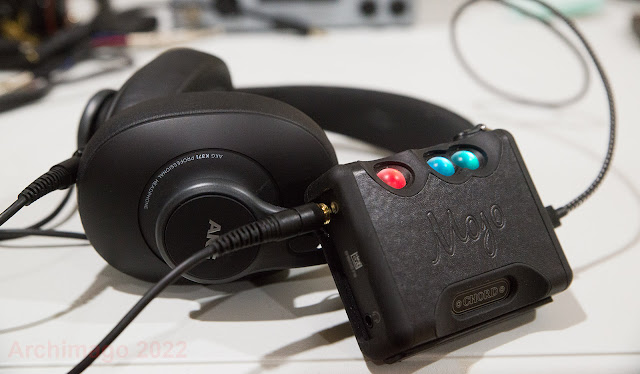
Mojo as shown here in the official rubber and leather Mojo Case. Looks and feels great in the hand. Shown with AKG K371 headphone.

Well, in the "better late than never" category, when I returned my friend AudioPhil's Cayin RU6 the other week, I borrow his Chord Mojo ("Mobile Joy", ~US$475 new but I think currently discontinued) for a spin!

This DAC has been out since October 2015! That's ages ago in the world of electronics. However, to be honest, high fidelity audio reproduction is rather ageless whether the device is 10 months old or 10 years old. So long as the internal components aren't deteriorating with age ("break-down" instead of "break-in", right?).

As you've probably seen in countless reviews on the Mojo (like here, here, here), this seems to be quite a popular DAC with a good following. It has been said that Chord sold something like 100,000 of these over the years. Objectively, the Stereophile review in fact showing some impressive performance results back in 2016.

As usual, Chord gear tends toward the large bulbous glowing buttons, at times steampunk metal esthetic. Colors are used to provide feedback on volume (the pair of buttons for +/- volume) and the main power button (red in image above) which changes color for sampling rate. I think this is an acquired taste and figuring out the colors will take some time as you get used to the sequence of colors in a rainbow with red (lowest volume/samplerate) on one end and purplish/grey/white (highest) on the other..

Saturday, 3 April 2021

MEASUREMENTS: Melody Onix SP3 Mk. II (~2006) Class AB Tube Integrated Amplifier. (And it isn't "diminishing returns" on sound quality, often there are simply "no returns".)


Recently I was curious about trying a tube amp in my system and my dad who's into his vintage gear including some older tube devices offered me this amp to test out. It was time to take up the offer and have a listen plus put some tube gear on the test bench for a peek at the performance.

As you can see, for today's post, we have the Melody Onix SP3 Mark II which I believe was first released in 2004 for US$1000. This one I believe was bought in 2006. It's a relatively compact unit (12" x 8" x 13" or so), 56lb beast designed by Melody Australia, made in China. Over the years, there have been various reviews on this product from 6Moons (Best of 2005 list), Audioholics, Home Theater Review, High Fidelity Review among others. Here's the Melody company website. I think this model was discontinued by around 2010.

I've always liked the look of this box. There's a cage that normally protects fingers from the four large power tubes and individual smaller covers (you can see 3 on the right removed) that protects the 6 flanking tubes. Turn off the lights at night and it all looks very cool.

Saturday, 19 September 2020

As We Hear It: Thoughts from an audiophile friend on assembling his sound system.


Every so often, I have the pleasure of having friends and readers add their thoughts to these pages. The other day my buddy whom I visited at the end of 2019 (a.k.a. "linnrd" online) sent me this discussion piece. Back in December when I visited, I invited him to take the opportunity to write about his equipment and how he came to this interesting collection of gear. Well, he delivered...

--------------------

A Complex Path to Simple Sound


Audio systems are generally an assemblage of products from different manufacturers. While significant R&D resources go into designing the various pieces that make up a system, it is left to the consumer to deal with the "R&D" of system design from "soup to nuts", as it were. The popular audio press is more oriented to singing the praises of individual components instead of educating and helping the reader actually assemble a decent combination of the aforementioned. Perhaps this a result of whom they view as customer and who as the product. A graveyard visit allows one to see much touted wonders such as Shakti Stones and the green CD marker (Ed: also see Harley's extensive investigation in Stereophile in 2004 amounting to nothing of course), to name just two, with the rotting corpse of MQA lying in wait for a plot (in both senses of the word!). 

Unfortunately, the self-proclaimed experts actively ignore existing knowledge and science and make it extremely difficult to fix this fundamental problem of the spread of misinformation by also subscribing to junk science. In other words, they are really messing up the S:N ratio of information transmission. As Bill Whitlock from Jensen says, reiterated in a recent discussion: "It often feels like an uphill battle to educate in a world of marketing deception and self-appointed experts."

Saturday, 30 November 2019

MEASUREMENTS: Onkyo TX-NR1009 "WRAT" AV Receiver Class AB Amplifier... Plus Pi / LP / Resolution miscellany.

I currently have 3 AV receivers here at home. The Denon AVR-3802 is my oldest machine, purchased back in 2001 and being used in the living room for stereo playback. My newer Yamaha RX-V781 (2016) is currently in use for movie playback with Atmos/dts:X decoding. This leaves the Onkyo TX-NR1009 (2011 model) that I bought used in 2013 which has actually been sitting unused for the last few years mainly because it's an older HDMI 1.4 device which did not support full 4K/HDR/60fps switching:


It's a shame because I think of the 3 receivers, subjectively this is probably the best sounding (no blind test done, just a suspicion), has the highest power rating (135W into 8Ω, 1kHz, 1%), THX Select2 Plus certified, can amplify 9 channels (9.2 decoding), and when new, was also the most expensive of the three. I'm sure at some point I'll find a use for this 41 pound monster - maybe if/when the old Denon breaks down :-).

I don't think anyone can fault the external build quality which also looks quite handsome. Onkyo did unfortunately have some electronics failure issues with this generation of receivers however and back around 2016, I sent this unit back to them for an HDMI board replacement (here's a thread on the issue a few years back).

For this post, I think it would be interesting to explore the sound quality of this device as a 2-channel amplifier (especially compared to the little Yeeco TI TPA3116 amp last week). It'll give us an idea of how well a good receiver could perform and give us a peek at a modern Class AB device sitting in the higher end of the consumer price ladder (Class AB receiver amplifier designs have not changed that much in the last number of years). These days a similar tier THX model with equivalent power would be the newer Onkyo TX-NR1030 and TX-RZ1100.

Saturday, 23 November 2019

MEASUREMENTS: Yeeco TI TPA3116 Class D Amplifier (aka Nobsound NS-01G, Douk Audio F900S, Mogu F900S)

As I posted back in June of this year, we can get inexpensive little amplifiers these days based on Class D chips such as the TI TPA3116D2 (first released in 2012) which is what is inside the device here:

Yeeco TPA3116 amp being probed... Notice that input is through the AUX phono jack in front from the RME DAC.
As you can see, I have a "Yeeco" branded device but these are produced in China and will come in a number of brands like the Nobsound NS-01G from Douk Audio, and other names like Fac"Mogu" discussed in this review and here's Z Review with an older version.

I mentioned in the previous post that once I have the amplifier measurement rig going I was going to have a look at the output from this little amplifier. I figure this would be a good device to start with using the MOAR amplifier procedure described last time.

So what does US$30 buy us in terms of sound quality in 2019?!

Tuesday, 10 September 2019

RMAF 2019 Day 3...


As it has been said, Day 3 of audio shows tend to be a quieter day. It was no exception this year at RMAF. The picture above is from the "Headspace" ballroom down one of the lines of booths where headphone-related vendors display products and demo for the visitors. This picture was taken around 10:30 in the morning shortly after opening at 10:00. While number ebbed and flowed through the day, it wasn't difficult to find plenty of headphones to try and devices to play with as I wandered in and out through the day.

Since I did indeed start my day in the "Headspace" exhibits, let's start there and listen to a few interesting products...

Sunday, 8 September 2019

RMAF 2019 Day 2...

Alright guys and gals, let's continue with the sights and sonic impressions from Day 2 of RMAF 2019!

Here's a picture of Colorado Ballroom C where the seminars are presented. Bob Hodas was presenting on room acoustics this afternoon and I suspect this is one of the best attended sessions:


I was able to catch most of the presentation. There were a few useful tidbits I suppose, and I imagine it will be up on YouTube for all to see at some point. Hope he would have been a bit more concrete with the equipment he uses and provided more basic discussion on what he's looking for from the measurements he does.

Saturday, 29 June 2019

LISTENING: Fully battery-powered wireless streamer & amplifier system (Yeeco - TI TPA3116D2, TalentCell 12V battery)


A few weeks ago, I read this review on an independent audiophile site about an inexpensive Nobsound Class D amplifier based on the TI TPA3116 chip. I was curious so I ordered an equivalent one off Amazon - the little Yeeco Bluetooth-capable amplifier shown above with box contents including the 12V power supply for <$US32 (for an even cheaper package, here's one without the switching power supply, <US$25).

As you can see, the reviewer linked above gave the product some positive comments on the sound. I was curious to listen and since we know that Class D amps like these are very efficient, how about we run the playback system - music streamer to amp to speakers - completely wirelessly and battery powered for a listen also?

Saturday, 6 October 2018

MEASUREMENTS: RME ADI-2 Pro FS as DAC (Part II - frequency response, noise, distortion and jitter)


As we saw previously, the RME ADI-2 Pro FS is based on the AKM AK4490 DAC chip and provides a good assortment of features like filter settings. We've seen that the headphone output amplifier provides plenty of power and the beginnings of what looks like a highly accurate DAC; consistent with my subjective opinion.

Time for part 2 of the objective evaluation today as we continue to explore the DAC output quality.