Showing posts with label Listening Test. Show all posts

Saturday, 8 February 2025

Do CD and lossless streaming sound the same? A response to ana[dia]log video. And on excessive complications in the audiophile culture.

Today's blog post was inspired by Mister MB in a comment he made on the post last week (about GR-Research, and the hype around passive crossover components):

Hey Arch,

Slightly unrelated, but I thought you'd be interested in this recent video about CDs vs Streaming by Guido of Anadialog:

https://www.youtube.com/watch?v=pY8PeMpT2DE

What do you think? ...

Thanks for the link MB. I've come across the ANA[DIA]LOG YouTube channel but admittedly haven't spent much time watching the contents. I certainly appreciate the host, Guido's, passion and energy! I see the content caters more to physical music media, especially tapes and LPs. As you probably know, for me, subjective preferences aside, analog media represent lower-resolution sound; no offence to vinyl/tape lovers, it's just a statement of fact (especially with LP/vinyl) given the much higher resolution capabilities of modern digital ADC and DACs, achieved with less hassle.

Good to hear about the interest around CDs these days. I guess what's old eventually becomes new (maybe even trendy) again at some point after a couple of generations! Although I have a feeling Edison's wax cylinders might have a tougher time staging a comeback. ðŸ™‚

Thursday, 2 January 2025

Lenbrook's MQA: The Next Generation - QRONO, FOQUS, and other AQWARD things. And listening impressions from the non-audiophile press.

Happy new year, audiophiles!

Other than a quick comment here and there in 2024, I'm glad that I didn't spend much time on MQA-focused material. The last we talked at length about MQA was over a year ago in December 2023 with the final sale of MQA to Lenbrook at the bargain basement sale price. My, how time flies! As much as I would love to never think/write about MQA again, this thing won't disappear. ðŸ§Ÿ

So I figured at the start of 2025, since there could be some MQA-related stuff later this year with possible new product announcements and such, let's anticipate a bit and consider the developments in this continuing saga.

The name "MQA" persists as part of Lenbrook's "MQA Labs" as the name MQA Ltd. has been re-registered to a food sales agent in the UK. Through 2024, we've been seeing the word "QRONO" hitting the news a few times already. In late 2024, there have been more articles in the audiophile press such as this in The Absolute Sound, and What Hi-Fi?. So, let's talk about what this seems to be about and what they're trying to do.

Saturday, 14 September 2024

Pacific Audio Fest 2024: Part I. [And expensive speaker cables unanimously turned down in a blind test?! 😕]


This is the third year for the Pacific Audio Fest which first started in 2022, basically after the COVID-19 pandemic reopenings. I think the first 2 years of the show were quite similar in size but this third show is clearly a smaller event with fewer display rooms and less stalls in the Marketplace. Correlated with that, I also noticed fewer headphone set-ups to try out.

To be honest, while I think this probably was disappointing for some, I only had a couple of days to visit anyways so this actually worked out driving into Seattle on Saturday morning, stayed a night, and got home by later afternoon Sunday having felt like I spent enough time in each room, even visiting a few of the rooms a number of times to compare.

So, let's have a peek at some audiophile eye-candy and consider the goods out on display this year. Let's be honest, one of the most important specs whenever doing any shopping is the asking price. Unless specified otherwise, all prices are in USD.

The show ran from September 6-8, 2024 at the SeaTac DoubleTree Hilton which is the same as in previous years. I spent the 7th and 8th "hitting the rooms". Let's go!

Saturday, 1 June 2024

"High-End" DAC Blind Listening Results - PART III: Subjective Descriptions

In this last part of the "High-End" DAC Blind Listening Survey write-up, (see Part I, Part II) let me document the more qualitative aspects of the responses I received from listeners. These come from the comments section where listeners described what they heard. You'll also get to see in context some of the descriptions of the hardware used in the evaluation.

Comments will be posted verbatim other than removing any identifying information and names unless the person specifically says it's OK. Not all comments are posted, only the ones with a fair amount of subjective experiential content or description of evaluation procedure. It's interesting knowing which city/country some folks are from so I'll leave that information if mentioned.

So as not to neglect those who said they heard no difference (yet I know many spent a good amount of time on the test), let's start with that group of respondents... I'll add some comments/responses along the way.

Saturday, 25 May 2024

"High-End" DAC Blind Listening Results - PART II: Results & Analyses

I imagine that the banner graphic above must be so bizarre for some audiophiles! How is it even possible that the audio output from something cheap like the Apple USB-C headphone dongle could be mistaken for the way more expensive Linn digital streamer devices that cost orders of magnitude more?!

Well, of course we can! And if we are to honestly appreciate the difference in sound output between the very cheap and very expensive (we can buy a lot of other stuff, services, and experiences for US$20,000!), IMO, as audiophiles, we must open our minds to such comparisons. The hi-fi audiophile pursuit is not a cult; everything is up for empirical examination regardless of company, price tag, or which heroic personality is attached to said product.

Last week in Part I, I unveiled the identity and discussed those DAC/streamer devices. Let's proceed today with looking at the data from the recent 2024 "High-End" DAC Blind Listening Survey which collected listener impressions for 6 weeks; plenty of time I trust for those motivated to download, listen, and offer their subjective opinions.

As usual, let's go through the data broadly and then let's see if the results can provide some answers for specific questions around audibility, preferences, and listener subgroups. I'll group these questions and evaluations into a number of Sections.

Grab your favorite beverage, have a seat, this is a pretty long one... ðŸ™‚

Saturday, 18 May 2024

"High-End" DAC Blind Listening Results - PART I: Devices Unveiled!


The time has come friends. Over the last 6 weeks, I've been collecting the data from the 2024 "High-End" DAC Blind Listening Survey. The procedure I think is already well described in that test invite post so I won't spend time here recapping that. Thanks for everyone who participated in the blind listening!

As with many blind listening tests, unless it's literally obvious, I know it's not easy to flip back and forth and it's very common after a few A/B/C switches to second-guess oneself! I certainly appreciate the time that participants spent downloading the >500MB file, getting it onto your listening devices, and the listening itself.

For this post, let's talk about the test, some rationale, and let me unveil the 3 DACs that were used.

Saturday, 6 April 2024

2024 "High-End" DAC Blind Listening Survey!

*Surprise!* It's time for another listening survey.

I like doing these once awhile because it's an opportunity for audiophiles to actually listen for differences between devices, resolutions, or even things like filter settings for themselves as opposed to hanging on to the testimonies of others whether in text or expressed in videos. We can argue all day long about whether THD+N of -120dB is better than -85dB, or if a US$20,000 DAC sounds better than a US$500 one; what matters ultimately is in the listening.

[I agree with Taylor Christensen in his excellent article on "subjectivisms" that what we need more of these days is audibility data to address the category of "scientific subjectivism"; not just opinions or measurements.]

This time, I'll be using recordings of the AMPT Test Track from 3 different DACs for you to listen to. These were created based on my standard procedure of recording and processing described in the link. The only difference is that I'll be using the 24-bit version of the AMPT for this survey to maximize higher resolution dynamic range potential from the DACs.

As a blind survey, I will not tell you which DACs these are to minimize bias. What I can say for now is that these are not devices from Chinese brands although anything can be "Made in China" these days (ie. these are not Topping, SMSL, Sabaj, Shanling, Matrix, Gustard, etc.). Some of these devices can be considered "aspirational" DACs or streamers in that the MSRP of the device could be out of reach to many, even priced "ridiculously" high.

Perhaps this fact might encourage you to listen for yourself: the difference between the least expensive and most expensive device is >100 times!

Saturday, 13 January 2024

MUSINGS: On YouTube listening tests and the sound of "high-end" vinyl vs. streamed digital playback.

The Internet is wonderful, isn't it?!

In the span of a few decades, we can all make our presence known to the far corners of the world and express (almost) anything we want whether it's sharing what we had for lunch, whether we're "available", our political/moral/ethical affiliations, or even esoteric blog topics. 🤪

Even better, we can project sounds and videos on YouTube and the like, opening up the opportunity to reach others though a modern "boob tube" where instead of the TV station programmer telling us what to watch next, good-ol' YouTube algorithms choose what we might desire from tracked search preferences. Amazing, if not also creepy...

Of course, if we have an entrepreneurial spirit, one could receive great rewards. Monetization potential can be impressive as witnessed by some of the elaborate content on YouTube channels! That's great so long as we're seeing knowledgeable, verifiable content presented in fair ways that can help teach and promote understanding. Not so great when information is perpetuating falsehoods, potentially destructive conspiracies and propaganda.

For this post, let's talk about something we've seen presented over the years on a number of audio channels. There is at least an implied idea out there, thanks to YouTube, we can now "hear" the sound quality of an audiophile system. Furthermore, that we can make comparisons of the sound quality. Is this true?

Sunday, 14 May 2023

RESULTS: Internet Blind Test of 24-Bit vs. Dithered 16-Bit Part Deux - Daft Punk Edition


Well ladies and gentlemen, the time has come to reveal the results of the 2023 24-bit vs. 16-bit Internet Blind Test as laid out in the post: "Internet Blind Test: 24-Bit vs. Dithered 16-Bit Part Deux - Daft Punk Edition!".

This test was launched on March 4th and remained open to May 5, 2023; plenty of time I trust for folks who wanted to perform the test to listen and give me their results. As indicated in that invitation post, this test was created as a response to discussions on a message forum where it was said that 24-bit audio could be audibly differentiated from 16-bit files. It was offered in the discussions that the Daft Punk track "Giorgio by Moroder" from Random Access Memories, an album well-known to audiophiles, is an example of a well-produced, modern recording that benefits from 24-bits "high resolution". For years, it has been available for download at places like HDtracks, and Qobuz.

In this post, let's discuss how the test samples were created, reveal which sample is the high resolution version, and results from the respondents. Grab a drink, let's have a peek... ;-)

Saturday, 4 March 2023

Internet Blind Test: 24-Bit vs. Dithered 16-Bit Part Deux - Daft Punk Edition! And the honest desire to seek truth as audiophiles.

BTW: 1.5kHz sine waveform, -65dBFS. 16-bits on the left, 24-bits on the right.

It's amazing how time flies. Nine years ago - 2014 - at a time when hi-res audio downloads were being promoted as the "next best thing" for audiophiles, we ran a 24-bit vs. 16-bit blind listening test on this blog. I'll leave you to examine the results.

Since then, electronics like DACs have advanced quite significantly. Compared to 2014, these days, high quality asynchronous USB DACs have become ubiquitous. Jitter is basically a non-issue now. Inexpensive audio streamers like Raspberry Pi devices can be easily put together. We can all play music with wide selections of digital filters without great difficulty. Very high quality headphone amps and phenomenal headphones have become commonplace with a growing "head-fi" community.

Recently, I had some fun on this Steve Hoffman Forums thread engaging in the discussion about 16-bit vs. 24-bit; the topic of audibility again came up. As usual, things can get pretty contentious among audiophiles and since it has been awhile and perhaps some of you did not have the opportunity to participate in 2014, let's do a blind test again for those wanting to listen to 24-bit vs. 16-bit audio.

Let's use popular music rather than the more esoteric 24-bit 2L classical recordings last time - let's try some "classic" Daft Punk. ;-)

Saturday, 13 June 2020

BLIND TEST RESULTS Part III: "Is high Harmonic Distortion in music audible?" Subjective Descriptions


As we've seen in Part II last week, based on the preference data, there was a pattern for the respondents to this blind test to choose the samples with lower added distortion as sounding "better". I believe this is encouraging for audiophiles who seek "high fidelity" and "accuracy" in the reproduction of music. It's a demonstration that correlates objective levels of distortion with a subjective preference.

Today, as we end off the write-up for this blind test, let's consider the subjective descriptions of what was heard by the respondents. Words describing experience and feelings can be difficult and imprecise, but by correlating how listeners expressed themselves with knowing how they ranked the samples, perhaps we can appreciate the scope of adjectives used when people listen to content with significant harmonic distortion...

Saturday, 6 June 2020

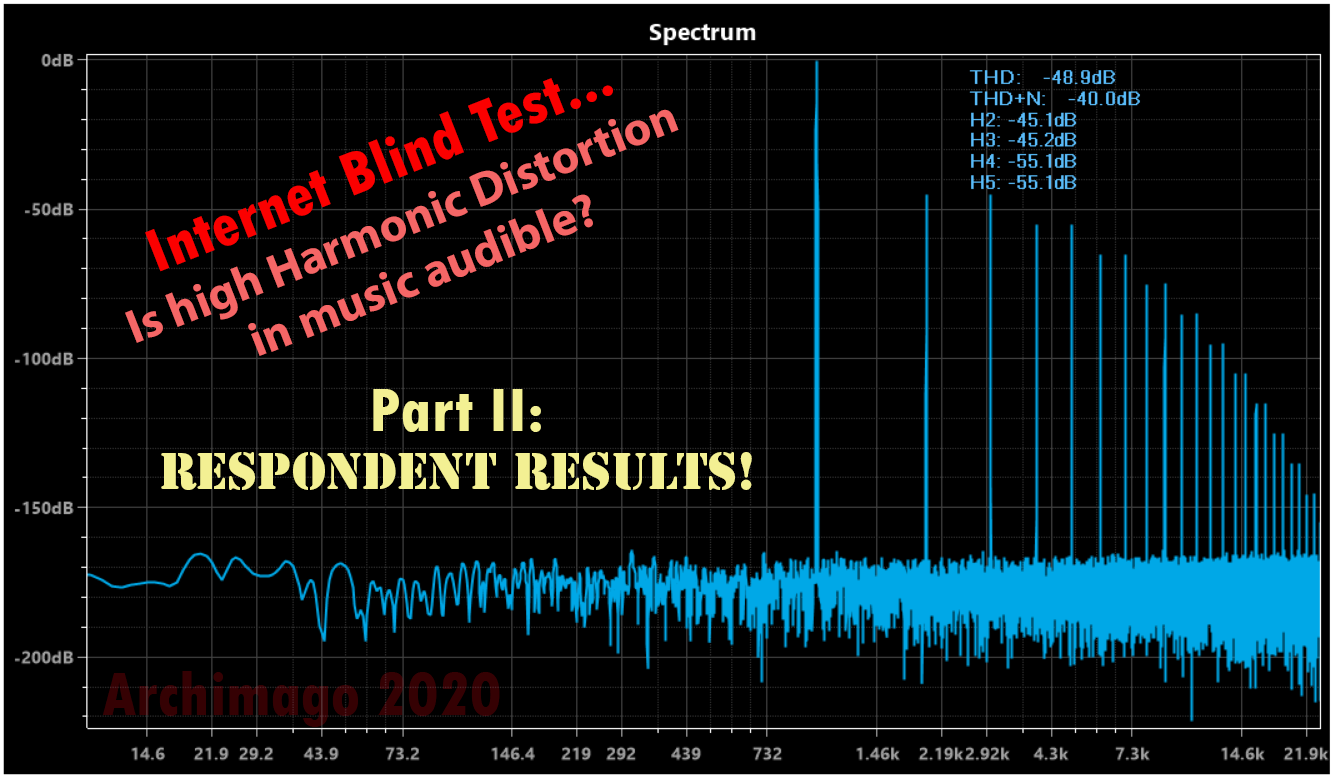
BLIND TEST RESULTS Part II: "Is high Harmonic Distortion in music audible?" Respondent Results


Having described the study and procedure last week in Part I for this most recent online blind test, let's continue by looking into the results from the 67 unique respondents. For this post, we will focus on the "objective" results based on the data. As I have done in previous tests, in a follow-up post, we'll have a look at the "subjective" descriptions of what respondents perceived.

We'll start as usual with some context into the respondents' demographics, we'll then proceed to examine the sound systems used by the respondents, and from there, look at their blind listening submission results to see if harmonic distortion correlated with preferences around perceived "better" or "worse" sound quality...

Saturday, 30 May 2020

BLIND TEST RESULTS Part I: "Is high Harmonic Distortion in music audible?" Procedures & Settings


As you perhaps know, over the years, there have been a number of blind tests conducted here on the blog - "Does high bitrate MP3 sound different from lossess FLAC?", "Does 24-bit sound different from 16-bit?", "Audible difference between linear vs. minimum phase filter?", "Do digital audio players sound different playing 16/44 music?" - for a sampling over the last while...

The question this time being posed is whether harmonic distortions are audible in music, and if so, perhaps through this test, we might be able to get a sense of the level of audibility. Remember that this is a complex question... It's not just "YES" or "NO" because it can depend on the AMOUNT of distortion in question. Furthermore, we can look at ODD vs. EVEN distortions. There are also questions around HIGH vs. LOW order amounts contributing to audibility.

Saturday, 25 January 2020

INTERNET BLIND TEST: Is high Harmonic Distortion in music audible? (plus Pet Shop Boys' newest, HRA needs HDR)


Another year, another Internet Blind Test, my friends! For me, doing this is important because it keeps us honest. It's worth reading this article in Audioholics published recently for an overview of the complexity of perception. I believe it's essential that audiophiles have an opportunity to participate in exercises of perception which I hope can enlighten ourselves and in aggregate, enlighten each other.

It's good to capture naturalistic data of audiophiles "in the wild" on top of information we may read from the "ivory tower" of Academia and profit-motive driven claims from Industry. Arguably, this is some of the most useful data. We can for example quite easily measure amazing levels of performance these days from our devices, but if we never correlate this to audibility, the data says nothing about relevance to humans, which at the end of the day is the only intent of these devices!

If you remember, last year we did the "Do digital audio players sound different?" test (the results systematically discussed starting here). This time around, in late 2019, Paul K [aka pkane] (who also wrote DeltaWave) contacted me to try out the early builds of his new software called "Distort"; aptly named software that allows us to purposely introduce anomalies into audio data. Among a number of distortions one could introduce is the one we've all heard off - harmonic distortion.

Saturday, 25 May 2019

BLIND TEST Results Part 4: "Do digital audio players sound different playing 16/44.1 music?" - Subjective Comments. Final thoughts on blind testing and critiques.


As we close off discussions and posts around the Internet Blind Test of devices playing 16/44.1 music, I want to publish some of the subjective comments from respondents who undertook this test... Impressions in the respondents' own words about the test when they submitted their results to me.

Remember that these are subjective. Human perception, especially when differences are at the margins of our perception are of course tough to describe. And when we compound that with the limited utility of words to describe ephemeral experiences (even with codifying the terminology as was attempted years back), it's no surprise that meaning can often only be conveyed as impressions. It's great to see the respondents trying their best and in many instances, I certainly appreciate the impressive use of language to express the experiences. Let's have some fun with these!

Saturday, 18 May 2019

BLIND TEST Results Part 3: "Do digital audio players sound different playing 16/44.1 music?" - Listener Results.


Thanks for the patience everyone. We are now into Part 3 of the report on the Internet Blind Test on the audibility of 16/44.1 digital playback using various devices. In Part 1 we talked about the test procedure itself and unblinded the devices (ASRock Z77 Extreme4 motherboard, Apple iPhone 6, Oppo UDP-205 as ethernet DAC, and Sony SCD-CE775 playing a burned CD-R).

Last week in Part 2, we reviewed the objective measurements of the 4 devices. I hope the readership recognizes the importance of doing this to set the context of what we're looking at this time as we dive into the results from the blind test respondents. As with many things in life, it is only with having facts at our disposal first, then we can make comparisons and develop ideas based on this foundation of knowledge.

Saturday, 11 May 2019

BLIND TEST Results Part 2: "Do digital audio players sound different playing 16/44.1 music?" - Relative objective performance. [And a few words about "Legends"...]


Last week, I revealed the four CD-resolution / 16/44.1 playback devices I used for this blind test. (By the way, if you want to have a listen to the original 16/44.1 track excerpts used, I added a link as an addendum to the post last week.)

While I'm still doing some counting, calculations, and writing the summary of the data, I think it's best this week to start by having a better look at those devices and seeing what objective results tell us about them so we can hypothesize what we might find when we examine the blind test results.

While it may be controversial to some in the audiophile world, I think we should keep our minds open to the idea that science and technology for digital audio playback has already surpassed the human auditory system. As discussed years ago, the human perceptual and cognitive systems do not have infinite resolution. I'm of course not discounting that the ears and mind have excellent abilities when it comes to appreciating miniscule differences, yet I think we have to remain humble; even if we believe we have "golden ears". Also, even if we don't believe measurements capture everything, it's not unreasonable to accept that the vast majority of what is heard can already be quantified in terms of fidelity to the source. This is why I think we need to explore the objective performance first... Then we can see if the subjective preferences from the respondents line up with expectations. I think for many of the well-respected audio engineers that design our hi-fi gear, this sequence makes sense. Ensure that the measurements are decent first, then verify and tweak with subjective listening.

Over the years, I've measured most of these devices in the blind test separately with different ADCs. For this post, let's run each one through the RME ADI-2 Pro FS and compare objectively using the exact same "measuring stick". For completeness, here's what the measurement chains look like with each player/DAC:

Saturday, 4 May 2019

BLIND TEST Results Part 1: "Do digital audio players sound different playing 16/44.1 music?" - Devices Unblinded! (Plus unusual exuberance & bias in the media?)


Thanks everyone for taking the time and efforts in performing the blind test which we started back in late January!

I officially closed off my survey from submissions May 1st (I promised April 30th, but gave a few hours more for stragglers from different time zones). I trust the 3 months provided plenty of time for everyone who wanted to perform the test to do so. I'll leave the blind test samples available for download for now and will take the files down in the near future.

You can read about the reason I ran this blind test in the previous post, but in a nutshell it's because of this poll result which I think reflects general audiophile perceptions on the question:

Saturday, 26 January 2019

INTERNET BLIND TEST: Do digital audio players sound different? (Playing 16/44.1 music.)


The other day, I was surfing the usual audiophile haunting grounds and came across this poll question on the Steve Hoffman Hardware Forum started a year ago. It reads: "Do You (Think) That Different CD Players Have Their Own Sonic Signature?"

Here are the results when I looked recently. I know it was closed last year, but it looks like it might be re-opened and still running into April if you want to cast a vote:


I thought it's worth spending some time to discuss this very simple question which of course is both understandable and asked frequently among newbies and longtime audiophiles alike. It's an important, and "core" question which can still be highly contentious after all these years! As suggested by the "blind test" title, by the end of this post, I will give you dear readers an opportunity to "cast your vote" and tell me what you think with a poll of our own using test samples to try (if you dare)!

 Let's make this our winter/spring research project...

Saturday, 7 October 2017

MQA Core vs. Hi-Res Blind Test Part IV: Subjective Results & The Wrap Up...


After having gone through the "core" results and subgroup analysis from the MQA Core vs. Hi-Res PCM Blind Test, let's review and post some subjective comments gathered in the survey. This provides an opportunity for us to see how people described what they heard and since we know what the preferences were, put them in the context of whether the descriptions referred to a bias towards the MQA decode or standard PCM...