Showing posts with label Multichannel audio. Show all posts

Friday, 17 July 2026

SUMMER MUSINGS: True audiophile aspirations; recent events in the audiophile culture - end of Atkinson's Stereophile measurements, YouTube influencer legal drama.

Through my years as an audiophile, I've come across articles in magazines and online talking about hobbyist "aspirations". At audio shows, and seemingly each new issue of magazine we read, we're introduced to the latest and greatest piece or gear, the next "must have" item to consider in this never-ending path of upgrade to satisfy luxury consumeristic appetites.

Given that it's "Summer Musings" season, let's take some time to think about what I think is the most important aspirational item in all of the audiophile hobby - your room. And since in the last month there have been other events happening in audio news, let's also talk about the fact that John Atkinson has retired from doing measurements for Stereophile magazine, and the interesting legal drama around the case of an "influencer" (Michael Gefteas/The Greek Audio Geek) and social media.

Saturday, 7 March 2026

Inexpensive USB2.0 Digital-to-Digital Converters (DDC) Pt.1: Douk Audio U2 PRO (Upgrade Version) and SMSL PO100 PRO - initial look, about I²S-HDMI. In praise of unofficial Atmos mixes!


This SMSL unit also does MQA decoding for those who want the feature. Unlike the Douk, this box only has an LED to indicate MQA decoding status but does not tell us the PCM or DSD samplerate.

While I've tested some inexpensive devices (like the Topping D10s DAC) which have the ability to convert USB 2.0 input into S/PDIF output, I have not specifically looked into these Digital-to-Digital Converter boxes which some audiophile reviewers (like this fellow, and this) seem to rave about.

For me, there just hasn't been any reason to be particularly interested since other than conversion from one interface type to another, the other promise of such devices - the reclocking capability - just hasn't been of great interest to me. As far as I can tell from listening, it's not like jitter has ever really been much of an issue unless severely bad for any decent modern device I've ever come across even at low price points (nor was jitter really an issue even with old CD players)!

However, since I have not tested I²S/I2S/IIS, I figure I'd buy both the Douk Audio U2 PRO 2025 upgrade version (US$63; Amazon Canada) and SMSL PO100 PRO (US$74; Amazon Canada) boxes to try out; have a listen and run some measurements. Unfortunately due to time limits, I'm not quite ready to show the measurements yet, so keep an eye out for those results, perhaps next week! For now let's just introduce you to these devices and talk about the I²S-HDMI connection.

As typical of the majority of my reviews/critiques, I bought these through retail channels.

Saturday, 27 September 2025

Auro-3D "Auro-Matic": Preset and Strength settings and effects. (Brief look at Dolby Surround Upmixer and DTS Neural:X.)

A number of months back, I talked about the nVidia Shield TV Pro box and explored Auro-3D which is another technology for reproduction of immersive sound with height layers. As noted in that post, I've seen comments over time about the use of Auro-3D's "Auro-Matic" surround upmixing algorithm for music playback as being the preferred setting compared to Dolby Surround Upmixer [DSU], and DTS Neural:X being the other two common options in modern AV receivers. As a reminder, while Auro-3D could use object-oriented tools in production, it is delivered as channel-based playback rather than the hybrid channel/object systems like Dolby Atmos and DTS:X.

Having now owned my Integra DRX-8.4 for about a year and listening for myself, I concur that for 2.0 and 5.1 upmixing, I tend to prefer using Auro-Matic to expand the 3D image into the height and surround channels. For most music material, Auro's method is noticeably "fuller" in presentation without sounding harsh. It also has more options as we can see in the settings menu for Onkyo and Integra receivers that have this feature:

Saturday, 20 September 2025

QUICKIES: Black aluminum alloy footers. Equipment racks. Center channel in music. Underwhelming Spotify Lossless. More Paul McGowan/PS Audio USB cable & jitter foolishness.


Hey guys and gals, not much time this week to test stuff but to start I thought I'd show some pictures of the black version of the inexpensive aluminum footers that were discussed last week.

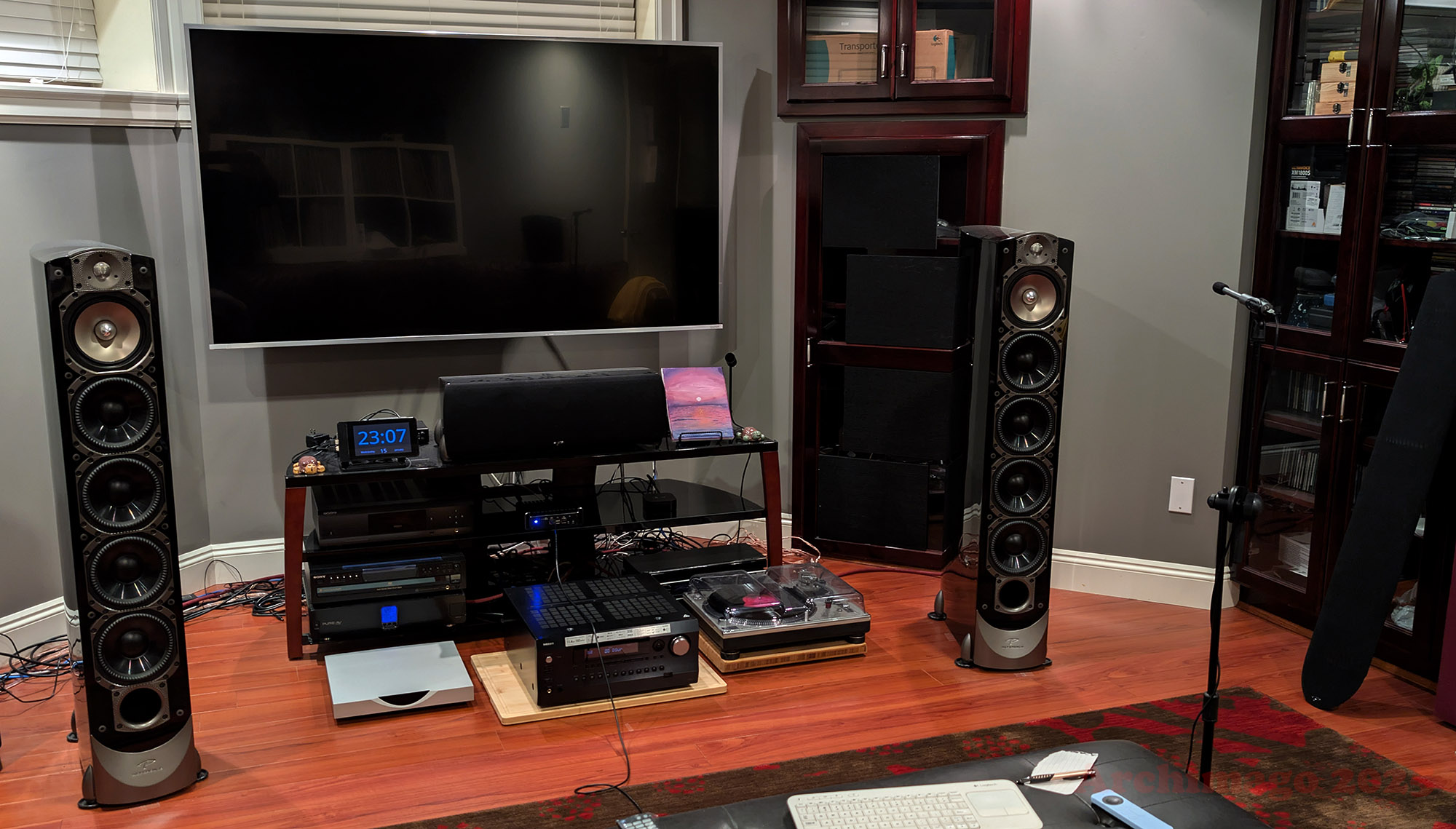
I got these black-colored ones (AliExpress) for my center channel, the Paradigm Signature C3 v.3 which is a 3-way, 4 speaker design that sits on my wood/glass component rack. (You can see other pictures of that component stand in my room article, or earlier when setting up the room.)

I picked the black ones since the center channel is sitting straight in front of me when watching movies, keeping it black will not add any color contrast to potentially distract from the show.

Monday, 18 August 2025

SUMMER MUSINGS: Who/What is an "Audiophool"? (And old quad album mixes.)

Hey guys and gals. This week, I thought it'd be fun to just talk about something that was brought up over at the Audiophile Style forums in this thread "Who or What Is An Audiophool?". Seeing that there were a number of comments already, I figured why not jump in over the past week and engage?

Doing this brought back memories of the early 2010's when I would spend more time on the forums to chat with fellow audiophiles. As you can imagine, over time with work, family life, having fewer questions to ask as I progressed through the hobby, and turning to writing articles here, my time on the forums have significantly been reduced. I'll still pop in once awhile but not like in the early 2010's to read and participate.

So this past week, as you can see from Page 6 of the thread onwards, it was fun to get back into the weeds a bit and liberally engage. Over many pages, we got into quite a few topics including ideas around blind testing, importance (or not depending on whose opinion) of objective measurements, anecdotes, human behaviors, the role reviewers play in the Industry, examples of bizarre pseudo-science, why we enjoy audio as a hobby, JG Holt's interview from 2007, personal values, anti-vaxxers, agreeing to disagree, ASR, website traffic numbers, quotes from Richard Feynman, what is knowledge, etc.

Saturday, 26 July 2025

Dolby Atmos Visualization: Elton John's "Rocket Man (I Think It's Going To Be A Long, Long Time)". [And Deadmau5 & The Neptunes' "Pomegranate".]

Still image from the official "Rocket Man" video.

For those who have attended multichannel demos over the years, you've probably come across Elton John's "Rocket Man" as a good track to listen to especially if it's the first time experiencing Atmos. 

[Other multichannel demo tracks you'll run into may include Pink Floyd material from Dark Side, Miles Davis' Kind Of Blue, Roger Waters' Amused To Death, Beatles Abbey Road, even Madonna's Immaculate Collection all are pretty cool.]

You might be surprised to learn that this track was remixed by Greg Penny in 2013. Recall that Atmos was first shown in theaters in 2012 with the Disney-Pixar movie Brave. So even though we typically associate multichannel audio and Atmos with movies, realize that music mixing in this format should not be seen as an after-thought that came many years later! Of course, we've had many multichannel music releases since the early 2000's on SACD and DVD-A but without the height dimension, potentially with audio objects, available now in Atmos, DTS-X, Sony 360 RealityAudio (MPEG-H 3D Audio) and Auro-3D content.

Saturday, 19 July 2025

SUMMER MUSINGS: Multichannel and the audiophile - recent articles and thoughts, 2025 update.

Preamble: In this article, I'll clearly be supportive of multichannel/Atmos music playback for audiophiles. This in no way should be seen as disparaging to those who feel that 2-channel stereo is completely adequate if not optimal for their listening! Simplicity, space considerations, availability of content, budgetary factors, perceived artistic intent, subjective preferences always play into the personal choices we make.

After 25 years of collecting multichannel content since the early days of DVD(-A) and SACD, currently about 15% of the albums on my music server are 3.0+ multichannel. With hopes that this continues to grow, of course!

Every once awhile I'll look over some of the posts I've made over the years to see if there's anything substantial I might revise or provide an addendum for. Most of the time, it's just for historical review to consider my thoughts back then, but sometimes, I'm encouraged to see how nicely things have changed over the ensuing years. Such has been the case for multichannel audio, so I thought I'd make this post as a review and pointer to the topic of multichannel music as an audiophile.

The first time I wrote a post titled "multichannel and the audiophile" was back in 2019, also during the summer - "SUMMER MUSINGS: Multichannel and the audiophile. MCh streaming with a TV Box. And Thoughts on the Future..."

As you know, things have changed since then with the advent of "Spatial" streaming thanks initially to Apple Music's push into the territory, the "chicken or egg" concern I discussed around not having enough multichannel music content has been addressed very nicely. As expected in that 2019 post, streaming came in the form of lossy EAC3 compressed audio. While we didn't quite get the 1+Mbps 7.1 data rate I was thinking about, EAC3-JOC Atmos with 5.1 bed channels at 768kbps is still high bitrate for audio and an excellent-sounding standard that's hard to fault. In my own testing, this bitrate has generally been "perceptually transparent" compared to an equivalent lossless TrueHD-Atmos encode using Dolby's reference Media Encoder (recent version 3.7). I'm sure there are some edge-case killer samples where TrueHD would audibly beat EAC3 (similar to killer samples like jangling keys with higher frequency details or detailed hand claps used in lossy compression testing), but I believe differences would be hard to spot even in volume-controlled blind listening side-by-side with actual music!

Of course, if you have access to the lossless TrueHD-Atmos Blu-ray or download, go grab that over the EAC3 version as a more accurate representation of the intended Atmos presentation potentially with higher number of bed channels like 7.1. I just don't think we need to get neurotic over the high bitrate lossy vs. lossless divide.

Tuesday, 1 July 2025

SUMMER MUSINGS: Paired speaker testing, more crossover thoughts, running tests ourselves and for ALL speaker reviews!

Paradigm Signature S8 v.3 speakers with grilles off. miniDSP UMIK-1 microphone for some simple testing with Room EQ Wizard (REW).

Well it's summertime which means (hopefully) a bit more opportunity to enjoy the nice weather around here in Vancouver with the family, more time to listen to music, maybe a little trip out of town on weekends.

As for my audiophile interests, it also gives me time to think about the broad topics and maybe run a little bit of testing here and there. Often these summer articles flesh out ideas and results covered over the last few months I may have left aside or on the "cutting floor" when writing.

This post will be along those lines in that these results were actually captured back in the January-February 2025 timeframe when I was doing the ferrofluid replacement for my tweeters, and then subsequent discussions about "audiophile" crossover parts and addressing beliefs of people like GR-Research/Danny Richie.

Since I grabbed these measurements and pictures when I was considering the importance (or not) of crossover part affecting sound quality, I thought I'd post them with some further summertime-meandering and related discussions.

Saturday, 14 June 2025

Follow-up: Topping DX9 DAC tests. And reduction in the ability to comment on the Stereophile website.

Topping DX9 DAC sitting on Linn Klimax DS/2 which we'll talk about another time.

Hey guys and gals, thanks for the comments and feedback over the years on this blog. It really helps to refine the testing and of course explore broader ideas about audiophilia and what it is we're after in this hobby. I think it's important that we're free to discuss and critique not just the hardware, but also the ideas (including the philosophy and psychology) that "we" as individuals believe in. There's so much unsubstantiated audiophile cultural beliefs out there based on myths such that everything should be up for examination regardless of who says what. It's not unusual to find that audiophile review "high priests" are wrong, and some "heroes" of the audiophile world are nothing more than false prophets.

It's also good to get feedback suggestions on the published measurements, for example in the recent series on the Topping DX9 flagship DAC (based on rare AKM AK4499EQ chip), Nick in the Part III comments suggested that I consider this:

"Hi Archi,

Prior to version 5.40.78 beta rew had a gross error in IMD vs Level plotting, the results were underestimated by about 12 dB. It looks like the version you used has this error.

IMHO there are not enough performance measurements at high frequencies for a complete picture. If still available, it would be very interesting to see THD (without noise) vs frequency performance, accurate THD measurement at 10kHz and wideband fft (without weighting) with a weak signal such as the signal for the DR test.

Thanks!"

Excellent feedback and suggestions Nick, let's focus on checking this out in this post!

Saturday, 7 June 2025

Roon in 2025, 10 years on: Sound quality, thoughts, and suggestions. And an increasingly AI-generated Internet.

Notice it has been "10 Years" for Roon as per the top left.
Roon 1.0 was released May 2015.

Obviously, it's impossible to get on all the discussion forum about the myriad subtopics in this audiophile hobby. However, I do get newsletters in my inbox and I see frequently asked questions that inspire many of the topics addressed here.

If we've come across each other on the audio forums (places like Steve Hoffman's site, or Audiophile Style), you'll notice that I often will respond with links to articles on this blog. I've posted more than 600 long-form articles already, the vast majority digging pretty deep into the audio topic. One of my intentions over the years is for this to be a repository of information, articles I can use as "landmarks" when I engage in discussions with fellow audiophiles; how I understand the hobby including big-picture philosophy, psychology, the debates. Contained within these pages are the thoughts, character, understandings of "Archimago the anonymous audiophile from the early 21st Century" with contributions from guest posters. Familiarity with these articles I think will provide a good starting point for "rational audiophiles", without necessarily going too deeply into technical details.

Apart from discussing individual products, broadly, I think we've covered many of the usual issues raised in audio circles already, much of it analyzed with data to seek out the facts, rather than mere opinions. Feel free on the main page of this blog to use the "Search This Blog" widget as I suspect you'll find articles addressing many questions.

So, coming back to a frequently asked question, for this post, let's think about Roon software in 2025 (currently version 2.51 build 1534). In a recent Roon forum newsletter, I saw this question posed by Eric_Pell:
"I am wondering for years why the most expensive app in the world of hifi and high end only has a sound quality which is only ok. If you compare Roon with JPLAY i think JPLAY has only a few people to develope (sic) software and improve sound quality. But here the difference. What is Roon doing to improve sound quality and do they compare with JPLAY or not?"

Tuesday, 1 April 2025

Multichannel/Atmos 3D Audio Walkthrough. The idea that DACs sound about the same. Countercultural & honest audiophiles?

Hey audiophiles, I've been wanting to do this for awhile now. Back in 2021 when I wrote about "Spatial Audio" music streaming on Apple Music, in the back of my mind I was thinking it would be pretty cool to not just listen to the music and consider whether this kind of content is worthy of audiophile exploration, but to actually fire up a DAW (digital audio workstation) and play around with Dolby Atmos myself to create a little something that I can also use as a demo or to help with set-up in my own room.

Nothing too fancy of course since the intent is to demo spatial capability rather than wow the listener with overly complex sounds or movements. It's also a fun way for me to learn how to use the software and to go a bit deeper into 3D audio - beyond just expressing opinions on the consumption side.

So, over the Spring Break with a little more time available, I bought a copy of DaVinci Resolve Studio 19 (currently US$300) and got to work on figuring out how to author some 3D audio content. The price is very reasonable for such a powerful piece of software which I plan to use in other audio/video projects. Other packages that allow Atmos audio mastering include Avid's ProTools, Steinberg's Nuendo and Cubase, Ableton Live, Apple's Logic Pro and Final Cut Pro.

Once I figured out how the Fairlight "audio console" module in DaVinci Resolve worked and got the immersive pieces authored, a friend who works in audio professionally helped with the Dolby Media Encoder (US$400/year subscription) side to bring the track over to Dolby Digital Plus / EAC3-JOC, TrueHD-Atmos, and AC-4 IMS.

Saturday, 1 March 2025

HDMI Musings: high speed cables, data rates, YCbCr color subsampling, Dolby Vision MEL/FEL, optical cables and +5V injection.

Hey folks, for this post, I thought it would be good to dive a little more into the world of AV technologies after discussing the nVidia Shield TV Pro last week. While "classic" audiophile technology (ie. standard hi-fi analog and digital 2-channel stereo without special DSP advancements) has matured nicely already, this isn't quite the case with modern digital video tech. While many (probably most) features have settled, we can see ongoing evolution of the High-Definition Multimedia Interface (HDMI) standard to be mindful of - for example the recent announcement of HDMI 2.2 at CES2025 expanding capabilities well beyond the needs of today.

As usual, it'll take time (years) for this standard to be incorporated into TVs and source devices like GPUs (latest nVidia RTX 5080/5090 are HDMI 2.1b) or something like VR devices being at the forefront of potential generational gains. For more than 20 years, with each significant revision of the HDMI standard, we're seeing doubling of data speed with HDMI 2.2 now aiming at just shy of 100 gigabits-per-second (96Gbps), twice of the 48Gbps bit rate in current HDMI 2.1 products.

This recent update makes HDMI the fastest of all currently-announced consumer Audio-Video connection standards, the one wire that basically does it all - hi-res video (with high dynamic and frame rate), hi-res audio (up to 32 PCM channels at 24/192, with DSD to 8-channel of DSD256), HDCP copy protection, audio return channel, even ethernet (100Mbps).

This level of sophistication (and licensing costs) could make it difficult for small companies with limited R&D capabilities to get in the game with custom designs. This is probably in part why the cottage industry audiophile companies rarely use HDMI other than selling overprices cables (like AudioQuest). Plus frankly, basic 2-channel audio doesn't need the higher technical capabilities anyway (which is basically what Paul McGowan says).

Let's run through a few thoughts about HDMI that might be good to know as general knowledge as tech enthusiasts. I'll provide a few links of interest, touch on tech stuff like color spaces and subsampling, and things you might want to try if you're running longer high-speed HDMI connections and potentially noticing issues.

Saturday, 22 February 2025

nVidia Shield TV Pro (2019 version), still relevant in 2025! A listen to Auro-3D & Auro-Matic Upsampler.

Hey guys, I thought it would be fun to talk about something that's been around quite awhile already but which I still bought in 2025. As per the image above, it's the nVidia Shield TV Pro (US$200, CAD$260). For years, I've been using the Apple TV 4K (2nd Gen, 2021) which is a fine unit with all the bells and UI whistles of the Apple ecosystem. But it is missing something that "serious" movie audio lovers - and even audiophile music lovers - might want; lossless audio bit-streaming for Dolby TrueHD/Atmos and DTS/HDMA/X.

That's right, sadly, after all these years, Apple doesn't care to update the AppleTV to support basic bit-streamed audio. 😢

Note that I don't necessarily blame them as a company, they make no money off local libraries of UHD/BluRay-ripped content. So if I were running the business, I'd also think twice about getting developers to support a feature that at this time in history they will make no streaming subscription revenue from. Streaming services - Apple TV, Apple Music, Netflix, Prime Video - all do not send lossless multichannel audio content, opting typically for lossy Dolby EAC3 with or without Atmos. Not supporting much beyond the basic feature set is nothing new with Apple as part of their KISS closed ecosystem mentality. (The only lossless multichannel I've come across are the few albums on Qobuz.)

Since 2021, without lossless bit-streaming to the receiver, I've been using Infuse PRO on the Apple TV which will decode Dolby TrueHD and DTS-HD Master Audio to multichannel PCM. Doing this removes the embedded Atmos or DTS:X height effects (can turn on Dolby Surround Upmixer or DTS Neural X to extract some content back). At least lossy EAC3-Atmos is sent directly to the receiver.

Therefore in 2025, the only other mainstream choice is still the Shield TV, a device that seems to be catered more to the home-theater enthusiast with lossless audio - thanks nVidia.

Saturday, 18 January 2025

As We Hear It: Audiophile hype vs. reality? GPU chatter (nVidia Blackwell RTX 50XX-series), thoughts on AI frame-generation ("fake frames"), gaming, and art as imagination.


I hope you're all doing well as we enter the year. It's rather amazing that the first quarter of the 21st Century has passed so quickly! Time flew. I do hope that as time passes, audiophiles worldwide are gradually becoming more knowledgeable about the science behind this stuff and in general much more critical thinkers, more resilient to the snake oil and scams of yesteryear. I simply think that this is part of the evolution that must happen for any hobby in order to not stagnate. If something is contentious or seems "too good to be true" based on conventional knowledge as we all become versed in how audio reproduction works, the product very well could be something to avoid; instead, better to save money and look for something more meaningful to purchase.

As per my usual routine, every once awhile I'll publish an E-mail or two from readers of the blog and take time to discuss matters brought up that might not have been fully covered previously, often hitting other short discussion items that don't need a full-length post.

Let's have a look at this E-mail from Michael in Sweden:

Saturday, 11 January 2025

Dirac Live 3 with Bass Control (DLBC): A look and listen with the Integra DRX-8.4.

I talked about the use of Dirac Live 3 in late 2024 after upgrading my receiver to the Integra DRX-8.4 which integrates the full-bandwidth DSP room correction as part of its feature set. Many modern multichannel receivers these days have Dirac as a feature included like the Onkyo TX-RZ70 or Pioneer Elite VSX-LX805 (both offering 11-channels amplification like the Integra). I have to say that I love this Integra unit with all its multichannel bells and whistles - not to mention great sound as well, of course.

I mentioned in the previous article that Dirac Live Bass Control (DLBC) is available as an upgrade for US$299 which activates the license on your account when you run the Dirac Live Room Correction Suite, unlocking the "Bass Control" module.

So, let's activate that and get into this with a look and listen to what DLBC brings to my set-up and of course some results in my room. (For reference, here is the official DLBC manual, and Dirac's Frans Rosencrantz's 2020 article "Bass Control, Where Did My Bass Go?".)

Saturday, 16 November 2024

Dirac Live 3: A look & listen with the Integra DRX-8.4 - the process, microphone placement suggestion, tweaking, and multichannel/Atmos results.

As discussed years ago with my sound room set-up, I believe room correction DSP is very important and has become part of my routine whenever I make significant changes in room layout or when I incorporate new equipment. I would argue that an audiophile who has not seriously spent time trying this likely has not heard the best sound in their room from their system. Simply put, you'll notice a level of control and audible difference way more than just swapping hi-fi DACs, amps, etc. hardware.

With the arrival of the Integra DRX-8.4 receiver recently, I started using the included Dirac Live Full Bandwidth license embedded in the hardware. As I had done in the recent past with Acourate and Audiolense XO, let's dive into the steps I used to get Dirac running and the results I achieved. Hopefully this discussion could be useful for those of you thinking of trying out Dirac.

I'll document the steps I followed, issues I ran into, and tips to overcome problems.

Saturday, 28 September 2024

The Dolby Atmos Music Target Curve. And on being an audiophile "tonmeister".

[For the post this week, let's take a pause from the Pacific Audio Fest 2024 discussions (last 2 weeks). Next week we'll have a Part III discussion about audio shows.]

Standardization is generally good.

I've discussed in previous posts that Dolby Atmos defines loudness characteristics for recordings and this has helped preserve dynamic range in multichannel/Atmos albums following their guidelines. Likewise, we can benefit from standardization of the frequency response as this will allow us to better "translate" the sound from the studio into our sound rooms. This idea is not new for audiophiles. The ill-fated (with good reason) MQA promised that we could experience the "sound of the studio", but they never could deliver in a large part because there was never any standardization for essential parameters like the frequency response, among other failings. In the same way, back in the day (~2014), this was the promise of hi-res audio by Neil Young and Pono that you would somehow get the "finest digital copy" and this would represent the sound the artists intended from the studio; clearly they overpromised and under-delivered by 2015.

It's one thing to standardize between the studio and home ("inter-system") playback, but it's also important to standardize "intra-system" - that is, between all the speakers in your set-up when you're doing multichannel such that each speaker is calibrated to the same timbre. This is important in a multichannel layout since we do not want "objects" moving through space changing tonality because of mismatch between speakers around the listener. The Dolby Atmos Music Target Curve is Dolby's recommendation for the music studio frequency response. This curve evolved from the X-Curve, an 'X'perimental frequency response based on some early empirical work exploring the performance of actual theater sound systems starting in the 1970's, and evolved over the years. See this paper for more details, note some similarity of the Dolby Atmos Music Target Curve to the SMPTE 202M - 1998 X-Curve.

As with all things in audio, nothing wrong with asking whether this curve is the "best". 🤔

Sunday, 7 July 2024

Seating variations, multi-seat correction & multichannel DRC. The audio "sweet spot".

A look at the rear of my room and the sofa seating - surround speakers, LP rack for a little bit of diffusion room treatment. For best practice, it's important to not sit too close to the back wall. I have 3' between the couch and the LP rack, and the rack is about 17" deep before that back wall. 

Before putting the UMIK-1 microphone away after using Audiolense XO as discussed last time, I thought it would be interesting to explore in greater detail what happens with frequency response and time-domain performance as we sit off the "sweet spot" where the measurements were collected and correction calculated for.

In the image above, I've put a meter stick on my listening couch to identify the seating positions 1 and 2-feet to the right and left of that sweet spot so I can take detailed measurements of what happens to the sound coming from the 5 main speakers at those positions with and without DSP turned on.

Saturday, 29 June 2024

Multichannel Digital Room Correction with Audiolense XO. And "What's your budget?".

As you might recall from over the years, I strongly believe that one of the most important things one should try as an audiophile seeking high-fidelity - after having a decent sound room, and getting good equipment - is to consider the use of room correction. It could be as simple as frequency-domain EQ correction for larger bumps and dips (as discussed with the Behringer DEQ2496 hardware back in 2013-2014, device measurements here), or the much more sophisticated frequency and time-alignment of filters created by software like AudioVero's Acourate (and 2019 update) capable of much higher resolutions.

The power that one has to optimize and customize the sound runs well beyond most hardware upgrades other than wholesale speaker replacements and changing sound room! The change one can expect with room correction dialed in is astronomical compared to all the snake oil tweaks, cables, hi-res DAC/streamers, even amplifiers you might want to throw at your system.

These days, I've increasingly been converting multichannel content over to my Roon server, typically 5.1 SACDs and DVD-As but also Bluray rips, ideally lossless TrueHD with 7.1 channels. Unfortunately, Roon is currently unable to decode codecs like EAC3-JOC (lossy multichannel/Atmos) or TrueHD (lossless, based on the MLP codec) so the content typically gets transcoded to multichannel FLAC-compressed PCM which can handle up to 7.1.  

Although Acourate can be used for multichannel filter creation, the manual procedure here is unfortunately quite involved and more than most audiophiles would like to get their hands dirty with! Which is why today's post is going to be about multichannel digital room correction using Juice HiFi's Audiolense XO (€390, currently version 6.21). I see that there is the less expensive Audiolense Surround which I suspect could be enough for many users, and if all you need is 2-channel stereo, there's Audiolense 2.0.

Saturday, 8 June 2024

The E1DA Cosmos Stack: ADCiso and 2 APUs. An example of bad multichannel - Neil Young's 'Harvest' on DVD-A (2002), fixed in new Atmos mix.

E1DA Cosmos ADCiso Grade A center.
Cosmos ADC Prototype I've been using over the years to the left.

Readers here probably are aware that over the last few years, I've been using the E1DA line of devices, the Cosmos ADC, APU, and Scaler typically paired with PC-based software like Room EQ Wizard for most of my measurements, especially for the highest fidelity products like DACs. As a hobbyist exploring objective performance, there's obviously no need to spend thousands of dollars on devices like the Audio Precision (here's a peek inside the APx555B top-of-the-line model, around US$30k). Not enough return on investment unless one is doing professional product design and testing.

As usual, over time things evolve around here and since I needed an extra ADC for work-related purposes, I bought one of the newer E1DA Cosmos ADCiso Grade A to replace the prototype that Ivan sent me back in 2021 which I will repurpose elsewhere.

This post is mainly an update and comparison, refer to the original article on the Cosmos ADC for more details.