Showing posts with label MiniPC. Show all posts

Saturday, 10 February 2024

REVIEW: HUNSN [CWWK] RJ36 Fanless MiniPC - Intel i3-N305 (12th Gen "Alder Lake-N", 8C/8T, 32EU iGPU). And comparison with the Raspberry Pi 5.

Another year, another upgrade to the sound room MiniPC! 😁 Honestly, for audio streaming purposes, I could easily just use the very low power MeLE Quieter2Q as a Roon endpoint with multichannel capability discussed in 2022. As usual, "Bits Are Bits" so this upgrade is not about sound quality, just fanlessness, and higher processing speed on tap.

Recently, I saw this interesting article for an Intel i3-N305 MiniPC and thought it might be fun to try a fanless low-power but reasonably fast machine. The i3-N305 CPU consists of 8 Intel 10nm 12th Generation Efficient-cores (E-cores) with a 32 Execution Units (EU) iGPU; significantly faster than the last miniPC I reviewed which was the Beelink EQ12 with Intel N100 CPU - 4-core, 24EU.

So to give this a try, I bought the HUNSN RJ36 off Amazon, standard retail "barebones" unit since I figure I could buy the DDR5 RAM and M.2 SSD drive myself. Current price about US$375 before RAM and SSD.

The OEM company who makes these computers is CWWK. Similar computers can be found with the Topton brand name. There's no logo or name on the box itself which to me is fine - brand names are not important to me for many tech products so long as performance, build quality and reliability (which can only be determined over time) are adequate.

Saturday, 10 June 2023

Beelink EQ12: Low power Intel N100-based Roon endpoint and Kodi 4K/HDR/60fps player, general Windows 11 computer. A few words on HDR10(+), Dolby Vision, AV1, and Kodi. And hilarious Transparent $$$ cables.

Beelink EQ12 MiniPC, some testing with the RME ADI-2 Pro FS R Black Edition.

Since around 2004, I've been using various computer systems for music playback, initially starting with ripped files on PCs and then quickly transitioning to server-endpoint "distributed" playback by something like 2006/2007 when I bought my first Slim Devices Squeezebox 3. I've never really looked back since, as this is IMO the superior way to manage music with a central home server repository and distributing the music around the home. It has been more than a decade since I've cared to use a CD transport other than to rip music and there's no reason why CDs would sound better anyways ("bit perfect" and all that).

Of course back in the day, especially prior to 2010, putting a computer in the sound room was likely going to be fraught with noise issues. In the 2nd decade of the 21st Century now, with much lower CPU/memory/motherboard power demands while capable of excellent speed, silent SSD drives, and small form factor MiniPCs, it's actually rather trivial these days to maintain cool and quiet, unobtrusive computers that perform well as AV "appliances". These machines will not contribute to acoustic or electrical noise pollution in listening rooms even with low ambient noise levels provided the hobbyist approaches device selection and optimization with some basic care.

Today, let's convert that little Beelink EQ12 Intel N100-based computer (discussed/reviewed last time) into something I would use as a Windows audio streamer and movie player in my media room. Let's talk about some BIOS settings, Windows set-up suggestions to consider, and computational potential.

Saturday, 27 May 2023

REVIEW: Beelink EQ12 Mini Computer - Intel N100 CPU (12th Gen, 4C/4T, 24EU iGPU), 8GB DDR5, 500GB NVMe. And on journalistic objectivity, truthfulness and non-neutrality.

For more than a year now, since the MeLE Quieter2Q, I've transitioned media playback away from the Raspberry Pi system in my main sound room as I've explored options in the MiniPC world. This is the result of technological progress as x86/x64 processors have become significantly more energy-efficient, available in smaller packages, with increasing processing speed, access to the huge library of PC software, and capabilities including support for multichannel HDMI audio output and 4K video decoding.

Yes, we could easily build massive "He-Man" computers these days sucking hundreds of watts to power fast CPUs and modern discrete GPUs, even as "audiophile computers", I believe these are clearly inelegant solutions for AV playback or even as a media server.

Today, let's look at a new entry - the Beelink EQ12 (currently just around US$250-300 depending on deals, with 8GB of DDR5 RAM, 500GB NVMe storage as tested). This machine uses the latest 12th Generation 10nm "Alder Lake" quad-core Intel N100 low-power processor running at up to 3.4GHz turbo. With this new generation, Intel has moved away from names like "Celeron" and "Pentium". While the specs say TDP of 6W for the part, in real life the computer does suck up more power.

For audiophiles thinking of using HQPlayer, these new processors feature the AVX2 instruction set; opening the doors for using the new versions of that software under Windows again should you desire. For the record, this machine was purchased through the usual retail channels.

Let's have a look today at this hardware, and evaluate the speed compared to previous reviewed machines on this blog.

Saturday, 12 November 2022

Accurate Sound's Hang Loose Convolver Multichannel on low power Mini PC. The disgraceful AQVOX ethernet switch. And some E1DA upcoming evaluations.


Over the last few weeks, I've been using the inexpensive Beelink Mini S Intel Celeron N5095A PC in my music system. Recently, I posted on using it in Linux as a streamer with HQPlayer upsampling and for multichannel Roon capabilities. As you can see in that post, for audio purposes, even this level of CPU performance on a modern entry-level machine is enough for what would be advanced PCM upsampling (ie. 1M-taps realtime PCM) and even IMO very good PCM-to-DSD256 performance. More evidence to remind us that there's generally no need to get excited about some of the more expensive "audiophile" computers and streaming machines which are often embedded low-power computers at heart.

Recently, my friend Mitch Barnett of AccurateSound.ca wondered if I could look into the performance of his latest version of Hang Loose Convolver (HLC) with this low-power computer using my power limited and quiet fan BIOS settings. HLC is an advanced standalone, VST3 plug-in, or AU (Mac) plug-in that provides the ability for audio lovers to load in various convolution filters, allows for easy level matching, and provides basically immediate switching (0.1ms) between these filters for accurate A/B listening comparisons. Let's take a look at this on the Beelink.

Saturday, 22 October 2022

Using low-power Beelink Mini S as Linux Roon streamer - HQPlayer (PCM 8x, DSD256), and HDMI multichannel. (A superior DIY M-Scaler?)

No worries! Putting a little low-power computer like this on top of the DAC did not affect noise level from the Sabaj DAC RCA/XLR outputs. Don't do this with more powerful computers obviously...

As expressed previously, my philosophy around computer audio is that given the speed of progress in computing technology, it really makes no sense to be building expensive and very fast computers as audio playback/processing devices. For me, if I have a general computer in an audio room, I would want to keep electrical noise low (ie. low power) while also targeting an ideally fanless solution. Inevitably, in less than 10 years, a powerful computer today would be very much obsolete. Monster machines would more than likely end up at the bottom of your closet with little value or interest left even if one wanted to sell. In fact, unless I'm doing a lot of 3D graphics, gaming, or editing videos, IMO progressively smaller, quieter, lower-power (let's aim for 10W or less with excellent performance!), and less expensive machines are where progress is heading for consumer-level general computing.

This is in part why on this blog, I've expressed much more interested in streamer systems like the Raspberry Pi devices or recently silent or very quiet MiniPCs (like the power-limited Beelink Mini S last week). As time goes on, one can judge objectively if technological progress and software updates like new DSP algorithms represent improvements in sound quality. If there are truly gains to be had, the machine can then be repurposed/replaced without feeling that one has wasted hundreds if not thousands of dollars.

At the end of the article last week, I spoke about how I reduced the fan speed and lowered the Mini S power limit to basically "silent" performance. Today, let's consider further what we can do with a machine like that in the audiophile sound room.

Saturday, 15 October 2022

REVIEW: Beelink Mini S (Celeron N5095A 4C/4T CPU, 8GB DDR4 RAM, 256GB SSD) Mini-PC. (And E1DA Cosmos ADC follow-up: RIAA EQ & 768kHz.)


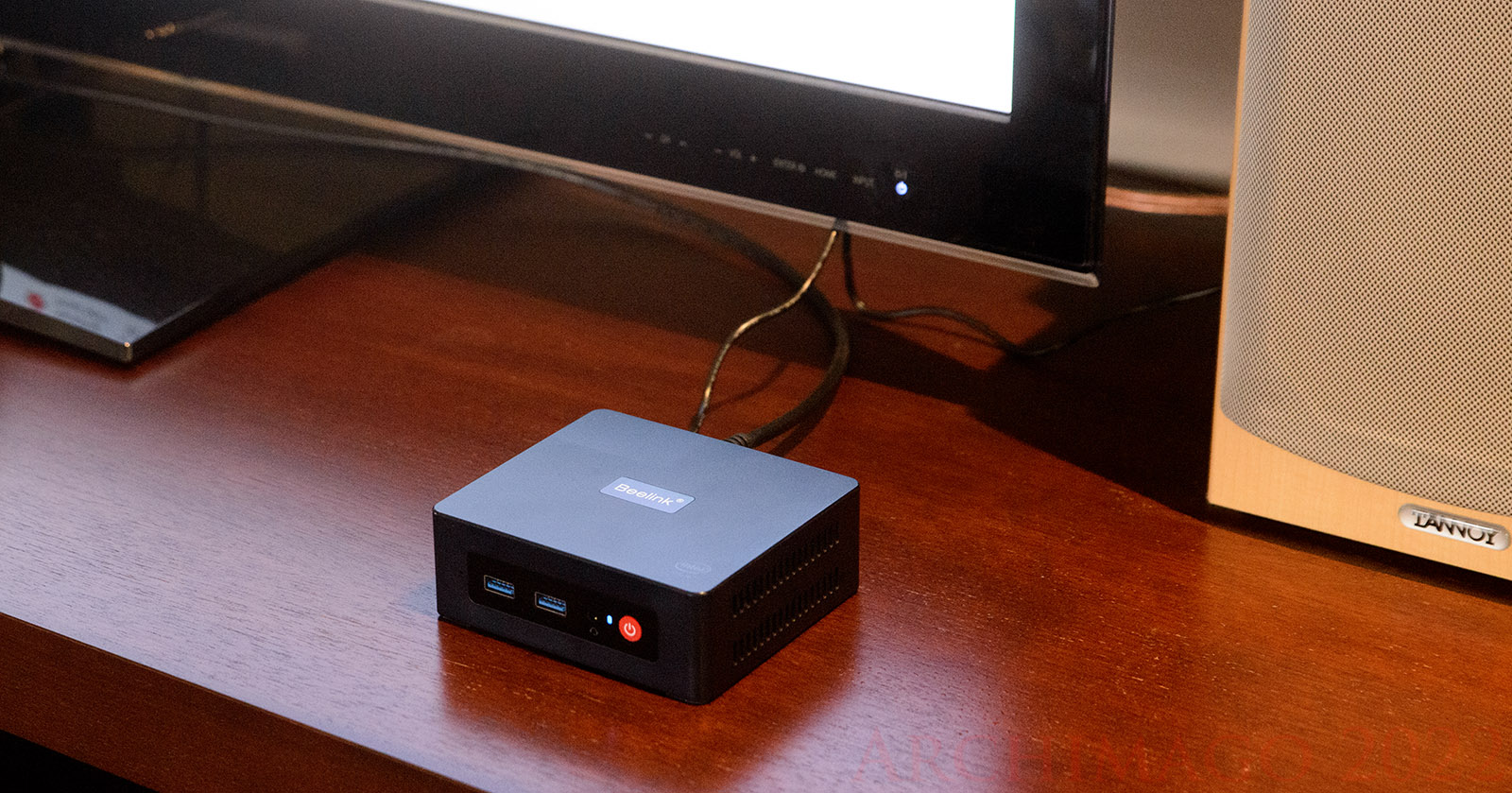
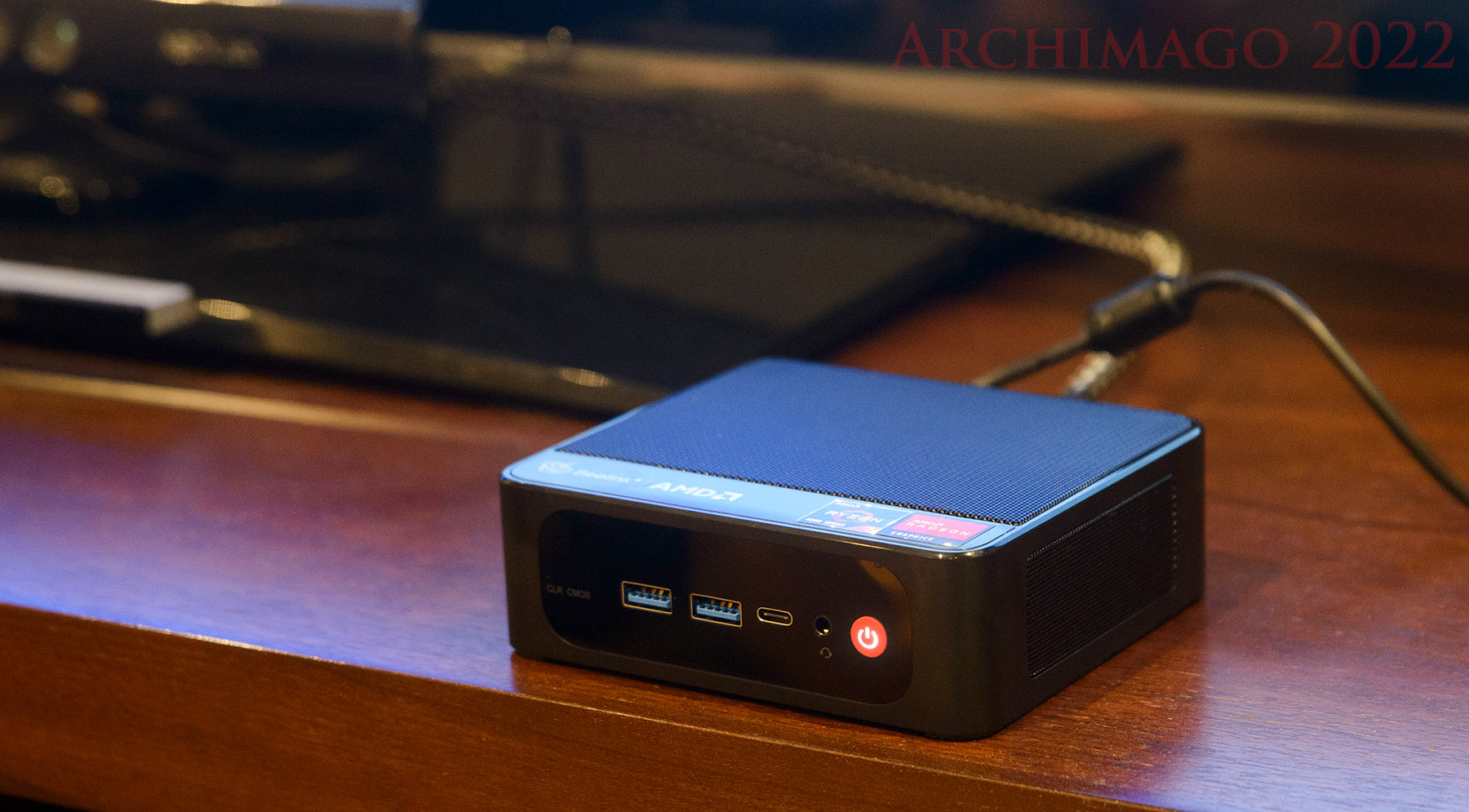
In the image above, we see the Beelink Mini S computer. I was sent this product from one of the distributors (thanks to MinixPC - see here for the current price) for an honest opinion in the context of the fact that over the last while, I had already explored the small MeLE Quieter2Q and Quieter3Q as well as the more powerful AMD-based Beelink SER4 Ryzen 7 machines. 

Now, unlike the MeLE Quieter machines, this one is not fanless, but it is indeed quiet and I suspect the fan noise will be no problem in the vast majority of settings. On balance however, what you get is a machine that is less expensive (you should be able to find one for around US$180 or better) and the active cooling will keep it cooler especially if you do end up placing it in more cramped environments. As usual, make sure there is still air flow of course!

Let's have a closer look at the item and performance...

Saturday, 16 July 2022

REVIEW: MeLE Quieter3Q (Celeron N5105, 8GB DDR4, 256GB eMMC) MiniPC: Fanless, 4K/HDR streaming. Getting closer! (Thoughts on Apple's M1 Mini as HTPC.)

Yeah, that's an old XBOX 360 Kinect camera back there! Hey, there are cool things you can do with this as a 3D scanner...

Greetings ladies and gents. In the posts for both the MeLE Quieter2Q post as well as just last week with the Beelink SER4 Ryzen 7 4700U computer review (BTW, I added an addendum - HDR10 works on that machine), I noticed questions, comments, and E-mails about utilization of these MiniPCs in the home theater setting; specifically video and HDR features.

Recently, I saw the availability of the MeLE Quieter3Q fanless MiniPC (currently around US$250) [in 2025, the updated model would be the MeLE Quieter4C with Intel N150 at the same price with more speed, RAM, storage]. With the various feature upgrades, I figure that this is one which might qualify as a reasonable HTPC computer given that it features HDR video capabilities and a bit more CPU processing power. As such, I decided to take it for a spin. I bought the slightly more expensive 256GB eMMC storage model; since I am targeting video playback, it might be nice to have some extra storage for local data.

Much of what I said about the Quieter2Q applies here, so let's focus on performance differences and discuss this machine as a video streamer beyond audio purposes...

Saturday, 9 July 2022

REVIEW: Beelink SER4 Ryzen 7 4700U (8C/8T) MiniPC - A small, quiet, fast, general "workhorse" PC... [Addendum: HDR works.]

These days, if we look around most homes, I think we'll see all kinds of computers used for different purposes in the rooms. I've talked about my main Workstation, the Server machine, even my Gaming rig a number of years back (much of that upgraded since). And a few months ago, we talked about the very low power fanless Celeron MeLE Quieter2Q which functions as a very stable stereo/multichannel streamer for Roon.

[BTW, there is an upgraded MeLE Quieter3Q now which is faster by ~30-40% featuring the Celeron N5105 processor for a few more dollars, but still no AVX2 if you're thinking about Windows HQPlayer as discussed here.]

Recently, I've been wanting to upgrade my 2016 Intel NUC 6i5SYH which in the last few years has been the heart of the audio measurements rig. Over time, as my measurement regimen has become more detailed, often using larger FFTs parameters, once awhile, I've started noticing that the old i5 CPU isn't keeping up with the processing needs and this shows up as glitches in the data such as when running multichannel REW "stepped sine" captures. Obviously, this will not do. ;-)

To remedy the situation, I got one of these Beelink SER4 Ryzen 7 4700U-based MiniPCs (8-core, 8-threads, currently less than US$450 for the 16GB RAM/512GB M.2 SSD model). There is also a more expensive SER4 with faster 4800U processor (8-core, 16-threads) if you need that extra speed.

This machine was purchased from standard retail channels; this review was not sponsored in any way.

Saturday, 26 February 2022

Using the MeLE Mini PC for Upsampling/Filtering - HQPlayer Desktop 4 streaming from Roon. [Going forward, AVX2 needed for HQPlayer + Roon... For some reason.]

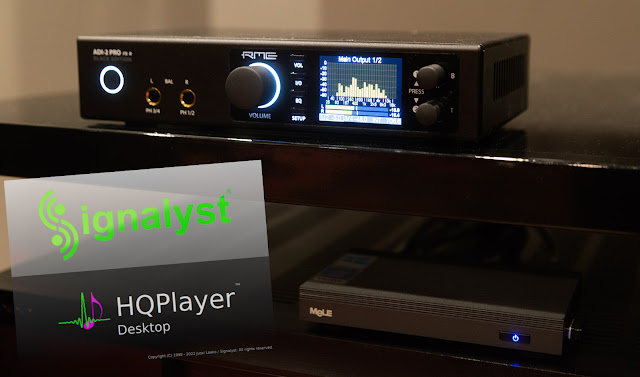
Hey folks, a few weeks ago, I mentioned that I've got the little MeLE Quieter2Q Windows 10/11 computer in my sound room these days used as a low-power (<10W) Roon streamer capable of 2.0 and 5.1 multichannel. The computer is relatively powerful for just an audio device handling Roon streams; 8GB DDR4 RAM, a 2.0+GHz turbo Celeron J4125 quad-core CPU is certainly much more than needed just to basically get data from the gigabit ethernet and shove it to USB or HDMI for playback!

It works fantastically also as a little fanless HTPC for movies with 4K video and audio bitstreaming. A tip: K-Lite Codec Pack works very well, it can even play MKV/MKA files with lossless TrueHD-Atmos like the 2019 Beatles Abbey Road BluRay rip which I know will trip up some HDMI hardware.

I mentioned in the previous article that it might be fun to consider utilizing the processing power of the little fanless box for audio. For many Roon users, one way of taking advantage of processing power is by using HQPlayer from Signalyst for high-quality upsampling with digital filtering, and possibly even PCM-to-DSD conversion. 

Saturday, 5 February 2022

MeLE Quieter2Q (8GB DDR4, 128GB eMMC, Celeron J4125) Mini PC: An inexpensive, silent, multichannel Roon Endpoint. On Paul McGowan (PS Audio): "digital audio is soooo noisy", and "computers are the worst". [+ Windows 11 Update]

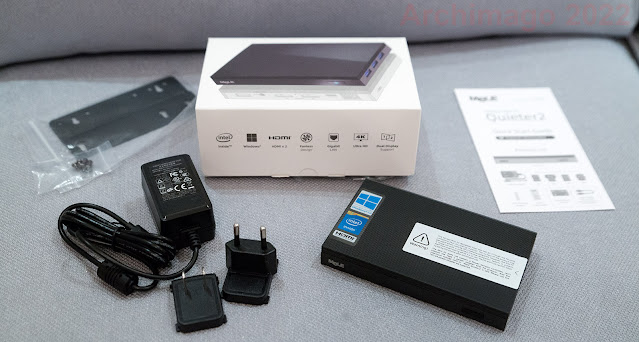
MeLE Quieter2Q (~US$250) box and contents. Notice VESA mounting plate (top left) included which is handy I think if used as a monitor back-mounted computer.

Over the last number of years, I've been a Roon user (lifetime membership, no I have not been subsidized in any way by the company). Although not perfect, it works well for me and I've certainly enjoyed the bountiful metadata this interface provides. The Roon software has unified control and access to my music library through Roon Core running on my Windows Server machine. In doing so, this has brought all the hardware playback systems in my home under the same "umbrella" whether it's my Workstation PC (listening to music writing these blog posts), on my phone using Bluetooth headphones while doing housework, or casually streaming Internet radio to the Chromecast Audio - Roon serves them all. The main item on my wish-list is for Roon to support streaming from the library remotely such as from the office.

For those who have read this blog over the years, you'll know that I like multichannel audio playback (discussed here, and here among elsewhere). No, I am definitely not one who thinks 2-channel is somehow "audiophile" territory and that multichannel is the domain of the "home theater guys". Audiophiles IMO should be greedy; we want it all because the love of music and the experience of great sound quality do not end the moment we go beyond 2.0 or 2.1 channel layouts! Some of the best sonic experiences I have had are with multichannel content and hardware.

As you likely know, I've been an advocate for Raspberry Pi devices, like the Pi 3B+ "Touch" and Pi 4 "Touch" builds discussed over the years. I still use these when I run my DAC tests given the convenience of the touchscreen and of course the price represents great value. However, there is a feature which still eludes the Raspberry Pi boards - I want easy multichannel Roon streaming in my main soundroom.