Showing posts with label DSP. Show all posts

Saturday, 25 July 2026

Room Target Curves - then, now, and options to try...

Be it resolved that there is no such thing as achieving sonic perfection - technically at least based on objective ideals, but "perfect" can also be a subjective state of mind.

In domestic homes, we're simply not going to be able to achieve near-perfect rooms. Likewise, no sound system will be absolutely transparent although the digital electronics side will get much closer to "perfect" than analogue playback and loudspeakers. Furthermore, beyond what we can say about our domestic playback systems, despite all the care and detail-orientedness put into a recording studio, they're not identical even if they followed published standards (like ITU-R BS.1116, or EBU Tech 3276), and besides, is there ever such a thing as a perfectly engineered recording? Or a perfect performance from our favorite artists for that matter?

While perfection might be out of reach, let's not turn away from the pursuit of what is reasonably accurate which is something we can all do to some extent whether it's choosing better-engineered gear, working on small room acoustics, or using DSP to improve frequency response and/or time-domain performance at our listening position. Regarding the specifics of DSP room correction, let me refer you to previous articles covering various methods here, herehere, here, and here.

The intent of this post is to focus on the topic of Room Target Curves which we define and apply when doing EQ and DSP correction. Let's explore a little history, what they are, what they look like and considerations for what to try at home.

Saturday, 4 April 2026

Crosstalk Cancellation/Ambiophonics: Updated CTXMatrix Lite with standalone processor & 60° speaker angle support.

Significant changes in the UI from the previous CTXMatrixBeta release.

I want to remind 2-channel "immersive sound" lovers about the potential for using stereo crosstalk cancellation (XTC) / ambiophonics playback to enhance the 3D soundstage. You might have already heard of uBACCH in the audio magazines and on forums - why not try a similar effect for free (or through a small coffee donation)?!

You might recall, last year STC contributed a post on CTXMatrixBeta DSP for Windows. Well, it's great to see that he has continued to develop the software with updated user interface and abilities, this latest edition renamed CTXMatrix Lite, currently at version 1.3. It now includes a standalone processor which I'll spend some time discussing in this post, along with the 64-bit VST3 plugin as shown above that can be used in JRiver, Audirvāna and DAW software like Reaper.

Furthermore, there is now a VST3 plugin for Linux. Since I primarily use Windows for my music listening and processing, I'll stick with the Windows variant here with the hopes that some of this will be applicable. In my discussions with STC, he's aware of interest from Mac OSX users.

Perhaps the most important update in the last few months is that there is now improved support for standard ~60° stereo speaker angle (typically, the recommendation is 20-30° in ambiophonics). As a result, one should have a much better experience with the effect on most set-ups. In particular, hopefully more desktop computer music lovers will give this a listen without needed to move the speaker position and explore what you might be missing in your existing music library.

[If you run a miniPC streamer in the sound room like I do, CTXMatrix can easily be used like with HAF X-talk Shaper DSP discussed a couple years ago.]

Sunday, 5 October 2025

Stereo Crosstalk Cancellation (XTC) / Ambiophonics: Introducing CTXMatrixBeta, a Free VST3 Plugin with XTC Calibration. [Guest post, STC.]

Greetings audiophiles!

As you may recall, Archimago and I (STC) wrote the previous article from October 2023 on stereo crosstalk cancellation (XTC). If you're not familiar with the topic, I recommend a look at that to familiarize yourself with the principles behind the technique.

I now want to introduce CTXMatrixBeta, a free 64-bit VST3 plugin that brings Ralph Glasgal's vision with freely accessible Ambiophonics for all to try. (In the near future, I'm planning to work on adding support with surround channels for the "Domestic Concert Hall" [DCH]. The ideas and logic are ready to implement.)

Regarding CTXMatrixBeta, by harnessing intuitive ear-based calibration, this plugin aims to deliver precise XTC, empowering enthusiasts to experience the immersive, lifelike sound of their 2-channel recordings with unmatched clarity.

Saturday, 27 September 2025

Auro-3D "Auro-Matic": Preset and Strength settings and effects. (Brief look at Dolby Surround Upmixer and DTS Neural:X.)

A number of months back, I talked about the nVidia Shield TV Pro box and explored Auro-3D which is another technology for reproduction of immersive sound with height layers. As noted in that post, I've seen comments over time about the use of Auro-3D's "Auro-Matic" surround upmixing algorithm for music playback as being the preferred setting compared to Dolby Surround Upmixer [DSU], and DTS Neural:X being the other two common options in modern AV receivers. As a reminder, while Auro-3D could use object-oriented tools in production, it is delivered as channel-based playback rather than the hybrid channel/object systems like Dolby Atmos and DTS:X.

Having now owned my Integra DRX-8.4 for about a year and listening for myself, I concur that for 2.0 and 5.1 upmixing, I tend to prefer using Auro-Matic to expand the 3D image into the height and surround channels. For most music material, Auro's method is noticeably "fuller" in presentation without sounding harsh. It also has more options as we can see in the settings menu for Onkyo and Integra receivers that have this feature:

Sunday, 7 September 2025

Linn's SPACE Optimisation DSP feature for their DS/DSM digital audio streamers. Does it even work?

Linn Klimax DS/2 streamer getting tested.

A couple months back while evaluating the Linn Klimax DS/DSM streamers, I mentioned that the products have the capability to implement what Linn calls "SPACE Optimisation" (Speaker Placement And Custom Environment, we'll call it SO for short); available since 2015. Because the products are network-connected, they're always online and through the Linn Account webpage, you can check the settings for your streamer and activate the SO function.

I remember being intrigued by this function and the claims of significant room-correction capability. For this post, let's take some time to explore what Linn SO features. To start, here is what their literature says about the intent of the system:

Space Optimisation is a toolset available to all Linn DS/DSM system owners which uses highly sophisticated acoustic modelling to build up a complete picture of how your speakers, their placement, and the unique characteristics of your room interact to affect the sound you hear. Space Optimisation takes account of the characteristics of your speakers, such as the position of each drive unit and the response of bass reflex ports, and of the characteristics of your room, such as room dimensions, construction materials, and features like doors and windows, to accurately model these interactions. It then precisely identifies frequencies that are artificially distorted by your environment, and reduces their energy and decay time, to reveal the music that would otherwise be hidden. It also applies a delay to each speaker to ensure the content from each speaker reaches your ears at the same time.

Saturday, 10 May 2025

nVidia RTX 5070 Ti GPU - a look at the lowest-priced version. And imagine, relinquishing "lossless" orthodoxy.


Hey everyone, as usual, every once awhile I'll look at other tech than audiophile stuff. In late 2024, I wrote about the nVidia GeForce RTX 4070 Super GPU and mentioned in that article about the upcoming RTX 5070 Ti and some of the expectations I had about this interesting card in comparison to the previous generation. Well, now in 2025, the new generation is here and as you can see above, I've got one to test out.

The box above is the Gigabyte GeForce RTX 5070 Ti Windforce SFF 16GB model which is probably the lowest-priced "MSRP" version of this class of cards; I got one of these at a local dealer. This is similar to the Gigabyte GeForce RTX 5070 Ti Windforce SFF OC (Canada) I see available online at places like Amazon but you'd save some money with a non-OC model if you can find it. (As usual, check out other brands like MSI, ASUS, Zotac, PNY for comparisons and relative deals.)

The only difference between OC and non-OC that I can tell for the Gigabyte Windforce is that this card is obviously not pre-overclock from the factory and I believe software like Afterburner power limits at 100% instead of 110%. Since I really have no desire to overclock GPUs (if anything, I do the "Power Limited Overclock" thing by pushing up GPU/Memory clocks but lower the power limit), I'm willing to stick with stock speed and tweak if I have the inclination.

Saturday, 11 January 2025

Dirac Live 3 with Bass Control (DLBC): A look and listen with the Integra DRX-8.4.

I talked about the use of Dirac Live 3 in late 2024 after upgrading my receiver to the Integra DRX-8.4 which integrates the full-bandwidth DSP room correction as part of its feature set. Many modern multichannel receivers these days have Dirac as a feature included like the Onkyo TX-RZ70 or Pioneer Elite VSX-LX805 (both offering 11-channels amplification like the Integra). I have to say that I love this Integra unit with all its multichannel bells and whistles - not to mention great sound as well, of course.

I mentioned in the previous article that Dirac Live Bass Control (DLBC) is available as an upgrade for US$299 which activates the license on your account when you run the Dirac Live Room Correction Suite, unlocking the "Bass Control" module.

So, let's activate that and get into this with a look and listen to what DLBC brings to my set-up and of course some results in my room. (For reference, here is the official DLBC manual, and Dirac's Frans Rosencrantz's 2020 article "Bass Control, Where Did My Bass Go?".)

Saturday, 16 November 2024

Dirac Live 3: A look & listen with the Integra DRX-8.4 - the process, microphone placement suggestion, tweaking, and multichannel/Atmos results.

As discussed years ago with my sound room set-up, I believe room correction DSP is very important and has become part of my routine whenever I make significant changes in room layout or when I incorporate new equipment. I would argue that an audiophile who has not seriously spent time trying this likely has not heard the best sound in their room from their system. Simply put, you'll notice a level of control and audible difference way more than just swapping hi-fi DACs, amps, etc. hardware.

With the arrival of the Integra DRX-8.4 receiver recently, I started using the included Dirac Live Full Bandwidth license embedded in the hardware. As I had done in the recent past with Acourate and Audiolense XO, let's dive into the steps I used to get Dirac running and the results I achieved. Hopefully this discussion could be useful for those of you thinking of trying out Dirac.

I'll document the steps I followed, issues I ran into, and tips to overcome problems.

Sunday, 3 November 2024

Integra DRX-8.4 Multichannel Receiver: Overview, features, build, a few pre-out measurements...

Obviously, value is an important consideration for consumers when it comes to buying and enjoying products. As discussed over the years, I'm not an audiophile who's particularly interested in the luxury aspect of these machines. To me, the ideal of achieving "high fidelity" sound does not care about MSRP or some other determinant of whether a product is artificially exotic/elite, thus "High End Audio" (a.k.a. High Priced Audio) is meaningless to me unless there is evidence of improved sonic performance (whether from plain increased objective fidelity or incorporating technical features) correlating with higher asking price. As such, I believe audiophiles should seriously think about the value of modern AV receivers which over time have also incrementally shown improved sound quality by incorporating higher quality DACs, newer DSP room correction technologies, and potential benefits like balanced connections.

In my opinion, this also means the divide between "home theater" enthusiasts and "audiophiles" is largely artificial when it comes to sonic performance. Subjectively, we're all aiming for an excellent audio experience with high-fidelity to the source with utmost clarity (including time-domain coherence), low distortion, high dynamic range, excellent reproduction of nuances, while achieving realistic/intended soundstage. Objectively, a high quality AV receiver these days should not have difficulty providing hi-fi performance compared to many very expensive products (like the Dan D'Agostino Momentum monoblocks US$80k/pr as an obvious example - other than high power, there's nothing particularly good), plus typically these AV companies provide way more features and modern amenities. The R&D firepower behind these companies are substantial compared to the small-business shops that typically make products for the esoteric 2-channel audiophile niche. Over time, as I hope audiophiles increasingly consider enjoying the new multichannel recordings and remixes, moving into "immersive" audio, these multichannel receivers should be seen as serious options.

The only utilitarian difference between home theater enthusiasts and audiophiles is whether video playback is needed.

In this post, let's start with having a look at the item pictured above, the Integra DRX-8.4 multichannel receiver. (Discussions and measurements of AV receivers are not new on this blog with previous posts on the Yamaha RX-V781 and Onkyo TX-NR1009.)

Despite being the current flagship receiver from Integra, the price is "only" US$3,200 or about CAD$4,000. I bought this item through standard retail channels online because I was interested in it; no company incentives.

Friday, 2 August 2024

AudioVero Acourate v3.1 - room correction with bass pre-filtering and Inter-Channel Phase Alignment (ICPA).

After writing the post on Audiolense recently, I thought it would be good to have another peek after a few years now at AudioVero's Acourate (€416 non-EU countries); the latest version 3.1 released in June 2024.

For years, Acourate has been the room-correction filter toolbox I've used (at least since 2016, updated 2019, plus discussion on partial correction in 2021). Now that it has been half a decade plus a pandemic (!) since the step-by-step 2019 update, let's look at the latest version which has brought with it changes in the user interface as well as the Inter-Channel Phase Alignment (ICPA) feature released in version 2 which I had not discussed previously.

Before getting started, a big thanks to Mitch Barnett of Accurate Sound for his YouTube video a couple years back using Acourate 2 showing the technique around pre-filtering and ICPA. I've taken inspiration from his video, applying it to my home set-up, and converting those steps into a written blog format for the current Acourate version. If what I'm doing here is not clear, make sure to also check out the video since Mitch might have already covered your questions/issues there.

Let's get started!

Sunday, 7 July 2024

Seating variations, multi-seat correction & multichannel DRC. The audio "sweet spot".

A look at the rear of my room and the sofa seating - surround speakers, LP rack for a little bit of diffusion room treatment. For best practice, it's important to not sit too close to the back wall. I have 3' between the couch and the LP rack, and the rack is about 17" deep before that back wall. 

Before putting the UMIK-1 microphone away after using Audiolense XO as discussed last time, I thought it would be interesting to explore in greater detail what happens with frequency response and time-domain performance as we sit off the "sweet spot" where the measurements were collected and correction calculated for.

In the image above, I've put a meter stick on my listening couch to identify the seating positions 1 and 2-feet to the right and left of that sweet spot so I can take detailed measurements of what happens to the sound coming from the 5 main speakers at those positions with and without DSP turned on.

Saturday, 29 June 2024

Multichannel Digital Room Correction with Audiolense XO. And "What's your budget?".

As you might recall from over the years, I strongly believe that one of the most important things one should try as an audiophile seeking high-fidelity - after having a decent sound room, and getting good equipment - is to consider the use of room correction. It could be as simple as frequency-domain EQ correction for larger bumps and dips (as discussed with the Behringer DEQ2496 hardware back in 2013-2014, device measurements here), or the much more sophisticated frequency and time-alignment of filters created by software like AudioVero's Acourate (and 2019 update) capable of much higher resolutions.

The power that one has to optimize and customize the sound runs well beyond most hardware upgrades other than wholesale speaker replacements and changing sound room! The change one can expect with room correction dialed in is astronomical compared to all the snake oil tweaks, cables, hi-res DAC/streamers, even amplifiers you might want to throw at your system.

These days, I've increasingly been converting multichannel content over to my Roon server, typically 5.1 SACDs and DVD-As but also Bluray rips, ideally lossless TrueHD with 7.1 channels. Unfortunately, Roon is currently unable to decode codecs like EAC3-JOC (lossy multichannel/Atmos) or TrueHD (lossless, based on the MLP codec) so the content typically gets transcoded to multichannel FLAC-compressed PCM which can handle up to 7.1.  

Although Acourate can be used for multichannel filter creation, the manual procedure here is unfortunately quite involved and more than most audiophiles would like to get their hands dirty with! Which is why today's post is going to be about multichannel digital room correction using Juice HiFi's Audiolense XO (€390, currently version 6.21). I see that there is the less expensive Audiolense Surround which I suspect could be enough for many users, and if all you need is 2-channel stereo, there's Audiolense 2.0.

Saturday, 2 March 2024

Home Audio Fidelity's (HAF) X-talk Shaper DSP. And is crosstalk correction/cancellation (XTC) just an "effect"?

See video and plug-in info at Home Audio Fidelity site.

Let's spend some time talking about X-talk Shaper in this post, a new DSP plug-in that will allow speaker system listeners enjoy crosstalk cancellation.

For those who have not read much about this, perhaps review the post from last year written with STC on crosstalk cancellation (XTC) and Ambiophonics. There's also the reposted article written by Ralph Glasgal that discusses some of the rationale for Ambiophonics you might find interesting and I hope provides good background for the 'hows' and 'whys' of this technique.

Saturday, 17 February 2024

HUNSN [CWWK] RJ36 Fanless MiniPC: Intel i3-N305. Power-limiting, setup, Roon outputs - multichannel, crosstalk cancellation DSP, direct USB. (And Ubuntu and ethernet post-suspend.)

Okay, let's continue with our exploration of the fanless HUNSN/CWWK i3-N305 computer discussed last week. This time, we'll focus on what I did here to get it running as my music end-point (for Roon), in particular creating multiple output options for multichannel, stereo crosstalk cancellation (XTC) DSP, and also for those times when I want the highest 2-channel resolution playback to the USB DAC.

Most of the time this computer will be running "headless" although it is connected to my TV and I will on occasion watch movies using Kodi. And since the machine is quite powerful (>100GFLOPS on Linpack stock), I turned down the power utilization for my purposes which in turn will keep the fanless solution cooler.

Let's get going!


Sunday, 8 October 2023

Stereo Crosstalk Cancellation (XTC): A review by STC. And trying out uBACCH, ambeo.one, and AmbiophonicDSP VST plus Foobar foo_dsp_ambio plugins.

Hey everyone, it has been very busy as expected through September here at the Archimago household. As a result, I haven't been able to spend as much time on the audio hardware hobby (still very much enjoying the music of course!).

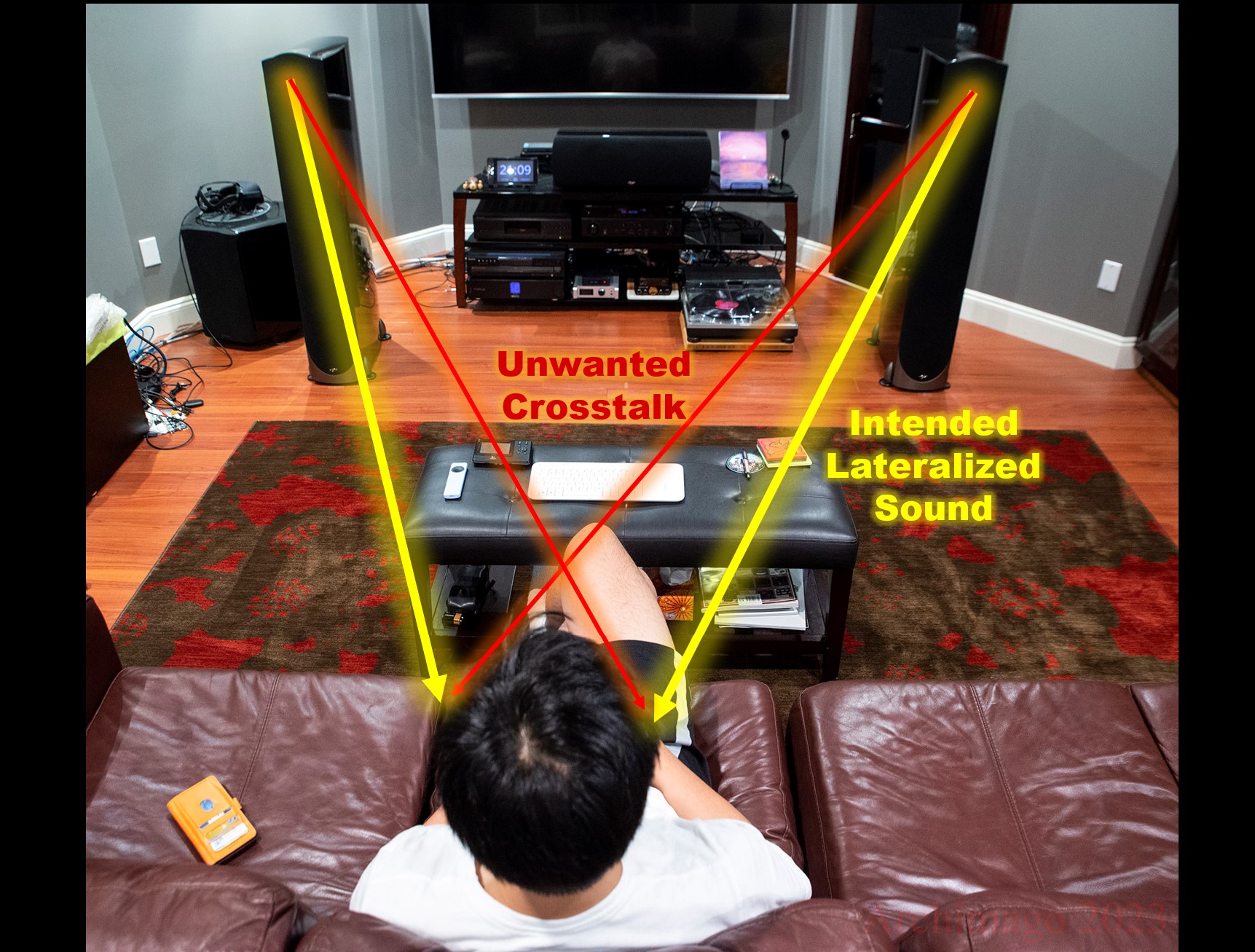
Over the years, you might have come across the term "crosstalk cancellation" (XTC) for speaker playback, words like "ambiophonics" or acronyms like "BACCH" may have passed by in your readings (for example great discussion on Reddit). For this blog post, let me ask an outspoken advocate of XTC to join for some guest content to discuss the reasons and techniques, and later on, we'll talk about a few DSPs one could try at home to experiment...

Take it away STC for Part I, I'll be back with STC for Part II, then I'll talk about trying some of the DSP options in Part III:

Part I: An introduction to XTC (by STC)

Crosstalk cancellation is an attempt to deliver stereo sound as it was meant to be played without the interaural crosstalk errors with loudspeakers (see Keele, 1986 for a technical exposition). Many listeners may not realize how much realism their high-end stereo hi-fi system is lacking until they hear a system with crosstalk-cancelled (or XTC for short) playback. It is like comparing a photo of a window with a view to an actual window looking out at the scenery. Or like watching Avatar in 2D versus 3D.

Saturday, 12 November 2022

Accurate Sound's Hang Loose Convolver Multichannel on low power Mini PC. The disgraceful AQVOX ethernet switch. And some E1DA upcoming evaluations.


Over the last few weeks, I've been using the inexpensive Beelink Mini S Intel Celeron N5095A PC in my music system. Recently, I posted on using it in Linux as a streamer with HQPlayer upsampling and for multichannel Roon capabilities. As you can see in that post, for audio purposes, even this level of CPU performance on a modern entry-level machine is enough for what would be advanced PCM upsampling (ie. 1M-taps realtime PCM) and even IMO very good PCM-to-DSD256 performance. More evidence to remind us that there's generally no need to get excited about some of the more expensive "audiophile" computers and streaming machines which are often embedded low-power computers at heart.

Recently, my friend Mitch Barnett of AccurateSound.ca wondered if I could look into the performance of his latest version of Hang Loose Convolver (HLC) with this low-power computer using my power limited and quiet fan BIOS settings. HLC is an advanced standalone, VST3 plug-in, or AU (Mac) plug-in that provides the ability for audio lovers to load in various convolution filters, allows for easy level matching, and provides basically immediate switching (0.1ms) between these filters for accurate A/B listening comparisons. Let's take a look at this on the Beelink.

Saturday, 21 August 2021

SUMMER MUSINGS: Room EQ Preferences - Vintage Spendor SA1-like curve, Hang Loose Convolver (HLC), and the increasing relative importance of software.

Getting ready for an evening of digital filter evaluation!

I mentioned a few month back in my Spendor SA1 (1976) review/measurements that I really enjoyed the sound of these classic speakers!

While it would not be possible to exactly replicate their sound - these are complex devices with all kinds of unique properties including distortion idiosyncrasies and unique radiation patterns - to some extent, we can try to replicate the frequency response via DSP.

These days, we have the technology available to modify the sound we hear in the soundroom without great difficulty; the trick is to make sure the sound has improved, at least subjectively, when we add things like EQ or applied other signal processing.

Although some (typically more traditional) audiophiles will speak of maintaining "purity" of sound with minimalistic set-ups, if one is a contemporary technologically astute music lover and audiophile, especially one already using complex streamers, computer gear, networked libraries, I don't believe there should be any fear in going all the way using high-quality DSP to shape and adjust what we hear. In fact, from the frequency response perspective, we can "emulate" almost whatever we might want depending on the flexibility of the software used.

Saturday, 13 March 2021

HOW-TO: Partial Frequency Correction with Acourate. Spotify HiFi coming and a look at the evolution of music sales/formats from 1980-2020.


[See Addendum update as of Acourate 2.0.]

Over the years, I've discussed the use of DSP room correction in these pages (here and here for the more recent articles). In Acourate, there's no single-step macro to tell the software to limit the correction to certain frequencies as far as I can tell. Instead, I saw this comment by Dr. Uli Brueggemann in one of Mitch Barnett's early articles (2013) hinting at a way to modify the inversion step of the filter to accomplish that task. This post is a step-by-step procedure for those interested in doing just such a thing with the software.

Note that even though I'm showing the process here, I'm certainly not suggesting that it's necessary whatsoever. In my listening, a full-spectrum room correction sounds great with the frequency-dependent-windowing (FDW) algorithm Acourate uses. Over the years with friends and family who have had the time to sit and listen, I have never had anyone complain that my usual full-spectrum filter did not sound better than the uncorrected sound in my room (and on occasion, I have measured and applied DSP to my friends'/family's sound systems as well to similar effect).

It's always great to have options though!

Saturday, 20 February 2021

REVIEW / MEASUREMENTS: HiFiBerry DSP Add-On with the DAC2 HD. A quick Roon 1.8 network/endpoint issue and remote access request.

This post is in many ways a continuation of the HiFiBerry DAC2 HD measurements presented last time with the devices sent to me by Doug Gardner for testing. For some background, this DSP Add-on is related to the BeoCreate project which was documented in this 2018 thesis in collaboration with Bang & Olufsen. The idea was to create an open-source system to allow consumers to build or update their own loudspeakers to be active devices. It looks like this DSP Add-On board leverages that software to do its magic.

As you can see in the thesis, the final BeoCreate product was a board which included 4-channel amplified outputs, digital S/PDIF input and output, DAC, and of course the programmable DSP subsystem. A Raspberry Pi could be added to provide network streaming capabilities.

For completeness, I want to mention that this DSP Add-On is also compatible with HiFiBerry's DAC2 Pro (~US$50-60) board. Notice that the DAC2 Pro is a less expensive DAC than the DAC2 HD and sports headphone out. The converter chip seems to be the TI PCM5122 (same as previous gen DAC+ Pro) based on what's listed in the specs sheet but I have not seen confirmation that is indeed the case.

Saturday, 13 February 2021

REVIEW / MEASUREMENTS: HiFiBerry DAC2 HD HAT for Raspberry Pi


It has been awhile since I've measured any of the Raspberry Pi DAC HAT boards. In fact, it was back in 2016 that I got the HiFiBerry DAC+ Pro which I still use for basic streaming in the living room these days. Thanks to blog reader Doug Gardner, he sent me both his HiFiBerry DAC2 HD (~US$100) and DSP add-on (~US$60) boards you see above for testing. Doug was also very helpful in providing some background information and discussions on subjective impressions.

The DAC2 HD was released last year (around June 2020) and is based on the TI/Burr-Brown PCM1796 "Advanced Segment" DAC chip, an upgrade from the TI/BB PCM5122 found in the DAC+ Pro board. With the majority of my DAC measurements recently being ESS and AKM products, it's good to have a listen and look again at a TI/Burr-Brown-based product. Note that the PCM1796 is not a new component by a long shot! It has been available since 2004 I think (earliest specs sheet Dec 2003). My TEAC UD-501 and ASUS Xonar Essence One from 2013 were both based on dual PCM1795, a close sibling.

While I will be looking at the DSP add-on daughterboard (version 1.1, dated April 2020) more next time, for now, suffice it to say that this is based on the Analog Devices ADAU1452 chip, a 32-bit, 295MHz DSP.