Showing posts with label HDMI. Show all posts

Saturday, 28 March 2026

Do HDMI cables make a difference for IIS/I2S/I²S-HDMI audiophile DACs?

It's taking a bit longer for my testing of the inexpensive I²S/IIS/I2S-HDMI DDC boxes due to some unexpected results which I'm chasing down currently; hopefully that gets resolved or understood soon.

In the meantime, let me address something that folks might be curious about related to this topic of the I2S-HDMI interface... Does the HDMI cable make a difference to the sound quality?

As with much of audiophilia wherein some members of the culture have the belief that "everything makes a difference", obviously this is not the case and I do not recommend this kind of mindset. There are many things that don't make much, if any difference (as discussed here and here) based on experience and understanding principles of the technology.

Since I have not seen measurements examining the effect of HDMI cables on I²S performance from a DAC, let's do some testing here.

Saturday, 7 March 2026

Inexpensive USB2.0 Digital-to-Digital Converters (DDC) Pt.1: Douk Audio U2 PRO (Upgrade Version) and SMSL PO100 PRO - initial look, about I²S-HDMI. In praise of unofficial Atmos mixes!


This SMSL unit also does MQA decoding for those who want the feature. Unlike the Douk, this box only has an LED to indicate MQA decoding status but does not tell us the PCM or DSD samplerate.

While I've tested some inexpensive devices (like the Topping D10s DAC) which have the ability to convert USB 2.0 input into S/PDIF output, I have not specifically looked into these Digital-to-Digital Converter boxes which some audiophile reviewers (like this fellow, and this) seem to rave about.

For me, there just hasn't been any reason to be particularly interested since other than conversion from one interface type to another, the other promise of such devices - the reclocking capability - just hasn't been of great interest to me. As far as I can tell from listening, it's not like jitter has ever really been much of an issue unless severely bad for any decent modern device I've ever come across even at low price points (nor was jitter really an issue even with old CD players)!

However, since I have not tested I²S/I2S/IIS, I figure I'd buy both the Douk Audio U2 PRO 2025 upgrade version (US$63; Amazon Canada) and SMSL PO100 PRO (US$74; Amazon Canada) boxes to try out; have a listen and run some measurements. Unfortunately due to time limits, I'm not quite ready to show the measurements yet, so keep an eye out for those results, perhaps next week! For now let's just introduce you to these devices and talk about the I²S-HDMI connection.

As typical of the majority of my reviews/critiques, I bought these through retail channels.

Saturday, 8 March 2025

High Frame Rate (HFR) movies: time to overcome resistance? Also, on anachronistic nostalgia. And why I rarely go to movie theaters these days.

This week, indulge me in staying a little longer with discussions on the video theme; since I view audio and video technologies as members of the same family, there will be references and detours made about audio in this post.

Although I think 4K is plenty of spatial resolution already for home use (discussed years ago at the advent of UHD BluRays), there is one obvious way to increase the perceived resolution of video playback - improve the "time domain" performance.

While basically everything about motion picture technology has evolved - aspect ratio changes from 4:3 (silent film) to widescreen, frame sizes (35mm various forms, 65/70mm, various digital sensor sizes), B&W to color, higher effective resolution, transition from analog film to digital - isn't it amazing that the cinematic framerate has remained at a mere 24fps, and commonly 180° shutter rule for motion blurring (more geeky testing here)? Since the dawn of the "sound film" in 1926 - almost exactly a century ago! 

High Frame Rate (HFR) movies - movies that were filmed and projected at more than the "cinematic" 24fps - typically 48fps or 60fps - have been simply uncommon for feature presentations to this point. Perhaps reminiscent of multichannel music which had its starts and misses over the decades (eg. 4.0-channel quad back in the '70s), HFR also had a time in the '70s and early '80s when the company Showscan was trying to achieve higher image quality with 65-70mm film at 60fps. But like quadraphonic audio, the technology of the day wasn't really good enough for practical, economical, trouble-free high-fidelity visual reproduction.

Imagine what kind of physical demands would have been necessary for this. Showscan ran the film at 4.68ft/s or 281ft/minute! Clearly a costly endeavor (estimated $2-3M just for the negatives and processing to make a movie back in the '80s) plus imagine the pounds of film to send out to all the theaters, maintenance needs, plus potential damage to the film after a number of runs. How many showings would have been needed for a decent return on investment?!

No surprise then that full-length films were never released in this format. (Here's an interesting brochure from 1990 of their High Impact Cinema prototype, and their 1987 company prospectus.)

Saturday, 1 March 2025

HDMI Musings: high speed cables, data rates, YCbCr color subsampling, Dolby Vision MEL/FEL, optical cables and +5V injection.

Hey folks, for this post, I thought it would be good to dive a little more into the world of AV technologies after discussing the nVidia Shield TV Pro last week. While "classic" audiophile technology (ie. standard hi-fi analog and digital 2-channel stereo without special DSP advancements) has matured nicely already, this isn't quite the case with modern digital video tech. While many (probably most) features have settled, we can see ongoing evolution of the High-Definition Multimedia Interface (HDMI) standard to be mindful of - for example the recent announcement of HDMI 2.2 at CES2025 expanding capabilities well beyond the needs of today.

As usual, it'll take time (years) for this standard to be incorporated into TVs and source devices like GPUs (latest nVidia RTX 5080/5090 are HDMI 2.1b) or something like VR devices being at the forefront of potential generational gains. For more than 20 years, with each significant revision of the HDMI standard, we're seeing doubling of data speed with HDMI 2.2 now aiming at just shy of 100 gigabits-per-second (96Gbps), twice of the 48Gbps bit rate in current HDMI 2.1 products.

This recent update makes HDMI the fastest of all currently-announced consumer Audio-Video connection standards, the one wire that basically does it all - hi-res video (with high dynamic and frame rate), hi-res audio (up to 32 PCM channels at 24/192, with DSD to 8-channel of DSD256), HDCP copy protection, audio return channel, even ethernet (100Mbps).

This level of sophistication (and licensing costs) could make it difficult for small companies with limited R&D capabilities to get in the game with custom designs. This is probably in part why the cottage industry audiophile companies rarely use HDMI other than selling overprices cables (like AudioQuest). Plus frankly, basic 2-channel audio doesn't need the higher technical capabilities anyway (which is basically what Paul McGowan says).

Let's run through a few thoughts about HDMI that might be good to know as general knowledge as tech enthusiasts. I'll provide a few links of interest, touch on tech stuff like color spaces and subsampling, and things you might want to try if you're running longer high-speed HDMI connections and potentially noticing issues.

Saturday, 22 February 2025

nVidia Shield TV Pro (2019 version), still relevant in 2025! A listen to Auro-3D & Auro-Matic Upsampler.

Hey guys, I thought it would be fun to talk about something that's been around quite awhile already but which I still bought in 2025. As per the image above, it's the nVidia Shield TV Pro (US$200, CAD$260). For years, I've been using the Apple TV 4K (2nd Gen, 2021) which is a fine unit with all the bells and UI whistles of the Apple ecosystem. But it is missing something that "serious" movie audio lovers - and even audiophile music lovers - might want; lossless audio bit-streaming for Dolby TrueHD/Atmos and DTS/HDMA/X.

That's right, sadly, after all these years, Apple doesn't care to update the AppleTV to support basic bit-streamed audio. 😢

Note that I don't necessarily blame them as a company, they make no money off local libraries of UHD/BluRay-ripped content. So if I were running the business, I'd also think twice about getting developers to support a feature that at this time in history they will make no streaming subscription revenue from. Streaming services - Apple TV, Apple Music, Netflix, Prime Video - all do not send lossless multichannel audio content, opting typically for lossy Dolby EAC3 with or without Atmos. Not supporting much beyond the basic feature set is nothing new with Apple as part of their KISS closed ecosystem mentality. (The only lossless multichannel I've come across are the few albums on Qobuz.)

Since 2021, without lossless bit-streaming to the receiver, I've been using Infuse PRO on the Apple TV which will decode Dolby TrueHD and DTS-HD Master Audio to multichannel PCM. Doing this removes the embedded Atmos or DTS:X height effects (can turn on Dolby Surround Upmixer or DTS Neural X to extract some content back). At least lossy EAC3-Atmos is sent directly to the receiver.

Therefore in 2025, the only other mainstream choice is still the Shield TV, a device that seems to be catered more to the home-theater enthusiast with lossless audio - thanks nVidia.

Saturday, 3 September 2022

As We Hear It: An audiophile comments on the Taiko Audio computer. The Mark Jenkins / Antipodes Audio Darko interview. On MoFi's One-Step DSD. And optical HDMI.

German "ear horns" circa 1917.

It's great to look inside my mail bag and post comments or questions here from readers once awhile. I must say that the clarity of thought and insight from readers have been inspiring over the years.

With permission, here's a comment from an audiophile in Europe regarding his direct experience with the Taiko Audio SGM Extreme "audiophile" computer server/streamer.

Since this reader has quite a unique high end system which can be easily traced, this message has been anonymized in a number of ways. Without further ado, a comment from SonicDeepThroat (SonicDT):

Received: July 2022 

Hi Archimago,

I thought I'd drop you a line as I found your blog post about the Taiko SGM Extreme very interesting. I auditioned this machine a few days ago and thought I would share my conclusions with you. (I tried to leave a comment on the relevant blog post, but Google wouldn't let me sign in to do so.)

Saturday, 5 February 2022

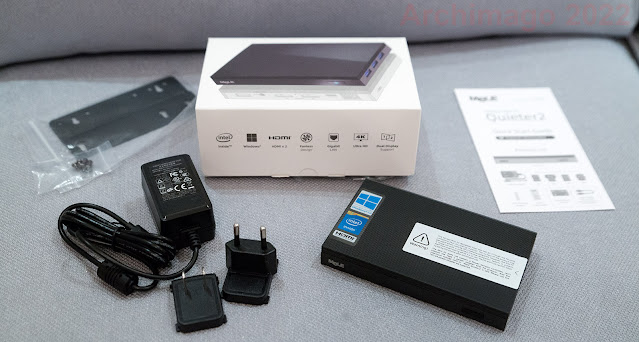
MeLE Quieter2Q (8GB DDR4, 128GB eMMC, Celeron J4125) Mini PC: An inexpensive, silent, multichannel Roon Endpoint. On Paul McGowan (PS Audio): "digital audio is soooo noisy", and "computers are the worst". [+ Windows 11 Update]

MeLE Quieter2Q (~US$250) box and contents. Notice VESA mounting plate (top left) included which is handy I think if used as a monitor back-mounted computer.

Over the last number of years, I've been a Roon user (lifetime membership, no I have not been subsidized in any way by the company). Although not perfect, it works well for me and I've certainly enjoyed the bountiful metadata this interface provides. The Roon software has unified control and access to my music library through Roon Core running on my Windows Server machine. In doing so, this has brought all the hardware playback systems in my home under the same "umbrella" whether it's my Workstation PC (listening to music writing these blog posts), on my phone using Bluetooth headphones while doing housework, or casually streaming Internet radio to the Chromecast Audio - Roon serves them all. The main item on my wish-list is for Roon to support streaming from the library remotely such as from the office.

For those who have read this blog over the years, you'll know that I like multichannel audio playback (discussed here, and here among elsewhere). No, I am definitely not one who thinks 2-channel is somehow "audiophile" territory and that multichannel is the domain of the "home theater guys". Audiophiles IMO should be greedy; we want it all because the love of music and the experience of great sound quality do not end the moment we go beyond 2.0 or 2.1 channel layouts! Some of the best sonic experiences I have had are with multichannel content and hardware.

As you likely know, I've been an advocate for Raspberry Pi devices, like the Pi 3B+ "Touch" and Pi 4 "Touch" builds discussed over the years. I still use these when I run my DAC tests given the convenience of the touchscreen and of course the price represents great value. However, there is a feature which still eludes the Raspberry Pi boards - I want easy multichannel Roon streaming in my main soundroom.

Saturday, 10 July 2021

Apple TV 4K, 2nd Generation (2021, A12 Bionic SoC, 6th Gen Apple TV): A look and listen (to "Spatial Audio" on Apple Music)...


So guys and gals, let's jump from the lo-tech "audiophile boutique" passive AudioQuest JitterBug FMJ last week to talk about something hi-tech this time.

As I mentioned a few weeks back, I've been listening to some of the "Spatial Audio" music streaming off Apple Music these days. Easy to give it a shot with the 1-3 month trial period they're offering.

As I mentioned before, while I enjoy the content on headphones and can experience the difference Atmos streaming makes, as one who enjoys excellent high fidelity sound quality (ie. "audiophile"), the best, most natural way of listening to multichannel content is in the sound room where I have my multiple speakers set up. I have a modest surround system with the ELAC Debut 2.0 A4.2 Atmos speakers (previously measured) adding a bit of that height effect with Paradigm Signature S8 v.3 fronts, matching C3 center channel, full tower Studio 80 v.3 for rears and dual subs to make basically a 5.1.2 arrangement.

The trick with getting the multichannel content out to the room has to do with whether Apple Music allows the bitstream to pass through the playback device into the AV receiver that can handle Atmos. As I mentioned in that previous article, I can get the "bed" channels out (ie. 5.1, 4.0, etc...) using my wife's M1 MacBook Air running the recent macOS Big Sur release, but this is with the machine decoding the DD+ (E-AC3) + Atmos stream into 24/48 5.1 PCM sent to the receiver over HDMI.

For bitstream passthrough including the full Atmos encoding, at least at this point in time, the Apple TV works and let's talk about this box today for audio/home theater usage... As you can see above, I have the Apple TV 4K, Gen 2, 64GB here - this was released just recently April/May 2021 with the "A12 Bionic" 7nm SoC which actually was first used in the iPhone XS series back in late 2018. Certainly energy-efficient and plenty fast for non-multitasking media playback. If you don't need the storage, the 32GB model saves you US$20 - as usual, Apple has no SD card expansion for their devices. Internally, the machine has 3GB RAM.

Wednesday, 20 June 2018

MEASUREMENTS: Oppo UDP-205 Part 3: Jitter, some conclusions, discussions, and suggestions.


We've reached the last of the "trilogy" measurement posts I'm planning to make on the Oppo UDP-205 (at least for now!). We've already examined some "microscopic" measurements like the oscilloscope reading of square waves, talked about the filter settings and relative differences. Then we've looked at the RightMark measurements demonstrating excellent low noise level, low distortion readings, good frequency responses, and minimum crosstalk across the different outputs.

With this post, let's have a look at the J-Test results from the various outputs to make sure there are no issues, and of course in the process examine temporal stability with the various digital inputs including USB, ethernet, S/PDIF, HDMI, and of course as a CD player. We will then close off with some general thoughts, suggestions, and opinions around this device and broader about the features that might be worth pursuing in audiophilia.

Saturday, 28 January 2017

QUICKIE POST: Yes, cables matter... (for HDMI 2.0/4K/60fps/HDR...)


Well, of course cables matter! Without them there would be no sound or image! The key of course is to be wise enough to have a concept of what is needed, and how much difference the cables/wires can make.

Just a reminder, if you have not seen it yet, here is my summary of tests and thoughts on audio cables over the years if you're wondering about that.

As for today, given that time is limited this week, I just wanted to put up a "quickie" post mainly about some 4K HDMI cables I tried over the last couple months in setting up my 4K TV (a Vizio P75-C1).

Saturday, 9 November 2013

GUEST REVIEW & MEASUREMENTS: The Quantum HDMI Squeezer + ULTRA Cable: A look at HDMI cables.


By Keaton I. Goulden-Eyre III, Esq.

With Archimago overseas, he implored that I take a few moments to contribute to this most obscene of blogs (sorry dear readers, "objective" and audio do not mix in my worldview based on experience, wisdom, and my ears). Recall that many months ago, I brought you the review of Dr. Frank's "Best-Coaxial-Digital" SPDIF cable. I remain steadfast in my opinion of that fantastic interconnect!

A reminder - the introductory price is still available until December 31st! At $4999.99, it is a steal.

----------------------------

The cellular phone rang - "How inconvenient!"

That was my initial thought the evening I heard about the cable being reviewed today. It happened in August as I was at my usual Las Vegas soirée with associates enjoying some Château Pétrus on my way to a Wolfgang Puck restaurant with a tender morsel of imported Wagyu in mind.

On the other end was Alfred Fitzgerald, LL.B. A member of my exclusive gentleman's club back home who could not wait to discuss an amazing audiophile find. Having had many deep conversations around our shared passion for audio reproduction, he knew that I would find his news intoxicating. He was correct.

It so happened that recently he was representing the interests of a client; Dr. Joseppi Maltzarelli, in the acquisition of a 30m yacht off the Florida Keys. He discovered that Dr. Maltzarelli was in fact a physicist who interned at CERN's Large Hadron Collider in 2005. His ground breaking theories on the vibrational qualities of quantum superstrings in the terahertz range drew applause but also envy from colleagues such that he decided to leave the "mainstream" physics community to become the chief scientific officer of a startup to leverage his theories and experience. The company: QuantaVibes Inc. based in Dushanbe, Tajikistan, aptly located just across the street from the Gurminj Musical Instrument Museum showcasing the history of stringed instruments.

Although the phone conversation was brief, I could not enjoy the succulent Kobe that night - lost in thought as I contemplated the potential of what I heard! I just had to call Dr. Maltzarelli upon my return home. I was almost unable to enjoy Céline Dion that evening!

After many E-mails and calls to QuantaVibes, I was finally able to track down Dr. Maltzarelli via satellite phone located somewhere off the coast of French Guyana in his yacht. It was a wonderful discussion; here is a good portion of our conversation:

ME: Good afternoon Dr. Maltzarelli. Thank you for taking my call.

JM: Absolutely Keaton, any friend of Mr. Fitzgerald's is a friend of mine. (Both laugh in approval.)

ME: I am curious my good fellow, whatever are you doing out at sea?

JM: The South Atlantic is beautiful this time of the year, my friend! I'm planning to sail down to Brazil and into Uruguay by the spring time where I will go inland to research the acoustic resonances of spiritual earthenware of the Amazonian peoples. Just a well deserved vacation after years of programming my supercomputer to calculate some Super Large Numbers involved in Superstring equations. The company is almost ready to ramp up production on what we believe will be the most significant HDMI audio upgrade in this generation - if not the most significant audio upgrade of all time!

ME: Amazing Joseppi. I'm perplexed however, how did a physicist of your calibre ever get involved in audio in the first place?

JM: You see, this is what happened. In 2005 when I was at CERN, I discovered that free-electron lasers were capable of inducing terahertz vibrations in the Superstring subequations as expressed using the derivative of the semiconductor Bloch equations. This caused quite a stir in the community because it meant that resonance effects created by this perturbation in high order space-time could fold down into our 3 spatial and single temporal dimensions! My colleagues were not able to handle this truth. They started a smear campaign decrying my theories and even went as far as to label me as mentally unstable!

ME: Terrible! Such close mindedness - they probably still believe the earth is flat! Was this why you left CERN?

JM: Yes, amico. I could not tolerate this final insult and left to pursue other avenues to realize the profound implications of this research. As to the second part of your question; audio was a natural fit for these equations. Like the strings of a violin, the Superstrings resonate in a natural harmonic. It just so happens that these harmonics precisely overlap with the audio spectrum when free-electron laser spectroscopy is activated at odd harmonic multiples. As a result, we can precisely tame the stray frequencies and decouple the thermionic energy flux passed across various equipment. My research pin pointed to the HDMI interface as one which could use this "taming" effect as a first foray into audio reproduction for the company.

ME: So, is it something to do with the HDMI interface's complexity?

JM: Precisely Keaton. You see, HDMI transports "bits" like how the Transporter in Star Trek transports matter. HDMI communicates using TMDS which sends those bits and nibbles with no respect for timing or integrity. This just shreds the musical information apart and artificially reproduces it at the other end! No wonder people experience horrific digititis, headaches, gout, sarcoidosis, gastrointestinal problems, and other forms of neurasthenia with this wretched interface for music. Is it any wonder how jittery the HDMI interface is?

ME: Impressive, doctor. So what is this product soon to be released to combat the problem?

JM: Soon, we will be releasing the QuantaVibe Quantum HDMI Squeezer and accompanying QuantaVibe ULTRA HDMI Cable. They should be purchased as a pair for synergistic effect. The Squeezer consists of an adapter for regular HDMI to micro-HDMI because supercomputer simulations demonstrated that the smaller size of the micro-HDMI interface precisely corresponded to the wavelength of these Superstring terahertz vibrations. The increased density of electron flow through the micro-HDMI connector accentuates the resonant-transduction effect by 323%. We've treated this device with a patent pending ultramicrochip which precisely aligns the resonances. Unfortunately this is a trade secret so I cannot elaborate any further.

ME: And how about the ULTRA Cable?

JM: We understand if an audiophile wishes to use a standard size HDMI-A connector or cannot modify their system to accept the micro-HDMI. It is more convenient but no matter how I load my equations for the terahertz wavelength, it is still a compromise due to the size of that connector. Nonetheless, we will be selling separately our ULTRA Cable which has some of the technologies incorporated in the microweave of the insulator. Again, I cannot divulge any further information on the technology itself lest I get in trouble with the CEO of the company. (Both laugh.)

ME: You know Joseppi, many insane "objectivists" will be very critical of these worthy products. What do you have to say to potential critics?

JM: Keaton, my friend, there will always be "haters" in this world. I faced many back at CERN under the guise of "peer review" and still get many thumbs down with my Facebook posts and criticism with interviews like this one probably. I do not expect everyone to appreciate the benefits. In our extensive testing in the lab, only those with excellent hearing, trained ears, truly high-end equipment, and impeccable taste in music can fully enjoy what we are about to produce. Furthermore, we are so convinced that the discriminating audiophile will love this product that we will be offering a 35-day guaranteed satisfaction or full refund! Absolutely no risk! I do not believe anyone can beat that.

ME: I have never heard of this kind of offer - 35 days! Now how about sending a set to me for a review?

JM: Absolutely, sir. I will have my people contact yours. I apologize Keaton, I have to go now, the fidanzata is calling... Never let the fidanzata wait...

ME: I absolutely understand. I look forward to the review sample and our next opportunity to converse. Perhaps at an audio show? I hope you find some hidden truths in the spiritual earthenware of the indigenous Amazonians.

With that, and good to his word, a package arrived from Tajikistan two weeks later. Neatly secured in its own black silk pouch I found this set of adapter and HDMI interconnect:

The workmanship was excellent. Black which matches my custom-designed HDMI DAC (connectors personally soldered by Nodko-san in Japan) with fabulously gold plated connectors. Directionality was clearly marked on the cable (not shown). I was informed by an associate at QuantaVibes that these are prototypes and the production units will feature gold embossed lettering on aerospace-grade titanium in place of the white label shown above.

The Quantum Squeezer is a mere 6cm (2.5") in length but tucked within it the full package of Superstring optimizations. At perhaps 15 gm in weight it was ethereally light - befitting of the level of technology! The ULTRA Cable is 12' in length and should be long enough for essentially any connection between your source and the HDMI DAC. This cable was optimized for music so do not expect it to carry nonsense HDMI 1.4 extensions like 3D or even 1080P to some sources*. Wow! Mind boggling how the potency of these optimizations were capable of limiting video transmission in the service of audio.

"Ultimate Smooth"
I immediately connected up the Quantum Squeezer and ULTRA Cable to the HDMI input of my UltraBook computer and custom DAC for a listen. (Remember, the Quantum Squeezer only works with the micro-HDMI port common on newer portable computers like laptops/ultrabooks.)

I don't know how Dr. Maltzarelli did it, but he did! I swear, the Herbert von Karajan & Berliner Philharmoniker Beethoven Symphonies played in my soundroom from my 16-driver 863 pound custom speakers with GIA FL grade diamond tweeters driven by special edition Nodko 8-Watt SET tube amps with a sparkle and clarity I had not thought possible. The strings were smooth like a well aged Highland single malt scotch whiskey or the hum of my newly acquired Jaguar F-Type V8 S. The timbre of each instrument resonated with a "note" beyond the vocabulary of the best Wine Spectator writer. This was the power of Superstring audio optimization!

The beautiful multi-layered vocals from Stephen Layton & Britten Sinfonia's version of Chorus: For Unto Us A Child Is Born (off "Handel's Messiah", 2009) almost dislodged me from my seat with the immensity of the recording venue's soundstage (St. John's, Smith Square, London). I had never heard the numerous voices with such definition. I could make out the fact that the tenor in the second row secretly picked his nostril at 1:23 into the track. Replacing the QuantaVibes cables with my AudioSearch Whiskey HDMIs ($300/3') demonstrated just how superior the QuantaVibes were and stepping down again to generic HDMIs ($20) resulted in either a collapse or dissolution of soundstage, leaving the voices decapitated, floating in space in one instance and the next congealed in an incomprehensible mess as if lying supine in a morgue. The joy was gone, the textures made bland, soulless. It was so obvious that anyone who could not tell the difference must be auditorily blind.

The same effect could be found with more pedestrian music. Consider the sitar on the Beatle's Norweigian Woods (off the 24-bit remaster of course). On the vast majority of HDMI cables (including very expensive ones I might add), they sound shrill, overly trebly, and ethnic. Through the Quantum Squeezer and ULTRA Cable, this instrument played with its full glory demonstrating George Harrison's connection with the numinous (perhaps aided by various hallucinogens?), altogether natural, at One, familiar. This level of sonic reproduction is priceless!

Finally, my luscious wife Candy wanted to participate in the audition.We cued up her favorite track from the Spice Girls - If You Wanna Have Some Fun. The soundstage exploded beyond the walls side-to-side, front-to-back; and the vocalization from the Girls were lined up beside each other - you could even discern the relative heights of these women! Candy squealed in delight exclaiming "I ain't heard it go so low before, Big Daddy!" Indeed, we had fun.

Readers, let me be perfectly clear about this. Forget all you have heard about "holographic" sound from inferior equipment. These cables offer HOLODECK sound. Miles Davis' spit could be heard and visualized dripping off his trumpet, Coltrane's sax keys rattled before my eyes, Elvis' hips gyrated in concert with his live performances, and Michael Jackson's lewd gestures beckoned beyond the grave off Thriller! Dare I say, this is the first time I have experienced digital sound even begin to achieve parity with my vinyl collection. Such was the presence. You know you want this.

Now, as per my agreement with Archimago, measurements are a pre-requisite for reviews of such gear on his blog (again, absurd). I lent him the QuantaVibes HDMI Squeezer and ULTRA Cable for a couple nights just before he went off on the plane. I'll be back in a moment after this unnecessary interlude...

Objective Analysis:

Okay, as Keaton said, I had the chance to measure his review cable with a couple other HDMI cables using the following setup just before I leave:

AMD A10-5800K HTPC with HDMI-A connector or ASUS Taichi with HDMI-D (micro-HDMI) --> Test HDMI cable --> Onkyo TX-NR1009 --> shielded RCA --> E-MU 0404USB --> shielded USB --> Win8 laptop for analysis

Cables tested:
1. HDMI "high speed" cable, ION branded, 6' long, used in my previous Onkyo DAC measurements. No problem with HDMI 1.4 functionality like 3D to HDTV. Cost - about $20.


2. Fancy 4m (~13') Energy branded HDMI with all the check boxes ticked for HDMI 1.4a. It's touted as the "Connoisseur" Series which I'm sure Keaton would approve of. High speed to "13.8Gbps" specified, ARC, 3D, ethernet, 4K... Even has a tag as seen in the picture with "Confirmation of HDMI ATC Testing" - ATC in this case means "Authorized Test Center" and for this cable, the center was "Dat Tran". Nice metal connectors and general cable build quality.

At $50, this is probably the most expensive cable I have and will be used between the Onkyo receiver and LG 3DTV in my new setup. Note that the upcoming HDMI 2.0 standard specifies data transfer rates up to 18Gbps but is backward compatible with high-speed cables so I hope this cable will do the job in the years ahead.


3. The review QuantaVibes Quantum HDMI Squeezer + ULTRA HDMI Cable. The HDMI Squeezer looks like a standard HDMI-A female to HDMI-D male converter capable of a 90-degree rotation. Although said to be "heavily modified", I do believe similar adapters can be found at the local Radio Shack :-).

The ULTRA Cable is "standard speed" - tested to be OK with 1080P with my TV and the ASUS Taichi ultrabook, but NOT fast enough for 3D video off my Panasonic BMP-TD220 Blu-ray player.

Starting with the usual RightMark measurements, here's the summary (all done at 24/96, HDMI WASAPI driver):

Frequency Response

Noise level
No difference folks! Frequency response, noise level, distortion levels appear indifferent to the HDMI cables used.
 
Let's look at jitter with the usual Dunn J-Test:


Hmmm, what's this? The QuantaVibes spectrum is more jittery - especially noticeable with the 24-bit condition. However, notice what's happening here. Both the ION and Energy cables are being measured off the standard HDMI connector whereas the QuantaVibes is off the ASUS Taichi laptop's micro-HDMI port. What happens if we use the "HDMI Squeezer" converter but with the fancy Energy HDMI cable instead?


Voilà, the jitter spectrum now looks like the one above with the QuantaVibes ULTRA HDMI cable. Basically what is demonstrated here is exactly what I saw with the TosLink, USB, and coaxial digital interfaces. The jitter spectrum is a function of the sending and receiving device. The cable itself does not change the pattern; in this case, the little ASUS Taichi ultrabook tends to show more jitter than the HTPC AMD A10-based computer. Whatever HDMI cable is used does not change the jitter pattern (although I suppose one could wonder whether the HDMI-A to micro-HDMI adapter has an effect; not likely).

Bottom line from the objective side: No evidence that HDMI cables make any difference to standard measures of frequency response, distortion, noise floor/dynamic range of the DAC (Onkyo TX-NR1009 in this case). Jitter remains a function of the active devices, not a property that varies with the passive cables themselves (at least within the reasonable lengths tested up to ~13 feet). I'm happy to be proven wrong if anyone else has good data especially with less jittery DACs than this receiver.

I am therefore at a loss as to Keaton's enthusiasm around this product.

Back to Keaton for his conclusions.
 

Keaton's Konclusions:

Bollocks, more squiggles from Archimago... Yet again, measurements remain insensitive and unable to achieve the resolution of my 73-year young experienced ears. Hence useless and invalid for audio evaluation. We all know that everything matters, even more so digital cables because there isn't such thing as digital according to these enlightened gentlemen. HDMI is of course the worst of all the digital connections for audio (some other enlightened gentlemen at Audio Asylum agree) which makes it so much more important that we spend more money on ensuring perfect digital transmission.

As a side note, I connected the ULTRA HDMI Cable by itself to my Blu-ray player and 85" 4K TV. I swear, the image was more stable, colors brighter, and the actors moved so smoothly and with such poise that B-movies seemed Oscar worthy. Likewise, the audio-video synchronization was even better with these cables that I wondered how I managed to watch movies without them! Here again, the power of jitter-free sympathetic Superstring resonance at work. Indeed, I will be ordering a separate set of ULTRA's just for the Blu-ray player when the final product is released. Nonetheless, I feel that without the HDMI Squeezer, the synergism just wasn't there. The sound didn't reach as deep, the trebles didn't quite touch the heavens; without doubt, you need the full set!

You likely are aware that so far I have not said how much these high-tech devices will be sold for. I was told the company is still perfecting the quality control due to the precise manufacturing standards and complexity of the patent pending process. Expectations are that both the HDMI Squeezer and ULTRA Cable will be priced as a set at the $3000 mark. By itself, the ULTRA Cable will be around $2000. Mere pocket-change for this level of sonic/video revelation - I bet your power cords costs about just as much and they only have 3 individual wire lengths inside at most, and require less precise shielding! This is very comparable to other high-end HDMI cables such as these or these or these especially given the improvements on the quantum scale!


With this premier product from QuantaVibes, I am confident that we will 'hear' more from this up-and-coming newcomer to the high fidelity audio scene. I have a strong feeling that Dr. Maltzarelli's research into Amazonian earthenware will yield many revelations into audio resonances for upgrading the sound room. It was with supreme regret that I had to return the review cable back to QuantaVibes after 3 weeks of audio bliss for fear of industrial espionage. Currently awaiting their formal release with bated breath and ample liquidity in hand.

Until next time; Magico wishes and Burmester dreams.

-----------------------------

* This cable is rated as "Standard HDMI".

Ed: And so ends the digital audio cable measurement quadrilogy. That is, until yet another digital audio interface shows up with fancy cable claims... Enjoy the music till then :-).

Saturday, 26 October 2013

MEASUREMENTS: ONKYO TX-NR1009 as HDMI / SPDIF DAC... Are AV Receivers any good?

The rat's nest.

Running separate components like multichannel processors/preamps to monoblock amplifiers are generally considered the ideal, "cost no object" approach to home theater. In the real world, cost and space are considerations and AV receivers become the "Jack-of-all trades" central device that most of us have in the home theater setup. But like the proverbial "Jack", it's useful to also consider the second part of that saying... Just how bad  is he also "the master of none"?

In the last installment, we looked at passing an analogue audio signal through the Onkyo and found that noise can be an issue. Today, I want to demonstrate the quality if we were to just use this device as a DAC - a look at the digital portion. Some natural questions arise - how well did the designers shield noise from getting in (especially in light of the high analogue noise measured previously)? Is the jitter through the use of HDMI "bad" (compared to TosLink and coaxial S/PDIF)? How does it compare to other stereo DACs?

Based on the Onkyo specs sheet, the TX-NR1009 uses the TI PCM1690 6-channel + PCM1789 2-channel DAC chips. Both are rated as 113dB SNR. These DAC chips are often found in consumer AV receivers and are lower spec'ed than most stand-alone DACs like the TEAC UD-501's PCM1795 with >120dB SNR. Of course, you cannot just look at this specification and judge the quality of a DAC. Much depends on the analogue circuitry around that DAC so the measured results are more useful than just looking at the components individually.

Setup:

As usual, for the sake of full disclosure and opportunity to repeat/verify, here is the setup for these measurements:

Win8 AMD A10 "Trinity" HTPC --> HDMI/TosLink/coaxial cable --> ONKYO TN-NR1009 front stereo "pre-out" --> shielded RCA --> E-MU 0404USB --> shielded USB --> Win8 laptop
CM6631A device used for asynchronous USB --> coaxial / TosLink conversion duties.

HDMI driver: default AMD WASAPI. I used JRiver for playback.

Since I want to check the performance in a more "naturalistic" fashion, I made sure the TV was connected and on as well as my Blu-ray player (Panasonic BMP-TD220). Remember that in my previous post, plugging in the HDMI TV cable added significant noise to the analogue pass-through. All results were made with the Onkyo in "Pure Audio" mode to defeat any audio DSP/bass management.

HDMI cable: A decent looking 6' length capable of high speed HDMI (officially rated as HDMI 1.3 but fine with my HDMI 1.4 3D TV), brand named "ION" that I purchased for something like $20 about 2 years back at a local computer/supplies store.


TosLink and coaxial SPDIF cables I'll be using for comparison are the "Acoustic Research" branded 6' lengths I measured previously (see links for details).


Results:

As usual, I ran the output through my digital oscilloscope first to have a look:
Here is a 0dBFS 1kHz square wave sent through the HDMI and measured off the front stereo "pre-out" RCAs. Not bad - good square waveforms with excellent channel balance (sorry about the pixellation, usually screenshot looks better than that). With the receiver volume set to the "reference" of 85 (there is a little popup on the front screen when you hit 85 that correlates to the 0dB THX reference level) and in "Pure Audio" mode, the peak voltage is around 2.3V.

Here's a 24/44 impulse response:
Good linear phase impulse response, nothing fancy here. Absolute polarity also maintained by the Onkyo.

I. RightMark:
As usual, I used RightMark to look at the measured dynamic range, noise level, distortion levels; here's the summary for HDMI at the various bit depths and sample rates:

As you can see, I've also included for comparison the results at 24/96 for the Squeezebox Transporter and TEAC UD-501 (unbalanced outputs) - two of the best measuring DACs I've tested here with the same hardware/software.

Clearly the Onkyo is capable of hi-res with >16-bit dynamic range. With 24-bit data, it can do ~109dB dynamic range which equates to just over 18-bits! Not as good as the dedicated audio units like the Transporter or TEAC but pretty darn good for an AV receiver! This result is about equivalent to the AUNE X1 and ASUS Essence One using unbalanced RCA output - however, those DACs had better distortion numbers.

Some graphs to review from the 24/96 dataset:
Frequency Response
Noise Level

THD
The Onkyo rolls off a bit more in the high end, a little more noisy, and notably more harmonic distortion.

For fun, here's the spectrum off the Onkyo playing 24/192:
Yup, capable of 24/192 although the roll-off on the high end is obviously earlier than the TEAC UD-501 (Onkyo drops -3dB at 50kHz).

I was curious if the SPDIF (TosLink and coaxial) inputs measured just as well:

Yup. They all look pretty good. The graphs all look identical except for slightly more high end roll-off with the HDMI interface compared to the SPDIFs - not sure why.


With the dynamic range >16-bits, this test should be no problem for the Onkyo (HDMI input).

That looks very nice given that many very expensive DACs are not even capable of this degree of resolution! Again, this is an AV receiver! As I previously posted, even recently released DACs like the Wadia 121 Decoding Computer is incapable of this resolution.

III. J-Test for Jitter
As usual for my DAC tests, let's have a look at the Dunn J-Test spectra for both 16-bit and 24-bit signals. Here is the summary using the 3 digital inputs - HDMI, coaxial SPDIF, and TosLink SPDIF:


As you can see, the Onkyo is quite jittery in general whether HDMI or the other SPDIF interfaces. Although quite similar, I am somewhat surprised that the sidebands were more pronounced for the coaxial digital input! For comparison, here's the Transporter and TEAC:


Although the scale and dimensions are a little different, one can certainly appreciate just how jittery the Onkyo is compared to the others especially with the 24-bit signal. From this data, we see that the Onkyo itself has more jitter as a whole; specifically it's not any worse with the HDMI interface. We'll talk about jitter again in a little bit...

IV. Does sending a 5.1 channel signal degrade the measured performance?
I thought this would be interesting to check out. I left the RightMark test signal as the two front channels and added some AC/DC "Thunderstruck" into the center, rear, and LFE channels played back in JRiver as a multichannel FLAC through HDMI.


Beautiful ain't it?! The idea is to see if driving 6 channels (5.1) at the same time through the HDMI cable into the Onkyo's DAC will change the audio quality... For example, doing this might increase the noise floor, or perhaps worsen channel crosstalk since we've tripled the number of audio channels being processed.


Frequency Response

Noise Level
As you can see, there's very little difference whether 2 channels are playing or 6 channels. Great to see! Essentially no frequency response or crosstalk difference. However, there is a very small increase in noise level when playing multichannel... IMO audibly insignificant but measurable.

Summary:

Here you go folks! That's how a higher-medium end "modern" AV receiver measures as a stereo DAC. Of course, each model will be a bit different, but I suspect similar tiered receivers from Pioneer, Denon, Integra, Yamaha, H/K, Anthem, etc... should be comparable (won't know unless someone tests it out). Note that most magazines like Sound & Vision will measure receivers but usually in the context of power output and flatness of frequency response rather than on the accuracy of the digital-to-analogue conversion as I did here.

In some ways I am impressed and in other ways the results were as expected.

I was impressed by the low noise and very good dynamic range for example. To achieve almost 110dB in the audible spectrum is quite something especially considering the complexity of an AV receiver with all the potential electrical noise sources inside the box! The accuracy of the 16-bit -90.3dB waveform looks excellent; something which only the better stereo DACs or CD players would have been able to accurately reproduce a decade back. Likewise, the fact that the measurements remained excellent even with 6 channels being processed concurrently and only measuring about 1dB difference in the noise floor again demonstrates the engineering quality. Given the results I found previously with HDMI noise polluting the analogue input, I'm guessing that Onkyo put more attention in optimizing the digital side which makes sense since most people will be connecting digital inputs for multichannel sound.

As for the more "expected" results, let's talk about jitter...

A few years ago in 2009 this message came over the 'Net which I remember made quite an impression on me around how "bad" HDMI is as an audio interface (supposedly from Hi-Fi News & Record Review / Miller Research):
(I didn't notice it at the time, but that Denon AVR-3803A was a typo - the 3803 has no HDMI. It's actually the 3808.)

Later, a more comprehensive message appeared:

Hmmm, it looks like HDMI jitter can be cleaned out after all (eg. Arcam, Classe, Pioneer)! It's about the implementation, not necessarily the interface itself. If you read around these posts, one also finds that the jitter value and subjective sound quality do not necessarily correlate.

Let's think about the J-Test and what was found in measuring the Onkyo for a moment. The Dunn J-Test is a synthetic test of data jitter first published by the late Julian Dunn around 1994 which (in the 24-bit 48kHz version) superimposes an undithered LSB 250Hz square wave over a primary 12kHz -3.01dBFS sine wave which is of course an exact 1/4 of the sampling rate. This superimposition stimulates the effect of subtle timing inaccuracies (jitter) which can be demonstrated as accentuation of the sidebands measured in the spectral graphs.

Remember that this test is synthetic and stimulative. What you see measured is not something you're probably ever going to "hear" in real music! The noise floor is not going to be down to the last bit in 16-bit audio and essentially impossible with recorded 24-bit audio (unless it's purely computer synthesized music). Also, jitter is more pronounced in the higher frequencies (11kHz and 12kHz are used as the primary signals in the J-Test). Realize that the human hearing sensitivity is well on its way down by 5kHz (as can be seen by the Fletcher-Munson Curves). Furthermore, if we specifically look at the Onkyo's J-test spectrum, the most pronounced side bands are about -90dB below the primary signal. To make matter even less worrisome is that the tall sidebands are all +/-250Hz around the primary signal and the audibility would be masked even if one did have awesome auditory acuity at 11/12kHz and could hear a signal 90dB down! This is also why I feel adding up all those sideband peaks and calling it a number (whatever picosecond or nanosecond) is really not all that useful when it comes to audibility.

What I'm trying to say is this... Tests like the J-test can demonstrate that jitter is a real phenomenon. Engineers should pay attention to it when designing hi-fi equipment. A discerning audiophile should be aware of it and if able to, can measure it themselves and decide if the engineer did a good enough job. However, IMO, to say that jitter is somehow audible at these kinds of levels I think would be impossible. In fact, unless the jitter were ridiculously high (like Track 26 from Stereophile Test CD 2, where an insanely simulated 10ns sideband is inserted +/-4KHz around the 11kHz primary - again totally synthetic), the concept of jitter significantly deteriorating sound quality I believe is utter nonsense in the real world. That some companies would even consider using jitter as a reason for putative significant audible differences between passive "components" like cables is just not credible!

I had a listen to the Onkyo's output over the last few nights with some familiar music - Ella Fitzgerald "Sings The George & Ira Gershwin Song Book", Grateful Dead "American Beauty", and Keb' Mo' "Just Like You". Also had a listen to Sting's new album "The Last Ship". They all sounded nicely rendered as they should with a good DAC. Great details with my older Paradigm Reference Studio 80 v2's which will be my rear speakers in the new sound room. The wife and I both enjoyed Sting's "The Night The Pugilist Learned How To Dance" - cute.

So, even though the AV receiver might be the "Jack-of-all-trades", at least in this specific instance with the Onkyo TX-NR1009 as an HDMI DAC, he might not be a "master" at it, but I'd say he's a pretty decent tradesman :-).

Well, unless I dig up something else to report, I'm likely "going dark" for the next month as I head off overseas for some work and then the big move to the new home. I'll be sure to post some pictures in time... Enjoy the music everyone!