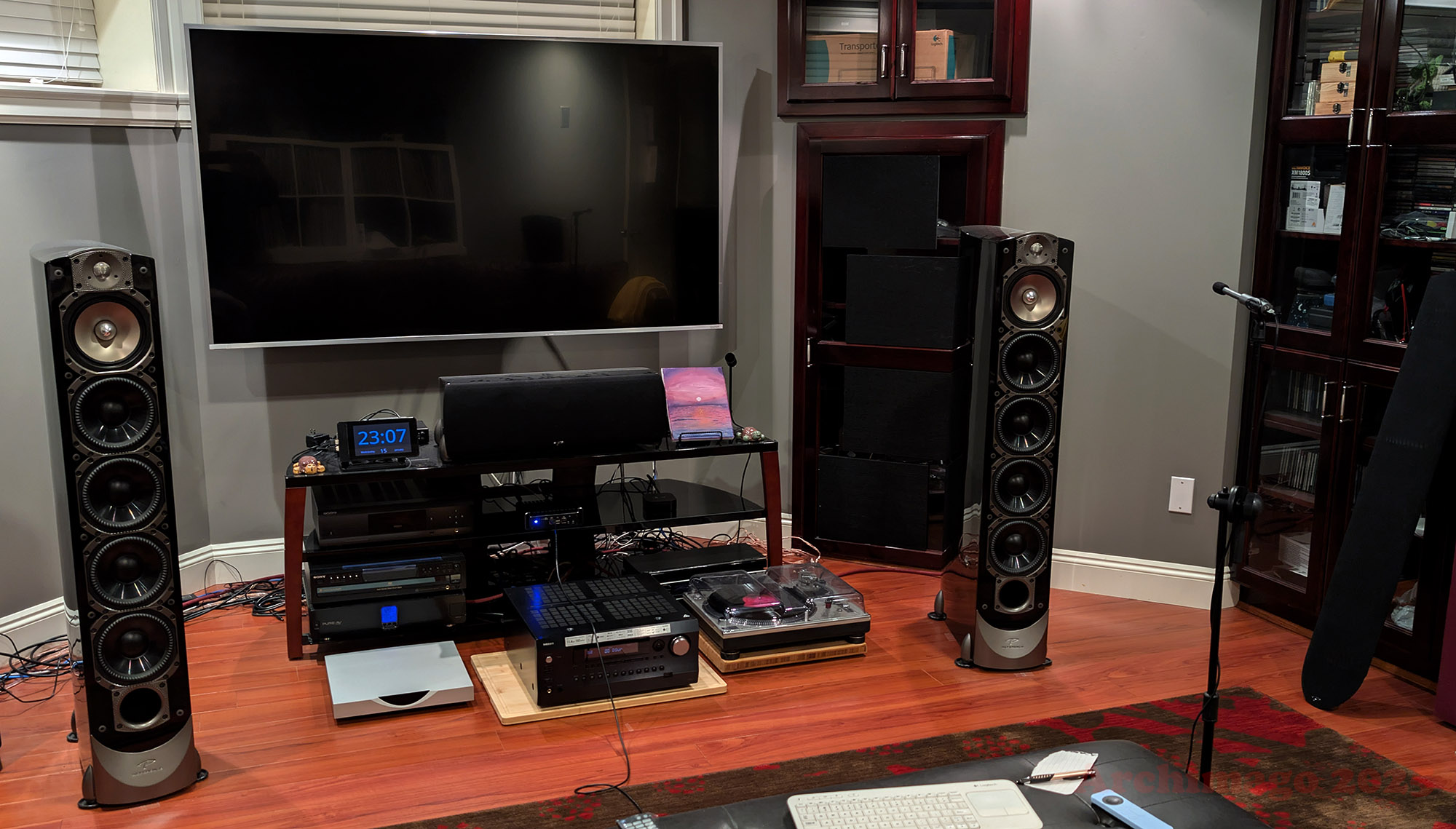
Showing posts with label Speakers. Show all posts

Saturday, 11 April 2026

MUSINGS: On high-end audio component prices, inflation, April Fools and peak "greedflation"?


Let's consider how over the last while even audiophile magazines have wondered about the High-End Audio Industry's escalation in suggested retail prices for their products.

A year ago, Stereophile attempted to answer "Why Hi-Fi Prices Have Risen". To be fair, I think Jim Austin in the article made some good points about inflation, tariffs, etc. I'm glad that the article also acknowledged the fact that for years now, each generation of "high-end" audio products seemingly have also been just getting more expensive, untethered from inflationary expectations.

Grab a nice beverage, have a seat. Let's talk about prices in audiophilia. Is it true that the "high end" has become much more expensive?
[Some of these thoughts will trickle into the psychology of other luxury products beyond audio. Also, we'll be talking about dollars and cents in this post. Since most audiophile goods are priced in US dollars, let's use that through this post, with early April 2026 currency conversion as needed.]

Saturday, 8 November 2025

Sony SS-CS5(M1) and Sony SS-CS5M2 bookshelf speakers - measurements, comparisons, and review.

Hey guys and gals, as shown above, I have pairs of both the Sony SS-CS5 (Mark 1) and the updated Sony SS-CS5M2 (Mark 2) bookshelf speakers here at home purchased through the usual retail outlets. As you might know from discussions online and videos on YouTube, opinions can be quite polarizing regarding these speakers. I think it's a combination of the low price (with associated biases as discussed recently) and the unusual "super-tweeter", 3-driver design. In this post, let's have a look, discuss, and go over a few measurements based on what I see and hear with these transducers.

For convenience, throughout this article, I'll often use "M1" and "M2" shorthand to refer to these Sony SS-CS5 variants.

Saturday, 13 September 2025

Do loudspeaker footers make a difference? Inexpensive aluminum alloy "isolation" footers.

As you can see through my posts, I'm obviously not averse to trying out "cheap audio guy/gal" products. 😏 I trust that this is completely consistent with my perspective on audio hardware for the most part being mature technologies, refined over decades already. For the high-fidelity audio reproduction pursuit, we can achieve excellent quality at very reasonable prices. Many (not all of course) of the "high-end" stuff that go for very high prices are clearly targeting a luxury crowd without necessarily achieving better fidelity. And some products, like what we'll be talking about in this post, I believe only demand "low-tech" solutions anyway.

China is the de facto consumer manufacturing powerhouse of the world in the 21st Century and we'll often find interesting and inexpensive products by mail order from places like AliExpress or Temu. Possibly worth trying some of this stuff if tariffs or shipping charges aren't too high for your country (eg. the de minimis suspension in the USA could take a big tax bite out of easy access to inexpensive goods). Technologically mature products made of standard materials at reasonable quality do not need huge price tags. For example, in early 2024, I grabbed this Nordost-like cable which worked out quite well and I believe performs equivalently in the ways that matter.

Similarly, for this post, let's look at this set of aluminum "isolation" footers which we can easily source from places like Amazon, AliExpress, and Temu:

Price: only about US$25 for a set of four as shown above - available in matte silver, black and gold. I bought two sets of the silver color for my pair of Paradigm Reference Signature S8 v.3 speakers for less than $50 total from Temu among other trinkets in that shipment. 😆

Tuesday, 1 July 2025

SUMMER MUSINGS: Paired speaker testing, more crossover thoughts, running tests ourselves and for ALL speaker reviews!

Paradigm Signature S8 v.3 speakers with grilles off. miniDSP UMIK-1 microphone for some simple testing with Room EQ Wizard (REW).

Well it's summertime which means (hopefully) a bit more opportunity to enjoy the nice weather around here in Vancouver with the family, more time to listen to music, maybe a little trip out of town on weekends.

As for my audiophile interests, it also gives me time to think about the broad topics and maybe run a little bit of testing here and there. Often these summer articles flesh out ideas and results covered over the last few months I may have left aside or on the "cutting floor" when writing.

This post will be along those lines in that these results were actually captured back in the January-February 2025 timeframe when I was doing the ferrofluid replacement for my tweeters, and then subsequent discussions about "audiophile" crossover parts and addressing beliefs of people like GR-Research/Danny Richie.

Since I grabbed these measurements and pictures when I was considering the importance (or not) of crossover part affecting sound quality, I thought I'd post them with some further summertime-meandering and related discussions.

Saturday, 1 February 2025

Loudspeaker crossover parts and sound quality. (Regarding Danny Richie / GR-Research's claims, of course.)

At the heart of most subjective vs. objective heated audiophile debates is the concern about the ease by which a person can dramatically exaggerate claims about sound quality without controlled listening tests, measurements, or any other higher level of evidence beyond personal testimony.

Without any meaningful repercussions, we can say almost anything, claim we experience almost anything, regardless of whether it's true, misperceived, or intentionally exaggerated for financial gain, status among peers, or other benefits. It is necessary therefore that audiophiles who read, watch, or listen to such comments develop the skills for critical thinking to assess such "testimonies"; acceptance without critical thought is simply blind faith, potentially leading us in directions we regret or might even be unhealthy. (See also the article on the types of "subjectivisms" in audiophilia.)

For this post, let's talk about a topic which has been around awhile but perhaps more notable over the last few years about passive speaker crossovers. In particular, the idea that at times quite expensive parts upgrades make desirable, even "huge" differences toward better sound quality.

Grab a seat, open up a beverage, sit by the fireplace if it's cold outside, and let's think about this stuff for a moment, dear audiophiles...

Saturday, 25 January 2025

DIY: Tweeter Ferrofluid Change - with pre- and post- frequency & distortion changes. And on-line amiability among hobbyists.


For this post, I thought I'd discuss a little DIY procedure you might want to think about if you've had your speakers for awhile - like say a decade or more - and know that the tweeter uses "ferrofluid". Not uncommon for tweeters since the 1970's.

Ferrofluid is a substance with ferromagnetic nanoparticles typically suspended inside an organic solvent. These particles are small enough that they're suspended by Brownian motion so over time, the particles do not settle. In tweeters, the ferrofluid surrounds the voice coil which is embedded in the gap between permanent magnets (do electromagnetic speakers use ferrofluid?).

There are benefits to doing this including improving heat transfer away from the wire coil to handle higher power, dampen vibrations (unwanted resonances), and I've heard it said that the ferrofluid can also help suspend the coil within the gap in a way that's better centered (lower distortion).

Now, depending on the type and quality of the ferrofluid, there is the potential that over time this stuff degrades. Some have said that it can dry out, or the consistency becoming more viscous over the years. Here's an interesting video showing degradation of very poor-quality ferrofluid.

Saturday, 18 January 2025

As We Hear It: Audiophile hype vs. reality? GPU chatter (nVidia Blackwell RTX 50XX-series), thoughts on AI frame-generation ("fake frames"), gaming, and art as imagination.


I hope you're all doing well as we enter the year. It's rather amazing that the first quarter of the 21st Century has passed so quickly! Time flew. I do hope that as time passes, audiophiles worldwide are gradually becoming more knowledgeable about the science behind this stuff and in general much more critical thinkers, more resilient to the snake oil and scams of yesteryear. I simply think that this is part of the evolution that must happen for any hobby in order to not stagnate. If something is contentious or seems "too good to be true" based on conventional knowledge as we all become versed in how audio reproduction works, the product very well could be something to avoid; instead, better to save money and look for something more meaningful to purchase.

As per my usual routine, every once awhile I'll publish an E-mail or two from readers of the blog and take time to discuss matters brought up that might not have been fully covered previously, often hitting other short discussion items that don't need a full-length post.

Let's have a look at this E-mail from Michael in Sweden:

Friday, 28 May 2021

REVIEW / MEASUREMENTS: (Anthony) Gallo Acoustics A'Diva Ti (~2005) & Nucleus Micro Speakers (~2000).

Hey ladies and gents, let's switch from discussing headphones this week and have a look and listen at some speakers.

You've probably seen speakers like the ones above over the years. These are the "iconic" Gallo Acoustics A'Diva Ti speakers from the UK. These specific ones are probably something like 16 years old and the 5" diameter A'Diva orb (with 3" driver) is in fact the larger of the 2 speakers from Gallo we'll be talking about today.

Here's the smaller 4" diameter (also 3" driver) little brother - the Nucleus Micro. Note that this is the "non-Ti" version which is from the previous generation, made around year 2000 with presumably a different driver. Unlike the stainless steel protective grille of the A'Diva, the fabric grille is easily removed for photography:

Saturday, 27 February 2021

MEASUREMENTS: Emotiva Airmotiv B1+ bookshelf speakers. A comment about Andrew Robinson's Fluance Reference XL8S video review and "Do measurements ultimately matter?".

Emotiva Airmotiv B1+: Comes with small manual, and some stick-on rubber footers in the plastic bag. Fabric covers in background.

Since mid-2020, I've been on a quest to find some replacement speakers for my computer desktop. Along the path, I've listened to and measured speakers like my old AudioEngine A2, the active Edifier S2000 MkIII, borrowed the Tannoy REVEAL 501a, the passive Fluance Reference XL8S, and of course tried the KEF LS50.

For this post, let's look at the Emotiva Airmotiv B1+ 2-way bookshelf speakers (US$229/pair), released in early 2020. Externally, these look like their predecessor, the Airmotiv B1 that first came out in 2016. I bought this pair direct from Emotiva in late 2020, arriving a little before Christmas.

Saturday, 6 February 2021

RETRO-MEASURE: Spendor SA1 (1976) monitor bookshelf speakers (The foam tweeter ring tweak!? And on "Listen For Yourself!".)


For this week's blog post, let's have a look at another "retro-measure"! This time, I had the opportunity to listen and test out the early-version Spendor SA1 speaker which hails from 1976. Over the years, Spendor has released newer versions of this "classic"; most recently around 2009 as reviewed here in Stereophile.

This is another speaker I borrowed from my friend linnrd and I spoke about it back in late 2019 when I visited his place. This time, let's have a proper listen with measurements and compare the performance objectively and subjectively!

The "Spendor Mini Monitor Type SA1" came out just before the classic BBC LS3/5A design around 1975. Like the LS3/5A, these monitors were designed to be used in mobile recording vehicles.

Saturday, 16 January 2021

RETRO-MEASURE: Radio Shack / Realistic / Tandy Minimus 7 speakers (early 1980s, Cat. No. 40-2030A)

While the "latest and greatest" gear is always nice to check out, read about and measure, over the years, I've also loved the opportunity to examine some of the vintage, "retro" stuff from back in the day. For example, today we have a pair of all-metal, black, Realistic (Radio Shack / Tandy Corp.) Minimus 7 speakers from the early 1980's.

These were "classics" back in the day, found in many college dorms, restaurants, doctors' offices and available for sale at your friendly neighborhood Radio Shack for >25 years. For some more history, check out this page.

Saturday, 9 January 2021

REVIEW / MEASUREMENTS: ELAC Debut 2.0 A4.2 Atmos Speakers

Well, with the pandemic of 2020/2021, one thing that has changed markedly in my family is that we're spending way more time watching movies and miniseries at home this past year. In fact the last movie I watched at the local "cineplex" was 1917 right before the Oscars on February 9, 2020. As such, 2020 has been a year of microwave popcorn, Netflix, Amazon Prime Video, Disney+ and the occasional UHD Blu-Ray played on my Oppo UDP-205 with the family on the sofa.

Wanting to use the Energy C100 bookshelf speakers elsewhere (see what I was doing here), I figured it was time to grab a pair of actual "Atmos elevation speakers". Not unexpectedly, the ELAC Debut 2.0 A4.2 Dolby Atmos Add-On Speakers were on sale before Christmas which you see in the image above.

Saturday, 19 December 2020

MEASUREMENTS: Tannoy REVEAL 501a powered monitors


Today, let's have a look and listen to the speakers you see above.

These Tannoy REVEAL 501a, though discontinued now and replaced with the newer Tannoy REVEAL 502 released in 2014, have been well-regarded over the years in home studio use (check out some user reviews here and on Amazon). They were first released back around 2010 and there's a good Sound On Sound write-up from mid-2011. These were budget priced at <US$500/pair on release (typically sold as individual speakers) although over the years, could be found for a relative steal down at US$200/pair.

These are biamped powered speakers - 40W mid/bass and 20W tweeter, unknown without opening them if these are Class A/B or D amps. There's a 1" soft dome tweeter, 5" mid/woofer, flared front port, and the box is MDF with curved front baffle. Dimensions are 11.9" x 7.3" x 9.4"; relatively small speakers. Each box is individually powered unlike the AudioEngine A2 or Edifier S2000 Mk III previously discussed where there is a cable tethering the speakers together, weighing about 6kg and quite solid in the hand.

Sunday, 29 November 2020

MEASUREMENTS: Fluance Reference XL8S Bookshelf speaker. (Blog post #401 with a brief look back...)


Let's continue with discussions and measurements of bookshelf/desktop speakers. As I expressed a few weeks back, these days I've transitioned to using passive speakers on the computer workstation table with the S.M.S.L. SA300 Class D amplifier. It has enough power I believe for almost any speaker one might want to use nearfield with great energy-efficiency.

What I have on the tabletop today is a pair of new Fluance Reference XL8S speakers that was released recently in summer 2020. These are the walnut veneer version (known as XL8SW). Fluance is a Canadian brand and over the years, may be more well-known for their affordable turntables (eg. the Fluance RT81 Elite looks nice with the RT85 Reference for their higher end), but their product line also includes speakers - other passive bookshelf models include the SX6 out since around 2014, and more recently the Signature HFS (released 2016). I see that they also have floor-standing versions.

Saturday, 31 October 2020

qSpins: AudioEngine A2 & Edifier S2000 Mk III 2-Way Bookshelf Speakers

Hi everyone, thought I'd just publish a couple of "qSpins" today as I might be away for a little bit to attend to other duties in the next couple weeks.

In the last while, I've been looking at getting another pair of speakers on my computer workstation desktop. Here's basically what my desktop speaker system has looked like for years:

Monday, 7 October 2019

Paradigm Signature S8 v.3 Tweeter Replacement. A word about importance of speakers (+ rooms). (And a link to a HDMI cable blind test.)

Paradigm Reference Signature S8 v.3 tweeters.
I mentioned in late August with my "Speaker Impedance - Part 2" post that I noticed a variance between the right and left speaker impedance from my Paradigm Signature S8 v.3 that I was going to track down.


While an ohm here and there might look innocuous on the impedance curves, sometimes this could be indicative of a significant imbalance between speakers. Since I'm a bit obsessive about these things, let's get down to the "nuts and bolts" of the speaker and have a closer listen and look at the frequency response in that frequency region...

Sunday, 7 June 2015

MEASUREMENTS: The Effect of Speaker Grilles...

"Clothed" or "Naked"... What's the difference?

A quick measurement for this week...

I was curious the other day as I was doing some room measurements what effect speaker grill(e)s make. My Paradigm Signature S8 V3's have typical fabric and plastic grilles up front. Simple question - How much difference does the grill make to the sound of the speaker?