Showing posts with label tweaking / optimizations. Show all posts

Saturday, 13 September 2025

Do loudspeaker footers make a difference? Inexpensive aluminum alloy "isolation" footers.

As you can see through my posts, I'm obviously not averse to trying out "cheap audio guy/gal" products. 😏 I trust that this is completely consistent with my perspective on audio hardware for the most part being mature technologies, refined over decades already. For the high-fidelity audio reproduction pursuit, we can achieve excellent quality at very reasonable prices. Many (not all of course) of the "high-end" stuff that go for very high prices are clearly targeting a luxury crowd without necessarily achieving better fidelity. And some products, like what we'll be talking about in this post, I believe only demand "low-tech" solutions anyway.

China is the de facto consumer manufacturing powerhouse of the world in the 21st Century and we'll often find interesting and inexpensive products by mail order from places like AliExpress or Temu. Possibly worth trying some of this stuff if tariffs or shipping charges aren't too high for your country (eg. the de minimis suspension in the USA could take a big tax bite out of easy access to inexpensive goods). Technologically mature products made of standard materials at reasonable quality do not need huge price tags. For example, in early 2024, I grabbed this Nordost-like cable which worked out quite well and I believe performs equivalently in the ways that matter.

Similarly, for this post, let's look at this set of aluminum "isolation" footers which we can easily source from places like Amazon, AliExpress, and Temu:

Price: only about US$25 for a set of four as shown above - available in matte silver, black and gold. I bought two sets of the silver color for my pair of Paradigm Reference Signature S8 v.3 speakers for less than $50 total from Temu among other trinkets in that shipment. 😆

Saturday, 25 January 2025

DIY: Tweeter Ferrofluid Change - with pre- and post- frequency & distortion changes. And on-line amiability among hobbyists.


For this post, I thought I'd discuss a little DIY procedure you might want to think about if you've had your speakers for awhile - like say a decade or more - and know that the tweeter uses "ferrofluid". Not uncommon for tweeters since the 1970's.

Ferrofluid is a substance with ferromagnetic nanoparticles typically suspended inside an organic solvent. These particles are small enough that they're suspended by Brownian motion so over time, the particles do not settle. In tweeters, the ferrofluid surrounds the voice coil which is embedded in the gap between permanent magnets (do electromagnetic speakers use ferrofluid?).

There are benefits to doing this including improving heat transfer away from the wire coil to handle higher power, dampen vibrations (unwanted resonances), and I've heard it said that the ferrofluid can also help suspend the coil within the gap in a way that's better centered (lower distortion).

Now, depending on the type and quality of the ferrofluid, there is the potential that over time this stuff degrades. Some have said that it can dry out, or the consistency becoming more viscous over the years. Here's an interesting video showing degradation of very poor-quality ferrofluid.

Sunday, 11 December 2022

REVIEW: E1DA #9038D6K Dongle DAC / Headphone Amp (Part II): Headphone Amp Power, DSD, Subjective Impressions, AMPT & Perfectionistic Tweaking!

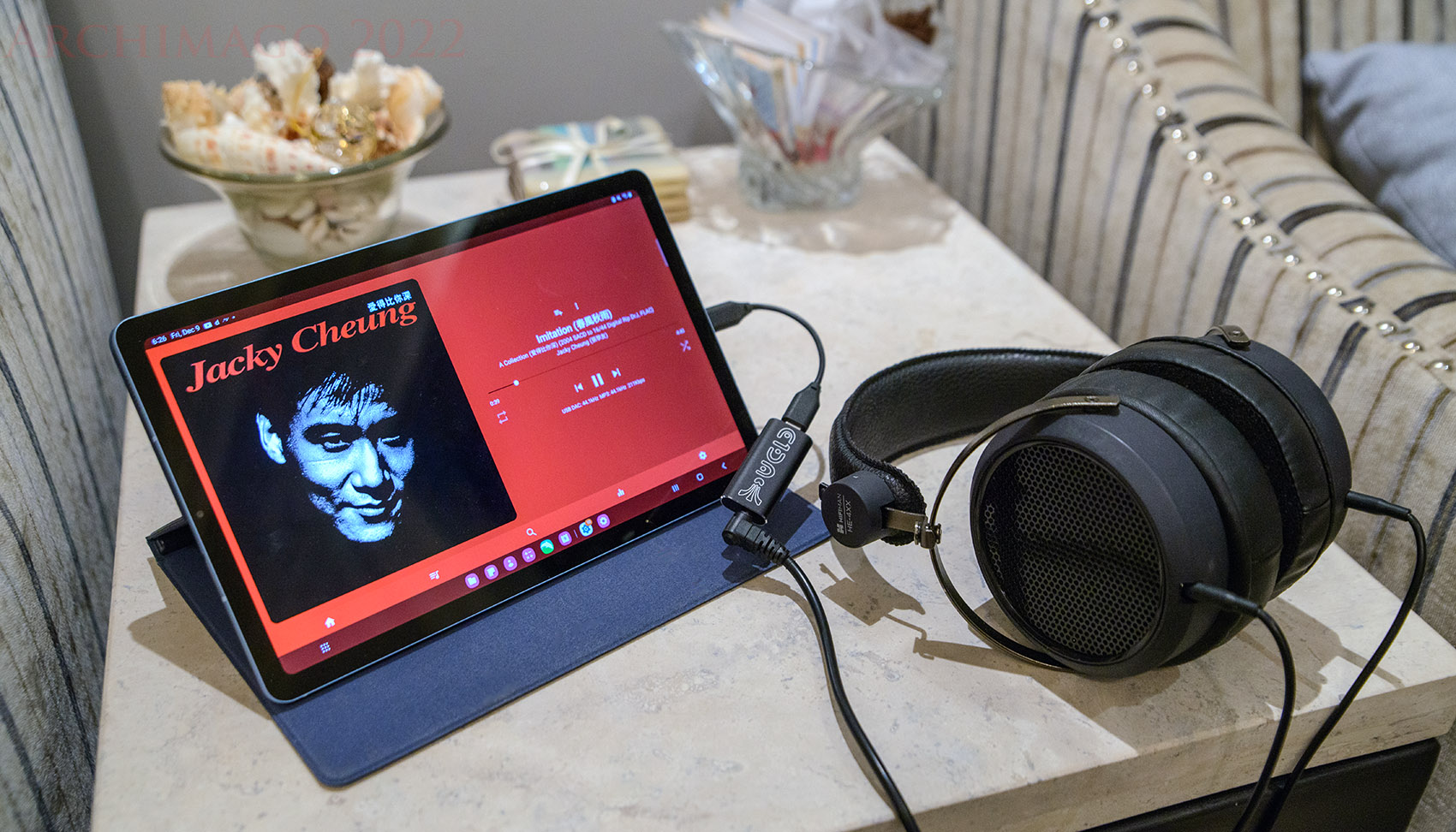
A great sounding music listening station! (Samsung Galaxy Tablet, Drop+HiFiMan HE-4XX, classic Jacky Cheung cantopop.)

Okay friends, today we continue with Part II of the discussion on E1DA's #9038D6K portable DAC/headphone amp. Please refer to Part I last time for the general overview of DAC performance which already tells us about the PCM resolution of the device. The data from last time shows that for the price and size, this unassuming dongle is one heck of an accurate, high-fidelity, high-resolution digital-analogue converter.

This time, let's move forward with exploring other areas not yet discussed. Specifically, let's focus on resolution when under headphone-like loads, look at DSD performance characteristics, have a listen to the DAC, and given that E1DA is known to be tweaker/DIY-friendly (including making devices like the Cosmos line), let's also talk about what I would consider more "extreme" tweaking for the perfectionist audiophiles!