Showing posts with label SINAD. Show all posts

Saturday, 14 May 2022

EARLY LOOK: E1DA Cosmos APU - high performance, low-noise pre-amp and 1/10kHz notch filter. [Quick peek - S.M.S.L. DO100 DAC.]

Readers on the blog will likely remember that last year, Ivan Khlyupin (aka IVX on a number of forums) of E1DA sent me a pre-production Cosmos ADC for testing and use. As discussed then, this affordable ADC unit turned out to be a remarkably capable device using the ESS Sabre ES9822Pro chip at a very reasonable price. With recent price upheavals, currently on Amazon for a Grade B device with SNR 127+/-1dB(A) in mono mode, it's selling for just less than US$250.

There were already discussions last year that the "Cosmos" line of devices would include the one we'll be talking about today - the Cosmos Analog Processing Unit (APU). As the name implies, this is an analogue device that serves the purpose of (pre)amplification with very low noise, also providing a 1kHz notch for accurate measurements of THD+N/SINAD as we typically see in DAC reviews.

With the APU near production release (possibly next month or so), Ivan again kindly sent me a unit for use here on the blog. Using the combination of Cosmos APU + good ADC (doesn't have to be Cosmos ADC), the user should be able to peer down into the noise limits and measure characteristics like dynamic range, and THD+N/SINAD with great accuracy even beyond the limits of modern state-of-the-art DACs.
Saturday, 15 January 2022

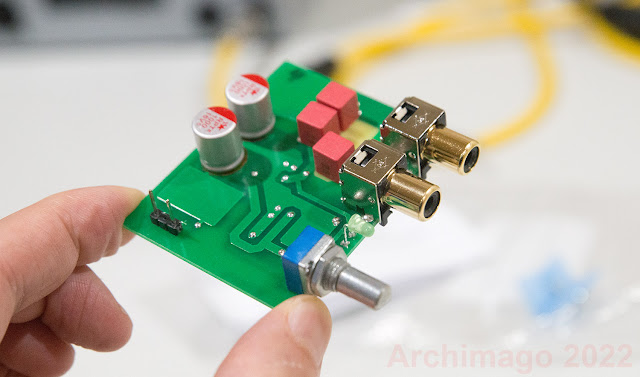
Using Victor's Oscillator as reference (1kHz, ultra-low distortion analogue sine generator). A quick peek at the APx555B Analogue & DAC Signal Generators @1kHz. And on playing music "for fun"!

Note the 2-pin power connector on the lower left.

As you've seen on the blog over the last year, I've been using the E1DA Cosmos ADC from Ivan Khlyupin for a number of measurements recently (early report discussed here). I remain quite impressed by the performance of this little device with some caveats (lower input impedance, individual unit idiosyncrasies including what "grade" device one has).

While the ADC comes pre-calibrated by E1DA and unless you really want to spend some time playing with it, one should probably just leave it alone. Nonetheless, it's pretty clear that this is the kind of device made by and for audio hardware geeks! ;-) One has the opportunity to use the Cosmos_Tweak Windows program to fine-tune the calibration by changing independent ADC 2nd and 3rd harmonic compensation amounts, SDM integrator setting, and digital filter for the ESS Tech ES9822 chip.

So then, for this post, let's spend some time in the area of calibration and see if we can tweak the ADC using the device above - Victor's Oscillator (US$57) - an ultra-low distortion, 1kHz analogue signal generator which comes pre-assembled and tested from Riga, Latvia. As you can see in the image, there are 2 single-ended RCA outputs, with volume control ranging from 300mVrms (-8.25dBu) to 2.7Vrms (+11.0dBu). Note that a 10kHz version (and other custom versions) can be purchased as well but for typical audio purposes, 1kHz is in line with human hearing sensitivity.

Saturday, 15 September 2018

MUSINGS / MEASUREMENTS: About THD(+N) and standardizing testing here... (With a taste of the RME ADI-2 Pro FS as DAC...)


Last week, when I published my look into the RME ADI-2 Pro FS ADC performance, I started using SpectraPLUS for measurements in high resolution for THD and THD+N. I know, it's an old measurement and everyone does it. I realized shortly after publication of the article that while I was using the same technique to measure the RME vs. Focusrite ADCs, I had the ADCs running at 192kHz and so issued an addendum that the results included the rising ultrasonic noise from the ADC and not just a reflection of the DAC. Not unreasonable as a comparison between the two ADCs I think, but this would not be fair to the DAC or other component measurements since much of the noise would be arising from the ADC stretching out to a 96kHz bandwidth. It's worth taking some time to think, going forward, how I could improve the usefulness of this test and in a standardized way here when focusing on whatever device is being tested...

If we look around, we see that the THD+N spec is probably the most used objective "number" for audio equipment as a quick snapshot of fidelity. The THD (page on calculation, how it's done) component tells us whether harmonics are being added to the sine wave at the integer multiples of the fundamental frequency (these are the results of "nonlinearities" in the equipment), and the +N piece adds the noise component found in the signal being tested which of course is also subject to noise limitations of the measurement device and the computational limits of the FFT technique used. In essence, the THD+N ratio is a representation of everything that's being added to a simple single-tone test which of course has its limitations as a test paradigm as well when real music is far from static.