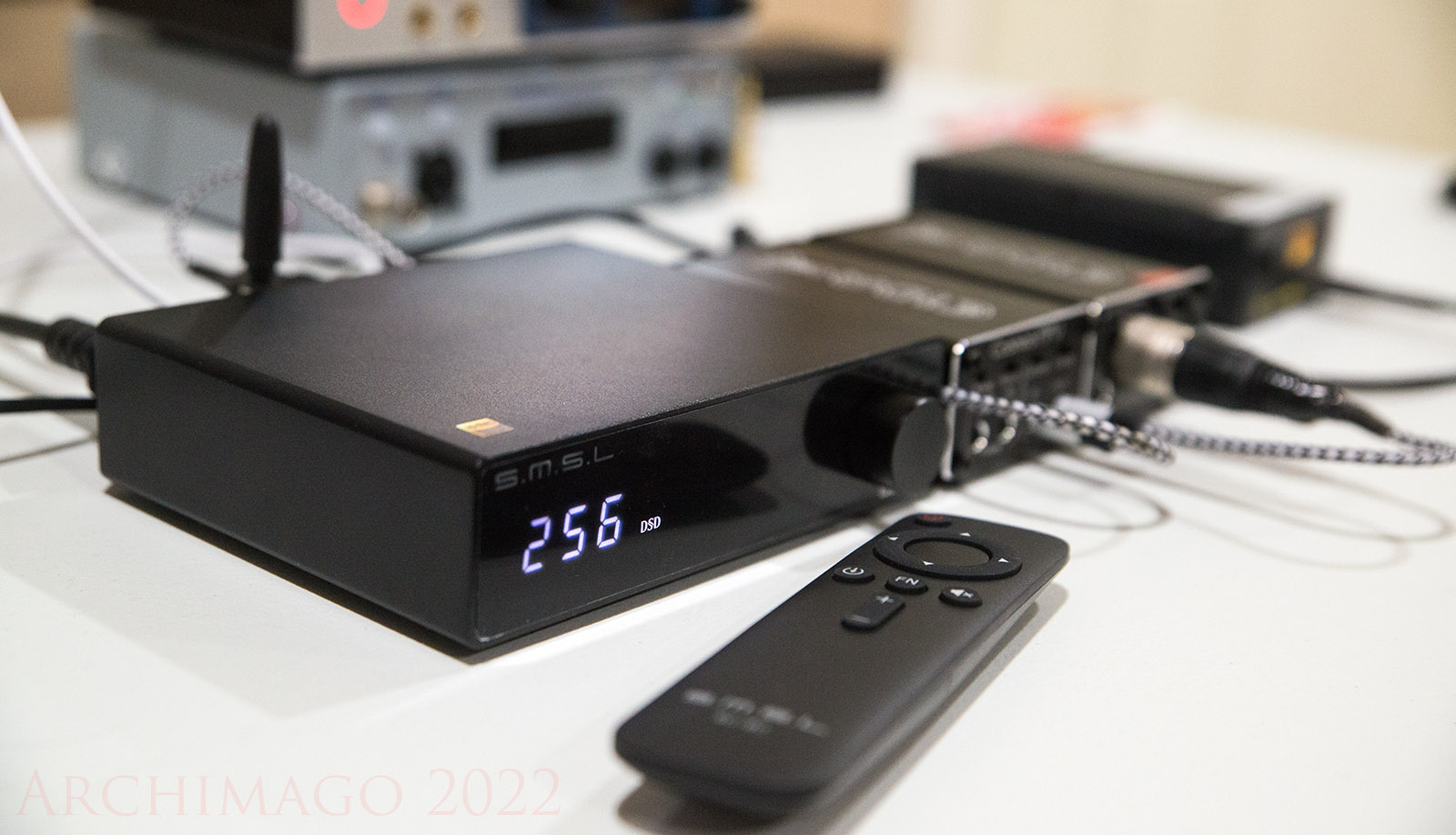
![]() |
| As you can see, the SMSL DO100 displays DSD samplerate in the form of DSD64 (64 x 44.1kHz = 2.8MHz), DSD128 (5.6MHz), DSD256 (11.3MHz) and DSD512 (22.6MHz). |
A 'more objective' take for Rational Audiophiles. Among other topics!
X/Twitter: @Archimago
E-Mail: archimagosmusings(at)outlook.com
[Some items linked to affiliate accounts - I may receive gift certs from qualifying purchases.]
Saturday, 25 June 2022
REVIEW: S.M.S.L. DO100 DAC [Part III - DSD, Subjective, AMPT Recording, and Conclusions]. And a very close look at the Topping D10 Balanced THD(+N) vs. Level graph.
Saturday, 11 June 2022
REVIEW: S.M.S.L. DO100 DAC [Part II - PCM Resolution]. (And on MQA's distasteful environmental claims...)
As we continue to evaluate the S.M.S.L. DO100 DAC, let's spend time today delving into the resolution that this machine provides as a PCM DAC (see Part I last week for filters and jitter performance). Given that PCM is the de facto digital modulation scheme, this post will form the heart of DAC performance evaluations. We'll leave DSD to Part III along with discussions of subjective performance.
With PCM data, this DAC will accept up to 32/768. Let's run some tests as per usual to see how this device compares to others I've looked at on this blog. For most of the tests, I will use my Raspberry Pi 4 "Touch" (USB) or a Logitech Squeezebox Touch (S/PDIF) as digital source. The E1DA Cosmos ADC will be used with or without the Cosmos APU to measure. For some of the REW-based tests, I will perform a simple loopback that looks like this:
Intel NUC → SMSL DO100 DAC → [Cosmos APU] → Cosmos ADC → Intel NUC
As usual, all cables are generic RCA when testing unbalanced, for XLR measurements 6' Monoprice Stage Rights were used.
Unless otherwise noted, the DO100 will be set-up to use "FL6" Linear Steep filter.
Without further ado, let's jump to it...
Saturday, 4 June 2022
REVIEW: S.M.S.L. DO100 DAC (dual ESS ES9038Q2M) [Part I - Overview, Filters & Jitter]. (And the likely continued contraction of MQA...)
Over the last number of years, we have seen a proliferation of DACs from Chinese manufacturers offering models of increasingly better resolution - higher fidelity - and greater feature set. These days, I am of the opinion that we have achieved way above and beyond the ability for human hearing to differentiate these machines unless the manufacturers purposely added some kind of "coloration" to the analogue output whether it be frequency response or changes to the noise and distortion levels (the "tube sound" being a prototypical example we may come across).
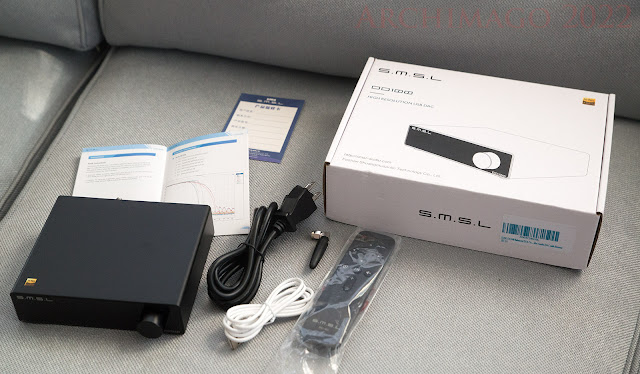
As you can see in the image above, we have the S.M.S.L. DO100 DAC (~US$250) in today for review. I bought this unit through retail channels and intend to either use it myself or give it away if I have no need for it.
For many devices these days, opening the manual will show us technical information like the frequency response of the filters in this example. I think this is a nice evolution among manufacturers recognizing that showing product performance is important to educated customers with graphs and technical details rather than mere prose which often provides little satisfaction for the consumer's intellect.
Today, let's start a multi-part look at this DAC; no need to hurry because I think the performance at this price point warrants serious consideration and the many ways and features one can gather performance metrics on (I don't promise to test everything of course!). Obviously it's not an expensive device, has a remote controller, has both unbalanced RCA and balanced XLR outputs, Bluetooth 5.0 input, capable of up to 32/768 PCM and DSD512 (1-bit, 22.6MHz) using USB 2.0, along with S/PDIF TosLink and Coaxial inputs for up to 24/192 and DoP DSD64. No money wasted on MQA licensing. Depending on what we find, this might be right for you...
Saturday, 14 May 2022
EARLY LOOK: E1DA Cosmos APU - high performance, low-noise pre-amp and 1/10kHz notch filter. [Quick peek - S.M.S.L. DO100 DAC.]
Readers on the blog will likely remember that last year, Ivan Khlyupin (aka IVX on a number of forums) of E1DA sent me a pre-production Cosmos ADC for testing and use. As discussed then, this affordable ADC unit turned out to be a remarkably capable device using the ESS Sabre ES9822Pro chip at a very reasonable price. With recent price upheavals, currently on Amazon for a Grade B device with SNR 127+/-1dB(A) in mono mode, it's selling for just less than US$250.
There were already discussions last year that the "Cosmos" line of devices would include the one we'll be talking about today - the Cosmos Analog Processing Unit (APU). As the name implies, this is an analogue device that serves the purpose of (pre)amplification with very low noise, also providing a 1kHz notch for accurate measurements of THD+N/SINAD as we typically see in DAC reviews.
With the APU near production release (possibly next month or so), Ivan again kindly sent me a unit for use here on the blog. Using the combination of Cosmos APU + good ADC (doesn't have to be Cosmos ADC), the user should be able to peer down into the noise limits and measure characteristics like dynamic range, and THD+N/SINAD with great accuracy even beyond the limits of modern state-of-the-art DACs.


