![]() |
| E1DA Cosmos ADCiso Grade A center. Cosmos ADC Prototype I've been using over the years to the left. |
A 'more objective' take for Rational Audiophiles. Among other topics!
X/Twitter: @Archimago
E-Mail: archimagosmusings(at)outlook.com
[Some items linked to affiliate accounts - I may receive gift certs from qualifying purchases.]
Saturday, 8 June 2024
The E1DA Cosmos Stack: ADCiso and 2 APUs. An example of bad multichannel - Neil Young's 'Harvest' on DVD-A (2002), fixed in new Atmos mix.
Saturday, 23 March 2024
EARLY LOOK (Part II): E1DA #9039S USB Balanced DAC dongle/headphone amp - DSD and performance under load. A few more words on the "need" for higher DAC fidelity!
Last week, I published Part I of the review/measurements on the upcoming E1DA #9039S USB dongle DAC/headphone amplifier. Already, we've seen that this ESS ES9039Q2M-based balanced DAC produces very clean, high-resolution sound.
As we continue, let's delve deeper into the performance of this little device. We'll have a look at some features like DSD performance and more importantly, let's examine the balanced amplifier output when subjected to headphone-like loads to see how well it performs.
Saturday, 16 March 2024
EARLY LOOK (Part I): E1DA #9039S USB Balanced DAC/headphone amp - Super Hi-Res, Tiny Package! Also, let's tweak...
![]() |
| Notice balanced 2.5mm TRRS phono output. |
Sunday, 11 December 2022
REVIEW: E1DA #9038D6K Dongle DAC / Headphone Amp (Part II): Headphone Amp Power, DSD, Subjective Impressions, AMPT & Perfectionistic Tweaking!
![]() |
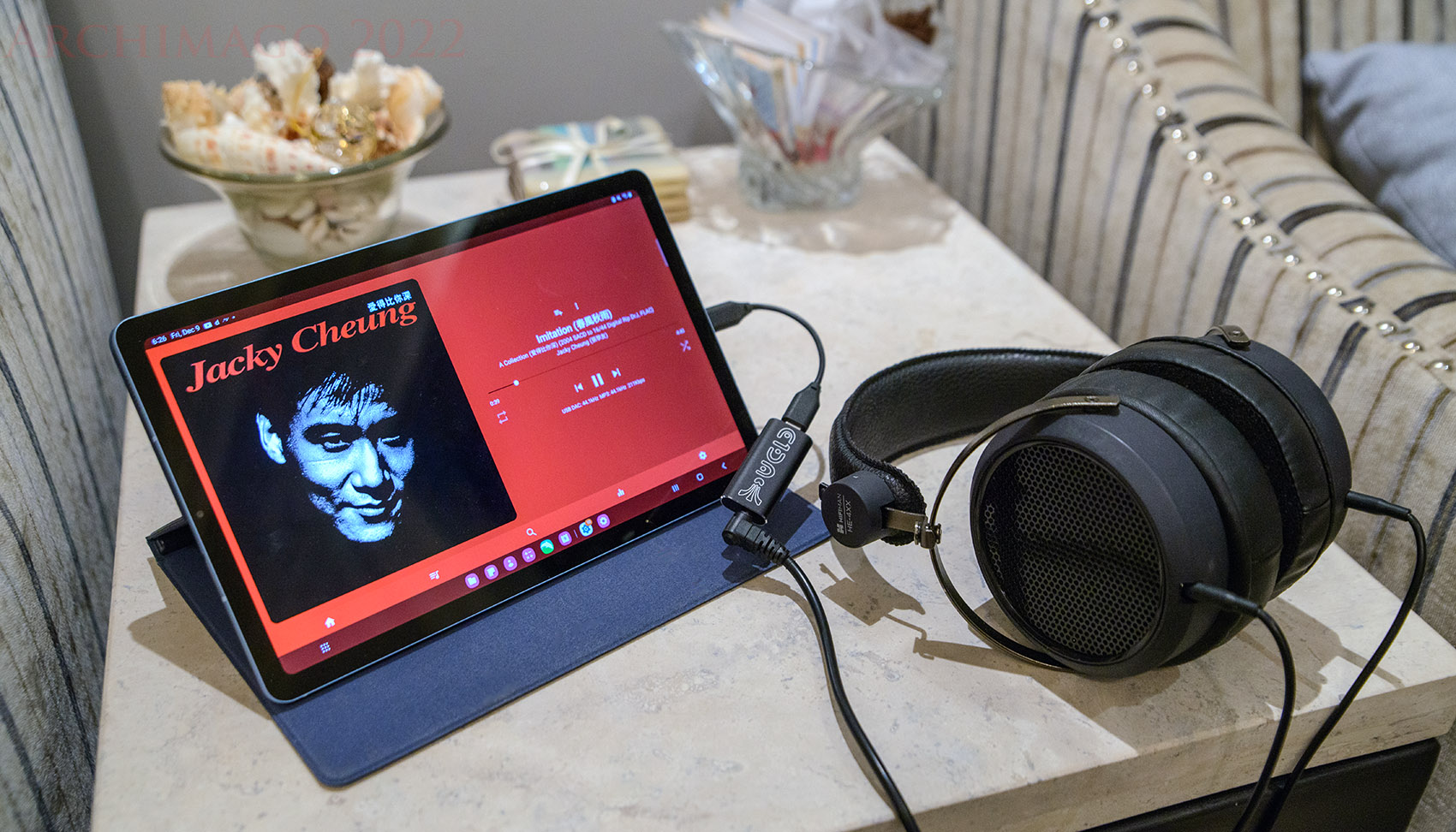
| A great sounding music listening station! (Samsung Galaxy Tablet, Drop+HiFiMan HE-4XX, classic Jacky Cheung cantopop.) |
Okay friends, today we continue with Part II of the discussion on E1DA's #9038D6K portable DAC/headphone amp. Please refer to Part I last time for the general overview of DAC performance which already tells us about the PCM resolution of the device. The data from last time shows that for the price and size, this unassuming dongle is one heck of an accurate, high-fidelity, high-resolution digital-analogue converter.
This time, let's move forward with exploring other areas not yet discussed. Specifically, let's focus on resolution when under headphone-like loads, look at DSD performance characteristics, have a listen to the DAC, and given that E1DA is known to be tweaker/DIY-friendly (including making devices like the Cosmos line), let's also talk about what I would consider more "extreme" tweaking for the perfectionist audiophiles!
Tuesday, 6 December 2022
REVIEW: E1DA #9038D6K Dongle DAC / Headphone Amp (Part I) - PCM DAC performance. And (potentially) higher dynamic range in Spatial Audio 2-channel fold-downs.
![]() |
| Little E1DA DAC to Sennheiser HD800 headphones via 1/4" adaptor... Looks ridiculous if walking around in public with this! But sounds great. ;-) |
This is the latest iteration of the #9038D models which feature 3.5mm single-ended output, to be distinguished from the #9038S models which are balanced devices with 2.5mm output jacks. And the "6K" refers to 6000μF (!) of power rail filtering (original #9038D has 4000μF).
As the name implies, internally, these DACs are based on the ESS ES9038Q2M low-power chips. They are capable of playing back PCM to 32/384 as well as up to DSD256. Over the last year or two, we've seen a proliferation of DACs based on this component and I would say that overall, the performance on these devices have in general been very good. Thanks to the low power consumption, we can now have mobile converters that perform at least to the resolution of many desktop DACs while being fully USB-powered.
To generate the amplified headphone output, op-amps used include the OPA1622 and OPA1602 based on the E1DA specs. To achieve very high resolution, internal components are advertised to be quality Susumu resistors, Murata C0G caps, Kyocera AVX tantalum caps, and connectors from Taiwan. In my discussions with Ivan, I know in the last while it has been slow for him to source some of these components and at times difficult to avoid fake parts out there!
Saturday, 19 November 2022
EARLY LOOK: The E1DA Cosmos Scaler prototype. As usual, Neil Young (in "World Record" album interview) remains neurotic against digital...
Saturday, 12 November 2022
Accurate Sound's Hang Loose Convolver Multichannel on low power Mini PC. The disgraceful AQVOX ethernet switch. And some E1DA upcoming evaluations.
Recently, my friend Mitch Barnett of AccurateSound.ca wondered if I could look into the performance of his latest version of Hang Loose Convolver (HLC) with this low-power computer using my power limited and quiet fan BIOS settings. HLC is an advanced standalone, VST3 plug-in, or AU (Mac) plug-in that provides the ability for audio lovers to load in various convolution filters, allows for easy level matching, and provides basically immediate switching (0.1ms) between these filters for accurate A/B listening comparisons. Let's take a look at this on the Beelink.
Saturday, 14 May 2022
EARLY LOOK: E1DA Cosmos APU - high performance, low-noise pre-amp and 1/10kHz notch filter. [Quick peek - S.M.S.L. DO100 DAC.]
Readers on the blog will likely remember that last year, Ivan Khlyupin (aka IVX on a number of forums) of E1DA sent me a pre-production Cosmos ADC for testing and use. As discussed then, this affordable ADC unit turned out to be a remarkably capable device using the ESS Sabre ES9822Pro chip at a very reasonable price. With recent price upheavals, currently on Amazon for a Grade B device with SNR 127+/-1dB(A) in mono mode, it's selling for just less than US$250.
There were already discussions last year that the "Cosmos" line of devices would include the one we'll be talking about today - the Cosmos Analog Processing Unit (APU). As the name implies, this is an analogue device that serves the purpose of (pre)amplification with very low noise, also providing a 1kHz notch for accurate measurements of THD+N/SINAD as we typically see in DAC reviews.
With the APU near production release (possibly next month or so), Ivan again kindly sent me a unit for use here on the blog. Using the combination of Cosmos APU + good ADC (doesn't have to be Cosmos ADC), the user should be able to peer down into the noise limits and measure characteristics like dynamic range, and THD+N/SINAD with great accuracy even beyond the limits of modern state-of-the-art DACs.
Saturday, 11 September 2021
EARLY LOOK: E1DA Cosmos ADC - affordable high performance measurements for the audio hobbyist!
As you can see in the picture above, I have one of Ivan Khlyupin's (aka IVX) Cosmos ADCs. It's not available yet on the market, so watch for when it's released from E1DA in the days ahead. (I see that variants are available on Amazon now.) Thank you Ivan for reaching out and sending this unit for me to use!
[If you're wondering about the E1DA name, as explained by Ivan, it comes from the pronunciation of "Ivan" as sounding like "E1" in Russian as opposed to the Americanized "Eye-Ven". "DA" as in "dah" ("да", "yes") - so it means "Ivan Yes".]
While this unit is one of his builds for external testers, I suspect that it should be much the same as the final product when available hopefully later this month. Obviously there could still be some changes with the final production release.
I think the price is slated for around US$150. Also, in the days ahead, E1DA will be releasing the "APU" (Analog Processing Unit) that can complement an ADC for measurements with the ability to notch out the 1kHz fundamental among other features allowing even more accurate measurements of very high performance gear. And there's also the Cosmos DAC coming as well to complete the "trinity".
For today, let's have a peek at the Cosmos ADC. Let's explore how to get it going, some of its features, and although still early days, we can take a quick look at measurements with this tool, with some DACs I have here.