Showing posts with label E1DA Cosmos ADC. Show all posts

Saturday, 15 October 2022

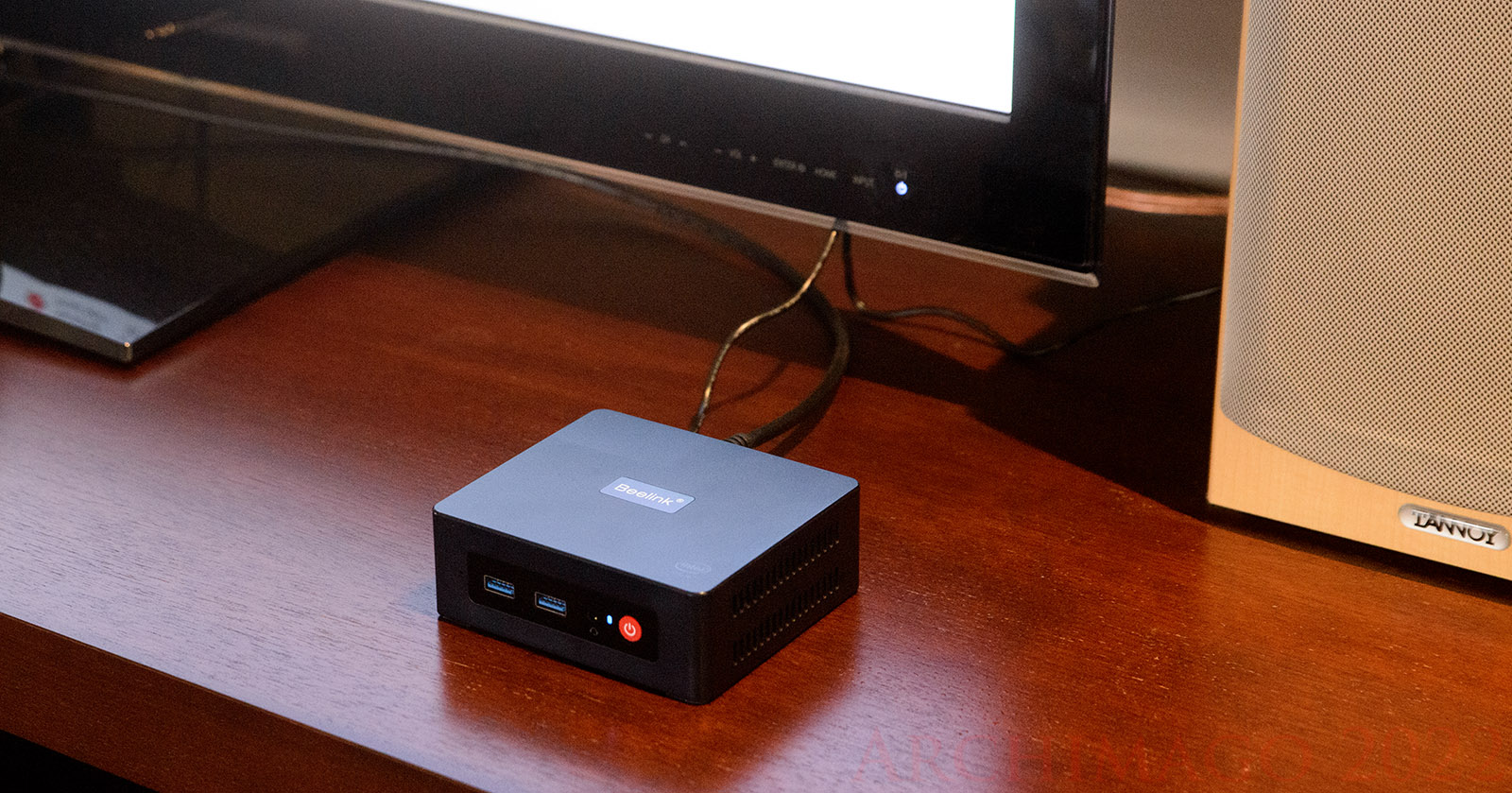
REVIEW: Beelink Mini S (Celeron N5095A 4C/4T CPU, 8GB DDR4 RAM, 256GB SSD) Mini-PC. (And E1DA Cosmos ADC follow-up: RIAA EQ & 768kHz.)


In the image above, we see the Beelink Mini S computer. I was sent this product from one of the distributors (thanks to MinixPC - see here for the current price) for an honest opinion in the context of the fact that over the last while, I had already explored the small MeLE Quieter2Q and Quieter3Q as well as the more powerful AMD-based Beelink SER4 Ryzen 7 machines. 

Now, unlike the MeLE Quieter machines, this one is not fanless, but it is indeed quiet and I suspect the fan noise will be no problem in the vast majority of settings. On balance however, what you get is a machine that is less expensive (you should be able to find one for around US$180 or better) and the active cooling will keep it cooler especially if you do end up placing it in more cramped environments. As usual, make sure there is still air flow of course!

Let's have a closer look at the item and performance...

Saturday, 21 May 2022

A Look at ADC Noise Limits and Distortion - Or "How much difference does the Cosmos APU make?" And a look at 2-channel Room EQ Wizard measurements!

I received a few questions as a follow-up to last week's post about the E1DA Cosmos APU basically around the question: "When do I need a pre-amp/notch filter like that if I have a high resolution ADC?"

That's a great question! Let's spend some time looking into this...

Now, the first thing to be mindful of is that our DACs and ADCs are not perfectly linear devices, nor have limitless low-noise performance of course. This is why we measure the limits of DACs to gauge the extent of "accuracy". And ADCs likewise have limits as well to their intrinsic noise level and potential for distortion. As we approach the limit of the ADC's performance, it will start introducing its own characteristics into the captured signal which could look like noise anomalies as well as harmonics - like DACs, there is an ADC THD+N.

In this post, let's run some practical "experiments" of sorts using the Cosmos ADC and RME ADI-2 Pro FS to examine these ADC limits when measuring DAC dynamic range and THD+N/SINAD with and without the aid of the Cosmos APU.

Saturday, 11 September 2021

EARLY LOOK: E1DA Cosmos ADC - affordable high performance measurements for the audio hobbyist!

As you can see in the picture above, I have one of Ivan Khlyupin's (aka IVX) Cosmos ADCs. It's not available yet on the market, so watch for when it's released from E1DA in the days ahead. (I see that variants are available on Amazon now.) Thank you Ivan for reaching out and sending this unit for me to use!

[If you're wondering about the E1DA name, as explained by Ivan, it comes from the pronunciation of "Ivan" as sounding like "E1" in Russian as opposed to the Americanized "Eye-Ven". "DA" as in "dah" ("да", "yes") - so it means "Ivan Yes".]

While this unit is one of his builds for external testers, I suspect that it should be much the same as the final product when available hopefully later this month. Obviously there could still be some changes with the final production release.

I think the price is slated for around US$150. Also, in the days ahead, E1DA will be releasing the "APU" (Analog Processing Unit) that can complement an ADC for measurements with the ability to notch out the 1kHz fundamental among other features allowing even more accurate measurements of very high performance gear. And there's also the Cosmos DAC coming as well to complete the "trinity".

For today, let's have a peek at the Cosmos ADC. Let's explore how to get it going, some of its features, and although still early days, we can take a quick look at measurements with this tool, with some DACs I have here.