Showing posts with label Roon. Show all posts

Saturday, 7 June 2025

Roon in 2025, 10 years on: Sound quality, thoughts, and suggestions. And an increasingly AI-generated Internet.

Notice it has been "10 Years" for Roon as per the top left.
Roon 1.0 was released May 2015.

Obviously, it's impossible to get on all the discussion forum about the myriad subtopics in this audiophile hobby. However, I do get newsletters in my inbox and I see frequently asked questions that inspire many of the topics addressed here.

If we've come across each other on the audio forums (places like Steve Hoffman's site, or Audiophile Style), you'll notice that I often will respond with links to articles on this blog. I've posted more than 600 long-form articles already, the vast majority digging pretty deep into the audio topic. One of my intentions over the years is for this to be a repository of information, articles I can use as "landmarks" when I engage in discussions with fellow audiophiles; how I understand the hobby including big-picture philosophy, psychology, the debates. Contained within these pages are the thoughts, character, understandings of "Archimago the anonymous audiophile from the early 21st Century" with contributions from guest posters. Familiarity with these articles I think will provide a good starting point for "rational audiophiles", without necessarily going too deeply into technical details.

Apart from discussing individual products, broadly, I think we've covered many of the usual issues raised in audio circles already, much of it analyzed with data to seek out the facts, rather than mere opinions. Feel free on the main page of this blog to use the "Search This Blog" widget as I suspect you'll find articles addressing many questions.

So, coming back to a frequently asked question, for this post, let's think about Roon software in 2025 (currently version 2.51 build 1534). In a recent Roon forum newsletter, I saw this question posed by Eric_Pell:
"I am wondering for years why the most expensive app in the world of hifi and high end only has a sound quality which is only ok. If you compare Roon with JPLAY i think JPLAY has only a few people to develope (sic) software and improve sound quality. But here the difference. What is Roon doing to improve sound quality and do they compare with JPLAY or not?"
Saturday, 14 January 2023

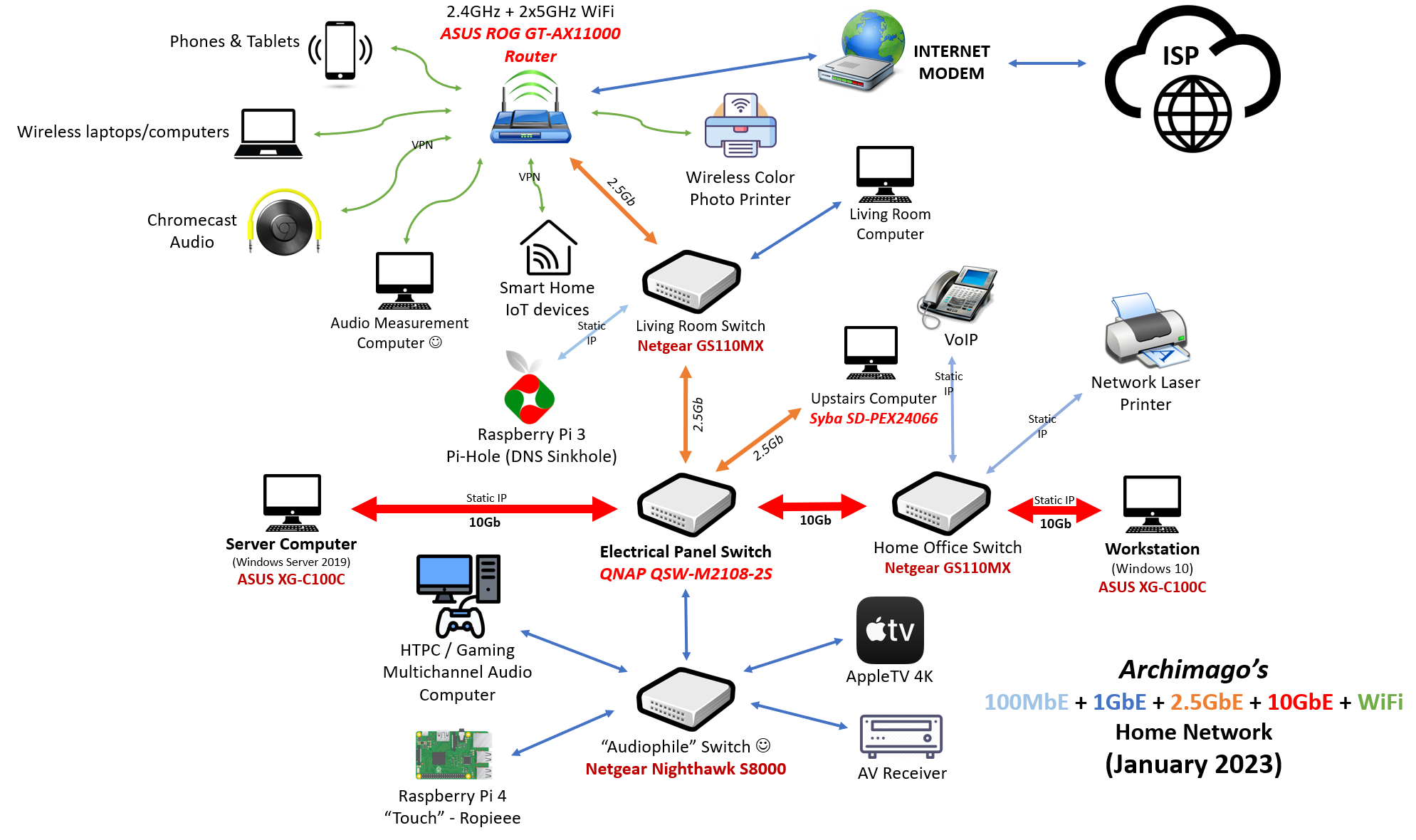
Home Network: Update on mixed 10 gigabit network, Roon stability & value? (And a quick look at Pi-Hole.)

Happy 2023, dear audiophiles!

While I typically publish articles like measurements of audio hardware, discuss albums (usually as part of reviews or examination of things like dynamic range), and offer critiques about extreme "High End" audiophilia, every once awhile I'll talk more generally about my computer hardware and local area network (LAN). I see the network stuff as part of a broader foundation of the modern digital audio system which simply has to work reliably and efficiently for digital streaming/computer audiophiles. Like other parts of the "perfectionist" audiophile system (like say the room which is often also neglected in audiophile hardware talk), this should be optimized for best performance such that those using it will not have to suffer from speed issues or dropouts. Sometimes it's easier said than done given potential interoperability nuances of the multitudes of network hardware!

Apart from silly "audiophile ethernet switches", or "audiophile ethernet cables", there's generally nothing specific to sell to audiophiles when it comes to home network hardware. As a result, it's atypical to see long articles at audiophile websites or in the magazines about this stuff despite the importance.

As a reminder, in my experience, unless we're dealing with faulty gear, "Bits Are Bits" when it comes to sound quality - that's just reality if you take the time to analyze the audio signal objectively or run some controlled listening trials. Despite all kinds of subjective voices/claims out there otherwise, high performance modern computer networks are simply not going to change the sound of audio playback so long as they're reliably "bit-perfect". After all these years, I find no reason to be concerned about ethernet cables, or switches transferring packet data around. Whether the data is of audio content or otherwise is irrelevant - the network doesn't care whether it's audio meant for the DAC or pixels aimed at the printer.

Digital data, given how it's packaged and transmitted, when corrupted will result in rather obvious audible anomalies if not corrected (like an error-prone USB cable). You will not hear subtle changes (like "more bass" or "better soundstage" or even more vaguely "improved presence") as some reviewers seem to promote when hyping nonsensical claims of what they supposedly "heard".

Saturday, 24 September 2022

HOW-TO: Roon 2.0 with ARC released, running Android ARC on Windows. Roon's "grace period". And how about more audiophile remasters of music from the '80s onward?


The big news this week among the audiophile channels I think is that Roon 2.0 has been released which allows remote access to your Roon Core when on-the-go. Nice, it's about time considering that I've been streaming off Logitech Media Server for ages to my phone and at the office! The app that allows access remotely is something called Roon ARC - available for 64-bit Android in Google Store and for Apple devices.

This is a nice step forward and now I can listen to my music on the smartphone. However, I want to also play the music at my office on the Windows 10 computer. However, when remote desktop streaming was discussed with the company, the official answer has been "Roon ARC is mobile device-only application". Well, that's not a completely acceptable answer, I'm afraid. :-(

For the time being, you could run the Android app in Windows with BlueStacks 5 - 64-bit Android 9 Pie edition. Here's a look...

Saturday, 23 October 2021

Miscellany: FlexASIO for 384kHz, Philips 2001 SACD/DSD64 test signals (thanks Black Elk!), and Roon network multicast. [And Coltrane's A Love Supreme Live Hi-Res, Music Industry Crystal Ball, Magic Quantum Fuses!]

A scene from The Simpsons 1996...

Hey everyone, for this week, let's talk about a few "miscellaneous" topics which I've either wanted to mention over the last few months or have just come up as interesting tidbits I think worth documenting but not necessarily large enough as topics in individual posts. The main topics are:

A. Instead of ASIO4All, we can use FlexASIO with the E1DA Cosmos ADC for 384kHz samplerate measurements in Room EQ Wizard.

B. A look at some "standard" SACD test signals from Philips back in 2001. With many thanks and great discussions with Black Elk.

C. Roon needs network multicasting. Check this out if you're running into network issues; I had some problems initially with my ASUS ROG GT-AX11000 and relatively complex home network.
 

Saturday, 20 February 2021

REVIEW / MEASUREMENTS: HiFiBerry DSP Add-On with the DAC2 HD. A quick Roon 1.8 network/endpoint issue and remote access request.

This post is in many ways a continuation of the HiFiBerry DAC2 HD measurements presented last time with the devices sent to me by Doug Gardner for testing. For some background, this DSP Add-on is related to the BeoCreate project which was documented in this 2018 thesis in collaboration with Bang & Olufsen. The idea was to create an open-source system to allow consumers to build or update their own loudspeakers to be active devices. It looks like this DSP Add-On board leverages that software to do its magic.

As you can see in the thesis, the final BeoCreate product was a board which included 4-channel amplified outputs, digital S/PDIF input and output, DAC, and of course the programmable DSP subsystem. A Raspberry Pi could be added to provide network streaming capabilities.

For completeness, I want to mention that this DSP Add-On is also compatible with HiFiBerry's DAC2 Pro (~US$50-60) board. Notice that the DAC2 Pro is a less expensive DAC than the DAC2 HD and sports headphone out. The converter chip seems to be the TI PCM5122 (same as previous gen DAC+ Pro) based on what's listed in the specs sheet but I have not seen confirmation that is indeed the case.

Thursday, 11 April 2019

COMPARISON: Roon DSP speed - Intel i5-6500 vs. Intel i7-7700K... (and the value of Intel Speed Shift!)


As mentioned, a little while back when I wrote about Roon, I was about to receive a "drop in" Intel i7-7700K CPU for my Server machine which runs Roon Core. I was able to find the i7-7700K used for a decent price and I didn't feel like dismantling the machine and upgrading the Z170 motherboard since the newest CPUs now need a Z3XX series board. Furthermore, for me, one of the least interesting "jobs" one has to manage as a technophile is reinstalling the operating system and software again... I try my best to avoid this mundane task :-(.

Note that if I were to rebuild my Server these days, I'd probably consider something like the very affordable Core i5-9600K with 6 cores. In fact, for most applications, this CPU will beat out the i7-7700K which I suspect would apply when using Roon for DSP as well.

Saturday, 6 April 2019

MEASUREMENTS: Roon 1.6 Upsampling Digital Filter Options & A Discussion on "Signal Path" Quality...


As discussed last month, I've started using Roon as my main music player for the sound room recently. Back in the days of Roon 1.2, many users performed upsampling using HQPlayer. While HQPlayer integration is still available (go to Settings --> Setup to access the installation option), since version 1.3, Roon has incorporated its own DSP samplerate conversion which I suspect would be completely adequate for the majority of users.

I was curious about the upsampling digital filter options available in Roon. If you look at the "Sample Rate Conversion" control panel, we see the four main "Sample Rate Conversion Filter" settings:


On the left panel, notice that Roon allows you to select the different DSP options and add various filters to the "chain" (left lower panel). "Headroom Management" is always available if needed which basically means you can set the amount of attenuation you want to use to prevent clipping while doing the DSP processes. Default setting is a very reasonable -3dB.

Saturday, 2 March 2019

MUSINGS: Let's talk about Roon (1.6) and DSP speed... (And an example of a poor quality "hi-res" classical recording.)


I mentioned a few weeks back in a comment that these days I've been using Roon for my music library and playback. A few years ago, I tried out Roon 1.2 and while good, it just wasn't quite compelling yet at that time for my needs. For years I've been using Logitech Media Server (LMS) given that most of my devices had been Squeezebox-based until recently. It certainly serves the purpose well to this day and in fact, I still run it on my server. I'll discuss why later...

I trust that you've already read or seen videos of Roon in operation so there's no need to cover the program's basics. In fact, I think I covered quite a bit of ground already back in early 2017 with the demonstration of Roon 1.2 on an Intel NUC and then subsequently talking about the use of Roon Bridge with the Raspberry Pi 3.

Since that time, with the newer versions, the program has, as expected, gotten better with even more features, more powerful user interface, etc... I appreciate the better support with display of track names and various settings with the older VFD Squeezeboxes. DSP has been added as of version 1.3 with support for room correction, upsampling options for PCM and conversion to DSD for DACs supporting the feature. We might look at measurements of these options in future blog posts. Of course, there's now also the ability to perform the first (and IMO only meaningful) MQA "unfold" in software as of version 1.5; not that I'm a fan of MQA of course.

For today's post, I'll highlight a few of the key benefits, discuss CPU and DSP speed, ending with a few suggestions I would love to see in future versions...

Saturday, 25 February 2017

MEASUREMENTS: A look & listen to Roon Bridge - Raspberry Pi 3 Streaming (HiFiBerry DAC+ Pro & USB DAC)


Last time, I talked about Roon and discussed my experience with it using the NUC as the primary installation and playback. No doubt, you are aware that many people will use inexpensive devices like the Raspberry Pi 3 to handle playback distributed around one's home... And no doubt you've also come across much hyping about more expensive, low power devices when for around $100 and a little know-how, you can get it done quickly, easily and sounding great.

First, I just wanted to practically lay out a simple way to install Roon Bridge on the Pi 3 that worked for me and using which I will run a few tests to demonstrate the sonic output. Remember that the network protocol from the Roon "Core" (my Windows computer) to the Roon "Bridge" (Pi 3) is what's called RAAT (Roon Advanced Audio Transport). It's a protocol with a number of benefits as highlighted in the link.

Saturday, 18 February 2017

MEASUREMENTS: Roon 1.2 (with Intel NUC 6i5SYH)


NOTE: I know that just a couple weeks ago, version 1.3 of Roon has been released and I'll perhaps look into that a bit later once some of the initial bugs are stamped out and the system matures a little. Clearly 1.3 has a few new interesting features but the basic bit-perfect playback function I trust would be the same which is what I'm aiming at exploring in this article.

Over the last few years, I have already gradually made my way across the different audio ecosystems that most audiophiles find themselves interested in. Starting with the venerable Squeezebox / Logitech Music Server system (eg. Touch, Transporter), to standard Windows PC and Mac OS X playback, to questionable software (like JPLAY and the JPLAY update), to even just as questionable OS tweaks (eg. Fidelizer), to more recently looking at DLNA streaming using low power devices like the Raspberry Pi 3 and ODROID-C2.

For today and the next few weeks (let's see how this goes), let's spend some time on Roon, another computer audio system much lauded in the audiophile press and see if we can make a few measurements and comment on some observations and thoughts...