Showing posts with label S.M.S.L.. Show all posts

Saturday, 28 March 2026

Do HDMI cables make a difference for IIS/I2S/I²S-HDMI audiophile DACs?

It's taking a bit longer for my testing of the inexpensive I²S/IIS/I2S-HDMI DDC boxes due to some unexpected results which I'm chasing down currently; hopefully that gets resolved or understood soon.

In the meantime, let me address something that folks might be curious about related to this topic of the I2S-HDMI interface... Does the HDMI cable make a difference to the sound quality?

As with much of audiophilia wherein some members of the culture have the belief that "everything makes a difference", obviously this is not the case and I do not recommend this kind of mindset. There are many things that don't make much, if any difference (as discussed here and here) based on experience and understanding principles of the technology.

Since I have not seen measurements examining the effect of HDMI cables on I²S performance from a DAC, let's do some testing here.

Saturday, 7 March 2026

Inexpensive USB2.0 Digital-to-Digital Converters (DDC) Pt.1: Douk Audio U2 PRO (Upgrade Version) and SMSL PO100 PRO - initial look, about I²S-HDMI. In praise of unofficial Atmos mixes!


This SMSL unit also does MQA decoding for those who want the feature. Unlike the Douk, this box only has an LED to indicate MQA decoding status but does not tell us the PCM or DSD samplerate.

While I've tested some inexpensive devices (like the Topping D10s DAC) which have the ability to convert USB 2.0 input into S/PDIF output, I have not specifically looked into these Digital-to-Digital Converter boxes which some audiophile reviewers (like this fellow, and this) seem to rave about.

For me, there just hasn't been any reason to be particularly interested since other than conversion from one interface type to another, the other promise of such devices - the reclocking capability - just hasn't been of great interest to me. As far as I can tell from listening, it's not like jitter has ever really been much of an issue unless severely bad for any decent modern device I've ever come across even at low price points (nor was jitter really an issue even with old CD players)!

However, since I have not tested I²S/I2S/IIS, I figure I'd buy both the Douk Audio U2 PRO 2025 upgrade version (US$63; Amazon Canada) and SMSL PO100 PRO (US$74; Amazon Canada) boxes to try out; have a listen and run some measurements. Unfortunately due to time limits, I'm not quite ready to show the measurements yet, so keep an eye out for those results, perhaps next week! For now let's just introduce you to these devices and talk about the I²S-HDMI connection.

As typical of the majority of my reviews/critiques, I bought these through retail channels.

Friday, 1 July 2022

Hi-Res THD(+N) vs. Output Level Measurements (ESS "HyperStream" vs. AKM vs. TI/Burr-Brown). And a bonus R-2R!

Notice last time as I ended off the post, I showed what I think is an interesting "high resolution" graph of THD(+N) vs. Output Level for the Topping D10 Balanced which uses the ESS ES9038Q2M chip. This was spurred on after some discussions on glitches and anomalies one might see due to the "HyperStream" architecture of the ESS chip.

These days, other than the occasional fully multibit or discrete R-2R DACs, the vast majority of what we're using are multibit/multilevel sigma-delta devices. This includes the brands I have listed in the upper graphic; Asahi Kasei Microdevices (AKM), ESS Technology, and Burr-Brown (which was acquired by Texas Instruments in 2000). We'll also talk about the Philips later. ;-)

Today, let's have a look at "high res" THD(+N) vs. Output graphs (XLR output where possible to keep noise as low as possible) comparing different DACs from these companies...

Saturday, 25 June 2022

REVIEW: S.M.S.L. DO100 DAC [Part III - DSD, Subjective, AMPT Recording, and Conclusions]. And a very close look at the Topping D10 Balanced THD(+N) vs. Level graph.

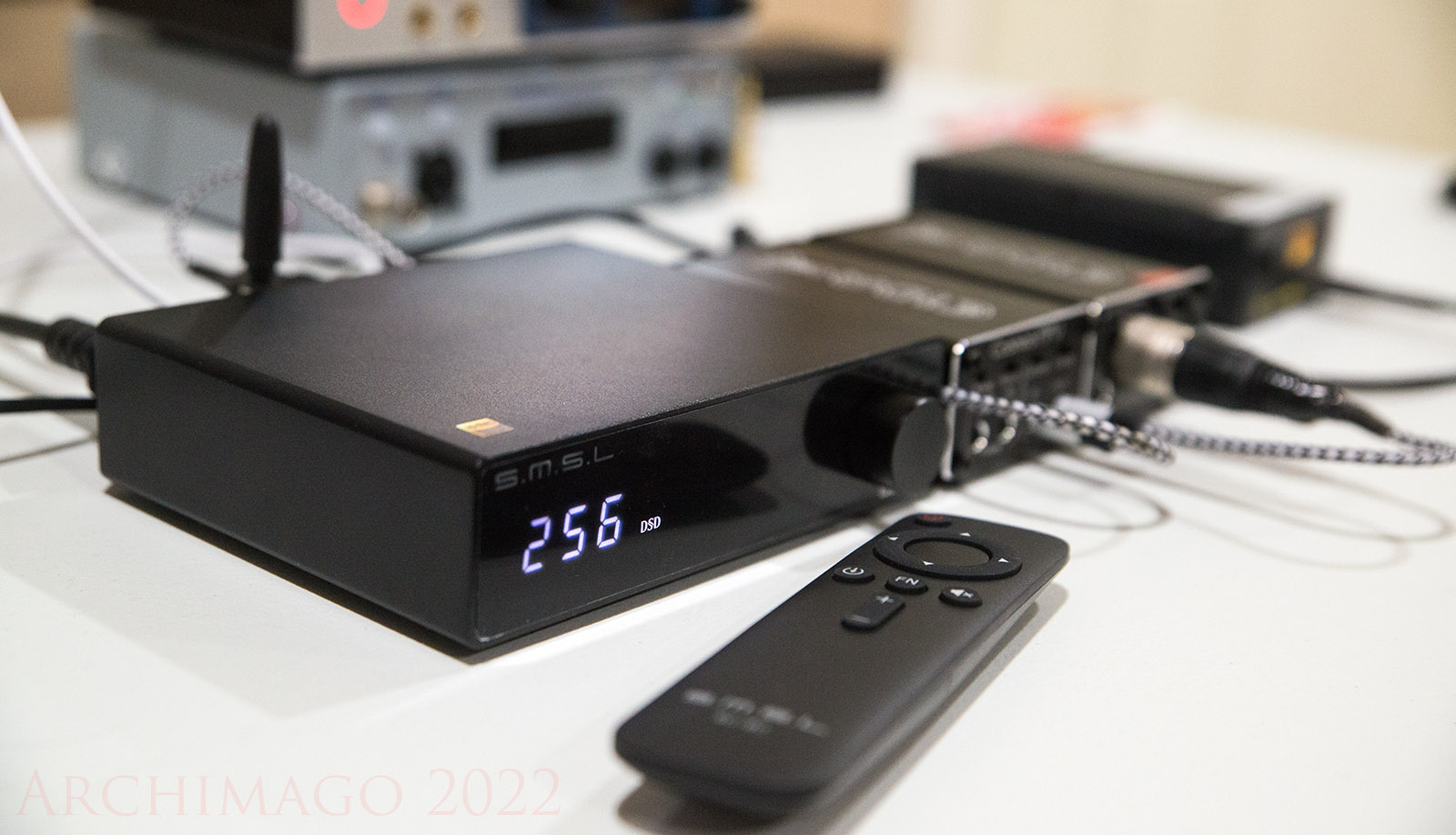
As you can see, the SMSL DO100 displays DSD samplerate in the form of DSD64 (64 x 44.1kHz = 2.8MHz), DSD128 (5.6MHz), DSD256 (11.3MHz) and DSD512 (22.6MHz).

Okay audiophile friends, let's finish off the trilogy of posts on the S.M.S.L. DO100 DAC with some final measurements around DSD performance, let's talk about subjective listening impressions, and as usual, let me provide a direct recording from the XLR output for comparison with others I have done (as discussed here).

We'll then put this all together as final concluding thoughts on this device.

Saturday, 11 June 2022

REVIEW: S.M.S.L. DO100 DAC [Part II - PCM Resolution]. (And on MQA's distasteful environmental claims...)

As we continue to evaluate the S.M.S.L. DO100 DAC, let's spend time today delving into the resolution that this machine provides as a PCM DAC (see Part I last week for filters and jitter performance). Given that PCM is the de facto digital modulation scheme, this post will form the heart of DAC performance evaluations. We'll leave DSD to Part III along with discussions of subjective performance.

With PCM data, this DAC will accept up to 32/768. Let's run some tests as per usual to see how this device compares to others I've looked at on this blog. For most of the tests, I will use my Raspberry Pi 4 "Touch" (USB) or a Logitech Squeezebox Touch (S/PDIF) as digital source. The E1DA Cosmos ADC will be used with or without the Cosmos APU to measure. For some of the REW-based tests, I will perform a simple loopback that looks like this:

Intel NUC → SMSL DO100 DAC → [Cosmos APU] → Cosmos ADC → Intel NUC

As usual, all cables are generic RCA when testing unbalanced, for XLR measurements 6' Monoprice Stage Rights were used.

Unless otherwise noted, the DO100 will be set-up to use "FL6" Linear Steep filter.

Without further ado, let's jump to it...

Saturday, 4 June 2022

REVIEW: S.M.S.L. DO100 DAC (dual ESS ES9038Q2M) [Part I - Overview, Filters & Jitter]. (And the likely continued contraction of MQA...)

Over the last number of years, we have seen a proliferation of DACs from Chinese manufacturers offering models of increasingly better resolution - higher fidelity - and greater feature set. These days, I am of the opinion that we have achieved way above and beyond the ability for human hearing to differentiate these machines unless the manufacturers purposely added some kind of "coloration" to the analogue output whether it be frequency response or changes to the noise and distortion levels (the "tube sound" being a prototypical example we may come across).

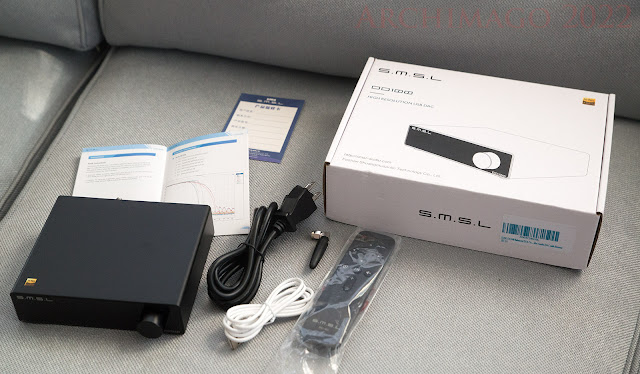
As you can see in the image above, we have the S.M.S.L. DO100 DAC (~US$250) in today for review. I bought this unit through retail channels and intend to either use it myself or give it away if I have no need for it.

For many devices these days, opening the manual will show us technical information like the frequency response of the filters in this example. I think this is a nice evolution among manufacturers recognizing that showing product performance is important to educated customers with graphs and technical details rather than mere prose which often provides little satisfaction for the consumer's intellect.

Today, let's start a multi-part look at this DAC; no need to hurry because I think the performance at this price point warrants serious consideration and the many ways and features one can gather performance metrics on (I don't promise to test everything of course!). Obviously it's not an expensive device, has a remote controller, has both unbalanced RCA and balanced XLR outputs, Bluetooth 5.0 input, capable of up to 32/768 PCM and DSD512 (1-bit, 22.6MHz) using USB 2.0, along with S/PDIF TosLink and Coaxial inputs for up to 24/192 and DoP DSD64. No money wasted on MQA licensing. Depending on what we find, this might be right for you...


Saturday, 14 May 2022

EARLY LOOK: E1DA Cosmos APU - high performance, low-noise pre-amp and 1/10kHz notch filter. [Quick peek - S.M.S.L. DO100 DAC.]

Readers on the blog will likely remember that last year, Ivan Khlyupin (aka IVX on a number of forums) of E1DA sent me a pre-production Cosmos ADC for testing and use. As discussed then, this affordable ADC unit turned out to be a remarkably capable device using the ESS Sabre ES9822Pro chip at a very reasonable price. With recent price upheavals, currently on Amazon for a Grade B device with SNR 127+/-1dB(A) in mono mode, it's selling for just less than US$250.

There were already discussions last year that the "Cosmos" line of devices would include the one we'll be talking about today - the Cosmos Analog Processing Unit (APU). As the name implies, this is an analogue device that serves the purpose of (pre)amplification with very low noise, also providing a 1kHz notch for accurate measurements of THD+N/SINAD as we typically see in DAC reviews.

With the APU near production release (possibly next month or so), Ivan again kindly sent me a unit for use here on the blog. Using the combination of Cosmos APU + good ADC (doesn't have to be Cosmos ADC), the user should be able to peer down into the noise limits and measure characteristics like dynamic range, and THD+N/SINAD with great accuracy even beyond the limits of modern state-of-the-art DACs.

Saturday, 27 November 2021

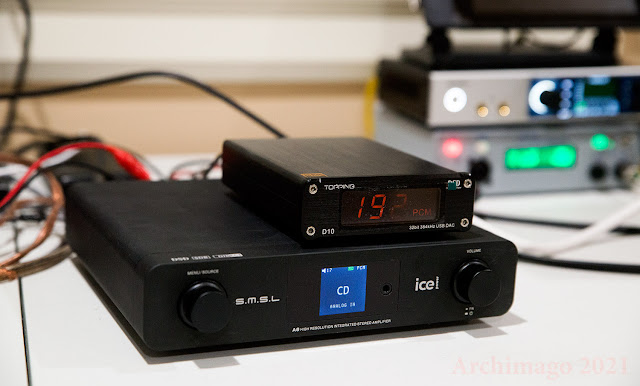
MEASUREMENTS: S.M.S.L. A6 as amplifier [ICEpower 50ASX2(SE) Class D module]. (And DAC output - AKM AK4452 AMPT.)


Over the years, there have been devices I've been meaning to measure but one thing or another got in the way. This SMSL A6 amplifier was something I discussed here on the blog back in 2017 (a subjective review and measurements of DAC output). Over the years, this device has been happily amplifying signals for my dad's Klipsch Forté which is quite a sensitive speaker of 96dB SPL/m/2.83V; certainly by now it is very much "burned in". ;-)

I wanted to measure this device as an amplifier out of interest, knowing that inside this is the Bang & Olufsen ICEpower 50ASX2(SE) Class D module. While the datasheet for this amplifier module is already very detailed, there's nothing like measuring oneself!

This ICEpower module is rated at 2x47W into 4Ω, both channels driven to 1% THD+N. The power rating halves to 25W/channel into 8Ω. Within the ICEpower ASX series, there is also the 250ASX2 that will supply up to 250W/channel into 4Ω, and 125W/channel to 8Ω if you need more power.

The nice thing about this Class D module is that it's inexpensive and easily available for hobbyists such as through PartsExpress (current price US$118), sometimes through Amazon as well. You could buy one of these and get a simple case such as this Ghent Audio one and assemble it for yourself quickly.

Saturday, 30 January 2021

REVIEW/MEASUREMENTS: SMSL (S.M.S.L.) M100 Mk II Hi-Res DAC (USB, S/PDIF Toslink and Coaxial In, ESS Sabre 9018Q2C, below US$100)


[Disclosure: Over the years, I have measured and reviewed products I have either bought or borrowed from friends. The product discussed in this post was sent to me by Aoshida Audio for an honest review and impressions which I can keep to use. It would only be fair that I provide the free shipping and "lowest price guarantee" links to Aoshida if readers want to purchase this DAC or others discussed. Considering that a major part of my review process is objective in nature and standardized over many years, I trust that much of what I present will remain free of bias. Note that I will be selective of what I agree to measure/review of this nature - accessible and high fidelity products that might be of interest to readers, or more innovative devices will obviously be most appropriate for what I do.]

As you can see in the image above, today let's have a look at another very inexpensive DAC product from S.M.S.L. with high-resolution ability. Over the years, I have reviewed/measured other devices from this company including the SMSL A6 integrated amp, the SMSL iDEA DAC, and more recently I've been enjoying the SMSL SA300 Class-D desktop amplifier. These are examples of "accessible" audio products, well within the price range of basically any music lover, "audiophile" or not.

So it is with this DAC. The S.M.S.L. M100 Mk II currently costs less than US$95, needs little power, and accepts USB/TosLink/Coax S/PDIF inputs. As you can see, it's shaped as a rectangular prism. The size is smaller than the photo might suggest measuring at about 2 1/8" x 2 1/4" x 3 5/8" long, weighing around 0.5lb (250gm). The enclosure is aluminum with shiny plexiglass front panel; the package feel solid. Inside the box is an assortment of printed manuals in English, Chinese and Japanese along with a basic white USB-A to micro-USB cable.

Saturday, 14 November 2020

MEASUREMENTS: S.M.S.L. SA300 - Infineon MERUS-based Class D desktop amplifier. (Screwed up New York Times - Wirecutter/Butterworth measurements/review?! And Klipsch on TIM.)

"BAS" on screen indicates I'm using the bass-boost EQ here.

Today, let's have a look at the little SMSL SA300 desktop amplifier I'm showing above sitting beside the Topping DX3 Pro V2 DAC (previously measured and reviewed here).

As mentioned previously, I found myself in the position of needing to update my computer workstation desktop speaker system. I figured, instead of staying with powered/active speakers, since I do have a few bookshelf speakers around the home, why not try some passives on the desktop as well?

While active speakers are great in that the built-in amplifiers and transducers can be well-matched and optimized, the ability to "mix-n-match" passive speakers while opening up the potential to upgrade amplifiers I think is fun for the hobbyist. As such, I found myself drawn to getting a small low-power Class D amplifier like this.

Since the amplifier will likely be left on 24/7, I wanted something that's highly efficient but provides adequate power. This SMSL device internally is powered by the Infineon Technologies MERUS MA12070 Class D amplifier which uses their "multi-level" modulation such that the switching output can have half-voltage levels which adds an extra level of control and power savings. The device is rated to provide up to 2x30W continuous into 8Ω or 2x80W into 4Ω but realize this is with 10% THD+N. What will be more interesting to me is how much power is available into something like 4Ω with ≤0.1% THD+N, and the noise this switching device produces. Let's see if this amp lives up to hopes of "high-fidelity" playback...

Saturday, 5 August 2017

MEASUREMENTS: SMSL A6 as DAC (Part II)

SMSL A6 Integrated Amp - playing through USB 24/352.8kHz signal. Notice the matte/satin finish of the aluminum case. Probably need to wipe it down once awhile if dusty.
As I mentioned last week with the initial review of the SMSL A6 integrated amp, this is a versatile device. It features an AK4452 DAC first released in 2015 which though not "top of the line", does perform very well with a potential 115dB SNR and is part of the "Velvet Sound Architecture" range of "Premium" DACs. For those keeping track, currently, the flagship DAC from AKM is the AK4497, capable of 5-channels and rated at 128dB SNR; they call this series the "Verita" which competes with the best of the ESS DACs like the ES9038Pro previously discussed in the Oppo Sonica DAC measurements and review. By the way, another claim to fame of the AK4497 is that it has a "volume bypass" mode which allows the DSD data to bypass the internal delta-sigma modulator; a more direct processing path... As usual with new features in otherwise mature technologies, whether this is audibly better is probably up for debate.

Today, what I wanted to test out with the SMSL A6 are the RCA and headphone outputs from this device. As usual, along the way we'll have a peek at jitter results, the antialiasing filter being used, and check out the various inputs - USB compared to the S/PDIF variants of TosLink and coaxial.

Saturday, 29 July 2017

REVIEW: SMSL A6 integrated amplifier - Part I: Overview and Subjective Listening (and briefly about USB cables)

SMSL A6 at home in my living room system with Tannoy Mercury Mx2 speakers. Doug MacLeod's Break The Chain (2017, Reference Recordings 24/176.4 downsampled to 88.2kHz, DR16) playing over Logitech Media Server.
For many years, my father's audio system consisted of various CD players, a Sony turntable and vintage pre-amplifiers. This then fed a tube pre-amp which then sent the signal to either a tube-based Onyx SP3 Melody amplifier or vintage solid state Pioneer amplifier to feed his Klipsch Forte speakers which have been cleaned and refurbished with new crossover parts over the years.

In the last 5 years, I've supplemented his system with various DACs for the CD player, and most recently got him a streaming connection with my Logitech Media Server based out of my home server using a Logitech/Squeezebox Touch.

This set-up sounds very good. The classic Klipsch speakers really do throw up a fantastic soundstage, have quite a smooth sonic signature (though a little mellow for my taste), is extremely sensitive, thus easily powered by low-wattage amps.

He has gradually transitioned to almost exclusively digital streaming, finding the convenience indispensable compared to spinning disks (whether of the polycarbonate or vinyl variety). As much as the tube and large integrated amps sound great, over time some of those components have needed maintenance and I figured it would be nice for him to try out something much simpler than manually turning on/off multiple devices every time he wants to hear good sounding audio. Thus, the purchase of the SMSL A6 integrated DAC/amp.

Saturday, 27 May 2017

MEASUREMENTS: SMSL iDEA USB DAC / Headphone Amp (ESS Sabre ES9018Q2C + XMOS XU208)

In 2015, ESS revealed its latest generation of DACs at the CES show. One of the interesting new products revealed was the SABRE9018Q2C, a tiny 5mm x 5mm SoC claiming very high audio quality out of an integrated DAC/headphone amp operating with low power along with the ability to decode a wide range of sample rates.

I was contacted by ZugZugOrc on Computer Audiophile to have a look at a recently released USB DAC he wanted to buy for some measurements based on the above chipset. So we made an arrangement where he sent the package to me to have a look at and subsequently after I'm done, I would send it off to him to use :-). Thanks Zug for the opportunity!

Here's the device - the SMSL iDEA (can be found on Amazon for ~US$86 currently), a mini USB powered "stick" based on the ES9018Q2C "audiophile-quality" mobile DAC capable of accepting up to 32/768 and DSD512!

SMSL stands for  "ShuangMuSanLin" Electronics Company based in Shenzhen, China. I was sent the black one, but the device is also available in red.