Showing posts with label Diminishing Returns. Show all posts

Saturday, 1 March 2025

HDMI Musings: high speed cables, data rates, YCbCr color subsampling, Dolby Vision MEL/FEL, optical cables and +5V injection.

Hey folks, for this post, I thought it would be good to dive a little more into the world of AV technologies after discussing the nVidia Shield TV Pro last week. While "classic" audiophile technology (ie. standard hi-fi analog and digital 2-channel stereo without special DSP advancements) has matured nicely already, this isn't quite the case with modern digital video tech. While many (probably most) features have settled, we can see ongoing evolution of the High-Definition Multimedia Interface (HDMI) standard to be mindful of - for example the recent announcement of HDMI 2.2 at CES2025 expanding capabilities well beyond the needs of today.

As usual, it'll take time (years) for this standard to be incorporated into TVs and source devices like GPUs (latest nVidia RTX 5080/5090 are HDMI 2.1b) or something like VR devices being at the forefront of potential generational gains. For more than 20 years, with each significant revision of the HDMI standard, we're seeing doubling of data speed with HDMI 2.2 now aiming at just shy of 100 gigabits-per-second (96Gbps), twice of the 48Gbps bit rate in current HDMI 2.1 products.

This recent update makes HDMI the fastest of all currently-announced consumer Audio-Video connection standards, the one wire that basically does it all - hi-res video (with high dynamic and frame rate), hi-res audio (up to 32 PCM channels at 24/192, with DSD to 8-channel of DSD256), HDCP copy protection, audio return channel, even ethernet (100Mbps).

This level of sophistication (and licensing costs) could make it difficult for small companies with limited R&D capabilities to get in the game with custom designs. This is probably in part why the cottage industry audiophile companies rarely use HDMI other than selling overprices cables (like AudioQuest). Plus frankly, basic 2-channel audio doesn't need the higher technical capabilities anyway (which is basically what Paul McGowan says).

Let's run through a few thoughts about HDMI that might be good to know as general knowledge as tech enthusiasts. I'll provide a few links of interest, touch on tech stuff like color spaces and subsampling, and things you might want to try if you're running longer high-speed HDMI connections and potentially noticing issues.

Saturday, 18 January 2025

As We Hear It: Audiophile hype vs. reality? GPU chatter (nVidia Blackwell RTX 50XX-series), thoughts on AI frame-generation ("fake frames"), gaming, and art as imagination.


I hope you're all doing well as we enter the year. It's rather amazing that the first quarter of the 21st Century has passed so quickly! Time flew. I do hope that as time passes, audiophiles worldwide are gradually becoming more knowledgeable about the science behind this stuff and in general much more critical thinkers, more resilient to the snake oil and scams of yesteryear. I simply think that this is part of the evolution that must happen for any hobby in order to not stagnate. If something is contentious or seems "too good to be true" based on conventional knowledge as we all become versed in how audio reproduction works, the product very well could be something to avoid; instead, better to save money and look for something more meaningful to purchase.

As per my usual routine, every once awhile I'll publish an E-mail or two from readers of the blog and take time to discuss matters brought up that might not have been fully covered previously, often hitting other short discussion items that don't need a full-length post.

Let's have a look at this E-mail from Michael in Sweden:

Wednesday, 18 December 2024

Game PC Update: nVidia RTX 4070 Super GPU. That "game console vs. PC" debate; twilight of the consoles? Upcoming RTX 50XX GPUs. And graphical diminishing returns in the Art of Gaming.

I know, that's a massive title! But sometimes there's a bunch of stuff to talk/think about before the holidays. ðŸ™‚

With recent holiday sales, like I did recently with the Server, I thought it was time to finally update that GPU in my GAMING rig. Although I had updated the CPU last year to the AMD Ryzen 7 5700X (~US$150) 8-core processor, I was still playing with the old-skool nVidia GTX 1080 GPU that I got back in 2017. 

Clearly, after 7 years and a few generations, it was time to get a modern gaming GPU; yeah I have the RTX 4090 but that's for the workstation rather than gaming, in fact, I haven't even installed a single game on this workstation!

As you can see, I got the ASUS GeForce RTX 4070 Super Evo OC Dual-fan model, currently ~US$600 (~CAD$800). The RTX 4070 Super variant was released in January 2024, not long ago and I figured would make for a good contemporary card with longevity for upcoming games and should last me into the 2030's. It's equipped with 12GB of GDDR6X which should be adequate for awhile. And because it's the dual-fan model, it's not as long as the 3-fan cards; this is important because the enclosure I'm using has a limit to the length of large graphics cards it can accommodate.

Saturday, 20 November 2021

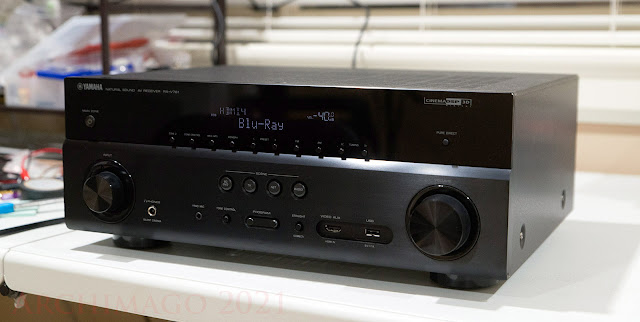
MEASUREMENTS: Yamaha RX-V781 A/V Receiver. Questionable magazine reviews of "high end" amps (D'Agostino). And thoughts on "hardware audiophiles", age and aging.

For this post, I want to have a look at the performance of my Yamaha RX-V781 as an amplifier. It's not new - I purchased this back in late 2016 to replace my Onkyo TX-NR1009 which I published on previously. Awhile back, I also looked at the pre-outs to examine the quality of this device's DAC.

This was an inexpensive receiver when I got it (as I recall, significantly less then US$700), being part of the "V" (Value) series from Yamaha, a step down from their "A" (Aventage) line. From the outside there's not much to look at, it's a black receiver with the usual buttons, knobs, and LCD screen to tell you the status. There's no swivel-open door to hide buttons like in more expensive models. It's a combination of plastic and metal exterior. Weight is not too heavy at 23lbs, mostly from the power transformer (looks like conventional E-I type, less expensive than toroidal but can provide greater capacity for size with potentially higher magnetic interference however).

The V781 is quite a feature-filled 7-channel amplifier capable of running 5.2.2 Atmos / dts-X, even compared to many of today's devices (see Yamaha specs here). What drew me to this model when I bought it was the fact that it had a full array of pre-outs so I could bring my own amps to the party if I wished.

Interestingly, even though over the years Yamaha updated these receivers with models like the RX-V385 and RX-V685, they never updated the "V78X" product line. My guess it that maybe the higher-end Value series might have been too close to the lower-end Aventages in terms of features and quality. For example the current Yamaha RX-A2A (~US$900) doesn't have a full complement of pre-outs, has more HDMI ins, no second HDMI out and quite similar to the Yamaha RX-V6A (US$650) already.

Saturday, 3 April 2021

MEASUREMENTS: Melody Onix SP3 Mk. II (~2006) Class AB Tube Integrated Amplifier. (And it isn't "diminishing returns" on sound quality, often there are simply "no returns".)


Recently I was curious about trying a tube amp in my system and my dad who's into his vintage gear including some older tube devices offered me this amp to test out. It was time to take up the offer and have a listen plus put some tube gear on the test bench for a peek at the performance.

As you can see, for today's post, we have the Melody Onix SP3 Mark II which I believe was first released in 2004 for US$1000. This one I believe was bought in 2006. It's a relatively compact unit (12" x 8" x 13" or so), 56lb beast designed by Melody Australia, made in China. Over the years, there have been various reviews on this product from 6Moons (Best of 2005 list), Audioholics, Home Theater Review, High Fidelity Review among others. Here's the Melody company website. I think this model was discontinued by around 2010.

I've always liked the look of this box. There's a cage that normally protects fingers from the four large power tubes and individual smaller covers (you can see 3 on the right removed) that protects the 6 flanking tubes. Turn off the lights at night and it all looks very cool.

Sunday, 1 March 2015

MUSINGS: Audio Quality, The Various Formats, and Diminishing Returns - In Pictures!

Let me be the first to say that graphs and charts where audio formats are plotted out in terms of unidimensional sound quality ratings are ridiculously oversimplified and can be very misleading! However, they can be fun to look at and could be used as bite-sized "memes" for discussion when meeting up with audio friends or for illustration when people ask about audio quality.

Since they're out there already, let us spend some time this week to look at these visual analogies as a way to "think" about what the authors of these works want us to consider/believe. I'm going to screen capture without permission a couple of these images to explore. As usual, I do this out of a desire to discuss, critique, and hopefully educate which I consider "fair use" of copyrighted material; as a reminder to readers, other than a tiny bit of ad revenue on this blog (hey, why not?), I do not expect any other gain from writing a post like this.

First, here's PONO's "Underwater Listening" diagram released around the time of the 2014 SXSW (March 2014):
PONO: Underwater Listening

Others have already commented on this of course (here also). I don't know what ad "genius" came out with this diagram, but it is cute, I suppose. I remember being taken aback by this picture initially as it's so far out of "left field" (creative?) that I felt disoriented when I first saw this thing...

How audio formats would evoke a desire to compare underwater depths remains a mystery to me. Obviously, there's a desire to impress upon the recipient two main messages - a direct correlation between sampling rate (from CD up) with quality, and to make sure the MP3 format gets deprecated as much as possible (1000 ft?!). On both those counts, this image gets it so wrong, it's almost comedic. Clearly, one cannot directly correlate samplerate and bitrate with audio quality because the relationship isn't some kind of linear correlation. Why would CD quality be "200 ft", and 96kHz "20 ft"? Surely nobody in their right mind would say that 96kHz is 10 times perceptually "better". Sure, there is a correlation such that a low bitrate file like 64kbps MP3 will sound quite compromised with poor resolution, but without any qualification around this important bitrate parameter, how can anyone honestly say that all MP3s sound bad? I might as well say that Neil Young's a poor-sounding recording artist because the Le Noise (2010) and A Letter Home (2014) albums are low fidelity.