Showing posts with label AV Receiver. Show all posts

Saturday, 11 January 2025

Dirac Live 3 with Bass Control (DLBC): A look and listen with the Integra DRX-8.4.

I talked about the use of Dirac Live 3 in late 2024 after upgrading my receiver to the Integra DRX-8.4 which integrates the full-bandwidth DSP room correction as part of its feature set. Many modern multichannel receivers these days have Dirac as a feature included like the Onkyo TX-RZ70 or Pioneer Elite VSX-LX805 (both offering 11-channels amplification like the Integra). I have to say that I love this Integra unit with all its multichannel bells and whistles - not to mention great sound as well, of course.

I mentioned in the previous article that Dirac Live Bass Control (DLBC) is available as an upgrade for US$299 which activates the license on your account when you run the Dirac Live Room Correction Suite, unlocking the "Bass Control" module.

So, let's activate that and get into this with a look and listen to what DLBC brings to my set-up and of course some results in my room. (For reference, here is the official DLBC manual, and Dirac's Frans Rosencrantz's 2020 article "Bass Control, Where Did My Bass Go?".)

Saturday, 16 November 2024

Dirac Live 3: A look & listen with the Integra DRX-8.4 - the process, microphone placement suggestion, tweaking, and multichannel/Atmos results.

As discussed years ago with my sound room set-up, I believe room correction DSP is very important and has become part of my routine whenever I make significant changes in room layout or when I incorporate new equipment. I would argue that an audiophile who has not seriously spent time trying this likely has not heard the best sound in their room from their system. Simply put, you'll notice a level of control and audible difference way more than just swapping hi-fi DACs, amps, etc. hardware.

With the arrival of the Integra DRX-8.4 receiver recently, I started using the included Dirac Live Full Bandwidth license embedded in the hardware. As I had done in the recent past with Acourate and Audiolense XO, let's dive into the steps I used to get Dirac running and the results I achieved. Hopefully this discussion could be useful for those of you thinking of trying out Dirac.

I'll document the steps I followed, issues I ran into, and tips to overcome problems.

Sunday, 3 November 2024

Integra DRX-8.4 Multichannel Receiver: Overview, features, build, a few pre-out measurements...

Obviously, value is an important consideration for consumers when it comes to buying and enjoying products. As discussed over the years, I'm not an audiophile who's particularly interested in the luxury aspect of these machines. To me, the ideal of achieving "high fidelity" sound does not care about MSRP or some other determinant of whether a product is artificially exotic/elite, thus "High End Audio" (a.k.a. High Priced Audio) is meaningless to me unless there is evidence of improved sonic performance (whether from plain increased objective fidelity or incorporating technical features) correlating with higher asking price. As such, I believe audiophiles should seriously think about the value of modern AV receivers which over time have also incrementally shown improved sound quality by incorporating higher quality DACs, newer DSP room correction technologies, and potential benefits like balanced connections.

In my opinion, this also means the divide between "home theater" enthusiasts and "audiophiles" is largely artificial when it comes to sonic performance. Subjectively, we're all aiming for an excellent audio experience with high-fidelity to the source with utmost clarity (including time-domain coherence), low distortion, high dynamic range, excellent reproduction of nuances, while achieving realistic/intended soundstage. Objectively, a high quality AV receiver these days should not have difficulty providing hi-fi performance compared to many very expensive products (like the Dan D'Agostino Momentum monoblocks US$80k/pr as an obvious example - other than high power, there's nothing particularly good), plus typically these AV companies provide way more features and modern amenities. The R&D firepower behind these companies are substantial compared to the small-business shops that typically make products for the esoteric 2-channel audiophile niche. Over time, as I hope audiophiles increasingly consider enjoying the new multichannel recordings and remixes, moving into "immersive" audio, these multichannel receivers should be seen as serious options.

The only utilitarian difference between home theater enthusiasts and audiophiles is whether video playback is needed.

In this post, let's start with having a look at the item pictured above, the Integra DRX-8.4 multichannel receiver. (Discussions and measurements of AV receivers are not new on this blog with previous posts on the Yamaha RX-V781 and Onkyo TX-NR1009.)

Despite being the current flagship receiver from Integra, the price is "only" US$3,200 or about CAD$4,000. I bought this item through standard retail channels online because I was interested in it; no company incentives.

Saturday, 20 November 2021

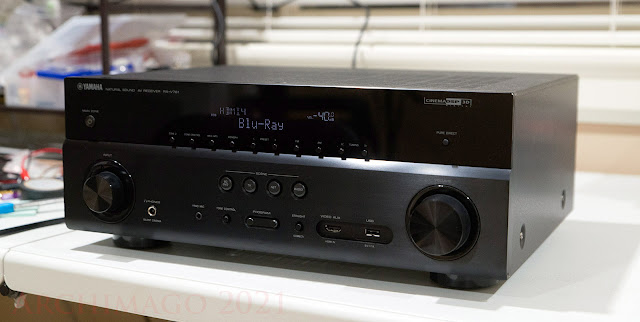
MEASUREMENTS: Yamaha RX-V781 A/V Receiver. Questionable magazine reviews of "high end" amps (D'Agostino). And thoughts on "hardware audiophiles", age and aging.

For this post, I want to have a look at the performance of my Yamaha RX-V781 as an amplifier. It's not new - I purchased this back in late 2016 to replace my Onkyo TX-NR1009 which I published on previously. Awhile back, I also looked at the pre-outs to examine the quality of this device's DAC.

This was an inexpensive receiver when I got it (as I recall, significantly less then US$700), being part of the "V" (Value) series from Yamaha, a step down from their "A" (Aventage) line. From the outside there's not much to look at, it's a black receiver with the usual buttons, knobs, and LCD screen to tell you the status. There's no swivel-open door to hide buttons like in more expensive models. It's a combination of plastic and metal exterior. Weight is not too heavy at 23lbs, mostly from the power transformer (looks like conventional E-I type, less expensive than toroidal but can provide greater capacity for size with potentially higher magnetic interference however).

The V781 is quite a feature-filled 7-channel amplifier capable of running 5.2.2 Atmos / dts-X, even compared to many of today's devices (see Yamaha specs here). What drew me to this model when I bought it was the fact that it had a full array of pre-outs so I could bring my own amps to the party if I wished.

Interestingly, even though over the years Yamaha updated these receivers with models like the RX-V385 and RX-V685, they never updated the "V78X" product line. My guess it that maybe the higher-end Value series might have been too close to the lower-end Aventages in terms of features and quality. For example the current Yamaha RX-A2A (~US$900) doesn't have a full complement of pre-outs, has more HDMI ins, no second HDMI out and quite similar to the Yamaha RX-V6A (US$650) already.

Saturday, 30 November 2019

MEASUREMENTS: Onkyo TX-NR1009 "WRAT" AV Receiver Class AB Amplifier... Plus Pi / LP / Resolution miscellany.

I currently have 3 AV receivers here at home. The Denon AVR-3802 is my oldest machine, purchased back in 2001 and being used in the living room for stereo playback. My newer Yamaha RX-V781 (2016) is currently in use for movie playback with Atmos/dts:X decoding. This leaves the Onkyo TX-NR1009 (2011 model) that I bought used in 2013 which has actually been sitting unused for the last few years mainly because it's an older HDMI 1.4 device which did not support full 4K/HDR/60fps switching:


It's a shame because I think of the 3 receivers, subjectively this is probably the best sounding (no blind test done, just a suspicion), has the highest power rating (135W into 8Ω, 1kHz, 1%), THX Select2 Plus certified, can amplify 9 channels (9.2 decoding), and when new, was also the most expensive of the three. I'm sure at some point I'll find a use for this 41 pound monster - maybe if/when the old Denon breaks down :-).

I don't think anyone can fault the external build quality which also looks quite handsome. Onkyo did unfortunately have some electronics failure issues with this generation of receivers however and back around 2016, I sent this unit back to them for an HDMI board replacement (here's a thread on the issue a few years back).

For this post, I think it would be interesting to explore the sound quality of this device as a 2-channel amplifier (especially compared to the little Yeeco TI TPA3116 amp last week). It'll give us an idea of how well a good receiver could perform and give us a peek at a modern Class AB device sitting in the higher end of the consumer price ladder (Class AB receiver amplifier designs have not changed that much in the last number of years). These days a similar tier THX model with equivalent power would be the newer Onkyo TX-NR1030 and TX-RZ1100.

Monday, 12 December 2016

MEASUREMENTS: Yamaha RX-V781 Receiver (a look at the pre-out quality)

With the upgrade recently to a 4K TV, it was alas also time to upgrade the surround receiver system I was using. A number of years ago, I bought a used Onkyo TX-NR1009 which I wrote about. It has served me reasonably well over the last few years but not without some issues. The most bothersome was the fact that the HDMI board died last year and it had to be sent back to Onkyo for a board replacement. Thankfully, despite the machine being released around 2011, Onkyo still honored the repair as apparently this is a common problem acknowledged by the company. Not good that the product was defective due to an engineering oversight (soldering & overheating issues), but at least the company "manned up" to the problem.

These days, to make full use of the surround sound system connected to a full-featured 4K TV, the best way is to upgrade the receiver to be compatible with the latest HDMI 2.0 specification with allowance for 4K/UHD @ 60Hz, HDCP 2.2 copy protection compatibility, as well as passing through the full video signal - including full color information (Rec. 2020/BT.2020 and HDR). (For those new to this kind of AV talk, you might want to review the 4K tech article from a few months back.)

Unfortunately, the Onkyo was only good to HDMI 1.4. It was time to upgrade to one of the new receivers... And this is what I found on sale locally:

It's a new model year 2016 Yamaha RX-V781 (current price ~US$700).

Saturday, 26 October 2013

MEASUREMENTS: ONKYO TX-NR1009 as HDMI / SPDIF DAC... Are AV Receivers any good?

The rat's nest.

Running separate components like multichannel processors/preamps to monoblock amplifiers are generally considered the ideal, "cost no object" approach to home theater. In the real world, cost and space are considerations and AV receivers become the "Jack-of-all trades" central device that most of us have in the home theater setup. But like the proverbial "Jack", it's useful to also consider the second part of that saying... Just how bad  is he also "the master of none"?

In the last installment, we looked at passing an analogue audio signal through the Onkyo and found that noise can be an issue. Today, I want to demonstrate the quality if we were to just use this device as a DAC - a look at the digital portion. Some natural questions arise - how well did the designers shield noise from getting in (especially in light of the high analogue noise measured previously)? Is the jitter through the use of HDMI "bad" (compared to TosLink and coaxial S/PDIF)? How does it compare to other stereo DACs?

Based on the Onkyo specs sheet, the TX-NR1009 uses the TI PCM1690 6-channel + PCM1789 2-channel DAC chips. Both are rated as 113dB SNR. These DAC chips are often found in consumer AV receivers and are lower spec'ed than most stand-alone DACs like the TEAC UD-501's PCM1795 with >120dB SNR. Of course, you cannot just look at this specification and judge the quality of a DAC. Much depends on the analogue circuitry around that DAC so the measured results are more useful than just looking at the components individually.

Setup:

As usual, for the sake of full disclosure and opportunity to repeat/verify, here is the setup for these measurements:

Win8 AMD A10 "Trinity" HTPC --> HDMI/TosLink/coaxial cable --> ONKYO TN-NR1009 front stereo "pre-out" --> shielded RCA --> E-MU 0404USB --> shielded USB --> Win8 laptop
CM6631A device used for asynchronous USB --> coaxial / TosLink conversion duties.

HDMI driver: default AMD WASAPI. I used JRiver for playback.

Since I want to check the performance in a more "naturalistic" fashion, I made sure the TV was connected and on as well as my Blu-ray player (Panasonic BMP-TD220). Remember that in my previous post, plugging in the HDMI TV cable added significant noise to the analogue pass-through. All results were made with the Onkyo in "Pure Audio" mode to defeat any audio DSP/bass management.

HDMI cable: A decent looking 6' length capable of high speed HDMI (officially rated as HDMI 1.3 but fine with my HDMI 1.4 3D TV), brand named "ION" that I purchased for something like $20 about 2 years back at a local computer/supplies store.


TosLink and coaxial SPDIF cables I'll be using for comparison are the "Acoustic Research" branded 6' lengths I measured previously (see links for details).


Results:

As usual, I ran the output through my digital oscilloscope first to have a look:
Here is a 0dBFS 1kHz square wave sent through the HDMI and measured off the front stereo "pre-out" RCAs. Not bad - good square waveforms with excellent channel balance (sorry about the pixellation, usually screenshot looks better than that). With the receiver volume set to the "reference" of 85 (there is a little popup on the front screen when you hit 85 that correlates to the 0dB THX reference level) and in "Pure Audio" mode, the peak voltage is around 2.3V.

Here's a 24/44 impulse response:
Good linear phase impulse response, nothing fancy here. Absolute polarity also maintained by the Onkyo.

I. RightMark:
As usual, I used RightMark to look at the measured dynamic range, noise level, distortion levels; here's the summary for HDMI at the various bit depths and sample rates:

As you can see, I've also included for comparison the results at 24/96 for the Squeezebox Transporter and TEAC UD-501 (unbalanced outputs) - two of the best measuring DACs I've tested here with the same hardware/software.

Clearly the Onkyo is capable of hi-res with >16-bit dynamic range. With 24-bit data, it can do ~109dB dynamic range which equates to just over 18-bits! Not as good as the dedicated audio units like the Transporter or TEAC but pretty darn good for an AV receiver! This result is about equivalent to the AUNE X1 and ASUS Essence One using unbalanced RCA output - however, those DACs had better distortion numbers.

Some graphs to review from the 24/96 dataset:
Frequency Response
Noise Level

THD
The Onkyo rolls off a bit more in the high end, a little more noisy, and notably more harmonic distortion.

For fun, here's the spectrum off the Onkyo playing 24/192:
Yup, capable of 24/192 although the roll-off on the high end is obviously earlier than the TEAC UD-501 (Onkyo drops -3dB at 50kHz).

I was curious if the SPDIF (TosLink and coaxial) inputs measured just as well:

Yup. They all look pretty good. The graphs all look identical except for slightly more high end roll-off with the HDMI interface compared to the SPDIFs - not sure why.


With the dynamic range >16-bits, this test should be no problem for the Onkyo (HDMI input).

That looks very nice given that many very expensive DACs are not even capable of this degree of resolution! Again, this is an AV receiver! As I previously posted, even recently released DACs like the Wadia 121 Decoding Computer is incapable of this resolution.

III. J-Test for Jitter
As usual for my DAC tests, let's have a look at the Dunn J-Test spectra for both 16-bit and 24-bit signals. Here is the summary using the 3 digital inputs - HDMI, coaxial SPDIF, and TosLink SPDIF:


As you can see, the Onkyo is quite jittery in general whether HDMI or the other SPDIF interfaces. Although quite similar, I am somewhat surprised that the sidebands were more pronounced for the coaxial digital input! For comparison, here's the Transporter and TEAC:


Although the scale and dimensions are a little different, one can certainly appreciate just how jittery the Onkyo is compared to the others especially with the 24-bit signal. From this data, we see that the Onkyo itself has more jitter as a whole; specifically it's not any worse with the HDMI interface. We'll talk about jitter again in a little bit...

IV. Does sending a 5.1 channel signal degrade the measured performance?
I thought this would be interesting to check out. I left the RightMark test signal as the two front channels and added some AC/DC "Thunderstruck" into the center, rear, and LFE channels played back in JRiver as a multichannel FLAC through HDMI.


Beautiful ain't it?! The idea is to see if driving 6 channels (5.1) at the same time through the HDMI cable into the Onkyo's DAC will change the audio quality... For example, doing this might increase the noise floor, or perhaps worsen channel crosstalk since we've tripled the number of audio channels being processed.


Frequency Response

Noise Level
As you can see, there's very little difference whether 2 channels are playing or 6 channels. Great to see! Essentially no frequency response or crosstalk difference. However, there is a very small increase in noise level when playing multichannel... IMO audibly insignificant but measurable.

Summary:

Here you go folks! That's how a higher-medium end "modern" AV receiver measures as a stereo DAC. Of course, each model will be a bit different, but I suspect similar tiered receivers from Pioneer, Denon, Integra, Yamaha, H/K, Anthem, etc... should be comparable (won't know unless someone tests it out). Note that most magazines like Sound & Vision will measure receivers but usually in the context of power output and flatness of frequency response rather than on the accuracy of the digital-to-analogue conversion as I did here.

In some ways I am impressed and in other ways the results were as expected.

I was impressed by the low noise and very good dynamic range for example. To achieve almost 110dB in the audible spectrum is quite something especially considering the complexity of an AV receiver with all the potential electrical noise sources inside the box! The accuracy of the 16-bit -90.3dB waveform looks excellent; something which only the better stereo DACs or CD players would have been able to accurately reproduce a decade back. Likewise, the fact that the measurements remained excellent even with 6 channels being processed concurrently and only measuring about 1dB difference in the noise floor again demonstrates the engineering quality. Given the results I found previously with HDMI noise polluting the analogue input, I'm guessing that Onkyo put more attention in optimizing the digital side which makes sense since most people will be connecting digital inputs for multichannel sound.

As for the more "expected" results, let's talk about jitter...

A few years ago in 2009 this message came over the 'Net which I remember made quite an impression on me around how "bad" HDMI is as an audio interface (supposedly from Hi-Fi News & Record Review / Miller Research):
(I didn't notice it at the time, but that Denon AVR-3803A was a typo - the 3803 has no HDMI. It's actually the 3808.)

Later, a more comprehensive message appeared:

Hmmm, it looks like HDMI jitter can be cleaned out after all (eg. Arcam, Classe, Pioneer)! It's about the implementation, not necessarily the interface itself. If you read around these posts, one also finds that the jitter value and subjective sound quality do not necessarily correlate.

Let's think about the J-Test and what was found in measuring the Onkyo for a moment. The Dunn J-Test is a synthetic test of data jitter first published by the late Julian Dunn around 1994 which (in the 24-bit 48kHz version) superimposes an undithered LSB 250Hz square wave over a primary 12kHz -3.01dBFS sine wave which is of course an exact 1/4 of the sampling rate. This superimposition stimulates the effect of subtle timing inaccuracies (jitter) which can be demonstrated as accentuation of the sidebands measured in the spectral graphs.

Remember that this test is synthetic and stimulative. What you see measured is not something you're probably ever going to "hear" in real music! The noise floor is not going to be down to the last bit in 16-bit audio and essentially impossible with recorded 24-bit audio (unless it's purely computer synthesized music). Also, jitter is more pronounced in the higher frequencies (11kHz and 12kHz are used as the primary signals in the J-Test). Realize that the human hearing sensitivity is well on its way down by 5kHz (as can be seen by the Fletcher-Munson Curves). Furthermore, if we specifically look at the Onkyo's J-test spectrum, the most pronounced side bands are about -90dB below the primary signal. To make matter even less worrisome is that the tall sidebands are all +/-250Hz around the primary signal and the audibility would be masked even if one did have awesome auditory acuity at 11/12kHz and could hear a signal 90dB down! This is also why I feel adding up all those sideband peaks and calling it a number (whatever picosecond or nanosecond) is really not all that useful when it comes to audibility.

What I'm trying to say is this... Tests like the J-test can demonstrate that jitter is a real phenomenon. Engineers should pay attention to it when designing hi-fi equipment. A discerning audiophile should be aware of it and if able to, can measure it themselves and decide if the engineer did a good enough job. However, IMO, to say that jitter is somehow audible at these kinds of levels I think would be impossible. In fact, unless the jitter were ridiculously high (like Track 26 from Stereophile Test CD 2, where an insanely simulated 10ns sideband is inserted +/-4KHz around the 11kHz primary - again totally synthetic), the concept of jitter significantly deteriorating sound quality I believe is utter nonsense in the real world. That some companies would even consider using jitter as a reason for putative significant audible differences between passive "components" like cables is just not credible!

I had a listen to the Onkyo's output over the last few nights with some familiar music - Ella Fitzgerald "Sings The George & Ira Gershwin Song Book", Grateful Dead "American Beauty", and Keb' Mo' "Just Like You". Also had a listen to Sting's new album "The Last Ship". They all sounded nicely rendered as they should with a good DAC. Great details with my older Paradigm Reference Studio 80 v2's which will be my rear speakers in the new sound room. The wife and I both enjoyed Sting's "The Night The Pugilist Learned How To Dance" - cute.

So, even though the AV receiver might be the "Jack-of-all-trades", at least in this specific instance with the Onkyo TX-NR1009 as an HDMI DAC, he might not be a "master" at it, but I'd say he's a pretty decent tradesman :-).

Well, unless I dig up something else to report, I'm likely "going dark" for the next month as I head off overseas for some work and then the big move to the new home. I'll be sure to post some pictures in time... Enjoy the music everyone!

Friday, 18 October 2013

MEASUREMENTS: Separate vs. AV Receivers (Emotiva XSP-1 vs. Denon AVR-3802 vs. Onkyo TX-NR1009) as Analogue Preamp.


Okay, so maybe I'm being a bit too dramatic using that epic battle between Godzilla and Rodan above :-).

With the recent acquisition of the Emotiva XSP-1, I wanted to see just how well a separate pre-amp with audiophile design in mind stacks up against something more ubiquitous like the AV receivers out there. Remember that a preamp at its core has very basic functionality - it allows switching of the source and volume control by adjusting voltage gain on the output. The essential difference between a good preamp versus poor one (beyond features, ergonomics, remote control quality, etc...) is how well it maintains a high signal-to-noise ratio (SNR). If you supply a high resolution line level DAC output, you want to see that signal come out of the preamp with as much resolution as possible; this demands that the preamp introduce as little noise as possible.

Is there good evidence that spending money on a good analogue preamp will result in more accurate music reproduction? Let's find out in this installment...

First, let me introduce the contenders today:

Emotiva XSP-1:

Currently the highest quality Emotiva preamp out. The claim to fame is the differential design for balanced operation. It provides 2 balanced inputs along with a host of unbalanced RCAs. Volume control is through a digitally controlled, analogue resistor network. For this test, I will not be using the analogue bass management or tone controls that could affect signal presentation / quality. SNR for this device is rated at >110dB across the board for both RCA and XLR operation.

Denon AVR-3802:
A 7.1 channel "classic" from the decade when SACD and DVD-A were starting life and home theater lovers started seriously investing in discreet surround receivers with Dolby Digital and DTS (as opposed to the matrix surround of previous Dolby Pro Logic receivers). Analogue 7.1 channels input available. I bought this unit back in early 2002. Though not the highest end back then, it wasn't cheap (I think I paid almost $2000CAD). I don't remember the results of actual 3rd party testing but the rated amplifier power is 105W into 2 channels at 8ohms with 0.05%THD.

Analogue input SNR is rated at (only) ~86dB based on the table in the manual. For the sake of measuring the best possible audio output, all measurements will be performed through the CD input in "DIRECT" mode which bypasses all processing including tone controls and bass management. Measurement will be off the front (stereo) channels of the 7.1 "pre-out" analogue outputs.

ONKYO TX-NR1009:
My new receiver mentioned in the previous post. Capable of 9.2 channels processing with 7.1 analogue external inputs. Again, not the most expensive in the Onkyo line but certainly in the upper end of the previous generation released in mid-2011. Amplifier is capable of more power than the Denon with a rating of 135W into 2 channels at 8ohms with 0.08%THD. Sound & Vision measured it as 145W into 2 channels at 8ohms with 0.1% distortion. Line level SNR rated at 110dB.

I'll measure it through the analogue CD input in "Pure Audio" mode where all extraneous audio processing is turned off. Likewise, it's supposed to quiet the video circuitry and even the front LED indicators and display are turned off. I will measure from the front (stereo) channels of the 9.1 "pre-out" analogue output.

Firmware was updated to the latest version as of September 2013 - 1131-1399-0211-4108.

Setup:


First, I just want to discuss the general setup. The main thing I wanted to know was just how much resolution was maintained with the signal going through the preamp and look/listen to the results through a variety of levels standard across each device.

For the TEAC UD-501 DAC at 24/96 (which to me is the sweet spot) using the "SHARP" digital filter measured the following way:

HTPC (AMD A10 "Trinity") --> shielded USB (Belkin gold) --> TEAC UD-501 --> shielded RCA --> E-MU 0404USB --> shielded USB -->  Win8 laptop

we get these results:

The hope of course is that when we pass the above signal through the pre-amp, there will be minimal loss in resolution (noise level remains low around -113dB, and no change to frequency response to suggest "coloration" of the sound). In my previous TEAC measurements, I noted that the XLR output was too "hot" for the E-MU 0404USB without volume attenuation which drops the resolution. My guess would be that the noise level drops to less than -116dB. I will measure the XLR output from the Emotiva XSP-1 and see (it's the only device out of the 3 capable of balanced operation).
 
Using the digital oscilloscope, I found the following correlation between peak voltage output from each preamp device (accurate to <0.05V) and the volume control setting (using the TEAC RCA or XLR input of course):

Nice to see the volume control accuracy of each device - every halving of output peak voltage corresponds with a 6dB decline of the volume "knob". Notice that the Emotiva and Denon are using a relative system of volume control (dB below 0dBFS) and the ONKYO is set to an "absolute" measure between 0 to 100.

The setup incorporating the pre-amp in-line therefore looks like this:
HTPC (AMD A10 "Trinity") --> shielded USB (Belkin gold) --> TEAC UD-501 --> shielded RCA/XLR --> Pre-Amp device --> shielded RCA/XLR --> E-MU 0404USB --> shielded USB -->  Win8 laptop

Results:


I. Emotiva XSP-1 RCA:

Without further ado, here is what the Emotiva looks like with the unbalanced RCA setup:


Frequency Response

Dynamic Range
This looks really good. At 2V peak output, the dynamic range at 111dB is very close to the "ideal" (113dB directly from the TEAC). Notice a very small amount of roll-off in the high end when using the Emotiva. Also as expected, when the volume is reduced (2V --> 1V --> 500mV --> 250mV), the signal-to-noise ratio goes down and we see a concomitant reduction in the dynamic range and rise in noise level.

II. Emotiva XSP-1 XLR:

Let's have a look at the XSP-1 operating in a balanced configuration:

Frequency Response
Dynamic Range
Well folks, proof that if you want absolute fidelity, you really need to squeeze out those last few dB's down below 110dB with balanced XLR cables! Irrespective of whether you can hear it or not :-)!

Seriously, these are some fantastic measurements. As I said previously, unfortunately, I don't have direct measurements for the TEAC's XLR output. When passing the XLR output from the TEAC to the Emotiva pre-amp, the results at 2V peak volume coming out of the Emotiva slightly exceeds the direct RCA output from the TEAC DAC across the board from noise level to distortion levels to even lower stereo crosstalk.

The high frequency roll-off is less than with RCA. Notice just how clean the dynamic range graph looks as well through XLR cables. Fantastic.

III. Denon AVR-3802 RCA

Now we get into the AV receivers:

Frequency Response
Dynamic Range
Remember, I am measuring the Denon in "DIRECT" mode with all audio processing including bass management turned off (front stereo speakers set to "Large" for the sake of completeness). Not unexpectedly, these results are clearly a step down from the Emotive XSP-1. With a dynamic range of ~96dB at 2V, the Denon is capable of passing through 16-bit CD resolution but nothing more.

Roll-off above 20kHz is similar to the Emotiva's unbalanced mode but worse than the Emotiva below 100Hz with a -1dB bass roll-off at 20Hz.

IV. ONKYO TX-NR1009

Finally, let us have a look at what approximately a decade of advancement (between this and the Denon) in AV receiver technology can do:


Frequency Response
Dynamic Range
With the ONKYO in "Pure Audio" mode, no video processing at all, HDMI and video inputs all disconnected... Wow! That's very impressive IMO for a machine that's a "jack of all trades". In fact, these results are almost the same as the Emotiva XSP-1 functioning in unbalanced mode!

As excited as I am about those results above, a modern AV receiver is meant to process HDMI and be connected to a TV. This receiver has a HDMI "passthrough" which is essentially always in operation and for most people, it would not be left in "Pure Audio" mode with all the video gear disconnected. As such, look what happens when I connect my LG 55LW5600 TV (55" passive 3D, LED TV from 2011) to the ONKYO and repeated the measurements:

Frequency Response
Dynamic Range
Ugly, my friends... Clearly having the TV HDMI connected has injected very significant amount of noise in the system! Dynamic range has dropped to ~80dB across the board (equivalent to 13-bits). Notice a very strong 60Hz mains hum which is even showing up in the frequency response graph... What is happening here is that I'm seeing the effect of ground loops. There are ways to overcome this of course. For example, using a 3-to-2 prong adapter to disconnect the TEAC DAC from ground resulted in the following:

Frequency Response

Dynamic Range
About 10dB improvement just by doing this. For now, I'm not going to bother isolating the problem further (I'll be moving house in about a month!) but suffice it to say that in a receiver setup with complex component interconnections, be very careful of noise polluting the analogue output as demonstrated above. Ground loops are very common especially with TV systems where ethernet and coaxial cables are often connected to the TV/receiver creating a number of potential ground points beyond the individual device plug-ins to the wall.

Summary:


So there you have it. The Emotiva XSP-1 measures as a very capable pre-amp unit with excellent resolution especially when used in a balanced configuration. There was barely any loss through RCA and the XLR performance is beyond the E-MU 0404USB's measurement capabilities. Note that in all these tests, I'm just using generic "Radio Shack" type RCA connectors and the XLR cables are inexpensive Monoprice brand. No reason for spending money on expensive cables when these kinds of results can be obtained with standard decent interconnects.

In "Pure Audio" mode without the HDMI system connected, the ONKYO performed excellently. It bested the 12-year old Denon AVR-3802 handily and is essentially neck-and-neck with the Emotiva in an unbalanced configuration. However, beware of the potential noise pollution and ground loops once you plug in all sorts of things into these receivers (like your fancy big screen TV)!

A little while back, I spoke about how music sounded better through the Emotiva XSP-1 compared to using the Denon as pre-amp. These results are supportive of my subjective impressions (I'm showing >10dB dynamic range difference and bass roll-off differences between the two). As for the ONKYO, it does sound much like the Emotiva as a stand alone audio device. Since I will be listening primarily with the ONKYO as a HDMI DAC (either from the computer or through Blu-ray player), for me the digital audio performance is much more important than the results I show here from the analogue input.

Music this evening:
My kids enjoyed Les Misérables (the movie) and really love to listen to it in the car on the way to school... My favorite recording of this is the recent 25th anniversary UK Tour cast from 2010's performance called "Les Misérables Live!" - certainly much better singing than Hugh Jackman and Russell Crowe!

I've got another trip coming up at the beginning of November and then the house move by the end of November. I hope to put up some results of the ONKYO as HDMI DAC before I go. Until next time... Enjoy the tunes...