A 'more objective' take for Rational Audiophiles. Among other topics!
X/Twitter: @Archimago
E-Mail: archimagosmusings(at)outlook.com
[Some items linked to affiliate accounts - I may receive gift certs from qualifying purchases.]
Saturday, 12 October 2024
GUEST POST: A Raspberry Pi Music System that Punches Above its Weight - Wax by Jeffrey Barish
Saturday, 10 February 2024
REVIEW: HUNSN [CWWK] RJ36 Fanless MiniPC - Intel i3-N305 (12th Gen "Alder Lake-N", 8C/8T, 32EU iGPU). And comparison with the Raspberry Pi 5.
Another year, another upgrade to the sound room MiniPC! 😁 Honestly, for audio streaming purposes, I could easily just use the very low power MeLE Quieter2Q as a Roon endpoint with multichannel capability discussed in 2022. As usual, "Bits Are Bits" so this upgrade is not about sound quality, just fanlessness, and higher processing speed on tap.
Recently, I saw this interesting article for an Intel i3-N305 MiniPC and thought it might be fun to try a fanless low-power but reasonably fast machine. The i3-N305 CPU consists of 8 Intel 10nm 12th Generation Efficient-cores (E-cores) with a 32 Execution Units (EU) iGPU; significantly faster than the last miniPC I reviewed which was the Beelink EQ12 with Intel N100 CPU - 4-core, 24EU.
So to give this a try, I bought the HUNSN RJ36 off Amazon, standard retail "barebones" unit since I figure I could buy the DDR5 RAM and M.2 SSD drive myself. Current price about US$375 before RAM and SSD.
The OEM company who makes these computers is CWWK. Similar computers can be found with the Topton brand name. There's no logo or name on the box itself which to me is fine - brand names are not important to me for many tech products so long as performance, build quality and reliability (which can only be determined over time) are adequate.
Saturday, 8 April 2023
As We Hear It: Innomaker HiFi DAC Pro HAT review by Doug Gardner. And MQA is bankrupt; the end is here.
I’ve been following along with your experiments using the Cosmos ADC and APU to test a variety of gear and I’ve put together a similar setup to do some measurements too. I’m sharing some results from testing I’ve done of the Innomaker HiFi DAC Pro HAT for the Raspberry Pi. I bought the DAC for US$89 directly from Innomaker for use in my home office.
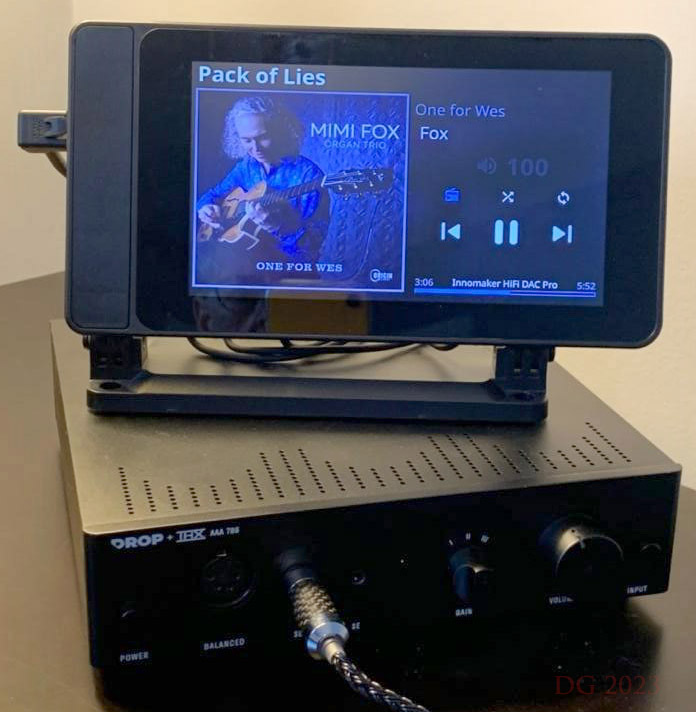
My home office system is headphones only using the Drop THX-789 headphone amplifier fed by a Khadas Tone1 (Tone Board Generic Edition) DAC connected via USB to a Raspberry Pi 4 with display running RopieeeXL. Music playback software is Roon with Drop+Dan Clark Aeon X, Aeon Noire, or Drop x Sennheiser HD6XX headphones with PEQ settings from Oratory1990 to make the physical sounds. This setup gives me a clean and compact footprint with a touch screen for ease of use and objectively good fidelity per the measurements and reviews performed by you here on your blog and by Amir over at Audio Science Review. A drawback to this setup is that the Tone1, sitting in a separate box and with the USB and unbalanced audio cables, makes for additional clutter on the desk.
The Innomaker HiFi DAC Pro uses the same DAC chip, ESS 9038Q2M, as the Khadas Tone1 but, unlike the Tone1 Generic, is HAT compatible and has both balanced and unbalanced output. Balanced output is via two 3.5mm headphone jacks and unbalanced through a single 3.5mm output that can also serve as headphone out. I chose to use the balanced outputs. I assembled 3.5mm to XLR cables from spare Amazon cables I had on hand. No need for anything flashy on the cable front. If you don’t want to roll your own then you can buy 3.5mm to XLR cables from Innomaker’s Amazon store. It should sound like the Tone1, right?
Saturday, 20 February 2021
REVIEW / MEASUREMENTS: HiFiBerry DSP Add-On with the DAC2 HD. A quick Roon 1.8 network/endpoint issue and remote access request.
This post is in many ways a continuation of the HiFiBerry DAC2 HD measurements presented last time with the devices sent to me by Doug Gardner for testing. For some background, this DSP Add-on is related to the BeoCreate project which was documented in this 2018 thesis in collaboration with Bang & Olufsen. The idea was to create an open-source system to allow consumers to build or update their own loudspeakers to be active devices. It looks like this DSP Add-On board leverages that software to do its magic.
As you can see in the thesis, the final BeoCreate product was a board which included 4-channel amplified outputs, digital S/PDIF input and output, DAC, and of course the programmable DSP subsystem. A Raspberry Pi could be added to provide network streaming capabilities.
For completeness, I want to mention that this DSP Add-On is also compatible with HiFiBerry's DAC2 Pro (~US$50-60) board. Notice that the DAC2 Pro is a less expensive DAC than the DAC2 HD and sports headphone out. The converter chip seems to be the TI PCM5122 (same as previous gen DAC+ Pro) based on what's listed in the specs sheet but I have not seen confirmation that is indeed the case.
Saturday, 13 February 2021
REVIEW / MEASUREMENTS: HiFiBerry DAC2 HD HAT for Raspberry Pi
Saturday, 24 October 2020
MUSINGS/HOW-TO: Raspberry Pi 4 "Touch" Audio Streamer, and CRAAP settings! ;-) The decline of public feedback, virtual showrooms, value-added content and Darko Audio?
![]() |
| Left - Raspberry Pi 4B, Right - Raspberry Pi 3B. Heatsinks installed on both boards. |
Back in August, I wrote an update on building and running the of Raspberry Pi "Touch" audio streamer with RoPieee software. The article was still written with the Raspberry Pi 3B(+) in mind.
Well, on Prime Day recently, I was able to get a Raspberry Pi 4, 4GB "Starter Kit" for a price I could not resist. It's nice to have all the parts including the appropriately sized heatsinks, ready-to-use microSD card, and 5V/3A USB-C power supply. For now, I have no need for the Pi 4 case and the micro-HDMI cables can go in my box of miscellaneous cables.
For audio streaming purposes, a basic 2GB Pi 4 kit (<US$55) would be even cheaper and works just as well. Given the minimal difference in cost, no point going with a 1GB model although that would still be fine - remember the Pi 3 was limited to 1GB. There is also an 8GB Pi 4 but that's a huge amount of memory for just an audio streaming "appliance"!
Saturday, 8 August 2020
DIY: Raspberry Pi "Touch" Audio Streamer (2020) and RoPieee - US$160. Spectral tilt, educational articles, and anti-audiophoolery...
It has been awhile since I built my Raspberry Pi "Touch" Streamer discussed back in 2017. We're here now in 2020 and I had the need to put another one together. Since 2017, I've been using Roon more than Logitech Media Server (LMS) in my sound room so I thought I'd focus on installing RoPieee for this article although piCorePlayer remains my preferred software for LMS use (I still have LMS running on a Linux VM on my Server machine for remote playback of music away from home).
Raspberry Pi 3 B+ - $42
AC Adapter 5V/3A with switch (microUSB for Pi 3) - $10
Official Raspberry 7" touchscreen - $64
SmartiPi Touch 2 case - $30
SanDisk 64GB microSD - $13
RoPieee software - donation-ware download, your choice "standard" or "XL"
Sunday, 28 July 2019
MEASUREMENTS: "Noisy" Switching Power Supplies vs. Lithium Battery Packs (12V battery with RME ADI-2 Pro FS & Topping D10 DAC results)
What you see here is the device connected to the Talentcell 6000mAh 12V Li-Ion battery pack. Since the RME ADC has become my standard for measurements in the last year, I have wanted to make it "portable". Talentcell makes an even smaller 3000mAh 12V battery which would work fine. While a little larger in size and weight, the 6000mAh unit is still lightweight and will be able to power the ADC/DAC for >5 hours - enough for any recording and measurement I would want to do in a single sitting.
Saturday, 29 June 2019
LISTENING: Fully battery-powered wireless streamer & amplifier system (Yeeco - TI TPA3116D2, TalentCell 12V battery)
As you can see, the reviewer linked above gave the product some positive comments on the sound. I was curious to listen and since we know that Class D amps like these are very efficient, how about we run the playback system - music streamer to amp to speakers - completely wirelessly and battery powered for a listen also?
Saturday, 15 December 2018
MEASUREMENTS: Intel i7 PC and Raspberry Pi 3 B+ Audio Streamer - XLR / RCA, Noise and Jitter. Do digital transports / streamers really make a difference? Do USB cables?
This is a picture of the corner of the room where I performed the measurements for the post last week. Notice that Intel i7-3770K computer in the left corner I use for gaming? Within that box are 16GB DDR3 RAM, both a SanDisk Ultra II SSD and a recent 2TB Firecuda drive, plus a rather powerful nVidia GTX 1080 graphics processor which is what is driving the display on the 4K TV. Inside the case, it's all powered by a 6-year-old Antec 650W switching computer power supply these days. The computer is about 6 feet away from the TEAC UD-501 DAC.
Suppose I take a 16' USB cable and connected this computer to the DAC and compared the measurements with the low-power Raspberry Pi 3 B+ streamer... What do you think the result would be from the perspective of distortion and noise?
Saturday, 8 December 2018
MEASUREMENTS: Raspberry Pi 3 B+ as streamer - switching power supply, battery, WiFi, touchscreen noise??? (32GB RAM, MI: Fallout and The Beatles' 2018 "White Album")
![]() |
| Battery-powered Raspberry Pi 3 B+ with JustBoom Digi. Bohemian Rhapsody soundtrack. |
Since I had my set-up running for last week's evaluation of the JustBoom Digi, I figure I might as well do a few more tests to demonstrate for myself (and you, fellow readers) whether these beliefs hold any truth.
Saturday, 1 December 2018
MEASUREMENTS: JustBoom Digi S/PDIF HAT for Raspberry Pi. (Plus "Why isn’t digital audio 'just ones and zeroes'?" anxiety...)
I mentioned a few months back in September that I updated my Raspberry Pi 3 B+ Touch device with the JustBoom Digi HAT for S/PDIF coaxial and TosLink digital audio output. Over the last few months, I've been using it more regularly for my nightly music listening.
As I noted previously, this device is essentially a 1-chip solution featuring the Cirrus/Wolfson WM8804 transceiver with jitter attenuating PLL (rated intrinsic jitter of ~50ps RMS) released in 2009. It also uses the Murata DA101JC isolation transformer for the coaxial output.
The device is rather plain otherwise as you can see. It does sound good and is capable of up to 24/192 with both coaxial and TosLink outputs. And at <US$40, it's also very affordable. Let's see how well it measures!
Sunday, 4 November 2018
MUSINGS: Raspberry Pi 3 B+ "Touch" Optimizations; CRAAP Settings, and the "Extremus" Filter Setting.
Okay, let's have some fun with the Raspberry Pi 3 B+ motherboard, piCorePlayer, and my little "Touch" device I recently updated. As discussed before and in the picture shown above, these days, I have the inexpensive JustBoom Digi HAT (~US$40) board attached out the back for simple S/PDIF connectivity as well as USB when I need.
Today, let's hit a few topics related to the Pi 3 B+ setup above. Some little tweaks, things to get it working well, and fooling around with a piCorePlayer/SoX filter you can try for yourself without unnecessary hype nor expense...
Saturday, 1 September 2018
Update: Raspberry Pi 3 B+ "Touch" Streamer, JustBoom Digi HAT, 3.0A power supply... And did they mess up Coltrane's "Both Directions At Once" in hi-res!?
Back in early 2017, I documented on the building of my little Pi "Touch" music streamer that I've been using over the last while for playback through my Logitech Media Server system at home. Over the last year, I've used this quite a bit for music playback and also some of the testing I've done on this blog.
As some of you may know, there has been an update of the Raspberry Pi 3 to the B+ model (~US$40). The upgrade isn't a major change to the existing Pi 3 board. However the new SOC, based on the Broadcom BCM2837B0 quad-core Cortex A53 (ARMv8, 64-bits) is slightly faster at 1.4GHz (1.2GHz previously, about 15-20% speed gain), and another upgrade is better ethernet speed which supports gigabit link but since it's still communicating through the USB2.0 port, will max out at ~300Mbps. In some benchmarks I've seen, though not true gigabit speed, the throughput is about 2x that of the previous Pi 3. For those interested in wireless connectivity, there are upgrades in the WiFi and Bluetooth departments as well.
Saturday, 20 May 2017
MEASUREMENTS: Raspberry Pi 3 "Touch" music streamer
![]() |
| The music being played is the soundtrack from Japanese anime Your Name (Kimi No Na Wa). Saw it with the family last week - great flick! |
Well... Let's have a look at those results! :-)
Saturday, 25 March 2017
HOWTO: Building and Installing the Raspberry Pi 3 "Touch" Audio Streamer.
![]() |
| Raspberry Pi 3 + 7" Touchscreen (left) and Squeezebox Touch (right): for the Pi device, I still had the plastic screen protector on in the picture, hence the bottom left tab... |
In this post, let's have a closer look at the device and some instructions / suggestions to build one.
Saturday, 25 February 2017
MEASUREMENTS: A look & listen to Roon Bridge - Raspberry Pi 3 Streaming (HiFiBerry DAC+ Pro & USB DAC)
Last time, I talked about Roon and discussed my experience with it using the NUC as the primary installation and playback. No doubt, you are aware that many people will use inexpensive devices like the Raspberry Pi 3 to handle playback distributed around one's home... And no doubt you've also come across much hyping about more expensive, low power devices when for around $100 and a little know-how, you can get it done quickly, easily and sounding great.
First, I just wanted to practically lay out a simple way to install Roon Bridge on the Pi 3 that worked for me and using which I will run a few tests to demonstrate the sonic output. Remember that the network protocol from the Roon "Core" (my Windows computer) to the Roon "Bridge" (Pi 3) is what's called RAAT (Roon Advanced Audio Transport). It's a protocol with a number of benefits as highlighted in the link.
Saturday, 7 January 2017
MEASUREMENTS: Raspberry Pi 3 as USB Audio Streamer (with recommended CRAAP config & TIDAL/MQA arrives)
Have you measured the USB output from the RPI3 to a USB DAC to see if it's "clean" like the ODROID?Good question Josh, and perceptive as well. I had not posted anything on the Raspberry Pi 3 specifically, whether there was any difference to be found streaming to the same USB DAC as compared to say the ODROID-C2. Let's have a good look at this and see if we can arrive at some facts and come to some conclusions...
Saturday, 22 October 2016
MEASUREMENTS: HiFiBerry DAC+ Pro, PCM5122 digital filters & further thoughts on filtering...
![]() |
| A summary slide from this presentation slide set. Just a reminder of the general desirability of digital filters providing higher accuracy compared to analogue... |
Sunday, 2 October 2016
MEASUREMENTS: Raspberry Pi 3 & HiFiBerry DAC+ Pro (Audio Streaming)
Last week in the preview, I introduced you to the Raspberry Pi 3 Model B with the HiFiBerry DAC+ Pro HAT board. You see above a picture of the boards assembled but in the "naked" state before installation in the case. As I mentioned it doesn't take much time to put this all together on the hardware side, and just a bit of tinkering with Volumio 2 was all that was needed afterwards to get the DLNA/UPnP streaming working over the wired ethernet (a little fiddling with the Volumio hotspot if you want to use WiFi - not recommended for hi-res audio). Since the software is still in development, I noticed that messing with network settings could lead to connection issues. But once it works, it has been stable.
As promised then, let us now put this device to the test and see how it performs objectively. What level of "high fidelity" does this streamer/DAC combination perform at?