Saturday, 28 October 2023

Part II: Topping PA5 Mk II Plus (PA5II+) Class D amplifier review. Power, Distortion, the Subjective and on Hi-Res amplification.

I mentioned previously that this is a very unobtrusive amp. With the shipped plastic protector off, notice the low contrast of the lettering with the black front makes it even less obtrusive! This was why I left the plastic protector on to take the photos last time to better show the labels for the switches.

I introduced the Topping PA5 Mk II Plus last time in Part I with some initial measurements. This time let's keep going as we explore the power capabilities of this little audio amplifier, examine playback fidelity, and discuss a bit of the subjective performance.

Unless otherwise specified, these measurements were done with the amplifier connected to standard 4Ω and 8Ω power resistors as load, both channels driven, 20Hz-20kHz bandwidth for distortion measurements, unweighted. The Linear Audio AutoRanger allowed automatic gain/attenuation to keep the signal from getting too "hot". Signal from the AutoRanger is fed to the prototype Cosmos Scaler as a preamp for the E1DA Cosmos ADC operating in mono mode. High resolution signal generator DAC is the SMSL DO100 connected to Intona USB isolator. No special cabling, the 3' female XLR-to-TRS balanced cable was just something decent and generic like this, likewise generic RCA was totally fine. Seriously audiophiles, that's all we need for hi-fi sound quality.

Let's get to it!

Saturday, 21 October 2023

Part I: Topping PA5 Mk II Plus (PA5II+) Class D amplifier review. (And RME ADI-2 Remote, "cultural pressure" for subjectivist audiophile reviews to include measurements?)

Over the last few months, I've been exploring the performance of the TI TPA3255 Class D chip amps including the AIYIMA A08 Pro, Fosi Audio TB10D, and AOSHIDA A7. Overall, we've seen very good results from these little amplifiers and I think they represent a level of low-distortion performance at a price point that is very attractive to many hi-fi hobbyists.

Depending on the power supply mated to the amplifier, measurements have been showing low output impedance up to 10kHz typically (<0.2Ω up to 10kHz), something like 80+W into 4Ω with less than 0.1% THD+N, and a -80dB Triple-Tone TD+N result at 1W into 4Ω which is excellent considering the prices of these little amps typically at less than US$150 depending on the features you want like Bluetooth input, VU meter, etc.!

Given the track record of these TI devices so far, this time, let's look at another chip amp which is based on an undisclosed part, not the TPA3255, although I can confirm it is a TI TPA chip. In my discussions with John Yang at Topping, the intent is to allow audiophiles to judge the product based on sound quality merits rather than focus too much on exactly which Class D part was used since the design around the chip is very important. Fair enough, and that's exactly what we aim to do here anyways since even with the previous TPA3255 amps reviewed, there were objective differences to find even if subjectively, differences might not be as noticeable.

I bought this Topping PA5 Mk II Plus (which I'll abbreviate as PA5II+ for simplicity) myself from Amazon, currently around US$325 with the intent to use in my own system. Since I'm interested in "high-fidelity" (not merely "euphonia"), I was interested to see how well this would compete with the DIY Hypex nCore NC252MP we measured a few years back. I like the feature set that it offers. On paper, it should provide the power I need and if the hi-fidelity performance is excellent, it could certainly be a listening "reference" here even though to be honest, I still love the Hypex's capabilities and would have no issue with enjoying the music from the inexpensive TPA3255 devices either.

Sunday, 15 October 2023

A Psychoacoustic Rationale for the Subjective Evaluation of Stereophonic Sound Systems by Reviewers and Audiophiles (Ralph Glasgal)

With the discussion of ambiophonics ("ambio") and crosstalk cancellation (XTC) last time, I came across a number of fascinating writings from Ralph Glasgal in the Ambiophonics Facebook group. The one below is one of them I think worth considering that I had not seen before, explicitly written as copyright-free. I've made some mild formatting edits and wording substitutions/additions for clarity as well as emphasis in areas I felt of importance. I trust this mildly edited version retains the full meaning and intent of the original found at the group above. A copy of this has been sent to Mr. Glasgal but I'm not sure if he's reviewing his E-mails or active in audio discussions these days in his 90s.

A Psychoacoustic Rationale for the Subjective Evaluation of Stereophonic Sound Systems by Reviewers and Audiophiles

By Ralph Glasgal, BEP, MSEE, AES, IEEE
glasgal@ambiophonics.org

The oft repeated assertion that high end components of stereo systems can only be truly evaluated by listening rather than by measurement or blind A/B testing by listening panels has been argued for decades now. The following text will, I believe, provide a psychoacoustic explanation of why this position is largely correct and not a question of practicing voodoo audio.

Very few audiophiles will want to read what follows since it is rather long, too technical, and not what they are used to reading in Stereophile or The Absolute Sound. But this article is for the record, for discussion forums, and to have it available for future debates. Anybody is free to use or forward this text. It is not copyrighted. Supporting technical references by a variety of authors are available at ambiophonics.org (mirrored).

Sunday, 8 October 2023

Stereo Crosstalk Cancellation (XTC): A review by STC. And trying out uBACCH, ambeo.one, and AmbiophonicDSP VST plus Foobar foo_dsp_ambio plugins.

Hey everyone, it has been very busy as expected through September here at the Archimago household. As a result, I haven't been able to spend as much time on the audio hardware hobby (still very much enjoying the music of course!).

Over the years, you might have come across the term "crosstalk cancellation" (XTC) for speaker playback, words like "ambiophonics" or acronyms like "BACCH" may have passed by in your readings (for example great discussion on Reddit). For this blog post, let me ask an outspoken advocate of XTC to join for some guest content to discuss the reasons and techniques, and later on, we'll talk about a few DSPs one could try at home to experiment...

Take it away STC for Part I, I'll be back with STC for Part II, then I'll talk about trying some of the DSP options in Part III:

Part I: An introduction to XTC (by STC)

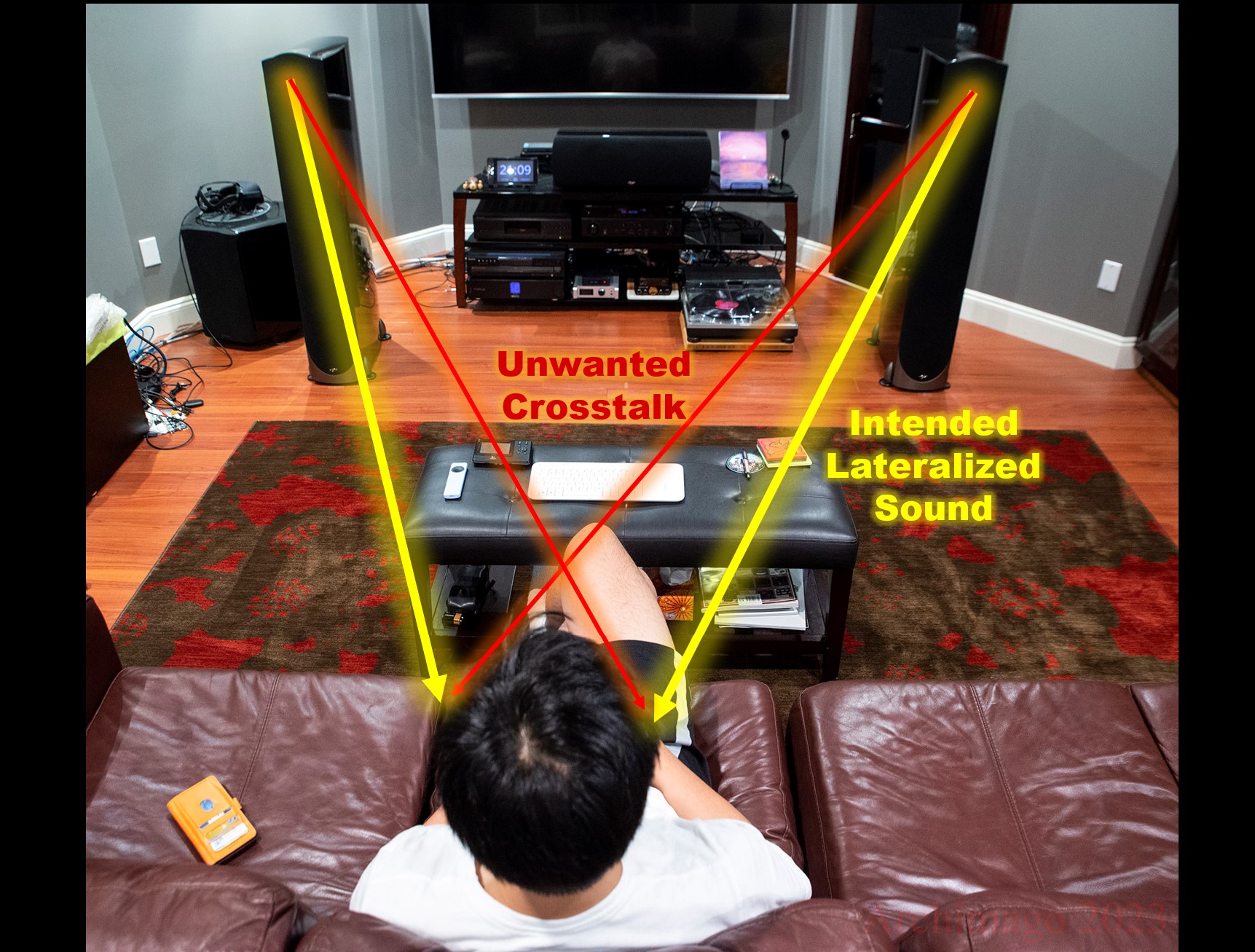
Crosstalk cancellation is an attempt to deliver stereo sound as it was meant to be played without the interaural crosstalk errors with loudspeakers (see Keele, 1986 for a technical exposition). Many listeners may not realize how much realism their high-end stereo hi-fi system is lacking until they hear a system with crosstalk-cancelled (or XTC for short) playback. It is like comparing a photo of a window with a view to an actual window looking out at the scenery. Or like watching Avatar in 2D versus 3D.

Wednesday, 20 September 2023

RIP MQA codec? (Yeah. On Lenbrook Group's acquisition of bankrupt MQA Ltd., and SCL6.)

Hey folks, it looks like the saga around MQA never ends, but I think they're just scraping the bottom of the barrel with one last crank of the hype machine with hopes that this is somehow face-saving as well. :-|

So as of yesterday (September 19, 2023) it appears that Canadian brand Lenbrook Group of Companies - NAD, PSB, Bluesound - has acquired the intellectual property for MQA. Let's talk about this.

Saturday, 16 September 2023

As We Hear It: On requesting artists/albums to streaming services. (Plus adding more RAM and larger SSD to the computer workstation.)

Hey everyone, life's been very busy so not much time to think or work on audio stuff.

A few weeks back in my discussion of Qobuz in Canada, I said: "I'm curious, has anyone out there contacted their streaming service to request the addition of an artist or album? Were you able to get your requests included?"

Well, I received a number of responses, mostly from folks who were happy that Qobuz or TIDAL were able to oblige with putting their requests up. Here's a very well written one that I thought would be good to share with everyone... It brings up important points especially these days as we transition into more music lovers depending on the services to supply our music. Many, including myself these days are collecting more playlists than actual physical albums or spending the time to download anymore.

Saturday, 2 September 2023

MUSINGS: nVidia's GeForce RTX 4090. Power Limited Overclock settings. On technological progress into cognitive domains.

For this post, I thought I'd explore technological progress in the computing space. While I speak mainly about audio topics in these pages, I hope this post gives you an idea of the broader technological progress happening around us.

As per the image above, I've updated my workstation graphics card to a Gigabyte GeForce RTX 4090 Gaming OC. This card is truly a beast, covering 3.5 slots in the computer thanks to the extra vapor cooling chamber. [Related to this card is the slimmer Gigabyte GeForce RTX 4090 WindForce V2 that "just" takes up 3 slots.]

Years ago in 2017, I spoke about my GTX 1080 used in the game machine of that time. Since then, it's obvious that technology has moved forward very substantially! Every couple years has seen a new generation of graphics cards churned out by nVidia typically with AMD following suit and these days Intel making headway with their more budget-friendly ARC line.

With each iteration, we're seeing objective improvements in computational ability and physical characteristics like the shrinkage of the transistor "process" from 16nm for the GTX 1080 down to the 5nm (near limits of silicon) in the RTX 4090 today. With the ability to fit more transistors into a smaller area (higher density), the number of parallel computational cores has increased from 2560 shading cores (also known as CUDA cores) in the GTX 1080 to 16384 units in the RTX 4090, a 6.4x increase in this one metric alone; not to mention the addition of new features like the Tensor cores (high speed, mixed precision, high-dimensional matrix multiplications) released in the RTX 20*0 generation, important in deep-learning tasks.

Saturday, 26 August 2023

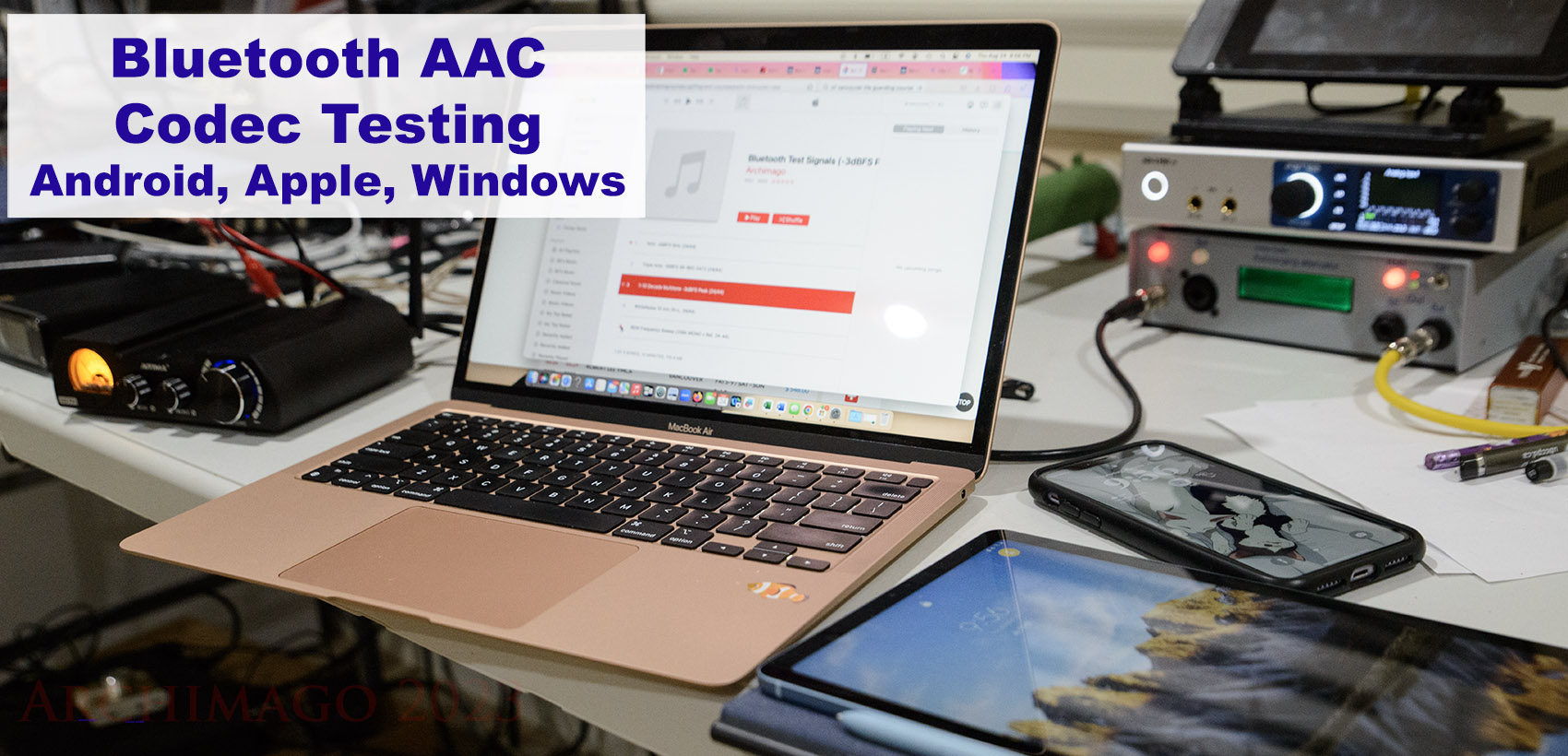
Part II: Comparison of Bluetooth Fidelity - AAC encoder quality (Android 10 & 13, Windows 11, Apple iPhones & Mac)

Greeting everyone, time to jump into Part II of our assessment of lossy Bluetooth music transmission.

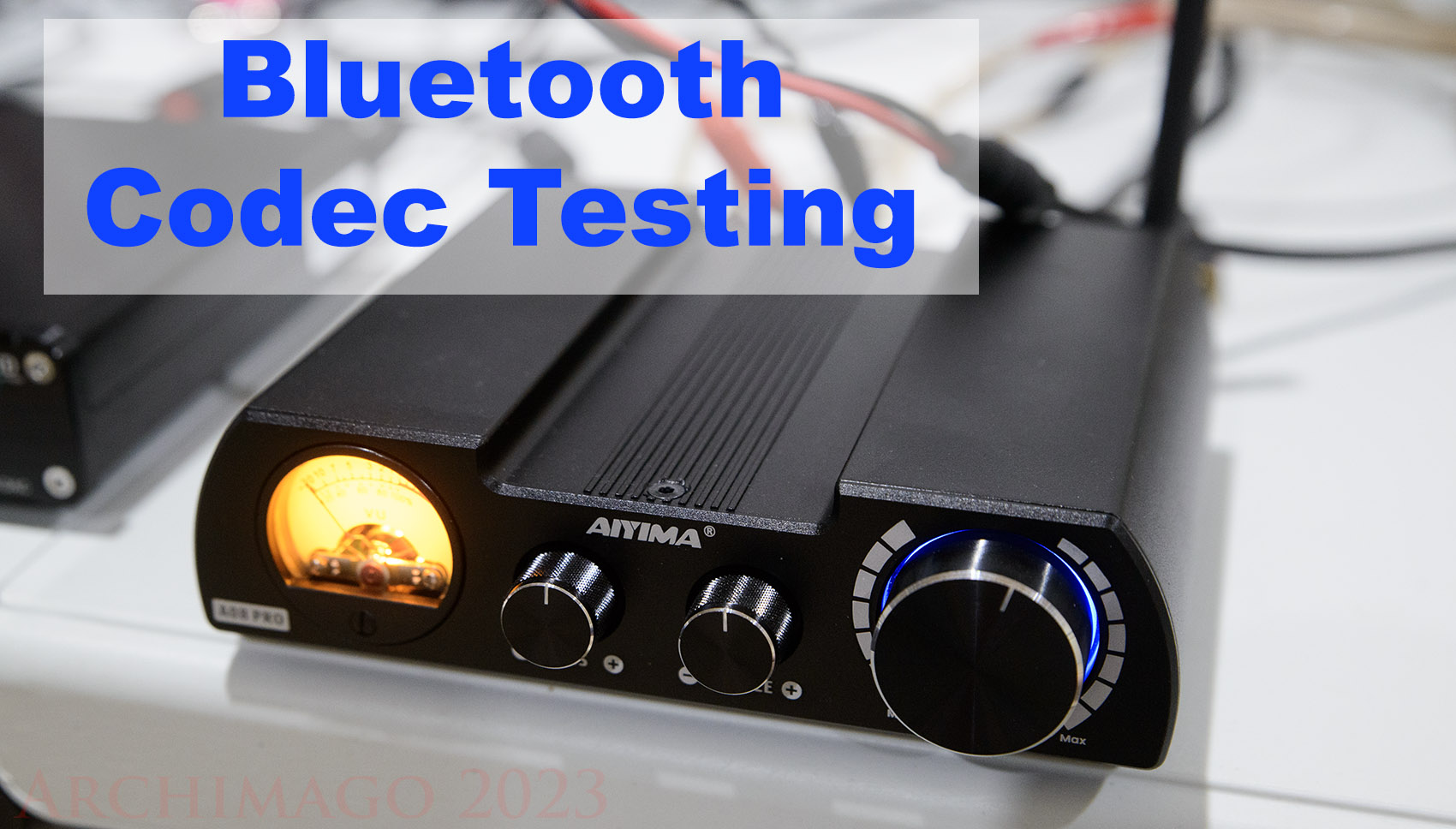
In Part I, we examined the use of an Android 10 device (Huawei P30 Pro) as audio transmitter showing the differences between the codecs as played back with the AIYIMA A08 PRO amplifier and its Qualcomm QCC5125 Bluetooth SoC. Please refer to that article for details about the methodology and comparison with the output from a high resolution Topping desktop DAC.

For this Part II, let's focus on the Advanced Audio Coding (AAC) codec which has become a very popular option. Other than the universal default SBC, AAC is probably the most common one for music transmission on account of the fact that the "elephant in the room" - Apple - uses this across its product lines as their standard codec running at 256kbps. Given the amount of use, this is basically a practical standard for quality music transmission over Bluetooth.

Given the broad range of computers/tablets/phones used among family members here, when I'm looking for wireless headphones, I would want to make sure the device supports AAC; probably more so than aptX or LDAC.

Note that there is actually a "family" of AAC profiles from the early Low Complexity AAC (LC-AAC) originating in 1997 up to later versions like Extended High Efficiency AAC (xHE-AAC) released in 2012. As end users, we're generally not privy to such details so I'll just use the generic term "AAC" in this article.

Saturday, 19 August 2023

Part I: Comparison of Bluetooth Fidelity - SBC, aptX, AAC, LDAC (Android 10 source)

Blue ring around power/volume knob = Bluetooth input.

I've been wanting to do this for awhile. The last time I had a look at Bluetooth playback quality was way back in the days of the Oppo Sonica DAC in 2017.

Bluetooth has been our ubiquitous wireless audio transmission technology for more than 2 decades now; Bluetooth 1.0 was released in 1999 but it took a few years for the number of supported devices to grow and costs to come down. Since then, with subsequent versions, we have seen an increase in bandwidth, codecs, transmission range, and power efficiency.

Currently, we are at Bluetooth 5.X (version 5.0 standard released 2016) with the potential for up to 2Mbps transfer rate and distance maximally up to 240m (800ft)! These are clearly ideal numbers. Bluetooth transmits in the 2.4GHz bandwidth like WiFi but can "hop" (Frequency Hopping Spread Spectrum) between 79 channels, 1MHz wide, so there are usually no issues with coexistence. 

Given the 2Mbps limitation, lossless audio transmission would be a problem. Lossless 16/44.1 stereo is already just over 1.4Mbps uncompressed. Yes, we could losslessly compress but compression ratios are variable. Due to inevitable errors in transmission plus protocol overhead, in practice, at most we should think of Bluetooth 5 as operating around 1Mbps reliably under reasonable, if not close to ideal, conditions with transmitter/receiver nearby.

Saturday, 12 August 2023

The Different Types of Subjectivisms in Audiophilia (And How to Get Rid of Them) - guest Taylor Christensen

By Taylor Christensen

I joined the audiophile hobby less than 10 years ago, and, as a person who relies heavily on understanding and applying scientific literature in my day job, I was baffled (pun intended) to discover the extent to which the culture of this hobby is shaped by “pseudosciency” beliefs and even frank scientific ignorance, especially when considering the high prevalence of the audiophile community being well educated and affluent.

Since then, I have thought a lot about this phenomenon. Whenever I am trying to make sense of the world, I find that exhaustive, mutually exclusive categorizations help a great deal, and I have come up with such a categorization that helps me organize and understand the strange things we see in this culture.

To communicate clearly, I need to explicitly define any words whose definitions may be ambiguous – in this case especially, because they sound very similar. Therefore, let me start with three definitions.

The first one, which I will be using frequently throughout this article, is "subjectivism," which I am defining as "any false belief in audibility".

Contrast that with the second word I want to define: "subjectivity," which relates to a person having a personal preference.

Tuesday, 1 August 2023

REVIEW / MEASUREMENTS: AIYIMA A08 PRO - TI TPA3255 Class D amp with AAC/LDAC/AptX Bluetooth input. On "giant killers" and "CHEAP" amps. Goodbye TIDAL MQA.

Over the last while it has been interesting checking out some TI TPA3255 "PurePath" chip Class D audio amplifiers such as the Fosi Audio TB10D [Upgraded] and AOSHIDA A7.

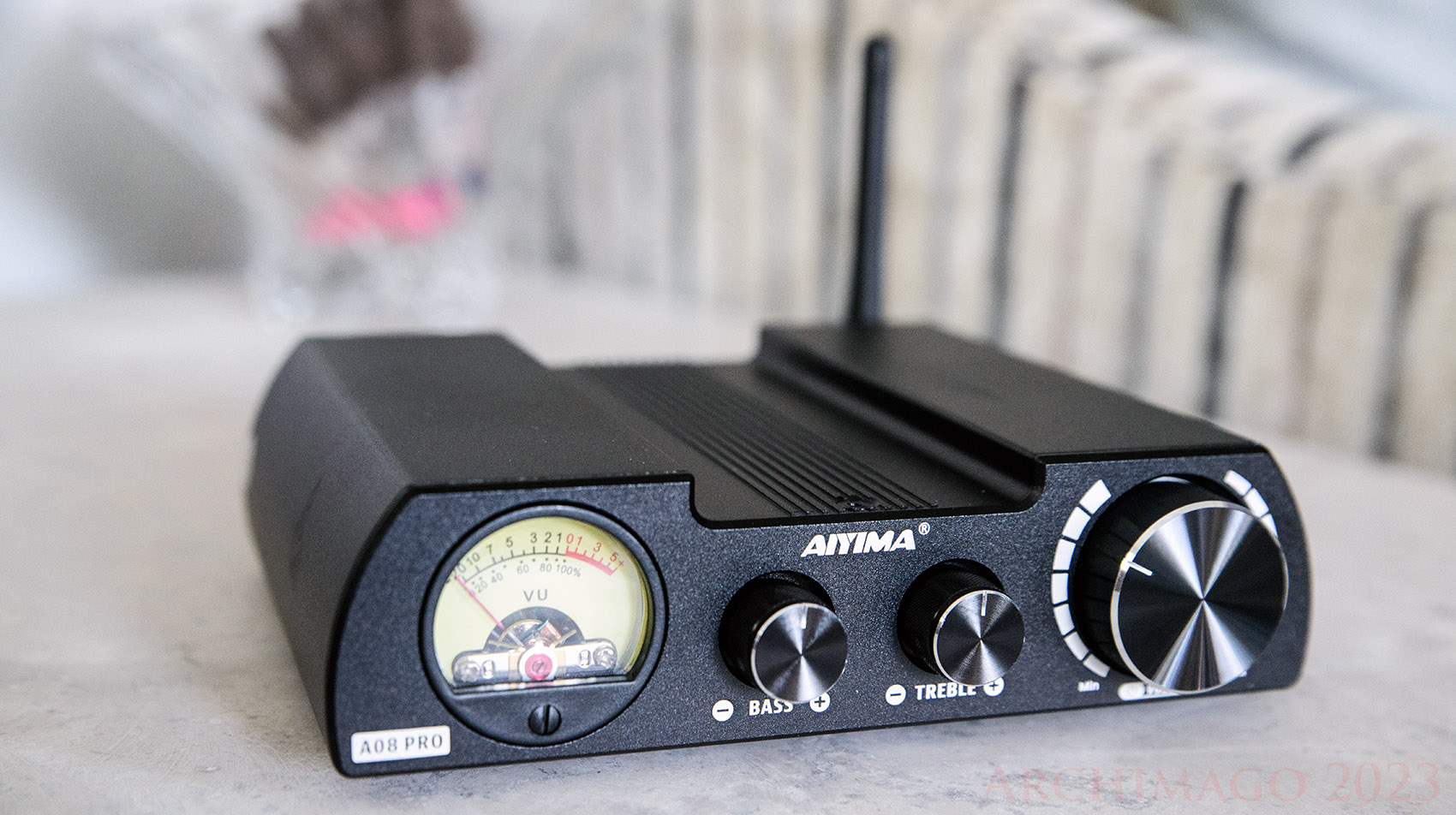
As you can see in the image above, I've got another one to put on the test bench for a look and listen - the AIYIMA A08 PRO (currently <US$130). Depending who you read/listen/watch, you'll see supporters who like the amp, sometimes calling it a "giant killer" of sorts, such as this blog post, or there are detractors like Andrew Robinson who seem to think these kinds of amps are only good in the nearfield and below 60dB SPL (see from 10:30). We'll talk about this below. :-)

As usual, let's start with a peek at what you get for a low price...

Saturday, 22 July 2023

Qobuz now in Canada. Finally, Roon integration and a taste of lossless multichannel streaming. Thoughts on the future of audio streaming.

Finally after all these years. Despite bugging them at least since RMAF2019, it has taken ages but at last as of April 2023, Qobuz is now available here in Canada. As you can see, price in Canadian dollars is reasonable at CDN$10.83/month yearly subscription or $13/month if you prefer month-to-month. I see a 60-day trial here; there are 3-month trials out there as well so look around for one that might apply to you.

With competition these days, the price is in line with other services offering up to 24/192 lossless hi-res content; here are the current prices in Canada:

Amazon Music HD - CDN$10.99/m ($8.99/m Prime members)
Apple Music Individual - CDN$10.99/m
Spotify Premium Individual (lossy Ogg Vorbis) - CDN$9.99/m
TIDAL HiFi (16/44.1) - CDN$9.99/m
TIDAL HiFi Plus (MQA, likely FLAC hi-res transition in August) - CDN$19.99/m.

Saturday, 15 July 2023

Pacific Audio Fest 2023: Part III - Final show musings... On sponsorships, seminars, unique listening opportunities (DSD256 vinyl sounds great ;-), and suggestions.

Collected promo materials, PAF2023.

Having published on the products seen at PAF2023 in Parts I and II, I thought it would be interesting to take some time to chat about other experiences from this show and parting observations.

These observations might apply at other audiophile shows as well.

Saturday, 8 July 2023

Pacific Audio Fest 2023: Part II - Hotel wing audio rooms. A few words on sound quality, and emotional connectedness.


Let's continue exploring Pacific Audio Fest 2023 beyond the main ballroom and larger rooms from last time. As you're probably aware, audio shows take place in hotels with companies renting out rooms to show off their gear. At PAF2023, we have 4 hotel "wings" to explore located on the first, second, and thirteenth floors.

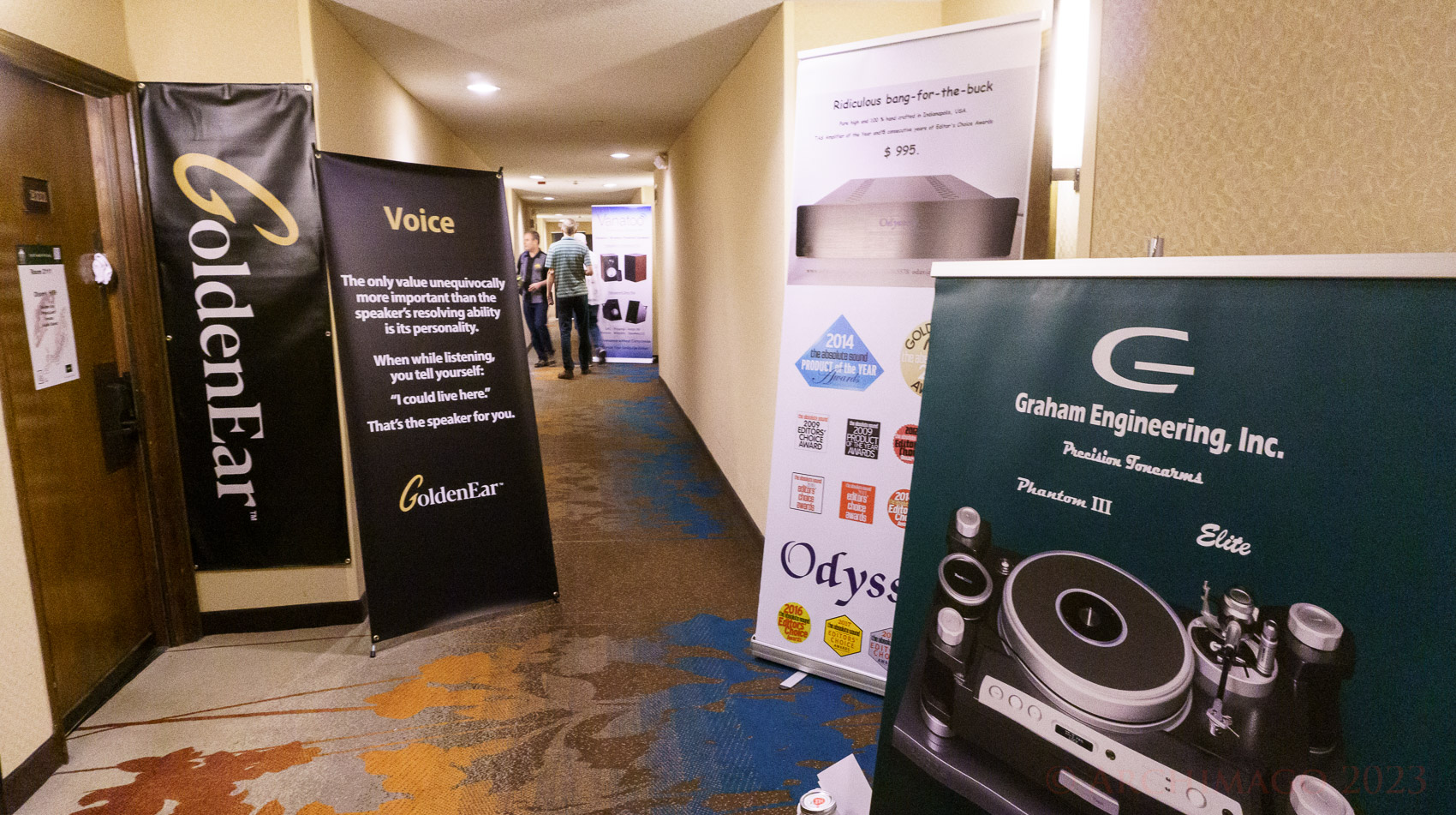
Mercifully, PAF2023 isn't a big show which allowed me to enter each room and have a listen over the leisurely 3 days (Friday to Sunday) that I was in Seattle. Let's go for a stroll and see what each room had to offer. While I don't think I missed any of the rooms, I'll only highlight the ones that seemed most interesting...

Saturday, 1 July 2023

Pacific Audio Fest 2023: Part I - Ballrooms, marketplaces, and the larger rooms... Thoughts on vinyl / LP at "hi-fi" demos.


At the time of publication, it will have been a week since the Pacific Audio Fest 2023 (June 23-25). Compared to last year, they held it about a month earlier. As usual, I took a number of photos at the show and figured it would be fun to do some reporting on what was seen and heard, offering impressions from my notes and memories of the time in Seattle.

To start, let me remind everyone that while audio shows are fun, they are definitely not the best places to listen for sound quality. This is better done at a local dealer showroom you might be familiar with or best in the comfort of home. Typically at shows, we're treated with unfamiliar music. Even if the song is familiar, they might be playing from a streaming remaster or off an unfamiliar LP. Room acoustics vary widely, and attendees are typically shifting in and out, chatting during the visit while you're trying to appreciate the music.

Nonetheless, there is something to be said about the importance of that first impression for attendees of what we hear. In an age where much of our purchasing habits come from online sources and web-based transactions, being in the presence of these devices, and the impressions they leave us with, are powerful in directing whether we're likely going to explore the brand or specific device. As such, if companies are going to attend audio shows, it is very important that they do it right.