Showing posts sorted by relevance for query dacs. Sort by date Show all posts

Friday, 1 July 2022

Hi-Res THD(+N) vs. Output Level Measurements (ESS "HyperStream" vs. AKM vs. TI/Burr-Brown). And a bonus R-2R!

Notice last time as I ended off the post, I showed what I think is an interesting "high resolution" graph of THD(+N) vs. Output Level for the Topping D10 Balanced which uses the ESS ES9038Q2M chip. This was spurred on after some discussions on glitches and anomalies one might see due to the "HyperStream" architecture of the ESS chip.

These days, other than the occasional fully multibit or discrete R-2R DACs, the vast majority of what we're using are multibit/multilevel sigma-delta devices. This includes the brands I have listed in the upper graphic; Asahi Kasei Microdevices (AKM), ESS Technology, and Burr-Brown (which was acquired by Texas Instruments in 2000). We'll also talk about the Philips later. ;-)

Today, let's have a look at "high res" THD(+N) vs. Output graphs (XLR output where possible to keep noise as low as possible) comparing different DACs from these companies...

Saturday, 18 May 2024

"High-End" DAC Blind Listening Results - PART I: Devices Unveiled!


The time has come friends. Over the last 6 weeks, I've been collecting the data from the 2024 "High-End" DAC Blind Listening Survey. The procedure I think is already well described in that test invite post so I won't spend time here recapping that. Thanks for everyone who participated in the blind listening!

As with many blind listening tests, unless it's literally obvious, I know it's not easy to flip back and forth and it's very common after a few A/B/C switches to second-guess oneself! I certainly appreciate the time that participants spent downloading the >500MB file, getting it onto your listening devices, and the listening itself.

For this post, let's talk about the test, some rationale, and let me unveil the 3 DACs that were used.

Saturday, 6 April 2024

2024 "High-End" DAC Blind Listening Survey!

*Surprise!* It's time for another listening survey.

I like doing these once awhile because it's an opportunity for audiophiles to actually listen for differences between devices, resolutions, or even things like filter settings for themselves as opposed to hanging on to the testimonies of others whether in text or expressed in videos. We can argue all day long about whether THD+N of -120dB is better than -85dB, or if a US$20,000 DAC sounds better than a US$500 one; what matters ultimately is in the listening.

[I agree with Taylor Christensen in his excellent article on "subjectivisms" that what we need more of these days is audibility data to address the category of "scientific subjectivism"; not just opinions or measurements.]

This time, I'll be using recordings of the AMPT Test Track from 3 different DACs for you to listen to. These were created based on my standard procedure of recording and processing described in the link. The only difference is that I'll be using the 24-bit version of the AMPT for this survey to maximize higher resolution dynamic range potential from the DACs.

As a blind survey, I will not tell you which DACs these are to minimize bias. What I can say for now is that these are not devices from Chinese brands although anything can be "Made in China" these days (ie. these are not Topping, SMSL, Sabaj, Shanling, Matrix, Gustard, etc.). Some of these devices can be considered "aspirational" DACs or streamers in that the MSRP of the device could be out of reach to many, even priced "ridiculously" high.

Perhaps this fact might encourage you to listen for yourself: the difference between the least expensive and most expensive device is >100 times!

Saturday, 15 April 2017

COMPARISON: MQA "Authentication" & Sound Quality? (Mytek Brooklyn & Meridian Explorer2)


You've probably heard or read the catch phrases from MQA over the years. "Revolutionary", "TAKE ME THERE"... "To the original performance..." Or how about using phrases like "end-to-end technology"?

As I have said over the last few months, I don't like talking about MQA based on my general impression of what they're trying to do and the way they try to convey supposed "value" to the audiophile world through their advertisements and sponsored articles in the audiophile press. Nonetheless, sometimes it's just necessary to comment and more importantly to put some of the rhetoric to the test. There appears to be a remarkable schism between those who advocate and praise MQA and those who have concerns. I'm pretty sure there are many wishing that MQA would just go away instead of complicating music playback with yet another questionable variant.

Last week, when I wrote about the idea of MQA CD, I brought up the Pono experience as another example of failure in the recent history of the industry. For Pono, the failure was perhaps rather obvious for those of us who have been listening to 24-bit and >44.1kHz music for awhile, especially those of us who have ever bothered to try an A/B-test. It does not take a genius to realise that audible differences are really quite subtle (if even there in most cases of mainstream music) and that differences do not translate to "benefit". Without clear audible benefits, there really was no way that the promise of the Pono music store could ever excite the music-buying public... Certainly not in the way Neil Young portrayed it (sure, the hardware PonoPlayer is unique but with its own quirks of course).

Sunday, 22 June 2025

1kHz Test Tone: Does increasing the number of PCM values really matter? And Stereophile's "still listening" to the community (so they say).

Hey there audiophiles, lots happening in life to keep me busy these days as we enter summer 2025, so let's do another little follow-up of a topic based on reader comments.

In the previous post, there was a comment by Mister MB about the 1kHz test tone and the idea that it would be good to use tones that employ more PCM values as quoted from Ken Pohlmann's book Principles of Digital Audio (currently 6th Edition, 2011, from page 81, emphasis mine):

"Digitally generated test tones are often used to measure D/A converters; it is important to choose test frequencies that are not correlated with the sampling frequency. Otherwise, a small sequence of codes might be reproduced over and over, without fully exercising the converter. Depending on the converter’s linearity at those particular codes, the output distortion might measure better, or worse, than typical performance. For example, when replaying a 1-second, 1-kHz, 0-dBFS sine wave sampled at 44.1 kHz, only 441 different codes would be used over the 44,100 points. A 0-dBFS sine wave at 997 Hz would use 20,542 codes, giving a much better representation of converter performance. Standard test tones have been selected to avoid this anomaly. For example, some standard test frequencies are: 17, 31, 61, 127, 251, 499, 997, 1999, 4001, 7993, 10,007, 12,503, 16,001, 17,989, and 19,997 Hz."

Certainly a good point to think about. However, if we look at actual hi-res DACs these days, and the way we're running 1kHz tests to show routinely >100dB SINAD, would we actually see significantly different results depending on how we create these test tones, specifically whether more or less PCM codes are being used in the signal sent to the DAC?

Well, while I still have the Topping DX9 on my testbench, let's have a look at the analog output from the device with a few ~1kHz test tone variants.

Saturday, 26 September 2015

MEASUREMENTS: Light Harmonic Geek Out V2


I know some folks have been awaiting the results for the Light Harmonic Geek Out V2. As you know, I have already provided a bit of a preview a few weeks back so no need to say much more I think. Generally my feelings about this device have not changes over the weeks... The 3D printed plastic smell has completely dissipated by now. It does sound great and I must say, going into the measurements, the impression was that this is some of the best sound I have heard from these little USB devices! Remember, this is a $235US unit I got as an "early bird" off the Indegogo promotion.

Let's see if the measurements are consistent with some of my early subjective impressions.

Saturday, 30 October 2021

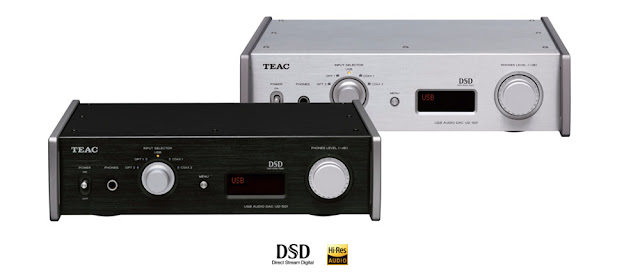
Revisiting the TEAC UD-501 DAC (2013): THD(+N), DSD output, Sweeps, Jitter, 1/10 Decade Multitone 32. (And on SSD transition, Corsair MX500 SSD, and Hi-Fi+ closes comments...)

After Bennet/Dtmer Hk's comment on this previous post, I thought it might be interesting to revisit my longtime friend, the TEAC UD-501 DAC that I bought new when it came out in 2013. My preview and measurements (Part 2 PCM, Part 3 DSD) are still online of course.

I still remember doing those measurements in my previous home - it feels so long ago! ;-)

These days with the E1DA Cosmos ADC and RME ADI-2 Pro FS available for measurements, let's take a trip down memory lane at what has been over the years a reference DAC for me. I think the TEAC UD-501 is a special device that ushered in for many audiophiles a cost-effective, high resolution, well-built, reliable, low jitter, asynchronous USB audio interface which I suspect has influenced the design and performance of other DACs over the years.

Spec-wise, it was one of the first to catch my interest with the ability to handle PCM 384kHz and DSD128. The high quality metal case looks serious. It's based on a dual-mono TI/Burr-Brown PCM1795 configuration with dual toroidal linear power supplies. There are a number of PCM and DSD filters including the ability to turn off the 8x oversampling and allow "NOS" (Non-OverSampling) mode. The quad JRC MUSES8920 opamps they used were also another "feature" talking point back then. (Quite a complete specs page here for the TEAC.)

Saturday, 15 February 2020

MEASUREMENTS & LISTENING: Topping D30 DAC by Greg Dunn. (And briefly, more USB cable nonsense.)


[Ed: Every once awhile, it's a pleasure to have guest posters adding their voice to this blog! There are many folks out there doing measurements, experiments, and I've certainly been in contact with a number of audiophiles with great stories about the gear they have, music they love, and the audiophile pursuit in general!

A few weeks back, Greg got in touch with me around the Topping D30 DAC that he has. This DAC was brought up in comment discussions back in 2018. The D30 measured quite well on Audio Science Review, but has been blasted as subjectively sounding bad - "like ass" as it were - on the Super Best Audio Friends forum. Elsewhere in that SBAF comment thread, the D30 was described as having "poor soundstage and poor timbre".

With this polarization of opinion, it's great to see Greg stepping up with his own opinion based on objective testing and subjective listening... Take it away, Greg!]

Saturday, 3 August 2019

MEASUREMENTS: AudioQuest Dragonflies Reviewed! Dragonfly Cobalt, Red, and v1.2.

Audiophiles following the news cycle know by now that the new AudioQuest Dragonfly Cobalt is out. About 3 weeks back, I noticed out of the blue (no pun intended), almost all mainstream audiophile websites had a post or promotional "give away" for one of these! Clearly this made a significant splash in the collective audiophile psyche.

Over the years, I've reviewed and measured these little USB DAC devices going back to the Dragonfly v1.2 in 2014. More recently, I wrote a series on the Dragonfly Black in 2017 with a good chunk of that looking at MQA "rendering". Note that I don't have the Black v1.5 here for direct comparison and will instead refer to those older results and articles as appropriate.

Here then are the 3 Dragonflies (Dragonflys?) I have in for a listen and on the "test bench" for direct comparison. From left to right - v1.2 (released 2014), Red (2016, ~US$200), Cobalt (2019, ~US$300):


As usual, I will start with building up the objective results and then later in the post, I'll talk about subjective listening impressions and broader ideas. I know this sequence appears backwards compared to how audiophile reviews usually are structured. Most reviews typically start with background on companies, personal anecdotes, people involved in the product, rationale, etc. If one is fortunate, maybe a sidebar or graphs at the bottom of the review for objective results.

As a "more objective" audiophile, the typical sequence above is not how I would prefer to learn about a new product. There are often insights one can gain through disciplined objective evaluation one simply cannot get based on company literature or even just listening unless one were truly meticulous. Objective results apply to us all, while subjectivity is the domain of the individual. As such, technical adequacy and fidelity IMO are much more interesting and significant than a company's history, who the "guru" was behind it, or to be honest, what the reviewer "heard" or probably more often than admitted, thought they "heard"; I'd rather leave many of those items as sidebars.

Thursday, 7 August 2014

MEASUREMENTS: AudioQuest Dragonfly v1.2 Reviewed

An audiophile buddy of mine (AudioPhil) got married a few months back and a few of us decided to chip in to give him one of these Dragonfly DACs for being a good sport :-).

I don't think the Dragonfly requires much introduction since it has been around in the 1.0 iteration since 2012 and Stereophile had it grace their cover page with a full review back in September 2012. It uses an unspecified ESS Sabre DAC (not sure if confirmed, likely the ES9023 with integrated 2Vrms driver - there's also the older ES9022 chip) and the USB communication part is the TI TAS1020 performing asynchronous data transfer. I haven't read anywhere if these parts have changed in the 1.2 version. Supposedly, the new version has improved sonics ("Even smoother and more open sound!" seems to be the official tagline).


It looks good and feels great in the hand with a slight rubberised texture to the surface of what seems to be a metal shell underneath. As you can see above, it is slightly smaller than my AudioEngine D3 previously tested. Despite the smaller size, the weight on the Dragonfly feels heavier; hence a noticeable ruggedness and density to the package. It comes with a small black pouch for safe keeping along with the USB cap. I don't think the Dragonfly comes with a 1/4"-to-3.5mm adapter cable like the D3.

You can see the Dragonfly indicator change color depending on sample rate. AKG Q701 connected.
In use, I found that it didn't get too warm and was clearly cooler to the touch after about an hour of listening compared to the D3. AudioEngine was quite open about revealing the use of the LME49726 op-amp for the headphone output and presumably the Dragonfly utilizes the integrated op-amp function of the ES9023 (or similar chip) as per the "direct-coupled circuitry" in their promo material. From a price perspective, both the AudioEngine D3 and Dragonfly are priced similarly, $150CAD for the Dragonfly and $170CAD for the AudioEngine D3.

Other specs like power (150mW Dragonfly, 200mW D3), both being driverless USB Audio 1.1 devices with a maximum of 24/96 sample rate (it is capable of the important 88kHz for DSD conversions) further adds to the functional similarities between the D3 and Dragonfly. However, output impedance - <1 ohm Dragonfly vs. 10 ohms D3 - is quite different and in the Dragonfly's favor. These driverless USB DACs make it really easy to just "plug 'n play" with Windows and Mac OS X - I did not try using Linux but that should not be a problem.

I. Objective Evaluation

A. The Basics
As you may recall, at 100% volume, the AudioEngine D3 would clip. This was noted to happen with the Dragonfly v1.0 as well; discussed in the Stereophile measurements, and used to show some atrocious distortion numbers by Light Harmonic when they did their "Geek Out vs. the Others, 3rd Installment" (5% THD+N!? Sorry, that's just plain nasty and paints the situation in a much poorer light than it should even though objectively correct...). Well, it looks like this issue has been resolved with v1.2; here's the oscilloscope measurement from the unit I have on hand:
Square wave at 0dBFS.
Sine wave at 0dBFS. No clipping at 100% volume.
Peak volume of 2.63V correlates with an RMS voltage of 1.86V. Hmmm... I suspect this must be what they did to avoid clipping if the ESS chip used is the ES9023 with 2Vrms capability; dropped the highest volume level settings (notice that the Geek Out test posted was with 100% volume at 2Vrms).

There is bit of channel imbalance in the graphs above... It represents approximately a 0.5dB difference (left channel louder) at full 100% volume.

Impulse response is the typical symmetrical appearance of a linear phase oversampling filter. The signal maintains absolute polarity. No surprise.

B. RightMark 6.4.0
Okay, with the above done, let's have a look at the resolution of this DAC using the RightMark test bench. Like with the AudioEngine D3 tests, this was performed with the latest free version using the ASIO device interface.

Setup:

Test machine + AudioQuest Dragonfly --> shielded phono-to-RCA cable --> E-MU 0404USB --> shielded USB --> Win 7 laptop running RightMark 6.4.0

Summary of the machines tested (the laptops were described here in more detail although OS has been updated):

1. ASUS Taichi 21 Ultrabook (early 2013): Intel "Ivy Bridge" i5-3317U (1.7GHz dual), 4GB, Windows 8.1 x64, 128GB mSATA SSD, USB3 port, foobar + WASAPI component 

2. Apple MacBook Pro, 15" (mid 2009): Intel Core 2 Duo (2.26GHz dual), 8GB, OS X 10.9.2 "Mavericks", USB2 port, WD 640GB SATA HD, Decibel player (AIFF files)

As you may recall when I tested the AudioEngine D3, I measured that device with 6 different machines! It was clear that this made no difference to the measured audio output (and I heard no difference either - indeed folks, bit-perfect does mean something)... For these tests, I just chose a PC platform and a Mac platform, both are laptops, but with major differences like OS, file types (FLAC vs. AIFF), different generation Intel CPU, different player software, USB2 (Mac) and USB3 (PC).

Let's start with the 16/44 standard resolution (CD-quality) signal:

The 2 columns on the left are the measurements from the Dragonfly 1.2 - leftmost using the ASUS Taichi laptop, second one using the MacBook Pro. The middle column is the result from the AudioEngine D3 connected to the ASUS Taichi (exact same cables and setup as the leftmost column measured the same day), and the last two on the right are with my higher end DACs - the Transporter using XLR connection, and the TEAC UD-501 with XLR output measured awhile back. Note that because the AudioEngine D3 clips at 100% volume, the measurements were done at 91% which approximated the same maximum output voltage as the Dragonfly.

As you can see, when it comes to noise level and dynamic range, all these DACs are capable of ideal 16-bit resolution. Very low noise floors all around. Where things do seem to separate out is in the area of distortion - the Dragonfly appears higher in this respect compared to the others (repeated this a number of times to double check). Also, the stereo crosstalk is objectively higher with the Dragonfly. Here are a few of the graphs off RightMark:
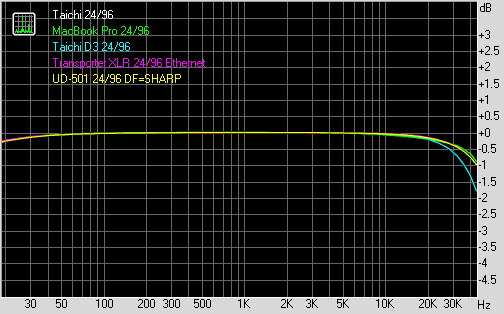
Frequency Response - Transporter seems to roll off a wee bit more.

Noise floor.

Dynamic Range test.

IMD+N

Stereo crosstalk - note the significant difference between the Dragonfly vs. the others.
Now, let us look at the 24/96 (high-resolution) results:

The columns are arranged the same as above. Leftmost two columns represent the Dragonfly results, then AudioEngine D3, then the Transporter (XLR), and finally TEAC UD-501 (XLR).

Again, no difference in results between using the ASUS Taichi and MacBook Pro laptops despite disparate hardware and OS. The Dragonfly is indeed capable of >16-bit dynamic range, and at approximately 106dB, that's about 17.5-bits (same as what Stereophile found with their v1.0 review). As with 16/44 above, however, when you look at the measurements of distortion, the AudioEngine D3 is capable of less distortion and dynamic range is about 0.5-bits higher. Needless to say, the stand-alone "higher end" DACs like the Transporter and TEAC UD-501 with XLR outputs handily beat these little USB DACs by about another 'bit' of dynamic range and lower noise floor (especially the old Transporter!) measurable within the limits of my ADC set-up of course.

Frequency Response (no significant difference <20kHz)
Noise level - notice Dragonfly slightly higher especially in the bass.
IMD+N
Stereo Crosstalk - Dragonfly again significantly higher crosstalk... Very impressed by the Transporter using XLR cables! 
C. Jitter
As usual, I'll use the Dunn J-Test paradigm. Easy enough to do...


As in previous tests, with these asynchronous USB DACs, the Dunn J-Test spectrum generally looks fine. This is the situation here, no evidence of jitter issue at all using this simple measurement... Only very slight noise floor differences between the two laptop machines.

II. Subjective Evaluation

So I asked my buddy AudioPhil (the guy who actually owns this Dragonfly) to provide his subjective review and it looks like he'll be providing a little write-up of his own in the next while... While that's in "gestation", I figure I'll jot down a few of my subjective impressions and comparisons on this little device.

I spent about 2 weeks listening to music with this DAC/amp (some before, and some after the objective testing) and comparing what I heard with the same tunes off the AudioEngine D3 and ASUS Xonar Essence One (which remains my primary DAC on the computer workstation). Each of the devices have quite different DAC architectures; Dragonfly with the ESS Sabre, D3 with an Asahi Kasei AK4396, and the larger Essence One using TI/Burr Brown PCM1795s (quite unfair comparison given that it's not a simple USB bus powered device!). It's impossible to "instantaneously" switch headphones / DACs and then level-match compare... I tried my best.

A potpourri of DACs and headphones: AudioEngine D3, AudioQuest Dragonfly 1.2, ASUS Xonar Essence One; Sennheiser HD800, AKG Q701, Etymotic ER-4B IEM.
The published output impedances for the D3 is around 10-ohms - the Essence One apparently has similar output impedance as noted by 'Xnoreq' in the comments although there are estimate of it being in the single digits [I'll need to have a look at this later]. The Dragonfly has been measured to have significantly lower output impedance <1-ohm which would make it the superior choice for low-impedance headphones like IEMs. So, to give them all a fair chance with the same headphone, I'll speak about what I heard using the Sennheiser HD800 (300-ohm input impedance) headphones primarily. Thankfully the HD800s have high enough sensitivity (102dB at 1Vrms) so music could be played reasonably loudly with the Dragonfly and D3 even with the lower power ratings. Of course from a price point perspective, the HD800 isn't the kind of headphone one would expect to see mated to an inexpensive USB DAC like this!

I started with listening to some "vocal audiophile jazz" - Diana Krall's The Look Of Love (2003 24/96 DVD-A) being one of my favourites over the years and particularly "Let's Fall In Love" as a track I've been using to compare new gear with since around 2000. I like the instrumental portion in the middle of the track and particularly the detailed resolution of the bass and piano through that portion. With the Dragonfly, the piano sounded rich and full. The bass was detailed with each pluck easily discerned. In comparison to the D3, the Dragonfly sounds more laid back and "smoother". The D3 just seemed to have a bit more sparkle, slightly brighter; for example the high-hats on the song stood out a bit more from the rest of the instruments. Personally, with my "Anaxilus mod" Sennheiser HD800, I preferred the D3 rendition but I can imagine with even brighter headphones, the Dragonfly may be preferred.

While staying with the vocal genre, I listened to some Nat King Cole - Cole Español (HDTracks 24/96 release, and no, I don't actually believe this album has enough resolution to warrant the high-resolution format). On a track like "Quizas, Quizas, Quizas", the Dragonfly was a joy to listen to with the HD800! This old 1958 recording can be a bit "brittle" through many DACs and the Dragonfly just made the instruments sound less harsh and the voice "ultra-smooth". I found the same on some traditional Chinese erhu recordings where the pleasant demeanor of the Dragonfly helped impart an enjoyable, smoother experience.

Time for some heavier fare - how about AC/DC Back In Black (1988 DR12 CD)? Pump this baby up to rock! The intro to track 1 - "Hells Bells" - with those church (er... hell's?) bells sounded realistic in terms of the attack and smooth decay using the Dragonfly. While not exactly the paragon of audiophile recording technique, this analogue recording from 1980 is about as "hard" as I like my rock to be and the Dragonfly was able to render it nicely. However, I found the Dragonfly to be a bit more on the "polite" side of things as compared to the more aggressive sound of the D3 which I thought fits this type of music better.

I listened to a number of other genres to get a feel for things - Pet Shop Boys Actually (2001 remaster), Yello Touch Yello (2009), Eiji Oue & Minnesota Orchestra Stravinsky: Song Of The Nightingale, Firebird, Rite Of Spring (1996 Reference Recordings), Ed Sheeran x (2014). In general, I thought that the Dragonfly performed well but was more at home with an acoustic set than say the synthpop or electric guitar rock. Despite the dynamic range compression especially near the end of the song, a track such as Ed Sheeran's "I See Fire" with overlaid vocals and relatively simple instrumentation found on x sounded just fantastic through the HD800 with the Dragonfly; bass response on that track was simply cavernous in depth.

Not unexpectedly, the much larger (and unportable) ASUS Xonar Essence One sounded better than the USB stick DACs. This has more to do with the quality of the headphone amp than the actual DAC function I believe - providing a more full-bodied, powerful sound overall (even more cavernous bass at the end on "I See Fire"!).

Near the end of my subjective evaluation, I put on some mono music to see if I could easily detect the channel imbalance noted above. For this I used the mono Beatles remasters from 2009. I listened to most of the Revolver and Sgt. Pepper's Lonely Hearts Club Band albums one evening. On the whole the stereo imbalance at normal listening levels with the Etymotic ER-4B balanced armature IEM (100-ohm impedance, excellent noise isolation) was subtle when I compared it with the output from the D3. I was concerned about perceptual bias knowing the objective results earlier so I asked my wife and she identified correctly the slightly louder left channel after listening for a bit. So, we're looking at a small, but perceptible imbalance.

III. Summary / Conclusions

There you go, the objective and subjective evaluation of the AudioQuest Dragonfly v1.2. Overall, from an objective perspective, it doesn't measure as well as the AudioEngine D3. The Dragonfly's 24-bit dynamic range is lower by about 0.5-bits in comparison, plus harmonic and intermodulation distortions measure higher. Furthermore, there's a bit more stereo crosstalk with the Dragonfly. Realize of course we're looking at tiny differences in terms of real-world audibility. For example, what audible difference is there between 0.011% THD (Dragonfly) versus 0.0009% (D3)? Would our headphones/speakers be able to manage such low level of distortion or our ears capable of such resolution? Remember that a typical NOS DAC like the old TDA1543 measures 5-10 times higher in terms of THD and IMD yet they can still sound OK (and in fact some audiophiles swear by them). The other difference was increased stereo crosstalk with the Dragonfly measured around -72dB. Compared to the others around -90dB or less, this sounds like a lot. Again, remember that a typical LP cartridge has "only" about 25-40dB channel separation at 1kHz. Therefore, again it's unlikely you're going to notice an audible problem.

The one area of concern for me was the channel imbalance on objective testing at 0dBFS on the oscilloscope with this unit. Even so, it was difficult to detect a difference at normal listening levels through my Sennheiser HD800 and AKG Q701 playing stereo music but could be detected with mono recordings using the Etymotic ER-4B IEM. This could really be a problem if one's headphones also had a slightly louder left channel imbalance issue. Perhaps others can double check if this imbalance is present with their own Dragonfly units.

I cannot help but suspect that the advertised "direct-coupled circuitry" where the op-amp is integrated into the ESS Sabre chip might be the reason for the relatively poorer objective test results. Compact size is achieved with this kind of arrangement but physical factors like significantly higher heat production could I suspect limit absolute sound quality from the DAC chip itself. I don't know if AudioQuest could have also "tweaked" the settings for the DAC chip to bias towards a more pleasant sound.

Here's the bottom line... If you're looking at the AudioEngine D3 versus Dragonfly v1.2 and want the best objectively accurate sound quality, go for the AudioEngine D3. It measures and sounds like a much more expensive separate DAC on a stick! However, the main caveat is that it clips at 100%, so keep it around a maximum of 92% and you'll hear some really clean audio. Remember what I also said previously about allowing a portable device to clip - it may not be an unreasonable trade-off when you just need that extra bit of volume in a noisy environment where a little distortion is fine. The D3 is also a little bit more expensive around here currently (only talking about $20 difference).

On the other hand, the Dragonfly is built very well and I would rate the look and feel of the unit higher than the D3. The color-changing dragonfly indicator based on sample rate is also a nice touch. Furthermore, it is slightly smaller and significantly cooler to the touch than the D3 after an hour of music being pumped through. Output impedance is much lower with the Dragonfly at <1-ohm which means you should be able to use even lower impedance headphones with more stable frequency response. The D3 can play a bit louder but remember this is with the potential for clipping at 100% volume. My usual benchmark for a "good enough" headphone amp is one where I would not need to put the volume to 100% to enjoy my AKG Q701s... And the Dragonfly is clearly good enough in this respect for what I listen to.

The main criticism I have of the Dragonfly is that ~0.5dB channel imbalance I found which I hope is just variability among samples rather than a systemic finding (remember that even well regarded cartridges for vinyl playback can have stated channel variances up to 2dB). Subjectively I thought the Dragonfly imparted a "pleasantness" to the presentation rather than aim for absolute technical precision as demonstrated objectively. Compared to the typical headphone jack on a laptop, it'll provide your headphones with more power, lower noise floor, and more dynamic range especially for 24-bit audio. I'd be very curious to know what objective differences there are between a 1.0 and 1.2 version of the Dragonfly if AudioQuest claims that 1.2 sounds better (other than no clipping at 100% volume)...

---------------------

Happy listening everyone... Considering the 24-bit performance from the AudioEngine D3 and Dragonfly, consumer audio technology is clearly getting better, smaller, and more affordable!

Weather has been very nice here in Vancouver lately. Off to an Alaska cruise next week so hopefully there will be blue skies and maybe see a few whales along the way. Catch you all later...

Saturday, 27 July 2013

MEASUREMENTS: DAC "Waveform Peeping" - the -90.3dB 16-bit LSB Test...


When it comes to technological "toys", I've vacillated over the years between the accumulation of digital photography gear and audio stuff... As I'm sure many of you know, "pixel peeping" is the act of "using 100% crops and similar techniques to identify flaws that have no effect on the photograph under real-world conditions" (Google web definition). Back in the "old" days (like a decade ago), the act of pixel peeping wasn't all that unreasonable since the differences visible could be demonstrated on photo-enlargements. When I was using my old Nikon D70 with 6 megapixels, sharpness at the pixel level was a significant consideration with moderate enlargements like 13"x19"; imperfections like moiré could be seen in the final product as well. Monitor resolution wasn't that high back then either so fine details were easily obscured.

Fast forward these days and I'm now using the Nikon D800. At 36 megapixels viewed on a >2MP monitor; unless I'm printing huge enlargements, there really is little need to "zoom" down into the 1:1 pixel level to appreciate a high quality image... Sure, sometimes it's just fun to see how much detail has been captured especially when evaluating different lenses or to show off each hair follicle, but for the most part, "pixel peeping" has become quite unnecessary.

Although in daily usage, one might not need to "peep" anymore, if one were to publish camera body or lens reviews, any reviewer these days "worth their salt" would run the images through objective tests; including highly detailed "pixel level" tests or compare 1:1 images between cameras or lenses. Dynamic range, ISO-noise interaction, color accuracy tests, distortion characteristics (for lenses), effect of file formats (JPEG vs. RAW) of course all serve to complete the evaluation. The quality is so high these days among high-end cameras (SLR's, medium format digital backs...), it is with these detailed tests that we can fully appreciate the qualitative differences between top contenders. Subjective opinions in terms of the camera's touch-and-feel and user interface are important of course, but if you care about the potential image quality that can be captured, then objective tests are really really important. If you haven't already done so, just have a look at the camera reviews on www.dpreview.com and see how much work actually goes into what I respect as proper reviews of well engineered equipment! Also of interest, Hasselblad is trying to market "exotic" cameras at high prices by appealing to aesthetics (just look at the responses to see how people feel about that!). [Here's another one.] Is this what happens when technology matures and companies have difficulty competing on primarily technological merits?

I've often wondered why in the audio world, objective measures have so often been left out as part of the review process - especially as it comes to line-level devices like DACs. Maybe it's because digital audio matured earlier and we're going to see the same outcome with cameras one day. Around some forums, the mere mention of objective measures seems to be scoffed at - as if objectivism with audio gear is either "obsolete" or the sole domain of "high end" manufacturers with arcane tests out of reach of mere mortals. I know I'm digressing into "MUSINGS" territory here, but IMO, a good review needs to dig into the gear's objective properties so the reader can truly appreciate how it compares with other similar gear in order to have an informed opinion and gauge value as a (hopefully) well engineered piece of technology... Let's get back on track then with some "MEASUREMENTS".

For me, one of the most interesting "waveform peeping" tests consistently done by Stereophile over the decades on digital gear has been the undithered 1kHz sine wave test at -90.3dBFS. This is one of the most "microscopic" tests of DAC performance. It's simple and the result basically answers the question "can this DAC accurately reproduce the least significant bit (LSB) in a 16-bit audio signal?" At a glance one can tell at least 3 things:
1. Is the DAC "bit-perfect" down to that last 16th bit? (Assuming everything upstream is set up properly, you should see something resembling the 3 quantization "steps".)
2. Is the dynamic range at least 16 bits? If not, the waveform becomes obscured by excessive noise.
3. Are there anomalies to the waveform morphology to suggest "DC shifts" leading to "tilting" of the waveforms (power supply related issues). (For a good example of 60Hz low frequency noise effect, see the measurement of the Philips CDR880 Figure 7.)

The Stereophile website archive provides some lovely examples of this test dating back to the late 1980's such as the Philips LHH1000 from 1989 (check out Figure 5). How about the Naim NA CDS from 1992 (Figure 6) or the $8000 Mark Levinson No.35 DAC from 1993 (Figure 6, still not good). By 1995, we saw excellent performance like with the $9000 Krell KPS-20i (Figure 5). In a few years, by 1998, reasonable priced gear like the California Audio Labs CL-15 CD player was capable of similar accuracy at the $1500 price point. Since the millennium, this level of performance can easily be achieved within the $1000 price point and below (eg. the Rega Apollo from 2006). These days, the little Audioquest Dragonfly can do a reasonable job USB-powered at <$250 retail.

On the whole, this test has demonstrated the progression of improved accuracy over the years. State-of-the-art DACs like the MSB Diamond DAC IV (Stereophile October 2012, not on website) and Weiss DAC202 (Figure 6) are great examples of what this level of accuracy looks like (as opposed to expensive gear of questionable technical ability which I will not mention). IMO, well engineered CD/DVD/SACD/Blu-Ray/DACs these days claiming to be "high resolution" really should pass this test without issue. Nonetheless, there are recent devices apparently incapable of a low noise floor for whatever reason (eg. Abbingdon DP-777 Figure 15, surprisingly the recent Wadia 121 Decoding Computer Figure 6 didn't fare too well either).

I was curious whether I could run a similar test using my simple test gear... After all, so long as the DAC and measurement device can achieve >16-bits dynamic range reliably, one should be able to obtain a reasonably good set of measurements. So far, from what I've seen in the other tests, I should be able to reproduce this test with the E-MU 0404USB!

Here goes... Setup and procedure for the various DACs/streamers:
Test DAC --> shielded RCA --> E-MU 0404USB ADC --> shielded USB --> Win8 laptop

- I created an undithered 1.1025kHz sine wave at -90.31dBFS at 16/44. This is what an "ideal" waveform would look like with the usual Gibbs phenomenon (ringing) due to bandwidth restriction.
- Green is LEFT channel, Blue is RIGHT channel. Notice the phase inversion between the channels.

- For comparison, I also created the equivalent at 24-bit quantization:

- Capture the above at 24/88 with Audacity using the E-MU 0404USB. From previous tests, the E-MU functions very well at 2x sample rates (88 & 96kHz) with optimal dynamic range. Although not as good as a high precision oscilloscope used by Stereophile, this should be adequate to allow relative comparisons between different DACs. I used the analogue preamp on the E-MU to boost the signal by about 18dB to give me "more" amplitude to capture.
- As you can see above, I decided to plot the channels overlaid and inverted to compare precision of timing and amplitude.

Here are the results of this test on the various DACs I have around here:

TEAC UD-501 [2x BB PCM1795 circa 2009] SHARP filter:
16-bit undithered:


24-bit:

Clearly the TEAC has no problem with reproducing that least significant bit in the 16-bit signal. Also, obviously the resolution has improved significantly by going to 24-bits.

ASUS XONAR Essence One [2x BB PCM1795 c. 2009] (opamps upgraded to all LM4562):

Very nice... Notice a wee bit of channel imbalance - the left channel (blue) seems consistently louder than the right. Same internal DAC chip as the TEAC so similar level of performance expected.

Logitech Squeezebox Transporter [AKM4396 c. 2004]:

Nice! Not bad for a discontinued device from a computer peripheral manufacturer released in 2006, eh? ;-)
Of course, the Stereophile review demonstrated this nicely already...

Logitech Squeezebox Touch [AKM4420 c. 2007]:
WiFi (only 30% signal strength 2 floors up from router!):

Ethernet:

24-bit:
Three observations:
1. Clearly the Touch is noisier than the better DACs above. It's still capable of >16-bit dynamic range though.
2. Some DC shift is evident - look at the upward slope with the 24-bit sine wave and compare to the Transporter above. Maybe this could be improved with a better linear power supply than the stock switching wallwart I used... Not sure if an improvement would be audible however.
3. No substantial difference between WiFi and Ethernet. (No surprise; just thought I'd have a look to see if WiFi added much noise down at this level.)
N.B. Remember that this is still a pretty good result - we are looking at a waveform down at -90dBFS, or ~90 microvolts! Nice correlation with what Stereophile found (Figures 5 & 6) in terms of the Touch being a 'touch' more noisy than better DACs.

AUNE X1 Mark I [BB PCM1793 c. 2003] (using CM6631A USB-to-Coaxial S/PDIF, ASIO driver):

This is what can be achieved by a <$175 DAC off eBay direct from China these days (I bought this unit in early 2012). Notice that it's able to produce a cleaner analogue output than the Touch. But it's also not quite up to the standard of the TEAC, ASUS, or Transporter. Notice both a slight channel imbalance as well as mild amplitude fluctuations (again, possibly due to cheap wallwart). Hopefully the following zoomed out screenshots illustrates this well for comparison:
 AUNE X1 - left channel (blue) noticeably louder and notice the amplitude fluctuations over time.

Touch - Notice it's more noisy with unpredictable amplitude spikes occurring in both right & left channels.

TEAC UD-501 - more stable, clean, uniform waveforms in comparison.

As much as it's great to see the level of performance afforded by DACs these days, I'm very impressed by the level of performance of this old E-MU ADC! As I have stated before, one of the reasons I put up these posts is to demonstrate that it doesn't take megabuck equipment to test out audio gear objectively. A lot can be "known" about the performance of a piece of hardware rather than depending on only subjective "opinion".

The other test I would categorize as the equivalent of "pixel peeping" is the Dunn jitter test where we're "peeping" into a small part of the audio spectrum around the 11 or 12kHz primary signal and scanning for sideband anomalies. IMO, neither the jitter nor this undithered LSB test really are that important for audio quality. Random noise affecting the 16-bit least significant bit would sound like some form of dither (eg. like what happens when an HDCD with embedded LSB data is decoded by a non-HDCD player). Likewise, my feeling is that even a "moderate" amount of S/PDIF jitter (like say 1ns) isn't going to intrude into my listening pleasure. (Maybe one could make the argument that the details and nuance of sound/music can reside in these microscopic domains but I have yet to see any proof...)

Assuming the digital player/DAC is meant to be faithful to the source signal and doesn't implement a DSP known to affect the LSB data, to be able to measure and verify precision down to these levels I believe would be a reasonable pre-requisite in achieving high-fidelity. It's a test of how well the hardware was designed and implemented than necessarily how it "sounds". Just like knowing if a hi-res digital camera is capable of the resolution it claims... You might never need 36 megapixels for a slideshow or in print, but it's good to know that the camera was capable of delivering on the claims! Likewise, if I'm going to spend a good amount of money on high-fidelity gear, I'd certainly like to know that precision engineering went into it by the results of tests like this among others already discussed over these months.

Let's throw some nostalgia in. Here's what the MUSE Mini TDA1543 x4 NOS DAC looks like down at -90dB (using the CM6631A USB-to-S/PDIF coaxial interface):

Party like it's 1991! Ugly... Clearly it's incapable of accurately reproducing the 16-bit LSB undithered tone.

Zoomed out (24/44) - still ugly:

Using a 24-bit signal makes no difference since this is a 16-bit DAC and the lower 8 bits get truncated. The Philips TDA1543 DAC chip was introduced back in 1991 according to the specs sheet... Thankfully, it looks like DAC designs have improved somewhat since then at least in this characterstic :-).

A stroll down memory lane... The top 3 highest grossing movies of 1991: Terminator 2, Robin Hood: Prince of Thieves, Disney's Beauty And The Beast. Top 3 songs (Billboard): (Everything I Do) I Do It For You, I Wanna Sex You Up, Gonna Make You Sweat (Everybody Dance Now). Hmmm...  Good year :-).

------------------------------------------------------------------

Folks, much of the measurements above were done about 3 weeks ago but I'm putting this post up behind the "Great Firewall" while on vacation (hey, >10hr plane flight gave me plenty of time to do some writing!). I know a few people are trying to get hold of me by E-mail. Unfortunately my VPN + Outlook is a bit finicky so other than more important work related matters as I check the E-mail every few days, I will likely not be responding until mid-August.

Time to go enjoy some good food... And snap some pictures of course... :-)


BTW: For those interested in some light non-fiction summer reading, consider picking up Chuck Klosterman's "I Wear The Black Hat: Grappling With Villains". An enjoyable, thought provoking social commentary.