Saturday, 27 January 2024

Cautionary Tale: Audiophile's dream's end... Make sure to find balance, audiophiles.

 I remember a couple of years ago, I saw this YouTube documentary on Ken Fritz:


[Available as audio podcast summary.]

That is certainly an impressive demonstration of dedication and passion poured into the sound room and audio system! Few would have such tenacity, disposable financial resources, or apparent family support. Admittedly, I wondered while watching that video just how well those massive DIY speakers integrated into the room and what measurements would have told us about frequency response and time-domain performance. There's a low resolution frequency response graph here. Yeah, I'm sure the system could play loud with 35,000W* of amplification.

And 2 years later, sadly, the final chapter of the life story was published a few weeks back:

I guess we'll never know exactly how that system sounded like now that everything has been taken apart. What looks like 27 years of labor and $1M original price was dismantled and sold off for $157k total in a comparatively short time. Clearly, neither the family nor the new home buyers had need for the extravagant system in the large room. The dead might at best influence, but cannot declare the will of the living.

Here's a detailed description and list of components. Obviously, audio/music items are generally not investment vehicles unless it's attached to someone very special (like maybe say Hendrix's guitar amp). These things we talk about are for the consumption of music primarily. The non-investable nature of these products is especially true of DIY items given that the quality of such items are unknown even if the bits and pieces like speaker drivers could be from a reputable brand. Over time as components degrade, it could be difficult performing repairs on non-standard builds.
Saturday, 20 January 2024

On Stereophile's "Dolby Atmos: A Bleak Shadow?" - really? ðŸĪ”


I saw Stereophile's "Dolby Atmos: a Bleak Shadow?" article the other day. Honestly, I found it a bit irritating. The ideas seemed poorly contextualized with little background or meaning for what I imagine would be the average audiophile reader. It basically consisted of hearsay-level cherry-picked concerns as if these are significant (including that title).

Let's be clear about this. It's not like any of us must or even should love Atmos or multichannel. We can easily get through a lifetime of music enjoyment with 2-channels. Even though I like and even prefer multichannel/Atmos for many of my albums, it's just an option for those like myself who want to explore the surround-sound music experience as a superset of modern audio reproduction technology. Some artists and audio engineers these days are also exploring the extensive flexibility and ways to best create the mix. So if a traditional audiophile magazine believes that staying at 2-channels is all that's needed, well that's fine. But one doesn't have to write articles that seem to be trying to induce some kind of emotional response, stirring intrigue or concern even in just that title. (These days, sound bites and headline titles might be all that many pay attention to.)

So what do you mean by "bleak shadow", Mr. Lindberg (as reported by Jim Austin)? Are we talking just about numbers like bit-rate going down when a lossy stream is delivered to the consumer, or are we implying that sound quality changed significantly in a negative, "bleak", way? If it's only bit-rate reduction, that's totally fine, isn't it? Since the consumer isn't keeping the data, there's no point wasting network bandwidth! Streaming services like Netflix or Disney+ all stream lossy video and audio. Many customers, I'm sure including discerning ones, will not complain if they understand the nature of the technology and the quality limits depending on how it's consumed.

Saturday, 13 January 2024

MUSINGS: On YouTube listening tests and the sound of "high-end" vinyl vs. streamed digital playback.

The Internet is wonderful, isn't it?!

In the span of a few decades, we can all make our presence known to the far corners of the world and express (almost) anything we want whether it's sharing what we had for lunch, whether we're "available", our political/moral/ethical affiliations, or even esoteric blog topics. ðŸĪŠ

Even better, we can project sounds and videos on YouTube and the like, opening up the opportunity to reach others though a modern "boob tube" where instead of the TV station programmer telling us what to watch next, good-ol' YouTube algorithms choose what we might desire from tracked search preferences. Amazing, if not also creepy...

Of course, if we have an entrepreneurial spirit, one could receive great rewards. Monetization potential can be impressive as witnessed by some of the elaborate content on YouTube channels! That's great so long as we're seeing knowledgeable, verifiable content presented in fair ways that can help teach and promote understanding. Not so great when information is perpetuating falsehoods, potentially destructive conspiracies and propaganda.

For this post, let's talk about something we've seen presented over the years on a number of audio channels. There is at least an implied idea out there, thanks to YouTube, we can now "hear" the sound quality of an audiophile system. Furthermore, that we can make comparisons of the sound quality. Is this true?

Saturday, 6 January 2024

MUSINGS: Fidelity, Immersion, and Realism (FIR) - Levels of Audiophile Attainment


As we start 2024, let's think about a "big picture" topic. Like with most things in life, I find it useful to think about the overarching philosophy - the "forest" if you will - alongside the details - the "trees" - which is when we get down to measurements and tests of specific products. Hopefully by doing this we can develop a more comprehensive understanding of whatever it might be we're engaged in.

As discussed years ago, I don't think the audiophile hobby is a monolithic entity based on only one core pursuit. In reality, it's a multitude of hobbyist pursuits ranging from the "music lover", to the "hardware audiophile", to subgroups like the "gear hoarder", "LP collector", even "high end (luxury) enthusiast", each of us at varying levels of emotional intensity; even resulting in more "fetishistic" extremes! ðŸ™„

We're not a particularly large group of hobbyists. Sure, there are billions of music lovers out there, but when it comes to guys (mostly) wanting to talk about audiophile hardware, geeky high-fidelity (transparency) reproduction, and things that appear extravagant to the general public, there really are not many of us. It's also hard to know if this hobby is growing, stagnant or diminishing in numbers.

As I look around at magazine reviews and YouTube videos, that idea of stagnation has entered my mind many times over the last few years. Not just wondering about the numbers of audiophiles and whether the hobby is growing, but rather, in what directions are we as hobbyists going forward, if even at all!

Approaching the mid-2020's, are we still in search of "High Fidelity" after all these decades and the multitudes of products? Maybe, maybe not... Let's talk about some ideas which I believe are the goals that audiophiles can aspire to which I've acronymized as FIR - Fidelity, Immersion, and Realism.

Sunday, 31 December 2023

Archimago's Musings: Terms & Conditions, Privacy Policy

Sites need to comply with General Data Protection and Regulation (GPDR) policies if there are visitors from the EU, so for transparency, here are some broad Terms and Conditions as well as Privacy Policy statements for this blog as we enter 2024.

Basically this: I trust we're here to learn, enjoy the hobby, debate sometimes, as generally anonymous participants, acting like decent persons online. The purpose here is not to sell stuff or make money even though I don't mind getting a little "tip" if folks buy stuff for example off Amazon links or if the ads work out for you. I have no interest in soliciting funding from anyone such as with Patreon and the like; my day job pays just fine.

Be mindful that public comments are public so don't say anything private unless you want it known broadly. No doubt in the days ahead there will be all kinds of bots and increasingly sophisticated autonomous agents reviewing the information and scraping the data. Consider how this might have an impact on you and the comments made.

Cookies and IP addresses are sent to browsers routinely so feel free to decline sharing cookies, use "incognito" browser mode, perhaps connect through a VPN if you don't want to be tracked especially on a public network (here's one I use). Google Analytics, AdSense, maybe a widget on the blog might use some of the cookie or IP info.

If you're responding to one of my surveys, blind tests, or contacting me by E-mail, unless you choose to do so, I will not have any need for your private information unless we get to know each other or plan to meet up, etc.

Otherwise, Happy 2024! May your life be free from scammers, spammers, identity hackers, snake-oil salesmen, and general crooks in the coming years! Peace.😌

Thursday, 21 December 2023

Merry Christmas & Happy 2024! A year in review, final MQA sales, and have a very Spatial Christmas. 🎅

Hey everyone, I want to post a holiday greeting and retrospective as we end off 2023 and as I wander off for some R&R down south. This has been an interesting year I think in the world of audio. In my journeys through audiophilia, it's the year I'll remember as one of continued evolution in the fidelity of various components and further maturation of technologies available to consumers at very reasonable prices - specifically amplifiers.

2023 also marks the point of crossing 10M hits to this blog according to Google's analytics which is I think a significant numerical milestone. Not bad I think given my pace of sub-weekly posts, dealing primarily with topics that attract a relatively small group of hobbyists. While some of these technically-oriented articles probably are a bit beyond the interest of many audiophiles, I do hope that in time, the "average" hobbyist will see them as presenting some foundational knowledge that we should all know about the technologies we buy, and expressing a worldview that those who assess the audiophile hobby more objectively would tend to focus on.

Let's have a little recap of some articles and ideas shared over the last 12 months...

Saturday, 9 December 2023

MUSINGS: On the duplicity of hi-fi audio anti-measurers? The John DeVore example.

The Hall of Measurement Devices.
"When you can measure what you are speaking about, and express it in numbers, you know something about it; but when you cannot measure it, when you cannot express it in numbers, your knowledge is of a meagre and unsatisfactory kind: it may be the beginning of knowledge, but you have scarcely, in your thoughts, advanced to the stage of science, whatever the matter may be." --- Lord Kelvin, Popular Lectures and Addresses vol. 1 (1889) ‘Electrical Units of Measurement’, delivered 3 May 1883

"What is measured, improves." --- Peter Drucker (from The Effective Executive) 
"When performance is measured, performance improves. When performance is measured and reported back, the rate of improvement accelerates." --- Karl Pearson

A longstanding debate over the years in the audiophile pursuit sadly is that of whether measurements are important in audio. Obviously, to me, and I think the vast majority of the world, the answer is "Of course it does!". One does not need to be a scientist of Lord Kelvin's stature or a statistician like Pearson, or a management consultant like Drucker to see the wisdom of such a basic idea which probably is one of the founding principles giving rise to our modern technologically sophisticated world.

Can you think of a single technological pursuit where the use of measurement instruments of some sort isn't beneficial to help gauge the effectiveness, efficiency, or value of a device which has been invented, produced, or manufactured? Is this not doubly important if that devices is supposedly built to a high "standard", reportedly made with quality and care? Typically at a higher cost like the things of "high end" audio?

Well, apparently, there are supposedly respected people in the audiophile world, designers even, who seem to think otherwise about the importance of measurements...

Saturday, 2 December 2023

Do bit-perfect digital sources affect a USB DAC's sound quality? [2023 Edition - phone, Raspberry Pi, MiniPC, laptop]

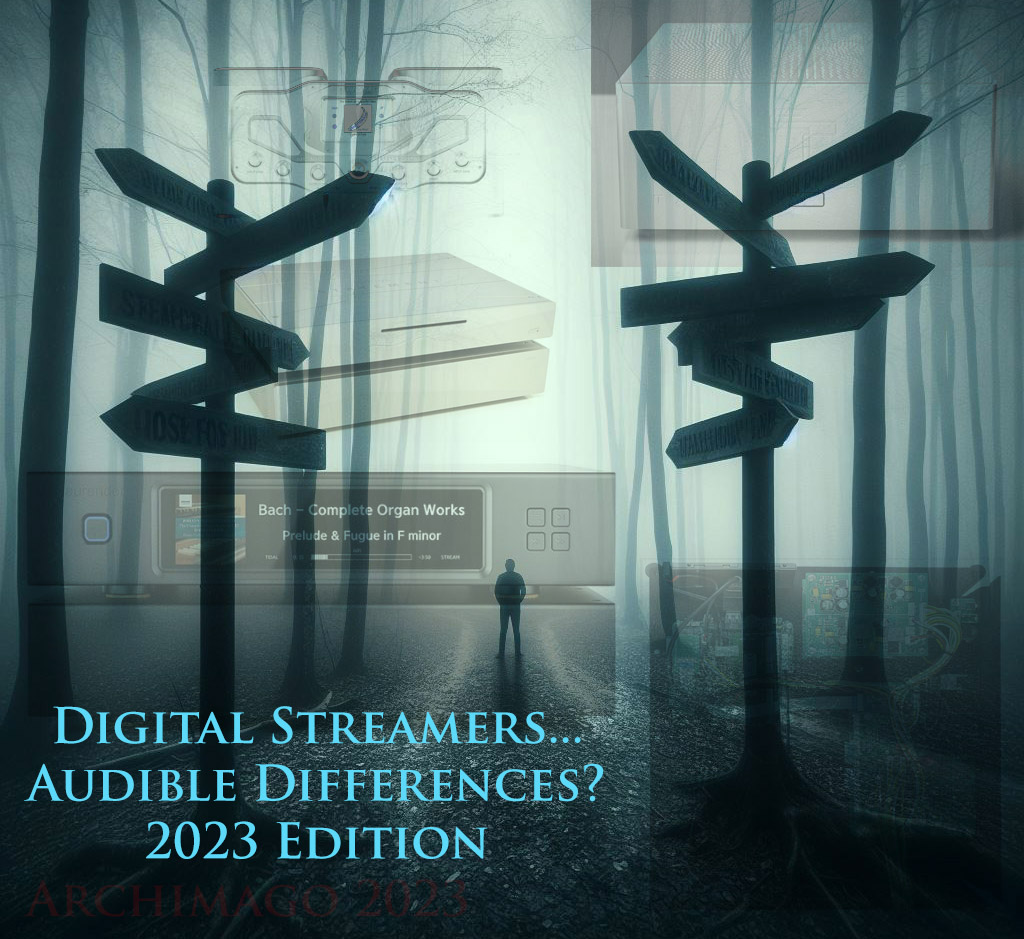
In the image above, we see embedded some pictures of contemporary, expensive (>US$10k) digital audio devices. Each one of these are just streaming or server boxes that can take data over your network or internal storage and pass them along to a DAC with no actual conversion. Typically, these "high end" audiophile products (for example some featured here) are not asked to perform DSP, thus passing the data in a "bit-perfect" fashion. Furthermore, these expensive devices do not include an internal CD/DVD/SACD/BluRay mechanical reader. They're basically computers with hard drives or SSD storage and software to index and manage your music library. You'll typically be connecting them to your favourite external DAC most popularly through USB although proprietary interfaces (eg. Wadax's optical), ethernet, S/PDIF coax/optical, and i2S could be other options.

The other day, a family member was in need of a replacement phone so I gave them my Huawei P30 Pro which I've been using since 2019 and got a Google Pixel 8 Pro. After transferring the apps and data over, I figured I'd try to see if USB Audio Player PRO on the Pixel 8 Pro would work with the very high resolution Sabaj A20d 2022 DAC (ES9038PRO converter) which the Huawei phone previously did not. It worked, reminding me that Android USB hardware and drivers can result in different levels of USB DAC compatibility.

With the phone connected to the DAC, and given that it has been awhile since I've put together a "shootout", let's see if there's any evidence now in the 2020's of potentially audible differences between source devices playing to a very high-resolution USB DAC. Not that I have a $10k streamer lying around here, but a $1000 phone could be different from a sub-$100 Raspberry Pi, right? ðŸ˜‰

[FYI: years ago, I did a test similar to this using various mostly S/PDIF outputs connected to the same ASUS Essence One DAC.]

Let's look at some data.

Saturday, 25 November 2023

MUSINGS: Beyond "High Resolution" recordings. Into "Immersive" and "High Reality" content.

The other day, I was reading this interesting article about someone upgrading his computer gaming gear to the latest and greatest, only to find that it ultimately made no meaningful difference for today's games that he's playing. No surprise? (As discussed a couple months back, I upgraded to the nVidia RTX 4090 but not for gaming.)

As tech hobbyists, it's important not just to be aware of what we could buy, but more importantly, what is it that buying the hardware would achieve.

Human sensory systems are not infinite - whether it's the angular resolution of vision, or how many frames per second we need for gaming before it's no longer noticeable (upper limit I've seen maybe 75fps?). So too, there's only so much audio frequency bandwidth or dBs of dynamic range we need to more than saturate our auditory limits.

To me, it's not good enough to just be fed information from the usual magazines or advertisers or reviewers, it's more important to understand what it is that the technology is able to do and by doing so, we understand what we really need, and have a chance to anticipate what we might be looking for ahead instead of being unduly externally influenced.

In this spirit, let's take some time to consider the road ahead. After all these years, where is progress to come from? Let's think about this...

Saturday, 18 November 2023

How-To: Resurrecting bad BIOS update with CH341 USB EEPROM Programmer (AMD AM4 motherboard, 1.8V flash example).

Let's do a quickie post this week.

As per the discussions last time, I've been doing some computer upgrades here at home and at one point a few weeks back, I was updating the BIOS on my AM4 MSI X370 SLI Plus motherboard but accidentally disrupted the power in the middle of the flash!

This basically "bricked" the machine because this particular board only has one BIOS bank and there are no facilities to reflash. Since my AMD Ryzen 7 1700 CPU is still a very reasonable 8-core processor that can still be used for many applications these days, I looked for an inexpensive way to fix this BIOS mistake. The solution is the package shown above - a CH341 24 and 25-Series EEPROM Flash Programmer (less than US$15, this item on Amazon Canada).

Saturday, 11 November 2023

Why not? 😉 AMD Ryzen 9 5950X Workstation & Ryzen 7 5700X Gaming CPU upgrades. Slowing pace of obsolescence & hardware waste for Windows 11 compatibility?

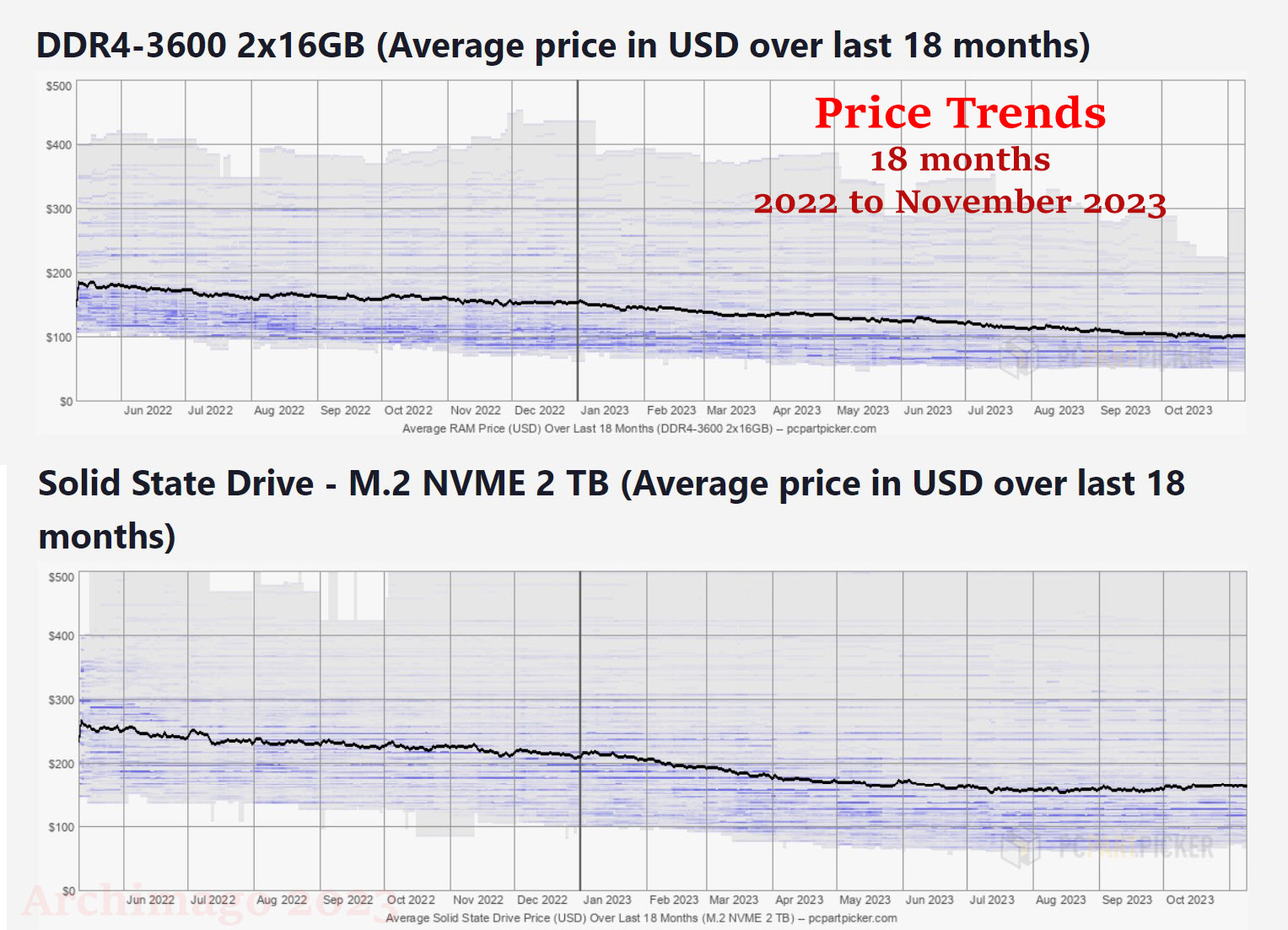
Although typically I write about audio stuff on these blog pages, not infrequently I'll talk about my computer updates as well. Looking back, this has allowed me to review the journey along the way over the last decade. As we enter into the Christmas season this year, I think this is a good time to be looking at computer parts as prices of things like SSD drives and DRAM in particular seem to be very attractive with DDR4 and DDR5 memory trending down, M.2 SSD likewise appearing to be bottoming over the last 18 months perhaps as the cost of basic necessities (food, housing, gas) have risen and disposable income reduced. I would not be surprised if inflation starts to drop in 2024 while the electronics parts rise in price again.

Who knows exactly what the future brings, but this looks like one of the best time to grab something like a 2TB M.2 SSD or some RAM:

The trend isn't as obvious with CPU prices. However, I upgraded my Workstation computer recently to the AMD Ryzen 9 5950X CPU - 16-cores, 32-threads I found at a decent price. And since it has been ages, I also updated my Gaming PC in the living room for the heck of it to the Ryzen 7 5700X.

Saturday, 4 November 2023

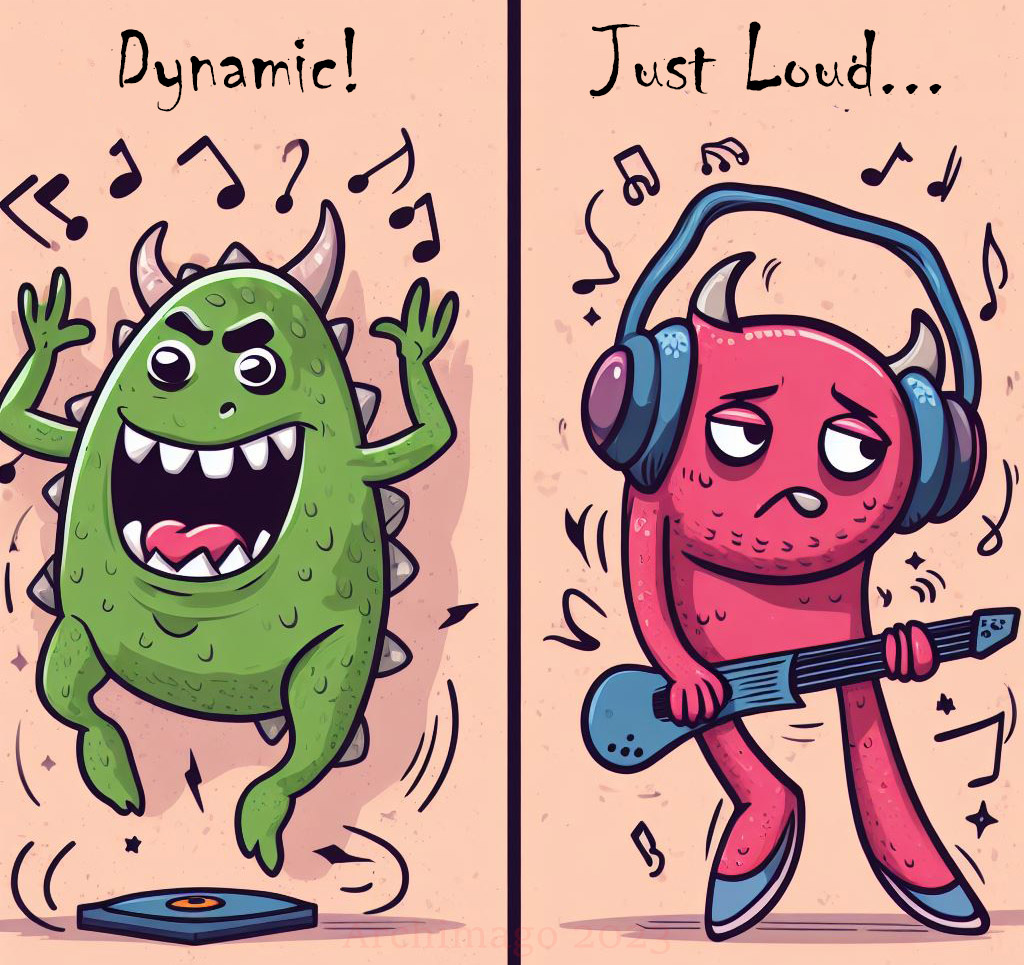
MUSINGS: Multichannel mixes are more dynamic than 2-channel, stereo releases. (Going beyond 2-channel stereo legacy.)

Last week, in the Part II review of the Topping PA5II+ amplifier, I talked about a few albums like The Rolling Stones' Hackney Diamonds and the sound quality of the album. For years now, I'm been unhappy with the status quo of ubiquitous Loudness War, dynamic compressed albums. We've even explored using DSP to artificially improve the content for example.

A complaint I have with the Stones album is that the dynamic range of the CD is poor at DR6; and yes, this is an audible limitation. However, if you like this album, I recommend listening to the multichannel/Atmos stream or grabbing the limited edition BluRay import box with 7.1 TrueHD-Atmos mix which is much less compressed, with album dynamics averaging DR12!

[For simplicity, I'll stick with the DR "crest factor" result due to familiarity for many of us. These days we can talk about LUFS, EBU R128, etc. as discussed before as measurements of volume and for normalization. Check out the DR Database for results from many albums.]

In the last few years, I think some of us will have noticed this pattern of much more gentle use of dynamic compression in multichannel content. This is why a few months ago, I suggested that multichannel streaming simply sounds better than standard stereo 2.0 to my ears (this possibility was also suggested back in late 2022 and discussing this Steve Wilson multichannel mix).

Let's have a look at some examples.

Saturday, 28 October 2023

Part II: Topping PA5 Mk II Plus (PA5II+) Class D amplifier review. Power, Distortion, the Subjective and on Hi-Res amplification.

I mentioned previously that this is a very unobtrusive amp. With the shipped plastic protector off, notice the low contrast of the lettering with the black front makes it even less obtrusive! This was why I left the plastic protector on to take the photos last time to better show the labels for the switches.

I introduced the Topping PA5 Mk II Plus last time in Part I with some initial measurements. This time let's keep going as we explore the power capabilities of this little audio amplifier, examine playback fidelity, and discuss a bit of the subjective performance.

Unless otherwise specified, these measurements were done with the amplifier connected to standard 4ÎĐ and 8ÎĐ power resistors as load, both channels driven, 20Hz-20kHz bandwidth for distortion measurements, unweighted. The Linear Audio AutoRanger allowed automatic gain/attenuation to keep the signal from getting too "hot". Signal from the AutoRanger is fed to the prototype Cosmos Scaler as a preamp for the E1DA Cosmos ADC operating in mono mode. High resolution signal generator DAC is the SMSL DO100 connected to Intona USB isolator. No special cabling, the 3' female XLR-to-TRS balanced cable was just something decent and generic like this, likewise generic RCA was totally fine. Seriously audiophiles, that's all we need for hi-fi sound quality.

Let's get to it!

Saturday, 21 October 2023

Part I: Topping PA5 Mk II Plus (PA5II+) Class D amplifier review. (And RME ADI-2 Remote, "cultural pressure" for subjectivist audiophile reviews to include measurements?)

Over the last few months, I've been exploring the performance of the TI TPA3255 Class D chip amps including the AIYIMA A08 Pro, Fosi Audio TB10D, and AOSHIDA A7. Overall, we've seen very good results from these little amplifiers and I think they represent a level of low-distortion performance at a price point that is very attractive to many hi-fi hobbyists.

Depending on the power supply mated to the amplifier, measurements have been showing low output impedance up to 10kHz typically (<0.2ÎĐ up to 10kHz), something like 80+W into 4ÎĐ with less than 0.1% THD+N, and a -80dB Triple-Tone TD+N result at 1W into 4ÎĐ which is excellent considering the prices of these little amps typically at less than US$150 depending on the features you want like Bluetooth input, VU meter, etc.!

Given the track record of these TI devices so far, this time, let's look at another chip amp which is based on an undisclosed part, not the TPA3255, although I can confirm it is a TI TPA chip. In my discussions with John Yang at Topping, the intent is to allow audiophiles to judge the product based on sound quality merits rather than focus too much on exactly which Class D part was used since the design around the chip is very important. Fair enough, and that's exactly what we aim to do here anyways since even with the previous TPA3255 amps reviewed, there were objective differences to find even if subjectively, differences might not be as noticeable.

I bought this Topping PA5 Mk II Plus (which I'll abbreviate as PA5II+ for simplicity) myself from Amazon, currently around US$325 with the intent to use in my own system. Since I'm interested in "high-fidelity" (not merely "euphonia"), I was interested to see how well this would compete with the DIY Hypex nCore NC252MP we measured a few years back. I like the feature set that it offers. On paper, it should provide the power I need and if the hi-fidelity performance is excellent, it could certainly be a listening "reference" here even though to be honest, I still love the Hypex's capabilities and would have no issue with enjoying the music from the inexpensive TPA3255 devices either.

Sunday, 15 October 2023

A Psychoacoustic Rationale for the Subjective Evaluation of Stereophonic Sound Systems by Reviewers and Audiophiles (Ralph Glasgal)

With the discussion of ambiophonics ("ambio") and crosstalk cancellation (XTC) last time, I came across a number of fascinating writings from Ralph Glasgal in the Ambiophonics Facebook group. The one below is one of them I think worth considering that I had not seen before, explicitly written as copyright-free. I've made some mild formatting edits and wording substitutions/additions for clarity as well as emphasis in areas I felt of importance. I trust this mildly edited version retains the full meaning and intent of the original found at the group above. A copy of this has been sent to Mr. Glasgal but I'm not sure if he's reviewing his E-mails or active in audio discussions these days in his 90s.

A Psychoacoustic Rationale for the Subjective Evaluation of Stereophonic Sound Systems by Reviewers and Audiophiles

By Ralph Glasgal, BEP, MSEE, AES, IEEE
glasgal@ambiophonics.org

The oft repeated assertion that high end components of stereo systems can only be truly evaluated by listening rather than by measurement or blind A/B testing by listening panels has been argued for decades now. The following text will, I believe, provide a psychoacoustic explanation of why this position is largely correct and not a question of practicing voodoo audio.

Very few audiophiles will want to read what follows since it is rather long, too technical, and not what they are used to reading in Stereophile or The Absolute Sound. But this article is for the record, for discussion forums, and to have it available for future debates. Anybody is free to use or forward this text. It is not copyrighted. Supporting technical references by a variety of authors are available at ambiophonics.org (mirrored).