Saturday, 27 November 2021

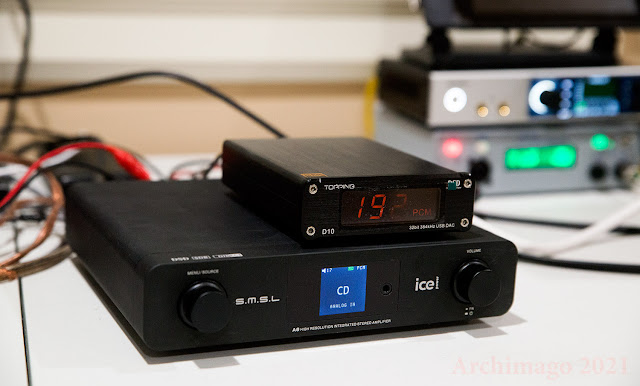
MEASUREMENTS: S.M.S.L. A6 as amplifier [ICEpower 50ASX2(SE) Class D module]. (And DAC output - AKM AK4452 AMPT.)


Over the years, there have been devices I've been meaning to measure but one thing or another got in the way. This SMSL A6 amplifier was something I discussed here on the blog back in 2017 (a subjective review and measurements of DAC output). Over the years, this device has been happily amplifying signals for my dad's Klipsch Forté which is quite a sensitive speaker of 96dB SPL/m/2.83V; certainly by now it is very much "burned in". ;-)

I wanted to measure this device as an amplifier out of interest, knowing that inside this is the Bang & Olufsen ICEpower 50ASX2(SE) Class D module. While the datasheet for this amplifier module is already very detailed, there's nothing like measuring oneself!

This ICEpower module is rated at 2x47W into 4Ω, both channels driven to 1% THD+N. The power rating halves to 25W/channel into 8Ω. Within the ICEpower ASX series, there is also the 250ASX2 that will supply up to 250W/channel into 4Ω, and 125W/channel to 8Ω if you need more power.

The nice thing about this Class D module is that it's inexpensive and easily available for hobbyists such as through PartsExpress (current price US$118), sometimes through Amazon as well. You could buy one of these and get a simple case such as this Ghent Audio one and assemble it for yourself quickly.
Saturday, 20 November 2021

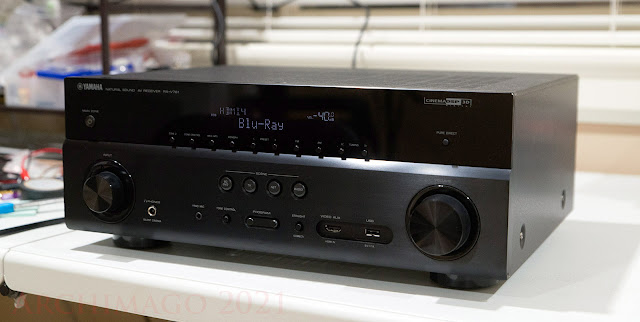
MEASUREMENTS: Yamaha RX-V781 A/V Receiver. Questionable magazine reviews of "high end" amps (D'Agostino). And thoughts on "hardware audiophiles", age and aging.

For this post, I want to have a look at the performance of my Yamaha RX-V781 as an amplifier. It's not new - I purchased this back in late 2016 to replace my Onkyo TX-NR1009 which I published on previously. Awhile back, I also looked at the pre-outs to examine the quality of this device's DAC.

This was an inexpensive receiver when I got it (as I recall, significantly less then US$700), being part of the "V" (Value) series from Yamaha, a step down from their "A" (Aventage) line. From the outside there's not much to look at, it's a black receiver with the usual buttons, knobs, and LCD screen to tell you the status. There's no swivel-open door to hide buttons like in more expensive models. It's a combination of plastic and metal exterior. Weight is not too heavy at 23lbs, mostly from the power transformer (looks like conventional E-I type, less expensive than toroidal but can provide greater capacity for size with potentially higher magnetic interference however).

The V781 is quite a feature-filled 7-channel amplifier capable of running 5.2.2 Atmos / dts-X, even compared to many of today's devices (see Yamaha specs here). What drew me to this model when I bought it was the fact that it had a full array of pre-outs so I could bring my own amps to the party if I wished.

Interestingly, even though over the years Yamaha updated these receivers with models like the RX-V385 and RX-V685, they never updated the "V78X" product line. My guess it that maybe the higher-end Value series might have been too close to the lower-end Aventages in terms of features and quality. For example the current Yamaha RX-A2A (~US$900) doesn't have a full complement of pre-outs, has more HDMI ins, no second HDMI out and quite similar to the Yamaha RX-V6A (US$650) already.

Wednesday, 17 November 2021

As We Hear It 2021 (I): Maurizio C on MQA, some ideas about TIDAL, and a few words about audio journalistic legacy...

Generation 1 earphones! For distant aircraft detection apparently...

As you might recall, over the years I have incorporated contribution posts from readers here on the blog. The article that follows was something I wrote back in the summer (2021) but since I was sick and tired of more MQA talk, I held on to it from publication a few months ago. Well, I think the time has come now that a few of the thoughts I wrote about TIDAL have actually come to pass - TIDAL just announced today that the price is down to $10/month, with the lossless 16/44.1 tier, pushing MQA into the "HiFi+" tier for $20/month. We're not sure if the lossless 16/44.1 tier has dumped the worthless MQA-encoded "MQA-CD" content though.

Here's the article with some modifications in light of the recent news...

A comment about MQA leading into 2021; some thoughts about the future of TIDAL and on journalistic legacy...

Here's an E-mail I received in late 2020 from Italy.
December 27, 2020 
To: Schiit Audio, Linn Audio
CC: Archimago


Dear Alls,
I'm an Italian, 60 years old, music lover and Older Analog Hi-Fi Fan and only recently I have converted to digital music, listening almost exclusively through the streaming services (Spotify, Tidal, QoBuz, Amazon, etc.).

Among hi-res listeners, Tidal is the most famous and expanding but they are "Forcing" the exclusive use of MQA format, with large investments, marketing campaigns, reviews from important audiophile magazines etc ..
Unfortunately this Campaign is gaining the upper hand, so much so that MQA Logo is now coveted by both manufacturers and sellers...

Saturday, 13 November 2021

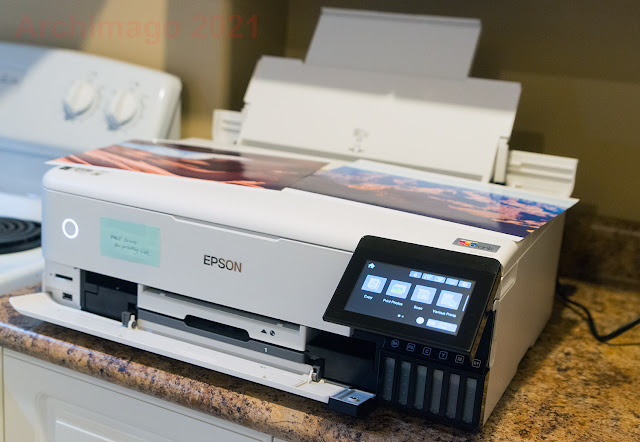
Epson Photo ET-8550 13" EcoTank Printer: Excellent, economical, wider photo printing! A quick look...

While for the most part this blog concerns itself with audio stuff, every once awhile it's nice to diversify into discussions of other tech products; over the years we've talked about TV tech, CPUs, and networking for example.

Whether in audio or computer tech, I like products that represent value. This probably will become more important in the years ahead due to inflationary pressures with possible slowing of technological innovations in consumer electronics.

A few years ago, I mentioned about the Epson ET-2550 (these days supplanted by the Epson ET-2760) for basic color printing. Of all the years of using printers, that device was the first time I felt ink jet represented good value. Since 2017, that printer is still going strong! Never had any issues with print head clogging, and it has achieved stable connection through the WiFi in my home and accessible to all computers within the network sitting unobtrusively in the basement.

In fact, I was so impressed that I simply had to jump at grabbing one of these new Epson EcoTank Photo ET-8550 units when they became available recently. This is the wider format 13" (ie. A3+ paper) model. If all you need is standard-width 8.5" then you can check out the less expensive EcoTank ET-8500. As the name implies, this is intended for photo printing with its 6 ink tanks as opposed to the 4 on the ET-2550/ET-2760.

Saturday, 6 November 2021

RTL Utility: A look at audio interface latency. Discussion: PLACEBO / NOCEBO in audio (Darko + Lavorgna... again).

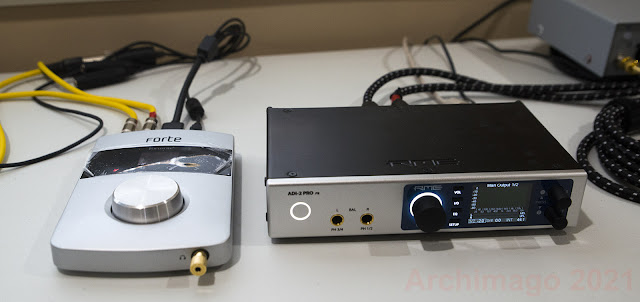
Hey guys and gals. For this blog post, I thought it would be of particular interest to some to have a look at latency and audio interfaces. As you can see in the picture above, I pulled out my Focusrite Forte for this alongside the RME ADI-2 Pro FS.

Latency is simply the delay for something to happen after an instruction has been issued for that event. Computers, device drivers, the hardware are not instructed "real-time" down to a bit by bit timeframe, but rather act on "chunks" of data generally issued with some buffer to keep the pipeline flowing. The buffering mechanism is a major, but not the whole, factor in the latency effect.

There is a balance to be struck though. The larger the buffer, potentially the more latency, but the less likely we could run into issues with dropouts. The shorter the buffer, the lower the potential latency, but the more demand on the CPU to deal with making sure the buffer doesn't go empty, and likelihood that we could have audio errors if needs are not met on time. This idea of "strain" on the CPU is particularly relevant on digital audio workstations (DAWs) when all kinds of DSP like VST plugins are used in audio production.

For us audiophiles, we generally don't care too much about latency because normally we're just interested in the sound quality once we "press play" and so long as the audio starts reasonably quickly and is not disrupted during playback, then there's nothing to complain about. Latency by itself has no effect on sound quality (despite the claims of some, which we'll address later).

Saturday, 30 October 2021

Revisiting the TEAC UD-501 DAC (2013): THD(+N), DSD output, Sweeps, Jitter, 1/10 Decade Multitone 32. (And on SSD transition, Corsair MX500 SSD, and Hi-Fi+ closes comments...)

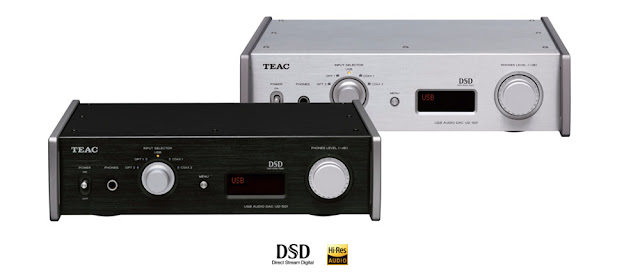
After Bennet/Dtmer Hk's comment on this previous post, I thought it might be interesting to revisit my longtime friend, the TEAC UD-501 DAC that I bought new when it came out in 2013. My preview and measurements (Part 2 PCM, Part 3 DSD) are still online of course.

I still remember doing those measurements in my previous home - it feels so long ago! ;-)

These days with the E1DA Cosmos ADC and RME ADI-2 Pro FS available for measurements, let's take a trip down memory lane at what has been over the years a reference DAC for me. I think the TEAC UD-501 is a special device that ushered in for many audiophiles a cost-effective, high resolution, well-built, reliable, low jitter, asynchronous USB audio interface which I suspect has influenced the design and performance of other DACs over the years.

Spec-wise, it was one of the first to catch my interest with the ability to handle PCM 384kHz and DSD128. The high quality metal case looks serious. It's based on a dual-mono TI/Burr-Brown PCM1795 configuration with dual toroidal linear power supplies. There are a number of PCM and DSD filters including the ability to turn off the 8x oversampling and allow "NOS" (Non-OverSampling) mode. The quad JRC MUSES8920 opamps they used were also another "feature" talking point back then. (Quite a complete specs page here for the TEAC.)

Saturday, 23 October 2021

Miscellany: FlexASIO for 384kHz, Philips 2001 SACD/DSD64 test signals (thanks Black Elk!), and Roon network multicast. [And Coltrane's A Love Supreme Live Hi-Res, Music Industry Crystal Ball, Magic Quantum Fuses!]

A scene from The Simpsons 1996...

Hey everyone, for this week, let's talk about a few "miscellaneous" topics which I've either wanted to mention over the last few months or have just come up as interesting tidbits I think worth documenting but not necessarily large enough as topics in individual posts. The main topics are:

A. Instead of ASIO4All, we can use FlexASIO with the E1DA Cosmos ADC for 384kHz samplerate measurements in Room EQ Wizard.

B. A look at some "standard" SACD test signals from Philips back in 2001. With many thanks and great discussions with Black Elk.

C. Roon needs network multicasting. Check this out if you're running into network issues; I had some problems initially with my ASUS ROG GT-AX11000 and relatively complex home network.
 

Saturday, 16 October 2021

REVIEW: Topping D90SE DAC - Part III: Subjective Impressions, AMPT, and Summary. A few words about "warmth" and "accuracy" in sound systems.


This is the final part of my trilogy review/evaluation of the Topping D90SE DAC (see Part I, and Part II for the objective testing results).

As we end off, let's close with a discussion of subjective impressions developed over many evenings of listening (about a month or so). I've described the soundroom previously in some detail and for the two channel system, the main amplifier is my home-assembled Hypex nCore NC252MP, main front speakers are the Paradigm Reference Signature S8 v3, and dual subs (main Paradigm SUB1 with the little Polk PSW111). The Topping D90SE feeds my Emotiva XSP-1 preamp. All cabling is balanced XLR from DAC to amplifier (no need to fret, inexpensive Monoprice Stage Right XLR runs are all ya need, feel free to spend more on cables if you see fit of course).

I listened both with and without DSP room correction activated; generally I prefer with DSP. Knowing the frequency response characteristics (flat to 20kHz) and setting to "Fast Roll-off Linear" (Filter 5) allows me to use the same DSP settings for my room interchangeably with the RME ADI-2 Pro FS Black Edition without need to remeasure (equivalent frequency and time-domain performance). As discussed before, one of the benefits of a high quality DAC is that we can have even more headrooom with DSP processing whether it be full room correction or applying volume normalization like ReplayGain.

Saturday, 9 October 2021

MEASUREMENTS / REVIEW: Topping D90SE DAC - Part II: Resolution

In this Part II of the review of the Topping D90SE DAC, let's focus on the performance that this DAC can achieve. As you can see in the picture above, I've got the machine on the test bench ready to capture some data. Given the anticipated performance as described in Part I last time, the E1DA Cosmos ADC is used for the measurements being presented today.

As you can see on the LCD screen, it's playing DSD512 (22.6MHz) material at the time of this picture. For a more complete examination of the device's performance, let's see if we can capture both PCM and DSD performance.

This device does have a broad number of features, so let's try to hit the key (and also some not-so-key) features to better understand how well it works and if there are nuances that the audiophile should be aware of. As readers here I'm sure are aware of over the years, objective testing can often show anomalies that listening tests easily miss due to the limitations of human hearing and cognitive ability. Sure, one could argue that inaudible limitations are not important. I'd like to think that in principle, audiophiles have an interest in achieving both technical perfection as well as immaculate subjective performance. 

Tuesday, 5 October 2021

MEASUREMENTS: DSD Testing with SoX-DSD Signals Part II (RME ADI-2 Pro FS R Black Edition, DSD Direct, Filter @ 50/150kHz) [Updated with 44.1kHz PCM --> DSD.]


Okay guys and gals, a rare "mid-week" update on DSD testing, a "Part II" follow-up to the previous article.

As I mentioned as an update in that article, I have a suspicion that the Topping DX3 Pro might not be using "DSD Direct" in its playback. However, I do have the RME ADI-2 Pro FS R Black Edition here as well. As you might know, I've been using the RME line of ADC/DACs for awhile now. These are certainly some very well thought out and high performance units with a ton of customization options.

Two of these options are shown in the screen in the picture above - "DSD Direct" and "DSD Filter". The "DSD Direct" is either OFF/ON, and "DSD Filter" either 50kHz/150kHz and is only activated when "DSD Direct" is ON, in recognition of course that DSD noise shaping does create significant ultrasonic content that in general probably should be filtered out; how much filtering is up to you.

Saturday, 2 October 2021

MEASUREMENTS: A look at DSD and using SoX-DSD as a standard for test signal conversion. The 1/10-decade Multitone 32 test. And retro-pop remixes... ;-)

Hey everyone, although I'm in the middle of the Topping D90SE review series, I thought this week I'd make a slight detour! Like I suggested last week, I'm planning to savor the D90SE measurements / discussion series and enjoy the DAC. No rush needed. I see this blog as more educational and philosophical than mere opinions about things you can just buy and try for yourself. ;-)

Over the years, the fun part of the hobby and blogging for me has been to "evolve". As an audiophile, it's fun taking on the challenge of examining this pursuit with a more objective lens. To do that, it has been good to see what others are up to and incorporate incremental improvements in the testing gear and techniques I use within the budget of a home audiophile.

Each of these "MEASUREMENTS" posts is like a mini-experiment that we as hobbyist/"citizen scientists" can do for ourselves. I trust that the information I post can be repeated and verified if you have the interest, time, and some know-how.

Inspired by discussions with Bennet Ng (aka Dtmer Hk recently and in the Topping D10B review), DSD measurements is something that I have seen little discussions of in reviews. For reference, in these blog pages, we have talked generally about DSD/SACD back in 2013, looked at conversion software (here, here), as well as talked about PCM --> DSD playback like with HQPlayer a couple years ago.

But I haven't really taken a more intentional look at my DSD testing regimen... Something I hope to rectify here and clarify the "standard" signals I'll use in the tests ahead.

Saturday, 25 September 2021

MEASUREMENTS / REVIEW: Topping D90SE DAC - Part I: The Hardware, Filters, MQA, and Jitter Performance


Today, let's start with what I'm aiming to be a 3-part review/discussion of the Topping D90SE DAC. I figure I'll take my time on this since things are busy around here and I hope not to purchase more hi-fi DACs going forward, so I might as well savor the moment. ;-) As a "more objective" audiophile who has a vision of aiming for "high fidelity" / "transparency", there is a clear target and end-point to what's needed from hardware performance especially with DACs.

Readers of this blog know that I've had a number of Topping devices reviewed here over the years. In fact, for any single brand of DACs, I think I've reviewed more Topping gear here than other brands. This, I believe, is a reflection of a brand that provides multiple products at price points with features that actually speak to me as a consumer interested in value which includes features, and price. I have certainly not been disappointed by overall quality to this point.

At a current retail price of around US$900, this is not an inexpensive model. As per most of my reviews, I bought this through usual retail channels so what I'm reporting on here is not any potentially specially-selected unit sent from the manufacturer.

Feature-wise, this is a DAC only but accepts multiple inputs - USB, HDMI-style I2S, S/PDIF Coax, S/PDIF TosLink, and wireless Bluetooth 5.0 (SBC, AAC, aptX [LL,HD], LDAC). While it has both unbalanced RCA and balanced XLR outputs, there is no headphone amp. For that, Topping recommends grabbing their top model the Topping A90 (~US$500).

What makes this DAC interesting in mid/late 2021 is that this is reputed to be the highest fidelity converter in the world (available to consumers) at this point in history, Topping's "flagship" device. 

Let's take a look...

Saturday, 18 September 2021

MEASUREMENTS: USB Isolation with Nobsound ADuM4160 device and hi-res DAC. The world these days, and the audiophile microcosm.


After writing about very high resolution measurements with the E1DA Cosmos ADC last week and touching on basically "state of the art" fidelity like the Topping D90SE, for this week's post, I thought it would be good to talk about something more "fundamental". Often spoken of among audiophile tweakers but rarely have I seen evidence of actual value/effect for many of these devices.

Before I begin with this post or even show you anything, let me just say that I do not believe audiophiles need USB isolation for use with devices like DACs unless you know you have noise issues. I think we've all see indiscriminate suggestions that audiophiles need all kinds of noise filters and isolators (like this, or this). Sometimes these things cost quite a significant chunk of change compared to the downstream device (like DAC) itself!

Over the years, I have tried out a number of USB DACs with computers and simple streamer devices like the Raspberry Pi. With a normal set-up, I cannot say I have ever heard an issue with any of the various decent DACs I've tried. Likewise, measurements already suggest that in general there are no major noise issues with at least reasonable modern devices.

However, there are times when the system is complex enough where indeed you do see ground loops and noise like the 8kHz USB PHY noise pop through. A couple months back, I showed you some of this when we took the rather useless AudioQuest JitterBug FMJ for a spin in some of these situations! Today, let's look at the effect of that little inexpensive Nobsound ADuM4160 USB Isolator (typically can be purchased for <US$25) you see in the picture above.

Saturday, 11 September 2021

EARLY LOOK: E1DA Cosmos ADC - affordable high performance measurements for the audio hobbyist!

As you can see in the picture above, I have one of Ivan Khlyupin's (aka IVX) Cosmos ADCs. It's not available yet on the market, so watch for when it's released from E1DA in the days ahead. (I see that variants are available on Amazon now.) Thank you Ivan for reaching out and sending this unit for me to use!

[If you're wondering about the E1DA name, as explained by Ivan, it comes from the pronunciation of "Ivan" as sounding like "E1" in Russian as opposed to the Americanized "Eye-Ven". "DA" as in "dah" ("да", "yes") - so it means "Ivan Yes".]

While this unit is one of his builds for external testers, I suspect that it should be much the same as the final product when available hopefully later this month. Obviously there could still be some changes with the final production release.

I think the price is slated for around US$150. Also, in the days ahead, E1DA will be releasing the "APU" (Analog Processing Unit) that can complement an ADC for measurements with the ability to notch out the 1kHz fundamental among other features allowing even more accurate measurements of very high performance gear. And there's also the Cosmos DAC coming as well to complete the "trinity".

For today, let's have a peek at the Cosmos ADC. Let's explore how to get it going, some of its features, and although still early days, we can take a quick look at measurements with this tool, with some DACs I have here.

Saturday, 4 September 2021

Archimago's Musical Performance Track (AMPT): Standard test track for listener evaluation of source playback. [RME ADI-2 Pro FS R BE, Topping D10s, D10 Balanced, TEAC UD-501, Squeezebox Touch recordings.] Loss of RMAF, Bluetooth aptX Lossless. PS: Topping D90SE.

Over the years, we've seen websites, blogs, and videos try ways to demonstrate the sound of a hi-fi device or for the adventurous, even try to convey the sound quality of listening rooms. For example, there are binaural recordings at audio shows, soundroom demos, speaker comparison samples, etc. This is not an easy task because high-fidelity is about nuances and slight variations; not wholesale "obvious" differences for many devices like DACs or high performance amplifiers. Unlike what you might read in audio reviews, assuming you have a decent DAC already, a replacement would be unlikely to result in obvious changes in characteristics like bass response or claims that jitter effects are somehow obviously audible! Sorry folks, a lot of that kind of talk is just fantasy.

While it is convenient to view and listen to typical YouTube clips, I think we can all appreciate that sound quality would be highly affected by: the recording microphone, room acoustics, set-up quality, the lossy audio compression from YouTube among others that I may have missed. Dissociating the effect of the different components would be impossible. And obviously any time you use a transducer to convert the sound pressure into electrical signal (ie. speaker, microphone), there will be a significant reduction in resolution if we're trying to determine the effect of something like a DAC!

Then there's the issue of what music is being used? Is it music that audiophiles have general access to? Is it material that audiophiles/music lovers would even generally listen to? Obviously this bit is very subjective but I think there's something to be said about esoteric test material that might be recorded amazingly well, but just not adequately popular to have "mainstream" level acceptance. When "subjectivist" audiophiles complain that test tones are artificial and synthetic, is it that much different from listening to a handful of albums that barely anyone cares about? ;-)