Saturday, 26 February 2022

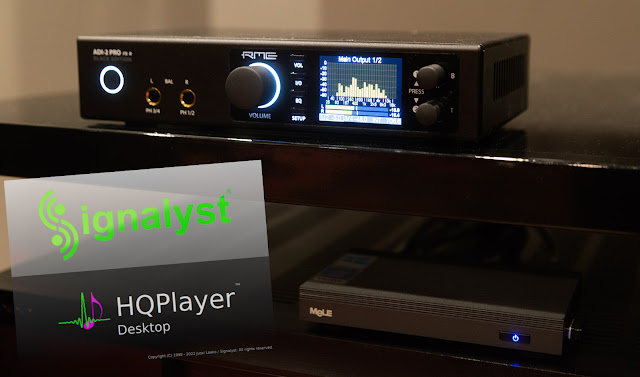
Using the MeLE Mini PC for Upsampling/Filtering - HQPlayer Desktop 4 streaming from Roon. [Going forward, AVX2 needed for HQPlayer + Roon... For some reason.]

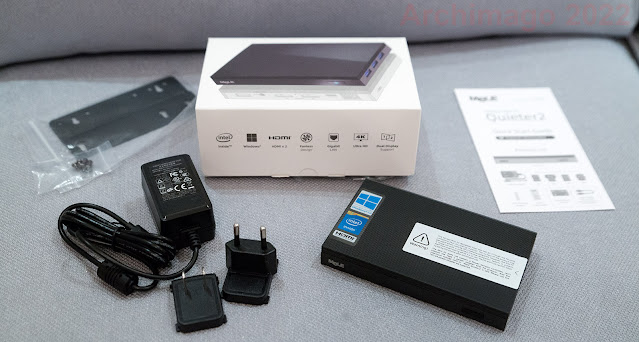
Hey folks, a few weeks ago, I mentioned that I've got the little MeLE Quieter2Q Windows 10/11 computer in my sound room these days used as a low-power (<10W) Roon streamer capable of 2.0 and 5.1 multichannel. The computer is relatively powerful for just an audio device handling Roon streams; 8GB DDR4 RAM, a 2.0+GHz turbo Celeron J4125 quad-core CPU is certainly much more than needed just to basically get data from the gigabit ethernet and shove it to USB or HDMI for playback!

It works fantastically also as a little fanless HTPC for movies with 4K video and audio bitstreaming. A tip: K-Lite Codec Pack works very well, it can even play MKV/MKA files with lossless TrueHD-Atmos like the 2019 Beatles Abbey Road BluRay rip which I know will trip up some HDMI hardware.

I mentioned in the previous article that it might be fun to consider utilizing the processing power of the little fanless box for audio. For many Roon users, one way of taking advantage of processing power is by using HQPlayer from Signalyst for high-quality upsampling with digital filtering, and possibly even PCM-to-DSD conversion. 
Saturday, 19 February 2022

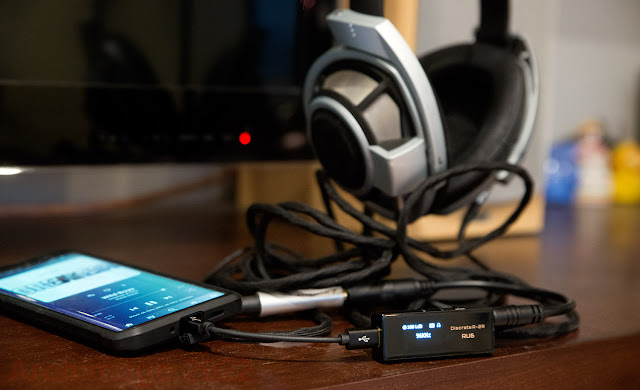
DEMO: Listening to the Cayin RU6 R-2R noise and distortions with headphone load. Confirming subjective impressions. And Jim Austin / Stereophile's "Thoughts On Reviewing".

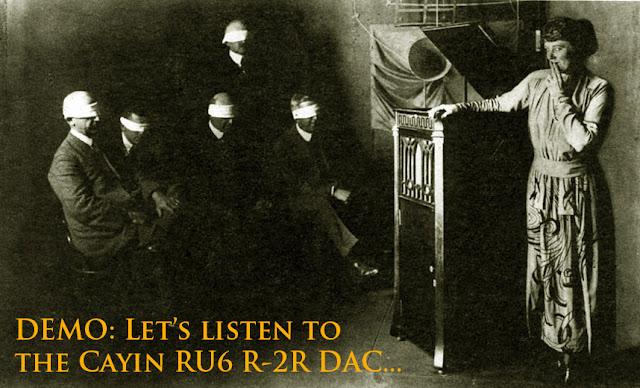
Notice that the quest for high fidelity has always been, almost exclusively, a male pursuit. A picture from the Edison Diamond Disc and the "tone tests" done back in the day circa ~1916.

I've been critical of many audiophile magazines, websites, and YouTube channels because it's hard to believe some of these individuals truly can hear what they report. I know, it's perhaps "rude" to question subjective claims, but unless one questions stuff like this, how are we to differentiate thoughtful critical listening from potentially biased claims of sound quality?

For example, I honestly doubt the folks who claim to hear big differences between cables. I think it's silly that some people insist they hear differences because of unsubstantiated "jitter" effects in digital audio. Those who think "bit-perfect" playback can sound very different have never over the years proved their case. Then there are those subjective reports that sing the praises of "hi-res audio" despite research never showing differences as being anything more than subtle. How about claims of the ability to hear the effect of "audiophile" ethernet switches, or USB noise/jitter devices?! As you can see in the links to these topics, I've tried to address them over the years so when questions come up, I can just point folks to areas covered already.

IMO, with time, more and more nonsense articles and claims have built-up in audiophile magazines and the Internet. I think young audiophiles must have difficulties making heads or tails about what is true anymore while negotiating this massive minefield of questionable information. I would not be surprised that some in this Industry actually prefer the presence of this "fog of subjectivity" because it allows people to make irresponsible claims about anything they want and not have to provide evidence so long as some key reviewers or readers have faith to repeat the belief over time! 

That the ongoing majority of audio hardware reviewing these days is purely subjective is a bit of a problem in the context of what I believe to be very poor reliability.

Saturday, 12 February 2022

MUSINGS: Speaking "As If..." claims are truths, Attribution Theories, and the Numerical Madness of Chord (Mojo 2 and 104-bit DSP)? (And quick note on Multichannel "Kind Of Blue".)

As you've seen, recently, I measured the Chord Mojo DAC and we discussed the imminent release of the Mojo 2 which was formally unveiled on January 31 (2022). With that of course comes the flurry of media posts, reviews and advertising material hyping the new features which might or might not be useful depending on your needs.

An interesting interview (and I'm sure one of a number in the days ahead) is the one Darko conducted with designer Rob Watts released on February 1st. As much as I've been critical of Darko over the years (like this), I appreciate the interview, the questions, and perhaps showing some guarded skepticism; good stuff John for letting Watts speak.

The DAC infrastructure of the Mojo 2 is basically an "evolutionary" upgrade to the custom sigma-delta design of the Mojo 1 which is already very good. Watts admits to this evolutionary step (12:50). As suspected, they needed to keep Poly compatibility (2:15) - a shame because I think the retention of micro-USB is a real turn-off in 2022. These days, Bluetooth in a premium product I think is a basic mobile feature. At this kind of price point >US$700 for the Mojo 2, I think it's a little silly to also have to pay another >US$700, tolerate the added bulk, just to get wireless options but still limited to Bluetooth 4.1 A2DP/SBC last I looked; no aptX, LDAC, or even AAC codec support for higher fidelity (lossless Bluetooth would not be high on my priorities, but aptX Lossless is good I guess). As a general rule-of-thumb in consumer electronics, I think expensive add-ons like this usually don't make much sense, much less insist on ongoing compatibility across generations of products in the mobile space.

Saturday, 5 February 2022

MeLE Quieter2Q (8GB DDR4, 128GB eMMC, Celeron J4125) Mini PC: An inexpensive, silent, multichannel Roon Endpoint. On Paul McGowan (PS Audio): "digital audio is soooo noisy", and "computers are the worst". [+ Windows 11 Update]

MeLE Quieter2Q (~US$250) box and contents. Notice VESA mounting plate (top left) included which is handy I think if used as a monitor back-mounted computer.

Over the last number of years, I've been a Roon user (lifetime membership, no I have not been subsidized in any way by the company). Although not perfect, it works well for me and I've certainly enjoyed the bountiful metadata this interface provides. The Roon software has unified control and access to my music library through Roon Core running on my Windows Server machine. In doing so, this has brought all the hardware playback systems in my home under the same "umbrella" whether it's my Workstation PC (listening to music writing these blog posts), on my phone using Bluetooth headphones while doing housework, or casually streaming Internet radio to the Chromecast Audio - Roon serves them all. The main item on my wish-list is for Roon to support streaming from the library remotely such as from the office.

For those who have read this blog over the years, you'll know that I like multichannel audio playback (discussed here, and here among elsewhere). No, I am definitely not one who thinks 2-channel is somehow "audiophile" territory and that multichannel is the domain of the "home theater guys". Audiophiles IMO should be greedy; we want it all because the love of music and the experience of great sound quality do not end the moment we go beyond 2.0 or 2.1 channel layouts! Some of the best sonic experiences I have had are with multichannel content and hardware.

As you likely know, I've been an advocate for Raspberry Pi devices, like the Pi 3B+ "Touch" and Pi 4 "Touch" builds discussed over the years. I still use these when I run my DAC tests given the convenience of the touchscreen and of course the price represents great value. However, there is a feature which still eludes the Raspberry Pi boards - I want easy multichannel Roon streaming in my main soundroom.

Saturday, 29 January 2022

REVIEW & MEASUREMENTS: Chord Mojo DAC/Headphone Amp. A note on LH Labs (Light Harmonic "subsidiary") audio crowdfunding. And Neil Young's ultimatum to Spotify. [Early Mojo 2 specs.]

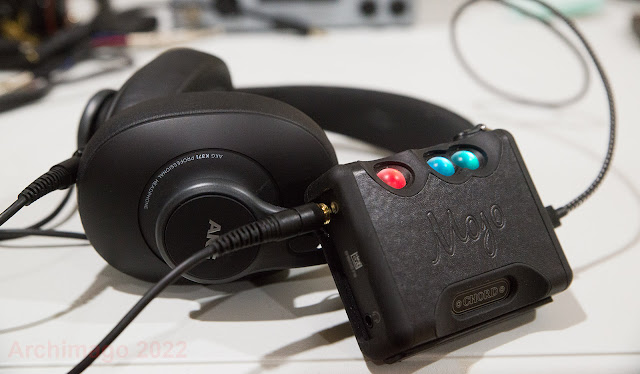
Mojo as shown here in the official rubber and leather Mojo Case. Looks and feels great in the hand. Shown with AKG K371 headphone.

Well, in the "better late than never" category, when I returned my friend AudioPhil's Cayin RU6 the other week, I borrow his Chord Mojo ("Mobile Joy", ~US$475 new but I think currently discontinued) for a spin!

This DAC has been out since October 2015! That's ages ago in the world of electronics. However, to be honest, high fidelity audio reproduction is rather ageless whether the device is 10 months old or 10 years old. So long as the internal components aren't deteriorating with age ("break-down" instead of "break-in", right?).

As you've probably seen in countless reviews on the Mojo (like here, here, here), this seems to be quite a popular DAC with a good following. It has been said that Chord sold something like 100,000 of these over the years. Objectively, the Stereophile review in fact showing some impressive performance results back in 2016.

As usual, Chord gear tends toward the large bulbous glowing buttons, at times steampunk metal esthetic. Colors are used to provide feedback on volume (the pair of buttons for +/- volume) and the main power button (red in image above) which changes color for sampling rate. I think this is an acquired taste and figuring out the colors will take some time as you get used to the sequence of colors in a rainbow with red (lowest volume/samplerate) on one end and purplish/grey/white (highest) on the other..

Saturday, 22 January 2022

REVIEW & MEASUREMENTS: Cayin RU6 R-2R USB Dongle DAC/Headphone Amp. Considering "Intentional Imperfections". (Topping D90SE -60dBFS input graphs.)

In the last few years, we've seen a resurgence in interest around R-2R DACs. Back in the day (like these old CD players for example), multibit ladder technology was the way to do the conversion until the rise of 1-bit and multilevel sigma delta modulation DACs became the norm.

High quality R-2R does require extra effort to make sure the resistor levels are precisely trimmed to achieve higher resolution. This is why hybrid techniques have also been implemented over the years such as the TI/Burr-Brown segmented architectures (like with my TEAC UD-501).

With this post, let's focus on the Cayin RU6 DAC (~US$250), a new USB-C dongle device (comes also with a USB-A adaptor) which aims to provide high performance headphone playback of PCM up to 24/384 and will accept DSD256 by converting the 1-bit SDM to PCM internally (no native DSD conversion).

Thanks to my buddy AudioPhil for lending this device for testing!

Saturday, 15 January 2022

Using Victor's Oscillator as reference (1kHz, ultra-low distortion analogue sine generator). A quick peek at the APx555B Analogue & DAC Signal Generators @1kHz. And on playing music "for fun"!

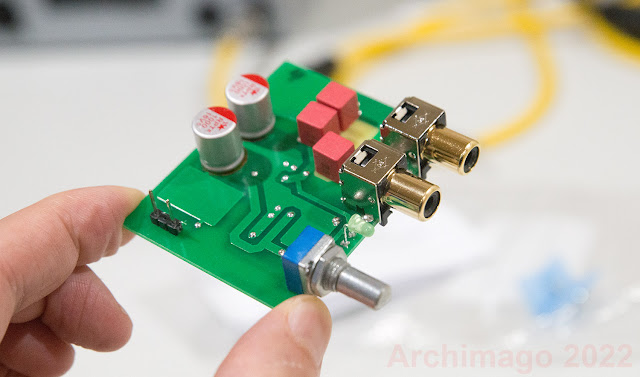
Note the 2-pin power connector on the lower left.

As you've seen on the blog over the last year, I've been using the E1DA Cosmos ADC from Ivan Khlyupin for a number of measurements recently (early report discussed here). I remain quite impressed by the performance of this little device with some caveats (lower input impedance, individual unit idiosyncrasies including what "grade" device one has).

While the ADC comes pre-calibrated by E1DA and unless you really want to spend some time playing with it, one should probably just leave it alone. Nonetheless, it's pretty clear that this is the kind of device made by and for audio hardware geeks! ;-) One has the opportunity to use the Cosmos_Tweak Windows program to fine-tune the calibration by changing independent ADC 2nd and 3rd harmonic compensation amounts, SDM integrator setting, and digital filter for the ESS Tech ES9822 chip.

So then, for this post, let's spend some time in the area of calibration and see if we can tweak the ADC using the device above - Victor's Oscillator (US$57) - an ultra-low distortion, 1kHz analogue signal generator which comes pre-assembled and tested from Riga, Latvia. As you can see in the image, there are 2 single-ended RCA outputs, with volume control ranging from 300mVrms (-8.25dBu) to 2.7Vrms (+11.0dBu). Note that a 10kHz version (and other custom versions) can be purchased as well but for typical audio purposes, 1kHz is in line with human hearing sensitivity.

Tuesday, 4 January 2022

As We Hear It 2022: Hypex nCore NC252MP DIY, The Joys of Modern Digital Audio, Upsampled Streaming, and Audible Amplifier Differences.

Happy 2022 everyone and greetings from Honolulu. As Bing Crosby once sang, "Here we know that Christmas (and New Years) will be green and bright" in Hawaii. A welcome first escape from Canada since the Pandemic began for myself and the family. Always good to escape winter in Canada for a little bit even if it's from relatively mild Vancouver although this year looks like we also avoided the snowy cold snap!

As a first post for 2022, let's look in the (virtual) mailbag a select a few items from readers for an "As We Hear It" post that have come in over the last number of months.

Saturday, 25 December 2021

Audiophile Psychology: Reconsidering Zelinger's "Hi-Fi Fetishism" (HFN&RR, October 1981), and Lofft's "Sense and Nonsense" (SR, October 1982). On neuroses & fantasies.

Greetings everyone. Grab yourself a nice beverage, settle into a comfy chair, let us delve a bit into audiophile psychology.

I think this is an important topic; one that is implied in many of my posts over the years (in fact, we started 2021 with some related thoughts). Some of these psychological constructs I believe explain to a degree the ceaseless arguments we often see online especially when things go off track and disagreements appear irreconcilable between different "sides", "camps", "tribes"...

I. Hardware Audiophiles and Hi-Fi Fetishism

Let's discuss some ideas by building on writings from the past. To start, here's something interesting by J. Zelinger "Hi-Fi Fetishism: a psychologist's view of the lunatic fringe" from October 1981, published in Hi-Fi News & Record Review (I noticed that the link above can be marginal and might not work, here's a PDF of the text).

First of all, I must send kudos to Mr. Zelinger for a thought-provoking piece from the early '80s. It appears that many in the audiophile hobby diverged off into the direction of pure subjectivity, areas untethered from reality testing during that decade. He touches not just on the importance of psychoacoustics (as playing its role in perceptual adjudication of course), but into the touchy subject of the personalities of certain audiophiles.

Let's dive into this without fear and talk/think about this important topic and how it relates to us as "audiophiles" in the 21st Century.

Saturday, 18 December 2021

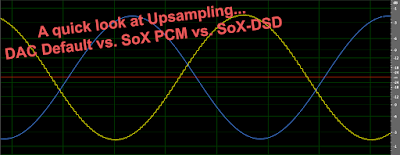
Upsampling: Native DAC Playback, and SoX PCM/DSD upsampling of 1kHz signal. (And the "Beatles: Get Back" documentary, "As the artist intended"?)

Notice one of the waveforms NOS.

A few weeks ago on this blog in a comment discussion, Bennet / Dtmer Hk talked about showing what it looks like when upsampling a 1kHz 16/44.1 signal in PCM side-by-side with DSD upsampling.

Sure, no problem! We can have a quick peek at the 1kHz sine tone from a couple of DACs for comparisons between direct playback with built-in filtering, upsampled in high quality with PCM SoX, and then using high quality DSD conversion with SoX-DSD.

Plus, let's also have a look at the recent Beatles: Get Back documentary series and some thoughts which I think relate not just to the "music lover" which I hope is in all of us, but also to the "hardware audiophile" side of this hobby.

Saturday, 11 December 2021

As We Hear It: Another High Dynamic Range Christmas Playlist (2021 Edition) by Allan Folz


Another High Dynamic Range Christmas Playlist (2021)

[Guest Post by Allan Folz]

Last year I shared with readers some of the Christmas albums that were a large part of our family's holiday tradition. Mostly they were CD's I bought in the mid and late 90's, which we listened to every year from Thanksgiving to Christmas. They were an eclectic mix of standards with the one thing in common that they all sounded great. Years later I learned about the importance of dynamic range and realized there was a objective reason I never tired of listening to these every Christmas, year after year. They sounded great because they had excellent dynamic range.

While those albums will always have a special place in our Christmas tradition, with streaming services now broadly available, over the last few years I have added some new favorites to our listening rotation.

Last year's guest post was so well received I took it as an invitation to write another post sharing some of our newer favorites. (Ed: Absolutely, Allan!) Many of these albums I listen to via streaming service so I don't always have dynamic range measurements from the CD's to compare. Rest assured they all sound great.

Saturday, 4 December 2021

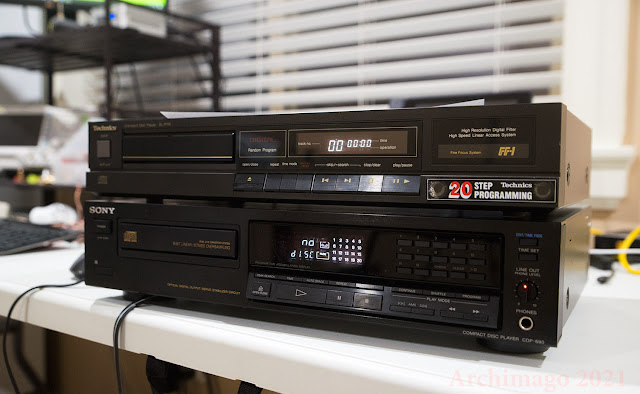
RETRO: Technics SL-P110 (1986) & Sony CDP-690 (1990) CD Players. Did early CD players sound bad?


As we enter the last month of 2021, let's go back in time and consider the question: "Did early CD players sound any good?"

Over the years, I have heard this question asked many times. Typically among audiophiles, the answer almost invariably seems to be that early CD players from the 1980's "suck" (or similar negative expression). Generally, these comments appear without further details to explain the sentiment; as usual in audiophilia, we can find many opinions out there, but few bother with facts to build their case. I haven't seen many contemporary articles or writers discuss this question while looking at objective data to examine performance compared with the hi-res DACs we have these days.

The genesis of this article came about while chatting with my friend linnrd a number of months ago about the sound of DACs, modern devices, and what we grew up with back in the day. Lo and behold, he dug out the two machines you see above from his "archive" of older hardware. They appear to be in excellent condition despite being >30 years old!

Let's have a good look at the performance of these machines, and a listen as well, of course. ;-)

Saturday, 27 November 2021

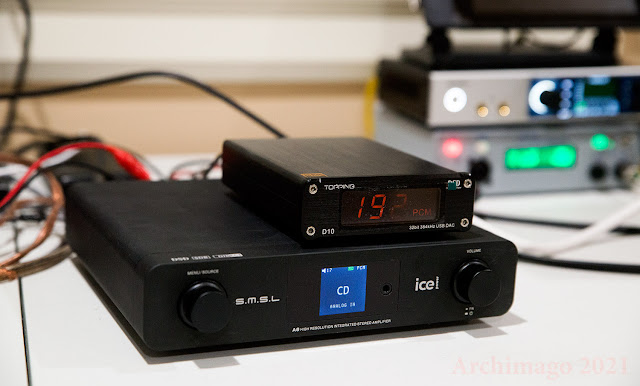
MEASUREMENTS: S.M.S.L. A6 as amplifier [ICEpower 50ASX2(SE) Class D module]. (And DAC output - AKM AK4452 AMPT.)


Over the years, there have been devices I've been meaning to measure but one thing or another got in the way. This SMSL A6 amplifier was something I discussed here on the blog back in 2017 (a subjective review and measurements of DAC output). Over the years, this device has been happily amplifying signals for my dad's Klipsch Forté which is quite a sensitive speaker of 96dB SPL/m/2.83V; certainly by now it is very much "burned in". ;-)

I wanted to measure this device as an amplifier out of interest, knowing that inside this is the Bang & Olufsen ICEpower 50ASX2(SE) Class D module. While the datasheet for this amplifier module is already very detailed, there's nothing like measuring oneself!

This ICEpower module is rated at 2x47W into 4Ω, both channels driven to 1% THD+N. The power rating halves to 25W/channel into 8Ω. Within the ICEpower ASX series, there is also the 250ASX2 that will supply up to 250W/channel into 4Ω, and 125W/channel to 8Ω if you need more power.

The nice thing about this Class D module is that it's inexpensive and easily available for hobbyists such as through PartsExpress (current price US$118), sometimes through Amazon as well. You could buy one of these and get a simple case such as this Ghent Audio one and assemble it for yourself quickly.

Saturday, 20 November 2021

MEASUREMENTS: Yamaha RX-V781 A/V Receiver. Questionable magazine reviews of "high end" amps (D'Agostino). And thoughts on "hardware audiophiles", age and aging.

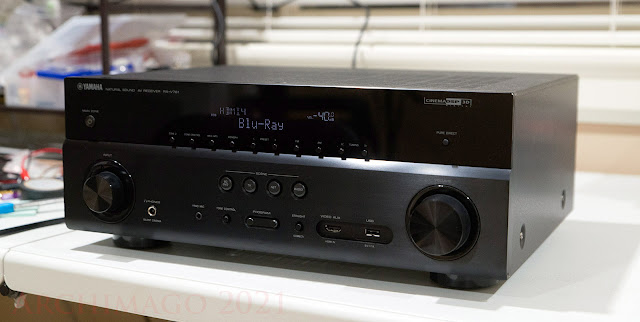
For this post, I want to have a look at the performance of my Yamaha RX-V781 as an amplifier. It's not new - I purchased this back in late 2016 to replace my Onkyo TX-NR1009 which I published on previously. Awhile back, I also looked at the pre-outs to examine the quality of this device's DAC.

This was an inexpensive receiver when I got it (as I recall, significantly less then US$700), being part of the "V" (Value) series from Yamaha, a step down from their "A" (Aventage) line. From the outside there's not much to look at, it's a black receiver with the usual buttons, knobs, and LCD screen to tell you the status. There's no swivel-open door to hide buttons like in more expensive models. It's a combination of plastic and metal exterior. Weight is not too heavy at 23lbs, mostly from the power transformer (looks like conventional E-I type, less expensive than toroidal but can provide greater capacity for size with potentially higher magnetic interference however).

The V781 is quite a feature-filled 7-channel amplifier capable of running 5.2.2 Atmos / dts-X, even compared to many of today's devices (see Yamaha specs here). What drew me to this model when I bought it was the fact that it had a full array of pre-outs so I could bring my own amps to the party if I wished.

Interestingly, even though over the years Yamaha updated these receivers with models like the RX-V385 and RX-V685, they never updated the "V78X" product line. My guess it that maybe the higher-end Value series might have been too close to the lower-end Aventages in terms of features and quality. For example the current Yamaha RX-A2A (~US$900) doesn't have a full complement of pre-outs, has more HDMI ins, no second HDMI out and quite similar to the Yamaha RX-V6A (US$650) already.

Wednesday, 17 November 2021

As We Hear It 2021 (I): Maurizio C on MQA, some ideas about TIDAL, and a few words about audio journalistic legacy...

Generation 1 earphones! For distant aircraft detection apparently...

As you might recall, over the years I have incorporated contribution posts from readers here on the blog. The article that follows was something I wrote back in the summer (2021) but since I was sick and tired of more MQA talk, I held on to it from publication a few months ago. Well, I think the time has come now that a few of the thoughts I wrote about TIDAL have actually come to pass - TIDAL just announced today that the price is down to $10/month, with the lossless 16/44.1 tier, pushing MQA into the "HiFi+" tier for $20/month. We're not sure if the lossless 16/44.1 tier has dumped the worthless MQA-encoded "MQA-CD" content though.

Here's the article with some modifications in light of the recent news...

A comment about MQA leading into 2021; some thoughts about the future of TIDAL and on journalistic legacy...

Here's an E-mail I received in late 2020 from Italy.
December 27, 2020 
To: Schiit Audio, Linn Audio
CC: Archimago


Dear Alls,
I'm an Italian, 60 years old, music lover and Older Analog Hi-Fi Fan and only recently I have converted to digital music, listening almost exclusively through the streaming services (Spotify, Tidal, QoBuz, Amazon, etc.).

Among hi-res listeners, Tidal is the most famous and expanding but they are "Forcing" the exclusive use of MQA format, with large investments, marketing campaigns, reviews from important audiophile magazines etc ..
Unfortunately this Campaign is gaining the upper hand, so much so that MQA Logo is now coveted by both manufacturers and sellers...