Saturday, 9 July 2022

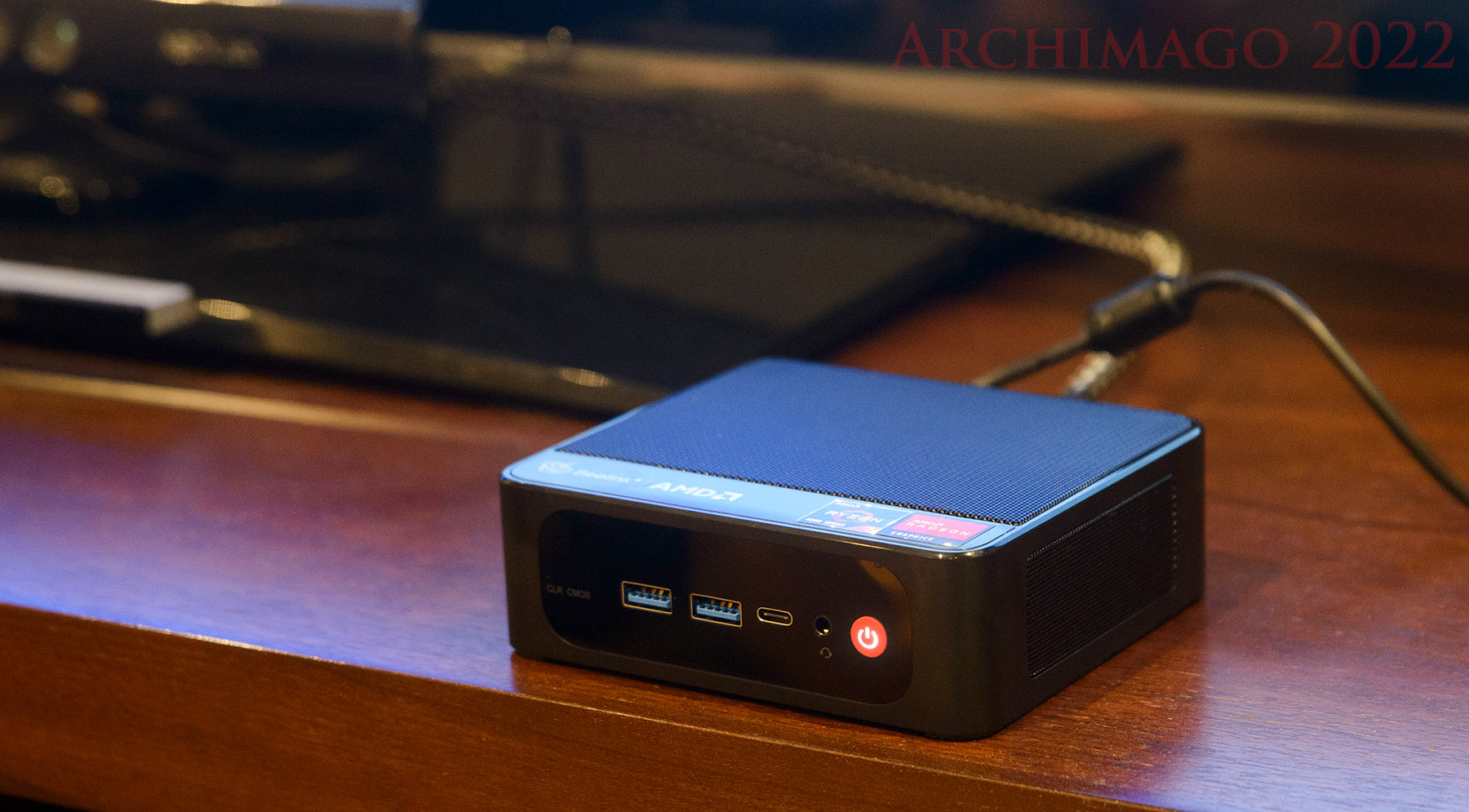
REVIEW: Beelink SER4 Ryzen 7 4700U (8C/8T) MiniPC - A small, quiet, fast, general "workhorse" PC... [Addendum: HDR works.]

These days, if we look around most homes, I think we'll see all kinds of computers used for different purposes in the rooms. I've talked about my main Workstation, the Server machine, even my Gaming rig a number of years back (much of that upgraded since). And a few months ago, we talked about the very low power fanless Celeron MeLE Quieter2Q which functions as a very stable stereo/multichannel streamer for Roon.

[BTW, there is an upgraded MeLE Quieter3Q now which is faster by ~30-40% featuring the Celeron N5105 processor for a few more dollars, but still no AVX2 if you're thinking about Windows HQPlayer as discussed here.]

Recently, I've been wanting to upgrade my 2016 Intel NUC 6i5SYH which in the last few years has been the heart of the audio measurements rig. Over time, as my measurement regimen has become more detailed, often using larger FFTs parameters, once awhile, I've started noticing that the old i5 CPU isn't keeping up with the processing needs and this shows up as glitches in the data such as when running multichannel REW "stepped sine" captures. Obviously, this will not do. ;-)

To remedy the situation, I got one of these Beelink SER4 Ryzen 7 4700U-based MiniPCs (8-core, 8-threads, currently less than US$450 for the 16GB RAM/512GB M.2 SSD model). There is also a more expensive SER4 with faster 4800U processor (8-core, 16-threads) if you need that extra speed.

This machine was purchased from standard retail channels; this review was not sponsored in any way.

Friday, 1 July 2022

Hi-Res THD(+N) vs. Output Level Measurements (ESS "HyperStream" vs. AKM vs. TI/Burr-Brown). And a bonus R-2R!

Notice last time as I ended off the post, I showed what I think is an interesting "high resolution" graph of THD(+N) vs. Output Level for the Topping D10 Balanced which uses the ESS ES9038Q2M chip. This was spurred on after some discussions on glitches and anomalies one might see due to the "HyperStream" architecture of the ESS chip.

These days, other than the occasional fully multibit or discrete R-2R DACs, the vast majority of what we're using are multibit/multilevel sigma-delta devices. This includes the brands I have listed in the upper graphic; Asahi Kasei Microdevices (AKM), ESS Technology, and Burr-Brown (which was acquired by Texas Instruments in 2000). We'll also talk about the Philips later. ;-)

Today, let's have a look at "high res" THD(+N) vs. Output graphs (XLR output where possible to keep noise as low as possible) comparing different DACs from these companies...

Saturday, 25 June 2022

REVIEW: S.M.S.L. DO100 DAC [Part III - DSD, Subjective, AMPT Recording, and Conclusions]. And a very close look at the Topping D10 Balanced THD(+N) vs. Level graph.

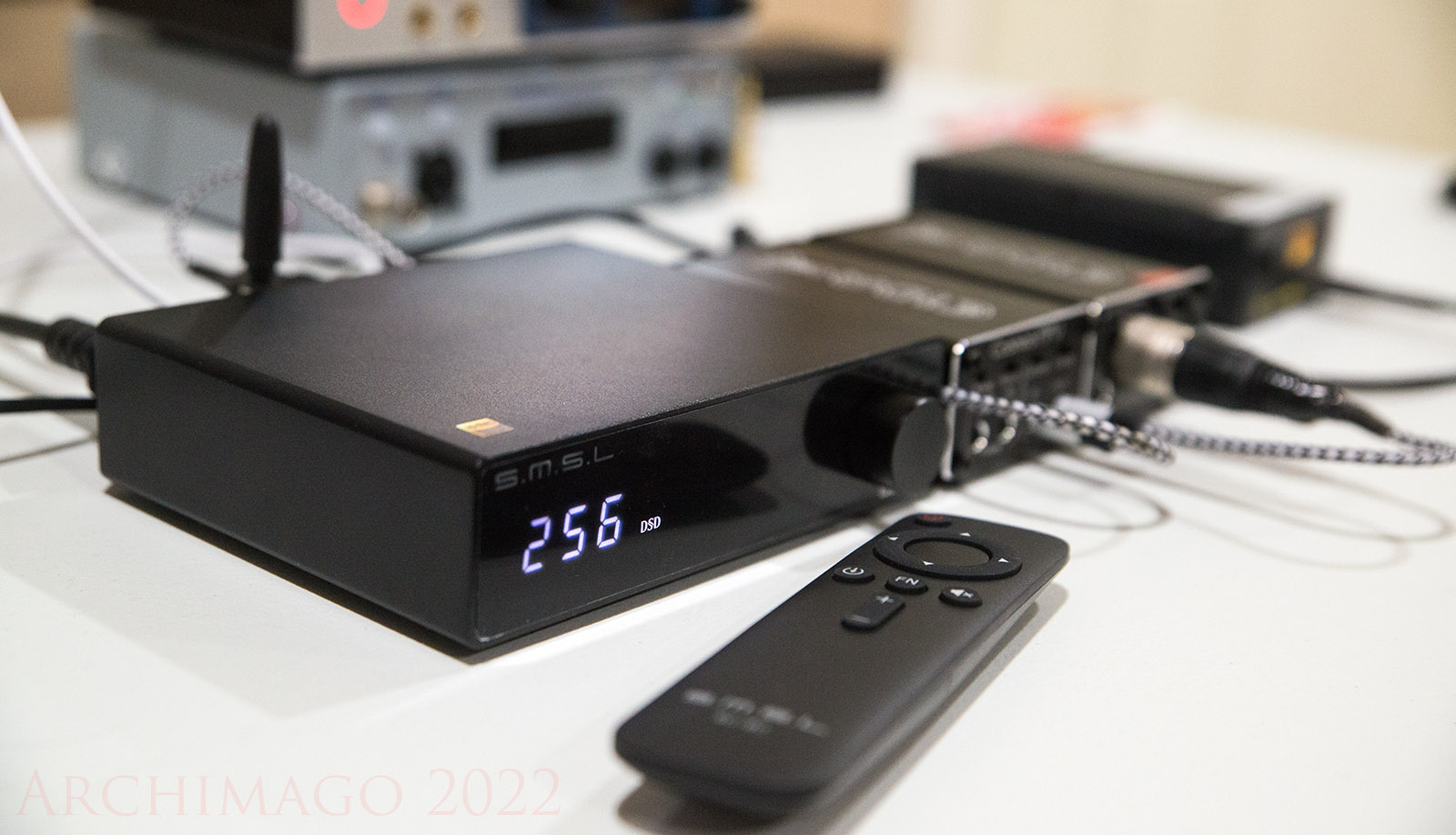
As you can see, the SMSL DO100 displays DSD samplerate in the form of DSD64 (64 x 44.1kHz = 2.8MHz), DSD128 (5.6MHz), DSD256 (11.3MHz) and DSD512 (22.6MHz).

Okay audiophile friends, let's finish off the trilogy of posts on the S.M.S.L. DO100 DAC with some final measurements around DSD performance, let's talk about subjective listening impressions, and as usual, let me provide a direct recording from the XLR output for comparison with others I have done (as discussed here).

We'll then put this all together as final concluding thoughts on this device.

Saturday, 18 June 2022

Notes on DAC DSD (1-bit PDM) measurements going forward...


In the early 2000's, we witnessed the battle over hi-res audio in the form of SACD vs. DVD-A. SACD, the brainchild of Sony, utilized a 1-bit Pulse Density Modulation (PDM) method they called DSD (an advertising term) whereas DVD-A had the ability to store up to 24-bit, 192kHz Pulse Code Modulated (PCM) digital audio data (multichannel up to 24/96).

From the beginning, there were concerns about this push towards 1-bit systems into the consumer space along with claims that 1-bit PDM should form some kind of archival foundation for music. There were critics include Lipshitz and Vanderkooy - see their paper "Why Professional 1-Bit Sigma-Delta Conversion is a Bad Idea" from the September 2000 AES. And the next year in May 2001, they followed up with "Why 1-Bit Sigma-Delta Conversion is Unsuitable for High-Quality Applications". Even Bob Stuart chimed in on the unsuitability of DSD for "high-resolution audio" back in 2004. This is no surprise since Meridian was firmly with DVD-A including developing the MLP compression system which subsequently has been licensed by Dolby and renamed TrueHD; it looks like Dolby and Meridian had an arrangement dating back even to 1998.

These concerns around fidelity and the unsuitability of 1-bit PDM as an editable format in audio production are why in the professional world, we see audio recorded and edited in 24/352.8 "DXD" and Sony's own "DSD-Wide" (8-bit/2.8MHz) instead of DSD64/1-bit "DSD-Narrow".

While this was playing out in the academic/professional arena, the advertising industry including the "mainstream audiophile media" championed DSD and published all kinds of flowery words suggesting how it sounded "more natural", or "analogue-like" compared to PCM. While I don't think we can put an exact date on when DVD-Audio officially died as a viable commercial product, I think by 2005 it was quite clear that hi-res physical formats were not going to be mainstream and DVD-A did not have the number of titles available compared to SACD. My sense is that the hybrid-SACD feature with both DSD and CD-compatible layers was a major differentiating factor that has resulted in still a trickle of SACDs released these days.

I'm bring this stuff up now as an extension to the discussions around SoX-DSD and the Philips Test SACD articles last year during my series on the Topping D90SE review because I've been thinking about how best to standardize the DSD test signals I use when testing. Different DACs tend to handle DSD playback differently and I wanted to make sure that my test signal parameters are at least somewhat in line with the music encoded on an SACD or maybe DSD128 download these days.

Saturday, 11 June 2022

REVIEW: S.M.S.L. DO100 DAC [Part II - PCM Resolution]. (And on MQA's distasteful environmental claims...)

As we continue to evaluate the S.M.S.L. DO100 DAC, let's spend time today delving into the resolution that this machine provides as a PCM DAC (see Part I last week for filters and jitter performance). Given that PCM is the de facto digital modulation scheme, this post will form the heart of DAC performance evaluations. We'll leave DSD to Part III along with discussions of subjective performance.

With PCM data, this DAC will accept up to 32/768. Let's run some tests as per usual to see how this device compares to others I've looked at on this blog. For most of the tests, I will use my Raspberry Pi 4 "Touch" (USB) or a Logitech Squeezebox Touch (S/PDIF) as digital source. The E1DA Cosmos ADC will be used with or without the Cosmos APU to measure. For some of the REW-based tests, I will perform a simple loopback that looks like this:

Intel NUC → SMSL DO100 DAC → [Cosmos APU] → Cosmos ADC → Intel NUC

As usual, all cables are generic RCA when testing unbalanced, for XLR measurements 6' Monoprice Stage Rights were used.

Unless otherwise noted, the DO100 will be set-up to use "FL6" Linear Steep filter.

Without further ado, let's jump to it...

Saturday, 4 June 2022

REVIEW: S.M.S.L. DO100 DAC (dual ESS ES9038Q2M) [Part I - Overview, Filters & Jitter]. (And the likely continued contraction of MQA...)

Over the last number of years, we have seen a proliferation of DACs from Chinese manufacturers offering models of increasingly better resolution - higher fidelity - and greater feature set. These days, I am of the opinion that we have achieved way above and beyond the ability for human hearing to differentiate these machines unless the manufacturers purposely added some kind of "coloration" to the analogue output whether it be frequency response or changes to the noise and distortion levels (the "tube sound" being a prototypical example we may come across).

As you can see in the image above, we have the S.M.S.L. DO100 DAC (~US$250) in today for review. I bought this unit through retail channels and intend to either use it myself or give it away if I have no need for it.

For many devices these days, opening the manual will show us technical information like the frequency response of the filters in this example. I think this is a nice evolution among manufacturers recognizing that showing product performance is important to educated customers with graphs and technical details rather than mere prose which often provides little satisfaction for the consumer's intellect.

Today, let's start a multi-part look at this DAC; no need to hurry because I think the performance at this price point warrants serious consideration and the many ways and features one can gather performance metrics on (I don't promise to test everything of course!). Obviously it's not an expensive device, has a remote controller, has both unbalanced RCA and balanced XLR outputs, Bluetooth 5.0 input, capable of up to 32/768 PCM and DSD512 (1-bit, 22.6MHz) using USB 2.0, along with S/PDIF TosLink and Coaxial inputs for up to 24/192 and DoP DSD64. No money wasted on MQA licensing. Depending on what we find, this might be right for you...


Saturday, 28 May 2022

MUSINGS: The hunt for -150dB THD with the Victor's 1kHz Oscillator; A look at Paul K.'s Multitone Loopback Analyzer; And the pinnacle of audio streamer pricing? The Wadax Atlantis Reference Server. (And REW IMD vs. Level Step!)

I like a good challenge ;-). A few weeks ago, in my post on the E1DA Cosmos APU, in the comments, MG discussed achieving THD -155dB on the Victor's Oscillator! In my original post, I showed a picture of -141dB. Subsequently, I then fiddled around with the set-up and achieved around -148dB.

Well, on one of my lazy afternoons, I thought I might as well give this another try. The aim - at least THD of -150dB. So I packed up some parts I needed and moved it into the quietest room (electrically and acoustically) in my house. Bits and pieces laid out on my ottoman where I place drinks on late night listening sessions. ;-)

Clearly this would have to be run off battery power to remove any mains hum. I went with my trusty RME ADI-2 Pro FS ADC, powered by a 12V/8300mAh TalentCell lithium battery pack for convenience in case I needed to fool around with input voltage settings. The E1DA Cosmos APU was powered with a 5V battery pack.

Saturday, 21 May 2022

A Look at ADC Noise Limits and Distortion - Or "How much difference does the Cosmos APU make?" And a look at 2-channel Room EQ Wizard measurements!

I received a few questions as a follow-up to last week's post about the E1DA Cosmos APU basically around the question: "When do I need a pre-amp/notch filter like that if I have a high resolution ADC?"

That's a great question! Let's spend some time looking into this...

Now, the first thing to be mindful of is that our DACs and ADCs are not perfectly linear devices, nor have limitless low-noise performance of course. This is why we measure the limits of DACs to gauge the extent of "accuracy". And ADCs likewise have limits as well to their intrinsic noise level and potential for distortion. As we approach the limit of the ADC's performance, it will start introducing its own characteristics into the captured signal which could look like noise anomalies as well as harmonics - like DACs, there is an ADC THD+N.

In this post, let's run some practical "experiments" of sorts using the Cosmos ADC and RME ADI-2 Pro FS to examine these ADC limits when measuring DAC dynamic range and THD+N/SINAD with and without the aid of the Cosmos APU.

Saturday, 14 May 2022

EARLY LOOK: E1DA Cosmos APU - high performance, low-noise pre-amp and 1/10kHz notch filter. [Quick peek - S.M.S.L. DO100 DAC.]

Readers on the blog will likely remember that last year, Ivan Khlyupin (aka IVX on a number of forums) of E1DA sent me a pre-production Cosmos ADC for testing and use. As discussed then, this affordable ADC unit turned out to be a remarkably capable device using the ESS Sabre ES9822Pro chip at a very reasonable price. With recent price upheavals, currently on Amazon for a Grade B device with SNR 127+/-1dB(A) in mono mode, it's selling for just less than US$250.

There were already discussions last year that the "Cosmos" line of devices would include the one we'll be talking about today - the Cosmos Analog Processing Unit (APU). As the name implies, this is an analogue device that serves the purpose of (pre)amplification with very low noise, also providing a 1kHz notch for accurate measurements of THD+N/SINAD as we typically see in DAC reviews.

With the APU near production release (possibly next month or so), Ivan again kindly sent me a unit for use here on the blog. Using the combination of Cosmos APU + good ADC (doesn't have to be Cosmos ADC), the user should be able to peer down into the noise limits and measure characteristics like dynamic range, and THD+N/SINAD with great accuracy even beyond the limits of modern state-of-the-art DACs.

Saturday, 7 May 2022

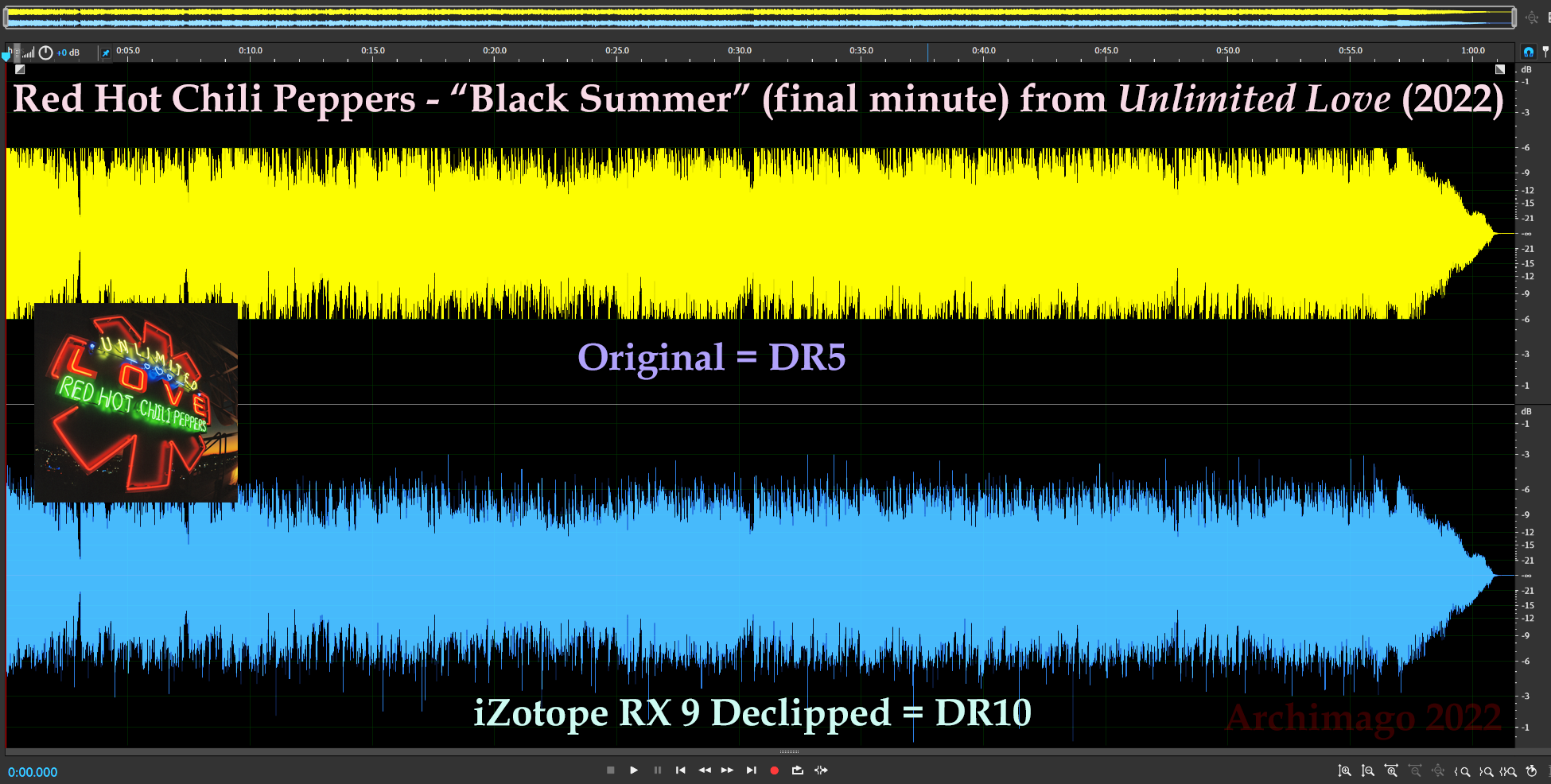
DEMO: Software de-clipping of dynamically compressed recordings (Red Hot Chili Peppers' Unlimited Love). On "Why you can't trust audio measurements". And "Those Obscure Objects of Desire" - Utility and Luxury.

Let's get right to the heart of the issue with the diagram above!

There have been discussions among audio sites like Audiophile Style and Darko Audio that this latest album from RHCP - Unlimited Love (2022, average DR7) - is their most "audiophile-friendly". 

Flea, the band's bassist, tweeted on April 1st (hope not meant to be April Fools' joke!):

“For you audiophiles out there, the new RHCP record is mastered directly from the tape we recorded it on, no computers, no lame compression or limiters”

In the image above, I extracted the last minute from track 1 ("Black Summer"), a portion of the music which is quite loud for a peek at the waveform. One look at the original data clearly shows that the music has gone through a compression step at some point in order to create that "flat top" DR5 in the image above. Flea is wrong.

Whether this happened in the recording, mixing, or mastering steps, who knows. The clear use of dynamic compression is present in both the 24/96 version and on the CD. Clearly, music like this does not benefit from the "hi-res" 24/96 version so I would recommend saving your money if you're tempted to purchase a download. As usual, be critical when buying hi-res.

Saturday, 30 April 2022

REVIEW / MEASUREMENTS: CCA (Clear Concept Audio) C12 IEM - 1 Dynamic + 5 Balanced Armature Drivers - are more drivers better? (Plus new analogue disc technology, cable-maker Russ Andrews interview.)


Earlier this month, as I was preparing the final write-up for the KZ ZSN Pro review, I was impressed enough by the performance of those very inexpensive IEMs (less than US$25) to go ahead and grab these CCA (Clear Concept Audio) C12 (US$50) earphones to see how an upgrade at twice the price would perform in both listening and measurements. Note that CCA is a related company to KZ so when we look at the open-box image above, we see that the contents are similar. We have this time a braided ear-loop cable (that's still easy to get tangled), also 1.2m in length, a couple of info pamphlets, 3 extra sets of silicone ear pieces, same as the KZ ZSN Pro.

At twice the price of the KZ, the hope here is that these would represent a significant sonic upgrade across a number of domains. On the surface, a major talking point for these headphones is that they consist of a more complex arrangement of drivers which in theory could provide more accurate coverage across the audible frequencies. Drivers in each earphone include a single larger 10mm dual-magnet dynamic/moving coil driver, and 5 small balanced armatures (two of which are reported as Knowles 30095, not sure the others). So that's a total of 6 drivers per ear piece, 12 both sides - hence "C12".
 

Saturday, 23 April 2022

MUSINGS: Myths, clichés and Hi-Fi+'s Taiko Audio SGM Extreme computer review. A hypothetical fast, fanless audio computer build. And "channels/bit-depth/samplerate" labeling convention - a suggestion.


"Nowadays people know the price of everything and the value of nothing."
-- Oscar Wilde, The Picture of Dorian Gray, 1890

Once awhile, we in the audio world run into devices that are so ludicrous that it becomes somewhat entertaining reading or watching reviews about them. Like Super Bowl ads, the advertising can be fascinating in themselves regardless of whether you care about or even know how to play American football. The Dutch Taiko Audio SGM Extreme is such a product which I find fascinating - not because the technology is all that mind-blowing (server CPUs, Optane storage, large SSDs, big fanless case) - but in seeing what they're trying to do with the "spin" around the product to try to justify an asking price! (Previously, I've referenced the device in a related discussion as well.)

I thought it was interesting reading this recent Hi-Fi+ review by Alan Sircom and examining the claims. Just because a review might be written in a "subjective" fashion doesn't mean readers can't or should not be critical about the beliefs expressed. To a certain extent, I believe it is the responsibility of "rational audiophiles" to push back against the nonsensical, even mythical, ramblings of certain subjective, supposedly honest, viewpoints. I agree with T.S. Gnu, typically we cannot expect magazine writers to be bluntly honest in today's environment.

For those unaware, The Absolute Sound (North America) and Hi-Fi+ (UK) are glossy, subjective-only, sister publications that IMO read like the unabashed advertising arm of the "high end" industry. Over the years, TAS & Hi-Fi+ have advocated snake-oil of all sorts and TAS even published pseudo-science articles purporting to be empirical research (look up the articles from Charles Zeilig and Jay Clawson around 2011 - I've mentioned this back in the day, and here's an example of what they do/say).

Saturday, 16 April 2022

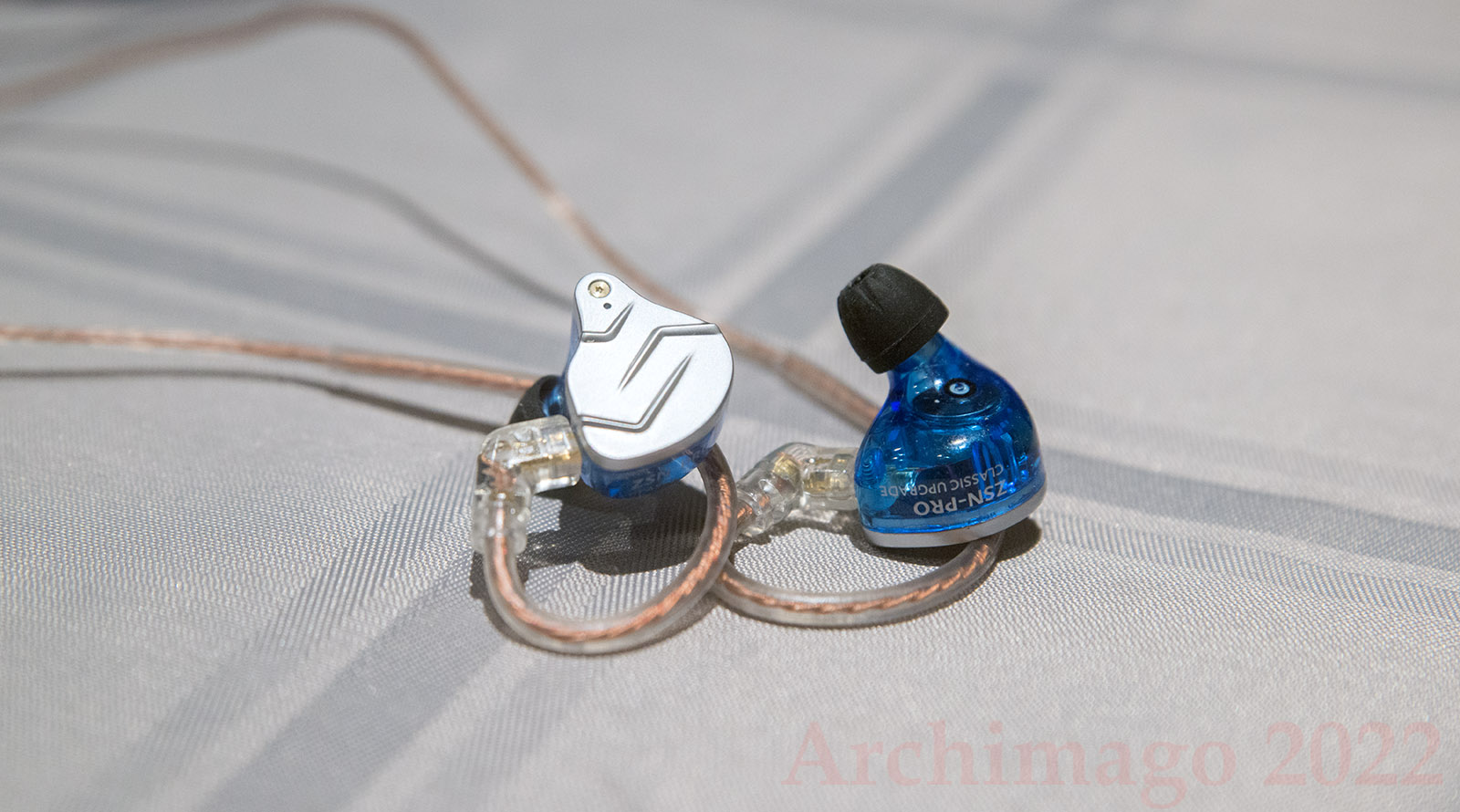
REVIEW / MEASUREMENTS: KZ ZSN Pro - very inexpensive dynamic + balanced armature IEM. (And the importance of the audiophile "low end" and meaningful succession.)


Since I believe much of high-fidelity audio is already "mature" technology, these days a lot of what I find interesting are products that either present new features for the music lover (and audiophile), or devices that are of high value. In a present era of inflation and energy price shocks, "value" I think for most people has become even more important into the foreseeable future. As discussed in the past, the price of luxury items is usually a reflection of non-utilitarian benefits rather than actual sonic fidelity; that is basically the epitome of the "high end" moniker, behind which, much snake oil is allowed to thrive.

In this post, let's have a look and listen at an IEM which I think absolutely represents a member of the "high value" class of products! At less than US$25, the KZ "Knowledge Zenith" ZSN Pro IEM is at a price point that anyone can afford if you're in the market for some wired headphones these days (funny the designation "Pro" for something in this price point!). Considering the wide range of prices for headphones, it's the kind of thing you can throw in your travel bag and not worry if they get damaged.

The question of course is how do these sound!? Let's take a deeper dive into this...

Saturday, 9 April 2022

MEASUREMENTS: 1MORE Quad Driver IEM (E1010)


For the post this week, let's have a look at the 1MORE Quad Driver IEM (~US$150 these days). These have been out for awhile; released in mid-2017 I believe. The specs on these are quite interesting given the asking price. Driver configuration seems complex with single dynamic driver and 3 balanced armature units within the relatively small capsule. The dynamic driver is advertised as being some kind of "diamond-like carbon" (DLC) that covers bass and mids with the balanced armature units filling in at the higher frequencies based on the advertising material.

Furthermore, the headphone also has an integrated volume/playback control as well as a microphone when making calls.

The brand also prides itself on this being the world's first "THX Certified Headphone". I'm not sure exactly what that certification means; presumably some combination of testing to ensure low distortion and frequency response thresholds must be in the mix.

Saturday, 2 April 2022

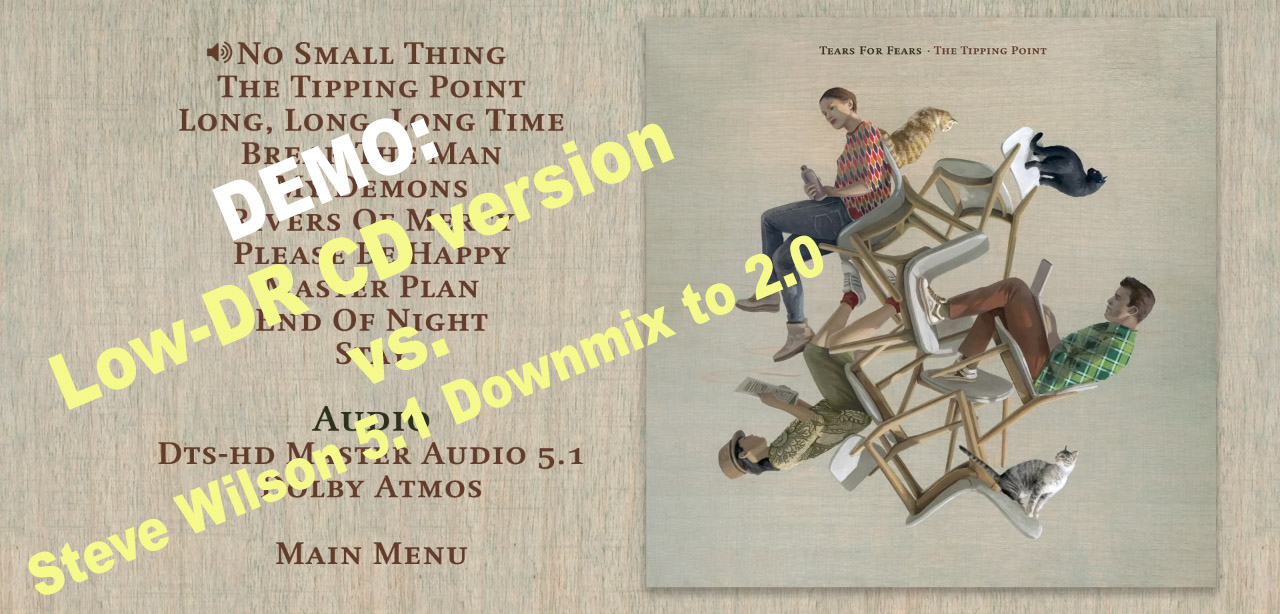
DEMO: Tears For Fears - "No Small Thing" - Low-DR CD vs. Higher-DR Steven Wilson 5.1 Downmix to 2.0 (and the obvious importance of audio production quality)

Despite all the examinations of what often amounts to subtle differences in sound when we compare different hardware devices, I think as audiophiles we too often neglect the very significant differences that mixing and mastering makes.

Recently, I received my copy of Tears for Fears' The Tipping Point, the Blu-Ray only available for order online here. As you can see in the image above (screenshot of the menu), the disc includes both lossless DTS-HD Master Audio 5.1 and Dolby TrueHD-Atmos mixes done by Steve Wilson.

I believe you can already stream the Atmos mix over Apple Music "Spatial Audio" but that would be in lossy Dolby EAC3+Atmos. As you can imagine, the multichannel mix sounds quite different from the 2-channel CD/lossless stream!