Sunday, 11 December 2022

REVIEW: E1DA #9038D6K Dongle DAC / Headphone Amp (Part II): Headphone Amp Power, DSD, Subjective Impressions, AMPT & Perfectionistic Tweaking!

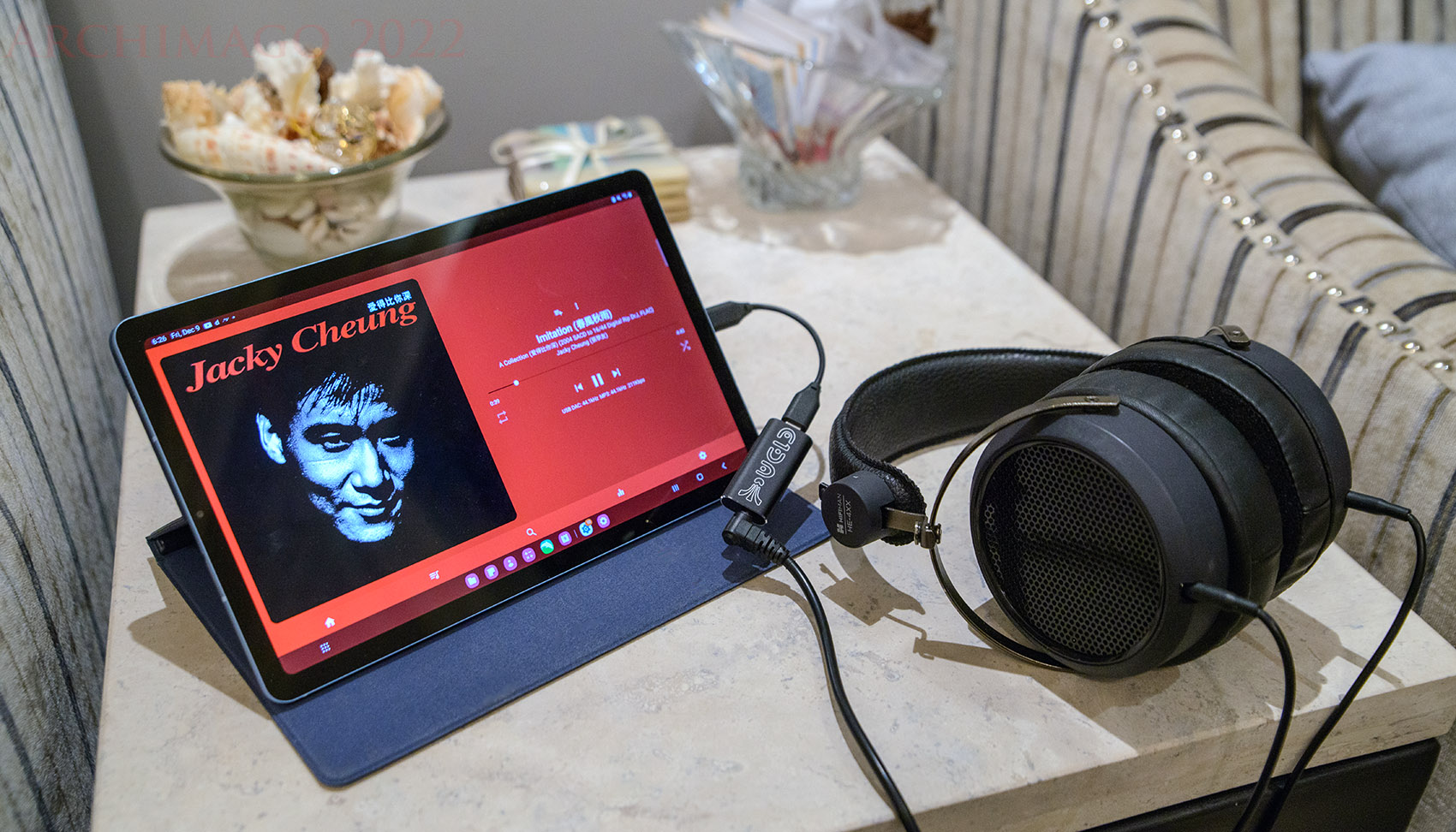
A great sounding music listening station! (Samsung Galaxy Tablet, Drop+HiFiMan HE-4XX, classic Jacky Cheung cantopop.)

Okay friends, today we continue with Part II of the discussion on E1DA's #9038D6K portable DAC/headphone amp. Please refer to Part I last time for the general overview of DAC performance which already tells us about the PCM resolution of the device. The data from last time shows that for the price and size, this unassuming dongle is one heck of an accurate, high-fidelity, high-resolution digital-analogue converter.

This time, let's move forward with exploring other areas not yet discussed. Specifically, let's focus on resolution when under headphone-like loads, look at DSD performance characteristics, have a listen to the DAC, and given that E1DA is known to be tweaker/DIY-friendly (including making devices like the Cosmos line), let's also talk about what I would consider more "extreme" tweaking for the perfectionist audiophiles!

Tuesday, 6 December 2022

REVIEW: E1DA #9038D6K Dongle DAC / Headphone Amp (Part I) - PCM DAC performance. And (potentially) higher dynamic range in Spatial Audio 2-channel fold-downs.

Little E1DA DAC to Sennheiser HD800 headphones via 1/4" adaptor... Looks ridiculous if walking around in public with this! But sounds great. ;-)

A few weeks back, I received a package from Ivan Khlyupin (IVX) of E1DA containing both the Cosmos Scaler and the device we'll be looking at today - the E1DA #9038D6K DAC / headphone amplifier.

This is the latest iteration of the #9038D models which feature 3.5mm single-ended output, to be distinguished from the #9038S models which are balanced devices with 2.5mm output jacks. And the "6K" refers to 6000μF (!) of power rail filtering (original #9038D has 4000μF).

As the name implies, internally, these DACs are based on the ESS ES9038Q2M low-power chips. They are capable of playing back PCM to 32/384 as well as up to DSD256. Over the last year or two, we've seen a proliferation of DACs based on this component and I would say that overall, the performance on these devices have in general been very good. Thanks to the low power consumption, we can now have mobile converters that perform at least to the resolution of many desktop DACs while being fully USB-powered.

To generate the amplified headphone output, op-amps used include the OPA1622 and OPA1602 based on the E1DA specs. To achieve very high resolution, internal components are advertised to be quality Susumu resistors, Murata C0G caps, Kyocera AVX tantalum caps, and connectors from Taiwan. In my discussions with Ivan, I know in the last while it has been slow for him to source some of these components and at times difficult to avoid fake parts out there!

Saturday, 26 November 2022

"High End" Audiophile Science? On Milind N. Kunchur's hard-to-believe research articles.

It has been a busy week so let's keep this article somewhat shorter. ;-)

Beyond the typical audiophile magazines, websites, and videos, I think it's interesting once awhile to think about some of the research out there in the academic literature related to "audiophile" topics.

As I have said many times, I believe that typical 2-channel hi-fi audio is very much a "mature" science these days so on balance it's probably unlikely that understanding of core technologies should be too contentious. I know, some audiophiles and companies will protest this idea with the belief that human hearing somehow has much more potential and that we cannot measure all domains of auditory acuity as applied to our audio tech. As science-driven hobbyists, since we can perform blind tests and show that people have difficulty differentiating high bitrate MP3 from lossless, even relatively high distortions are difficult to hear, and hi-res audio is generally indistinguishable from 16/44.1 lossless (except for a few minor instances which can be statistically significant but practically not likely relevant for music listening), I think the onus of proof remains on those who make contentious or dramatic claims outside of the standard paradigm.

Saturday, 19 November 2022

EARLY LOOK: The E1DA Cosmos Scaler prototype. As usual, Neil Young (in "World Record" album interview) remains neurotic against digital...


Today, let's talk about something rather unique.

In the image above, we see the E1DA Cosmos Scaler in use as I was running measurements of some DACs I have around here. As I mentioned last time, this is a prototype product which although has been announced/discussed online, as far as I am aware, is not at the stage of imminent production or public release. As such, be mindful that details I describe here might change if this were to be released as a product.

The Scaler functions as a balanced 2-channel in/out pre-amp that can apply 16 discrete levels (this is not a regular volume knob for routine volume control) of very clean amplification (using OPA1612) from 0dB to +26.7dB along with an "auto-ranger" feature that aims at a target voltage level to feed the ADC. Along with this, the Scaler's stable high 200kΩ balanced (100kΩ unbalanced) input impedance resolves one of the limitations of the Cosmos ADC; the lower input impedance for example 1.66kΩ at a commonly-used 4.5Vrms setting.

Thanks again to Ivan Khlyupin (IVX) for sending me the package to test out.

As with any pre-amp product, the question is how quietly does this device perform when feeding the output into a high-resolution measurement ADC in this case. And related to that, whether the device adds any of its own distortions.

Saturday, 12 November 2022

Accurate Sound's Hang Loose Convolver Multichannel on low power Mini PC. The disgraceful AQVOX ethernet switch. And some E1DA upcoming evaluations.


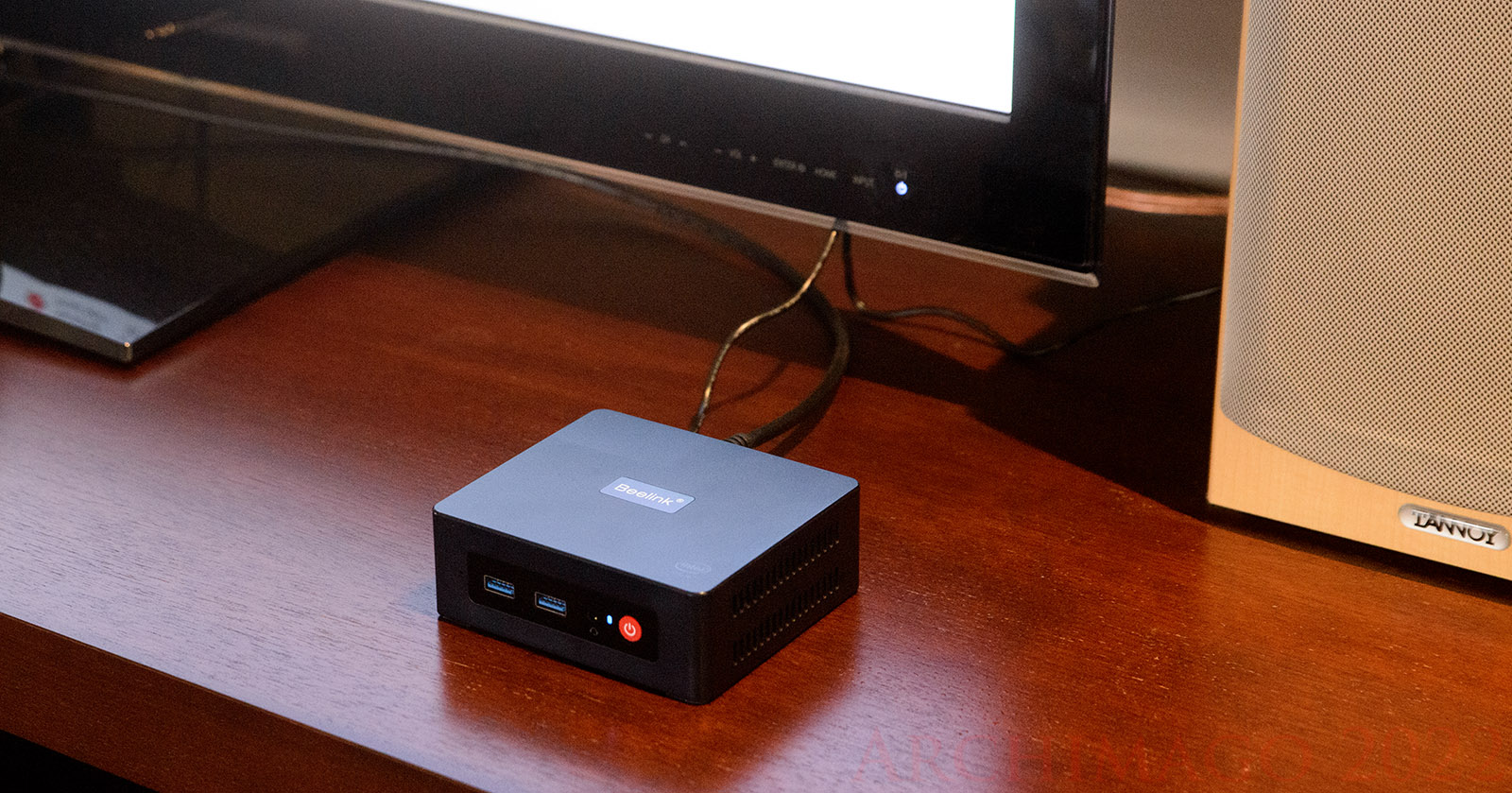
Over the last few weeks, I've been using the inexpensive Beelink Mini S Intel Celeron N5095A PC in my music system. Recently, I posted on using it in Linux as a streamer with HQPlayer upsampling and for multichannel Roon capabilities. As you can see in that post, for audio purposes, even this level of CPU performance on a modern entry-level machine is enough for what would be advanced PCM upsampling (ie. 1M-taps realtime PCM) and even IMO very good PCM-to-DSD256 performance. More evidence to remind us that there's generally no need to get excited about some of the more expensive "audiophile" computers and streaming machines which are often embedded low-power computers at heart.

Recently, my friend Mitch Barnett of AccurateSound.ca wondered if I could look into the performance of his latest version of Hang Loose Convolver (HLC) with this low-power computer using my power limited and quiet fan BIOS settings. HLC is an advanced standalone, VST3 plug-in, or AU (Mac) plug-in that provides the ability for audio lovers to load in various convolution filters, allows for easy level matching, and provides basically immediate switching (0.1ms) between these filters for accurate A/B listening comparisons. Let's take a look at this on the Beelink.

Saturday, 5 November 2022

The studio production: The Audiophile Society & Chesky's Mega Dimensional Sound; Revolver Remix. Is there an "absolute sound"?

Above, you see some recently added albums on my Roon server. I thought it might be fun to focus this week on the music instead of hardware and discuss a little more on this so-called "absolute sound" (the concept, not the name of the Harry Pearson-founded magazine) some audiophiles are supposedly going for (touched on this somewhat years ago). 

I don't know if Pearson described his concept of the "absolute sound" with much greater depth beyond the oft-quoted, vague quality of "the sound of actual acoustic instruments playing in a real space" which may or may not be hard to achieve these days depending on one's threshold of what sounds "real". Let me know if you've come across any other articles on this that defines the concept with greater detail. To be honest, I don't think I've met any audiophiles who still believe that there is a single "absolute" subjective sound we should all be striving for, but it's good to be clear about it and maybe lay it to rest.

When it comes to music, I have rather eclectic tastes. As I mentioned last time, I've been checking out some electronica, hence the amane + 曇った空 (Kumottasora) album 彷徨 (Wandering) (DR7, 2017) off BandCamp on the list. You can have a listen to track 2 "~ Discontinuity ~" on YouTube. It's an atmospheric piece of work that's very much at home in the Blade Runner universe I can play in the background without getting distracted; in fact, excellent background music when doing medical charting on the computer - the bane of the medical professional's existence these days. ;-)

To the right, we see a couple versions of David Chesky's The Great European Songbook (DR13, 2022). As you can see, I've labelled the cover image for easy identification; we have both a "Headphone Mix" and "Speaker Mix".

Saturday, 29 October 2022

Blog Post #502: Musings on a decade of audiophilia, maturation, objectivism and the road ahead.

Well guys and gals, this marks post 502 since the start of the blog back in 2012, although articles really only started flowing by 2013. As we are approaching the latter months of 2022, it's amazing to think that a decade has flown by!

Over the years we have touched upon a huge number of audiophile topics. Much of the ideas and experiments over the years have and will continue to serve as the foundation for me in the days ahead as a music lover and "hi-fi" audiophile. Before embarking on this blog, I remember the frustration of feeling entrenched in audiophile obsessions over the fears and uncertainties around things like whether I needed expensive cabling, whether the ethernet switch was deteriorating my audio stream, concerns about the "noise" from my computer, and if for some reason jitter was further destroying my sound. I remember recognizing that none of those anxieties were ever fully addressed or clarified by product manufacturers or the mainstream magazines of the day, and there were little resources out there on YouTube or other websites. Descriptions were vague, and as I recall, nobody ever could clearly express to me what jitter sounded like for example, despite prominent claims. Other than suggesting that handing over money was the solution by buying and "listening for yourself", hobbyists could seem to do nothing else - powerless in the face of dramatic claims.

I remember thinking at one point: "How problematic are these issues, really?!". Given the decades of audio hardware evolution, and in the context of all that we know in the 21st Century about the engineering that has gone into these human-designed and assembled electronic devices, is it reasonable that hobbyist audiophiles seemed to blindly stagger in the dark, typically discussing these things with little facts, or figures, easily drawn into opinions and assumptions that can swing to extremes or seem so idiosyncratic depending on the subjective whims of the reviewer who supposedly "hears" things?

Even where there are measurements (like in the pages of Stereophile), it also seemed odd to me that the objective results appear to be subservient to unsubstantiated subjective comments. If the subjective reviewer heard some "harshness" and the DAC showed higher jitter anomalies, it's not hard to use that as the "attribution theory". But if the DAC is expensive from a prominent name, more likely than not the subjective listener likes it, and the impact of sometimes exceedingly poor measurements appear softened and the device still gets an overall recommendation (look at the measurements for this).

For this post, I hope the reader will indulge me with an opportunity to meander into thoughts that have been bouncing in and out of my mind over the years, and consider expectations over the next decade.

Saturday, 22 October 2022

Using low-power Beelink Mini S as Linux Roon streamer - HQPlayer (PCM 8x, DSD256), and HDMI multichannel. (A superior DIY M-Scaler?)

No worries! Putting a little low-power computer like this on top of the DAC did not affect noise level from the Sabaj DAC RCA/XLR outputs. Don't do this with more powerful computers obviously...

As expressed previously, my philosophy around computer audio is that given the speed of progress in computing technology, it really makes no sense to be building expensive and very fast computers as audio playback/processing devices. For me, if I have a general computer in an audio room, I would want to keep electrical noise low (ie. low power) while also targeting an ideally fanless solution. Inevitably, in less than 10 years, a powerful computer today would be very much obsolete. Monster machines would more than likely end up at the bottom of your closet with little value or interest left even if one wanted to sell. In fact, unless I'm doing a lot of 3D graphics, gaming, or editing videos, IMO progressively smaller, quieter, lower-power (let's aim for 10W or less with excellent performance!), and less expensive machines are where progress is heading for consumer-level general computing.

This is in part why on this blog, I've expressed much more interested in streamer systems like the Raspberry Pi devices or recently silent or very quiet MiniPCs (like the power-limited Beelink Mini S last week). As time goes on, one can judge objectively if technological progress and software updates like new DSP algorithms represent improvements in sound quality. If there are truly gains to be had, the machine can then be repurposed/replaced without feeling that one has wasted hundreds if not thousands of dollars.

At the end of the article last week, I spoke about how I reduced the fan speed and lowered the Mini S power limit to basically "silent" performance. Today, let's consider further what we can do with a machine like that in the audiophile sound room.

Saturday, 15 October 2022

REVIEW: Beelink Mini S (Celeron N5095A 4C/4T CPU, 8GB DDR4 RAM, 256GB SSD) Mini-PC. (And E1DA Cosmos ADC follow-up: RIAA EQ & 768kHz.)


In the image above, we see the Beelink Mini S computer. I was sent this product from one of the distributors (thanks to MinixPC - see here for the current price) for an honest opinion in the context of the fact that over the last while, I had already explored the small MeLE Quieter2Q and Quieter3Q as well as the more powerful AMD-based Beelink SER4 Ryzen 7 machines. 

Now, unlike the MeLE Quieter machines, this one is not fanless, but it is indeed quiet and I suspect the fan noise will be no problem in the vast majority of settings. On balance however, what you get is a machine that is less expensive (you should be able to find one for around US$180 or better) and the active cooling will keep it cooler especially if you do end up placing it in more cramped environments. As usual, make sure there is still air flow of course!

Let's have a closer look at the item and performance...

Saturday, 8 October 2022

MEASUREMENTS: "CheapDAC'22" - Cheapest DAC in 2022? US$3.57 S/PDIF DAC from AliExpress. (Does objective analysis correlate with sound quality? Of course! And Lavorgna's DUT comment - "HiFi" is not art.)


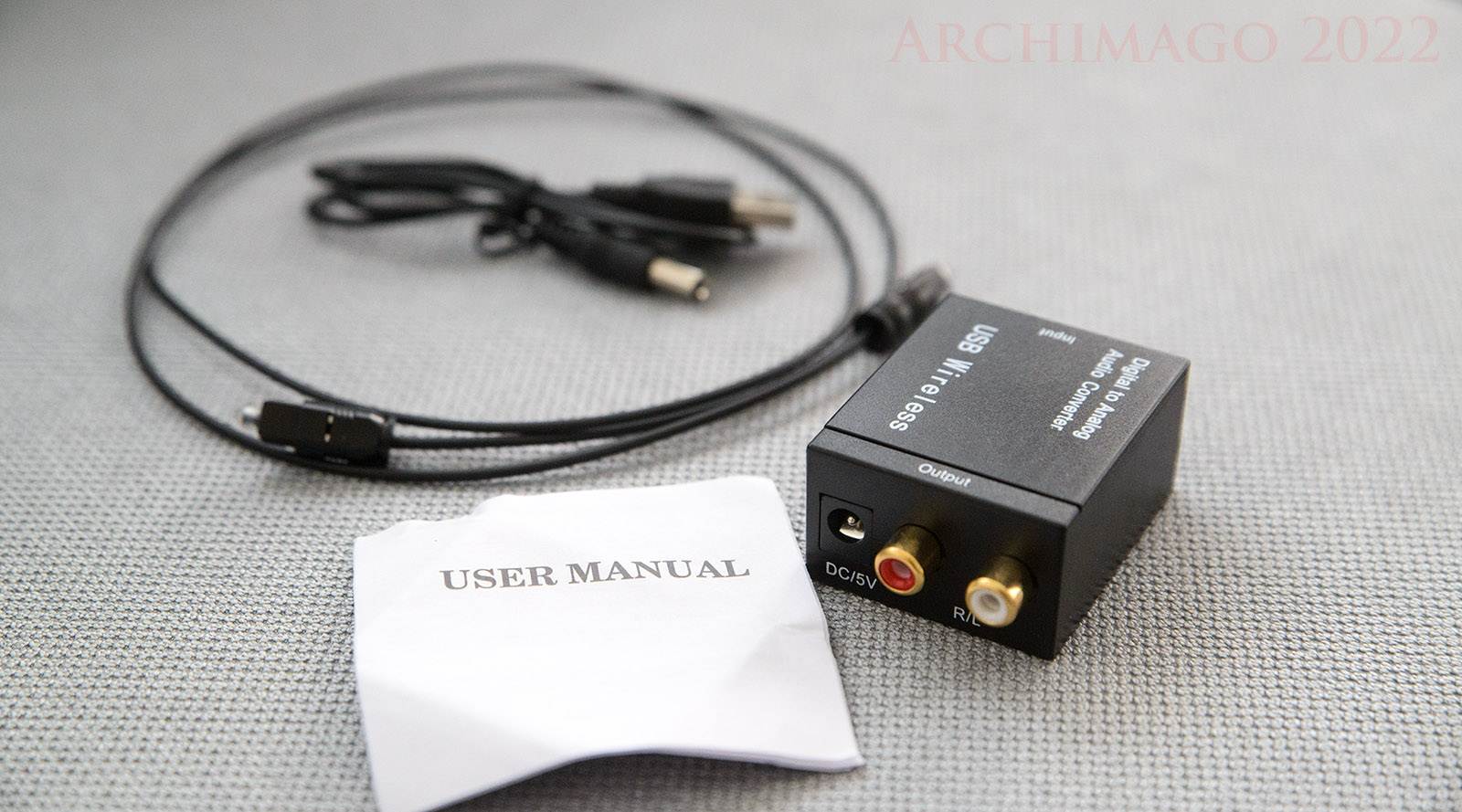
"CheapDAC'22" - box, pamphlet, optical cable, USB 5V power cable.

While we've recently been examining high performance, high-fidelity DACs with amazing measurements, once awhile, I think it is good to have a peek at what "low-end" performance looks and sounds like. All the more important I think because audiophile magazines and "high end" online sites often seem to be reviewing increasingly more expensive "bling" these days, typically with just subjective comments. Needless to say, many expensive products do not appear to actually improve fidelity even if externally they might look great.

BigGuy in July pointed out to me one of the cheapest DAC packages ever seen on AliExpress - US$3.57; no tax, free shipping, arrived from China in about 5 weeks! For simplicity and lack of a better name, let's just call this generic device the "CheapDAC'22" (for 2022).

[With inflation lately, I see the price has increased since July as of this writing.]

The DAC is capable of both S/PDIF (Coaxial + TosLink) and Bluetooth input even (appears to be basically SBC codec, nothing fancy). The advertising even mentions 24/192 input.

Well, at this price, how could I resist not giving it a listen/test dear music lovers and audiophiles!? :-)

Saturday, 1 October 2022

Aquantia/Marvell AQC107 10GbE Network Cards (eg. ASUS XG-C1001C): Driver and Firmware updates and improving stability. (And more audiophile ethernet snake oil warnings.) [Update: Reduce latency for Roon audio playback.]

While this blog is primarily about audiophile stuff, over the years I have discussed modern audiophile systems including thoughts on networks. Like it or not, computer audio/video is ubiquitous and probably has become the primary source of access for many of us these days (rather than deal with physical media). Furthermore, a fast, responsive, reliable home network is almost essential as a foundational "utility" for entertainment and work. As discussed back in 2018, I've been running 10 gigabit/s home ethernet (standard copper RJ45 Cat-5e/6) with an update to the ASUS router and QNAP switch infrastructure in 2021.

In 2022, when it comes to very high-speed computer network cards, the Aquantia/Marvell AQtion AQC107 chipset devices remain attractive due to reasonable price, PCIe 3.0 x4 compatibility, and ability to run at 2.5/5 gigabit intermediate speeds (also dropping down to 1Gbps and 100Mbps as needed of course). Over the years, I've seen comments online with frustrations around the popular cards like my ASUS XG-C1001C shown above. The issues are typically described as episodic disconnects usually for about 5 seconds (discussed herehere) and then coming back online. As you can imagine, this will lead to a time-out of network transmissions.

Depending on the application, this might or might not lead to problems. For audio and videophiles, this is a problem when we're streaming video to something like an AppleTV or playing music off Roon in real-time. Other apps may be more tolerant and can just wait a little longer and retry.

Saturday, 24 September 2022

HOW-TO: Roon 2.0 with ARC released, running Android ARC on Windows. Roon's "grace period". And how about more audiophile remasters of music from the '80s onward?


The big news this week among the audiophile channels I think is that Roon 2.0 has been released which allows remote access to your Roon Core when on-the-go. Nice, it's about time considering that I've been streaming off Logitech Media Server for ages to my phone and at the office! The app that allows access remotely is something called Roon ARC - available for 64-bit Android in Google Store and for Apple devices.

This is a nice step forward and now I can listen to my music on the smartphone. However, I want to also play the music at my office on the Windows 10 computer. However, when remote desktop streaming was discussed with the company, the official answer has been "Roon ARC is mobile device-only application". Well, that's not a completely acceptable answer, I'm afraid. :-(

For the time being, you could run the Android app in Windows with BlueStacks 5 - 64-bit Android 9 Pie edition. Here's a look...

Saturday, 17 September 2022

MUSINGS: Regarding the MoFiGate class action document, the love of analogue master tapes (on recent Bernie Grundman interview), and reminder of digital developments. [Yes, Canadian iPhone 14 still has hardware SIM tray.]

There are "hot topic" debates that stand the test of time, never truly resolved as it were. Typically, these debates are arguments of subjective ideologies (thus never fully resolved even if some elements can be shown to be clearly false) rather than explorations of nuanced facts. The "Analogue vs. Digital - which is best?" debate remains popular among audiophiles since the dawn of CD consumer audio in the early 1980's. As if there is ever only one single answer to such a broad topic with various pros and cons. I suspect most of us these days have grown at least a little tiresome of the topic even if we recognize that this "issue" will inevitably arise along our audiophile journeys interacting with others.

In the last while, there have been items in the news related to analogue audio, and by extension this whole debate, I think worth examining honestly. Let's spend some time to talk about this, consider some facts, and address a few of the unsubstantiated beliefs often perpetuated even among some respected members in the audiophile pursuit.

Saturday, 10 September 2022

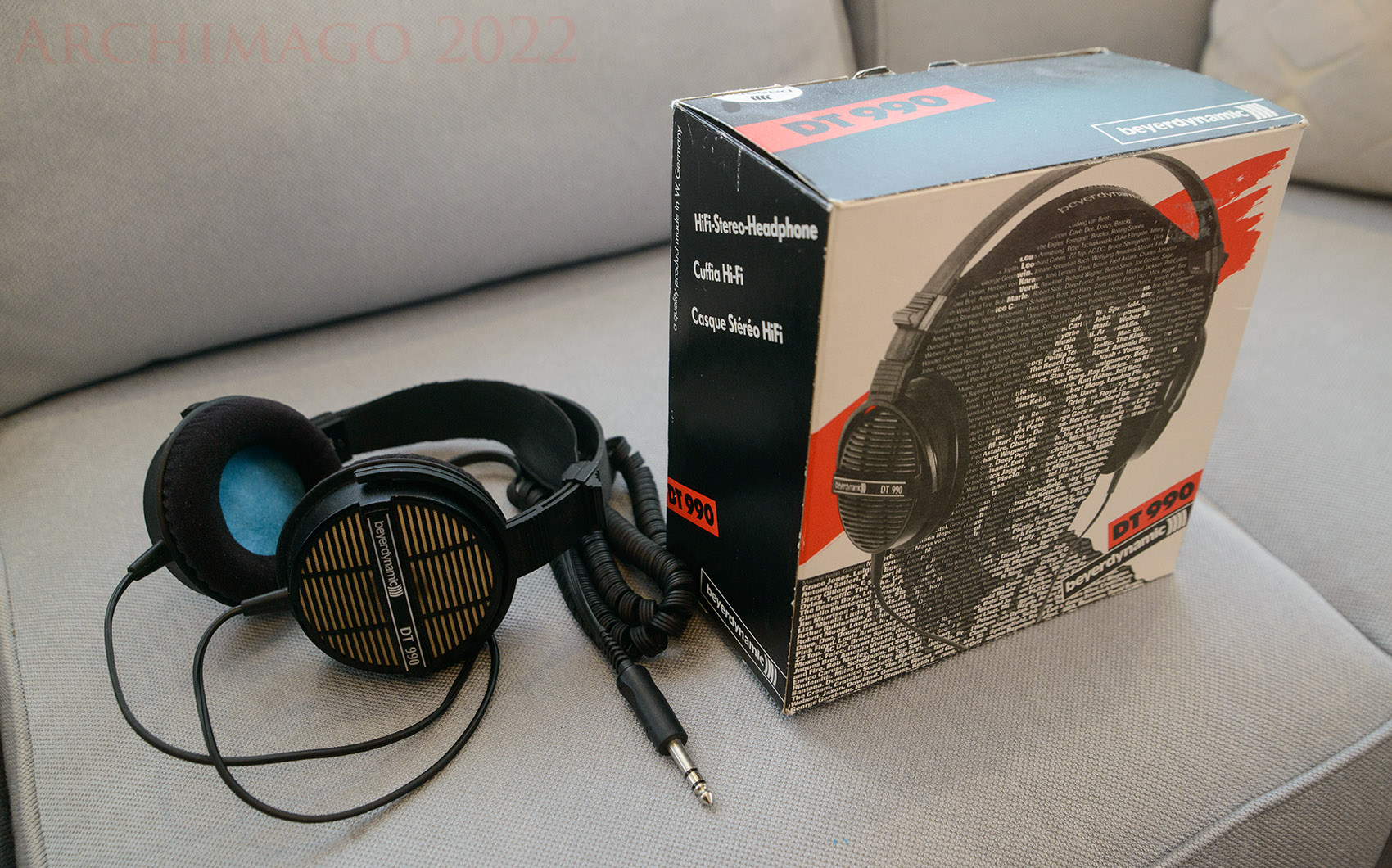
RETRO: Beyerdynamic DT 990, 600Ω, classic open-back circumaural headphones (circa 1991).

This week, I thought I would do a "retro" measurement of and listen to a headphone from the days of the Cold War. ;-)

Above, you see the 600Ω impedance Beyerdynamic DT 990 (forefather of the current DT 990 Pro, ~US$150), a pair of headphones lent to me by my buddy linnrd that he has had in his archives of audio equipment for quite awhile. As you can see on the box, these were made in W. Germany and purchased back in 1991, a couple of years after the fall of the Berlin Wall; either in Düsseldorf or nearby Essen I was told. The history of these headphones began back in 1981.

For headphones of this vintage (>30 years old), they are in great shape although in the image above, notice that I had replaced what used to be a thin layer of disintegrating black foam inside the earpiece with some bluish 1.5mm felt which I had used in my Dekoni Blue mod last year. So, not exactly a "stock" unit but pretty close.

Saturday, 3 September 2022

As We Hear It: An audiophile comments on the Taiko Audio computer. The Mark Jenkins / Antipodes Audio Darko interview. On MoFi's One-Step DSD. And optical HDMI.

German "ear horns" circa 1917.

It's great to look inside my mail bag and post comments or questions here from readers once awhile. I must say that the clarity of thought and insight from readers have been inspiring over the years.

With permission, here's a comment from an audiophile in Europe regarding his direct experience with the Taiko Audio SGM Extreme "audiophile" computer server/streamer.

Since this reader has quite a unique high end system which can be easily traced, this message has been anonymized in a number of ways. Without further ado, a comment from SonicDeepThroat (SonicDT):

Received: July 2022 

Hi Archimago,

I thought I'd drop you a line as I found your blog post about the Taiko SGM Extreme very interesting. I auditioned this machine a few days ago and thought I would share my conclusions with you. (I tried to leave a comment on the relevant blog post, but Google wouldn't let me sign in to do so.)